
Square
Following
Hot
News
Profile

SinCity

vip
Airdrop Hunter
Market Analyst
Memecoin Hunter
There is still a light called tomorrow, don't close your eyes, it's waiting for you.
132
Following
29
Followers
1.5k
Liked
$ZEC #GarrettJinHolds320MInZEC
Zcash Retreats From Record Highs as Whale Hedges and Momentum Cools
Zcash has pulled back from the all-time high of $1,535 it printed on Friday, trading near $1,450 as of this writing, a decline of roughly 6% over the past 24 hours. The retreat comes after a remarkable month-long rally that saw the privacy-focused asset surge more than 215% from around $470 in mid-August. The move has been driven by a combination of institutional inflows, a governance overhaul, and a short squeeze that forced bearish traders to cover their positions.
The Whale in the Room
On-cha
YamahaBlue
$ZEC #GarrettJinHolds320MInZEC
Zcash Retreats From Record Highs as Whale Hedges and Momentum Cools
Zcash has pulled back from the all-time high of $1,535 it printed on Friday, trading near $1,450 as of this writing, a decline of roughly 6% over the past 24 hours. The retreat comes after a remarkable month-long rally that saw the privacy-focused asset surge more than 215% from around $470 in mid-August. The move has been driven by a combination of institutional inflows, a governance overhaul, and a short squeeze that forced bearish traders to cover their positions.
The Whale in the Room
On-chain data has brought a significant position into focus. Addresses linked to Garrett Jin, a well-known figure in the digital asset space, hold approximately 202,080 ZEC, worth roughly $320 million at current prices. Records show that the bulk of these holdings, some 202,100 ZEC, were withdrawn from a major exchange spot account in December 2025. Separately, Jin maintains a short position on the decentralized perpetuals platform Hyperliquid valued at approximately $60 million, a partial hedge against the spot exposure rather than a directional bet against the asset. The disclosure has generated discussion about the concentration of holdings and the hedging strategy employed by large participants.
Institutional Demand and the Grayscale ETF
The structural bid beneath Zcash has been reinforced by the performance of Grayscale's ZCSH ETF, which launched on August 25. The fund has attracted more than $233 million in cumulative net inflows, including a single-day inflow of $46.56 million on September 18. Its holdings have grown to approximately 596,269 ZEC, representing 3.52% of the circulating supply, an increase of 28.4% since launch. A planned 3-for-1 share split aims to make the fund more accessible to a wider range of investors.
Governance Overhaul and the NU7 Upgrade
The rally has also been supported by the successful conclusion of a community governance vote on the NU7 network upgrade. Approximately 2.4 million ZEC participated, with 99.9% backing a reduction in target block time from 75 seconds to 25 seconds. A further 98.9% supported retaining the existing halving schedule, and 99.3% voted to ship the upgrade as soon as possible rather than wait for all approved components. The upgrade is targeted for November 5, 2026, subject to implementation by the network's node software. The governance process demonstrated a high degree of alignment among holders on the network's technical direction.
Technical Picture and Near-Term Caution
The daily chart shows ZEC breaking below its 7-day moving average at $1,444.69 and its 30-day moving average at $1,486.79. The Relative Strength Index has retreated to 42.16, down from overbought territory above 70 earlier in the month, and the MACD has turned negative, signaling weakening short-term momentum. Immediate support sits near $1,428, followed by the $1,400 area. A break below that zone would bring the $1,300 level into view. On the upside, the first resistance is the $1,500 to $1,535 zone that capped the recent advance, with the $1,672 level representing a more substantial barrier.
The divergence between the cooling technical picture and the supportive fundamental backdrop leaves the near-term direction genuinely uncertain. The ETF inflows and the governance outcome provide a structural floor, but the velocity of the recent rally and the concentration of holdings among large participants introduce a degree of fragility that the market is now testing.
DYOR 🔎 NFA ✔️
#Gate广场中秋团圆局 #GateSquareMidAutumnReunion #ShareWeekly $ZEC ‌ ‌
ZEC+5.62%
HYPE-0.11%
$BTC #BTCRetakes80K
Bitcoin Reclaims $80,000: A Recovery Built on Liquidations, ETF Flows, and a Shift in Sentiment
Bitcoin has pushed back above the $80,000 mark for the first time in over ten days, recovering ground lost after last week's Federal Reserve rate hike. The move was not a slow grind higher. It was a sharp, almost violent repricing that caught the market off guard.
The first phase of the rally was mechanical. In a single hour, more than $183 million in short positions were liquidated as Bitcoin broke through the $80,000 level, forcing bearish traders to buy back their positions
YamahaBlue
$BTC #BTCRetakes80K
Bitcoin Reclaims $80,000: A Recovery Built on Liquidations, ETF Flows, and a Shift in Sentiment
Bitcoin has pushed back above the $80,000 mark for the first time in over ten days, recovering ground lost after last week's Federal Reserve rate hike. The move was not a slow grind higher. It was a sharp, almost violent repricing that caught the market off guard.
The first phase of the rally was mechanical. In a single hour, more than $183 million in short positions were liquidated as Bitcoin broke through the $80,000 level, forcing bearish traders to buy back their positions at a loss. That forced buying added fuel to the move, pushing the price as high as $80,930 on Friday. By Saturday, the price had settled into a consolidation range, trading near $81,300 as of this writing.
The ETF Bid Returns
Beneath the price action, the flow data tells a more structural story. U.S. spot Bitcoin ETFs returned to net inflows on Thursday, absorbing $159.45 million, led by a sharp rebound in BlackRock's IBIT. That followed a massive $433 million inflow day on September 18. The pattern is notable because it suggests that institutional allocators, who had paused during the Fed-driven selloff, are stepping back in as the price stabilizes.
This is not a speculative surge driven by retail leverage. The funding rates, which measure the cost of holding long positions in the perpetual futures market, have returned to neutral. That means the rally is not being driven by an overcrowded long side that could unwind violently. The derivatives market is balanced.
The Technical Battlefield
The charts now describe a market at a decision point. The $79,800 to $80,500 zone has become the immediate support band. If Bitcoin holds above this level, the next major test is the $82,000 to $82,900 resistance zone. A decisive break above $82,300 would open the path toward the $83,000 to $85,000 range. On the downside, a loss of $80,000 would shift the focus to the $74,000 to $75,000 support area.
The daily chart shows a market that has recovered from a low near $74,965 but has not yet confirmed a new uptrend. The price is trading above its short-term moving averages, but the medium-term structure remains in transition. The volatility has compressed in recent sessions, a sign that the market is waiting for a catalyst to determine its next directional move.
What Comes Next
The next 24 to 48 hours will be critical. A sustained hold above $80,000 would confirm the recovery and set up a test of the $82,000 resistance. A failure to hold would suggest that the rally was a short-covering bounce rather than a genuine shift in trend.
For those watching the market, the signals to track are the ETF flow data, the funding rates, and the behavior of the $80,000 support level. The recovery is real, but it is still fragile. The market has reclaimed a key psychological level. The question now is whether it can build on it.
DYOR 🔎 NFA ✔️
##Gate广场中秋团圆局 #GateSquareMidAutumnReunion #ShareWeekly
BTC-0.30%
IBIT-0.46%
  • 1
🔥 The more divided the market gets, the more Meme opportunities people look for
As the market splits, strategies are going different ways too 👀
Some are waiting for a bounce, some are staying on the sidelines, and others are already hunting the next one.
Post your moves and takes on Gate Square with #GateMemeCarnival 👇
🎯 More posts = more draw entries, up to 10 USDT per draw
📈 First valid trade post each week guarantees a 50 USDT Futures Position Trial Voucher
🍀 Complete a copy trade for a chance to be 1 of 2 weekly winners, 20 USDT each
Markets can disagree. Your take still deserves to
YamahaBlue
🔥 The more divided the market gets, the more Meme opportunities people look for
As the market splits, strategies are going different ways too 👀
Some are waiting for a bounce, some are staying on the sidelines, and others are already hunting the next one.
Post your moves and takes on Gate Square with #GateMemeCarnival 👇
🎯 More posts = more draw entries, up to 10 USDT per draw
📈 First valid trade post each week guarantees a 50 USDT Futures Position Trial Voucher
🍀 Complete a copy trade for a chance to be 1 of 2 weekly winners, 20 USDT each
Markets can disagree. Your take still deserves to be heard.
👉 Join now: https://www.gate.com/campaigns/6197
#GateMemeCarnival
#EthereumSpotETFsSee144MNetInflow #GateSquareMidAutumnReunion
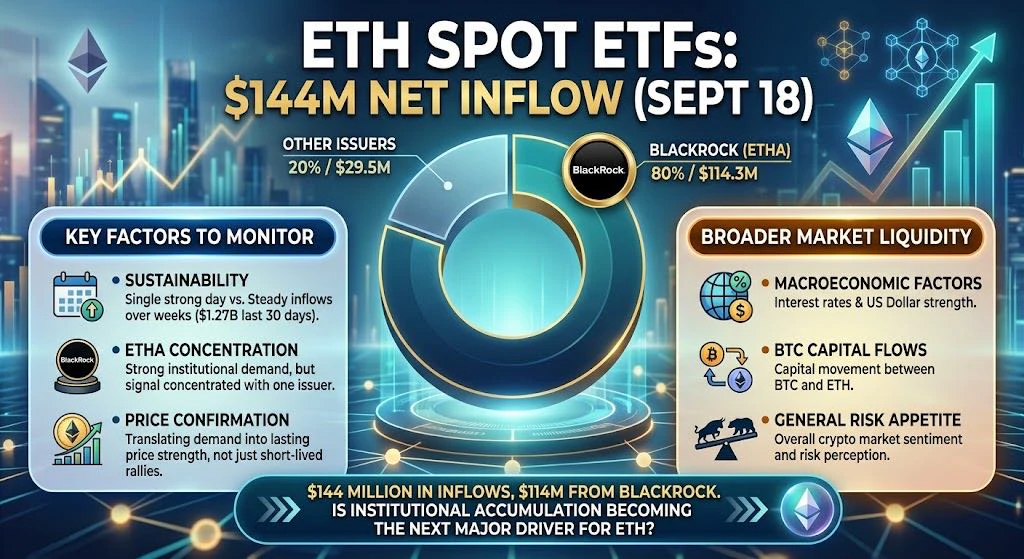
Yes, the $144 million capital inflow signals a significant bullish trend regarding the demand outlook for ETH. On September 18, US spot Ethereum ETFs recorded net inflows of approximately $143.8 million; of this, $114.3 million—roughly 80% of the day's total—came from BlackRock's ETHA fund.
Here are the factors I will be monitoring moving forward:
* Sustainability: A single strong day is not as significant as steady inflows sustained over weeks. Current data shows net inflows of approximately $1.27 billion over the past 30 days.
ybaser
#EthereumSpotETFsSee144MNetInflow #GateSquareMidAutumnReunion
Yes, the $144 million capital inflow signals a significant bullish trend regarding the demand outlook for ETH. On September 18, US spot Ethereum ETFs recorded net inflows of approximately $143.8 million; of this, $114.3 million—roughly 80% of the day's total—came from BlackRock's ETHA fund.
Here are the factors I will be monitoring moving forward:
* Sustainability: A single strong day is not as significant as steady inflows sustained over weeks. Current data shows net inflows of approximately $1.27 billion over the past 30 days.
* ETHA concentration: The fact that the majority of the inflow originated from BlackRock indicates notable institutional demand; however, it also implies that the signal is not evenly distributed among issuers.
* Price confirmation: While ETF demand acts as a supportive factor, ETH needs to translate this demand into lasting price strength rather than just a short-lived rally.
* Broad market liquidity: Interest rates, the strength of the dollar, capital flows into BTC, and general crypto risk appetite could overshadow the impact of ETF-driven demand in the short term.
In summary, the data reinforces a bullish outlook but does not, on its own, guarantee that ETH will inevitably rise from here.
If you are turning this into a social media post, a more impactful closing question might be: "$144 million in inflows in a single day, with $114 million coming from BlackRock. Is institutional accumulation becoming the next major driver for ETH?"
$ETH
repost-content-media
ETH-0.43%
BLK-2.17%
BTC-0.30%
The Index Trade: SanDisk Enters the S&P 100 and the Mechanics of Forced Demand
There is a particular kind of buying that has nothing to do with valuation, earnings, or sentiment. It is mechanical, contractual, and it expires the moment the closing bell rings. That is the dynamic now playing out as SanDisk prepares to join the S&P 100 before the open on Monday, September 21, alongside Dell Technologies, Palo Alto Networks, and Arista Networks. The four will replace Nike, Colgate-Palmolive, Simon Property Group, and Honeywell Aerospace in the blue-chip index.
For SanDisk, the inclusion is the cu
M谋ngYueZen
The Index Trade: SanDisk Enters the S&P 100 and the Mechanics of Forced Demand
There is a particular kind of buying that has nothing to do with valuation, earnings, or sentiment. It is mechanical, contractual, and it expires the moment the closing bell rings. That is the dynamic now playing out as SanDisk prepares to join the S&P 100 before the open on Monday, September 21, alongside Dell Technologies, Palo Alto Networks, and Arista Networks. The four will replace Nike, Colgate-Palmolive, Simon Property Group, and Honeywell Aerospace in the blue-chip index.
For SanDisk, the inclusion is the culmination of a remarkable year. The memory chipmaker has been the best-performing stock in the S&P 500 in 2026, up roughly 600% since January. Its shares jumped 11% on Thursday after the index change was confirmed, closing at $1,792. The immediate catalyst was not a product launch or an earnings revision. It was the simple fact that funds tracking the S&P 100 are now required to own the stock, and they must build that position before Monday's open.
This is what market structure analysts call a flow trade. The demand is not a view on SanDisk's NAND pricing or its data center backlog. It is a mechanical consequence of index rules. Every passive fund benchmarked to the S&P 100 must buy the additions and sell the departures to minimize tracking error. The buying is indifferent to valuation: a fund buys the same dollar amount whether the shares are cheap or expensive. And it is concentrated in the final moments before the rebalancing window closes.
The distinction matters for anyone considering how to interpret the move. The forced buying that supports the shares into Monday's open is not a durable bid. Once the rebalancing is complete, the incremental index demand disappears, and SanDisk trades on its own fundamentals again. The longer-lived effect is visibility. Index membership brings the stock into every S&P 100-tracking portfolio, expands the pool of institutional holders with a mandate to own it, and typically draws additional sell-side coverage.
Yet the index event is arriving on top of a structural story that was already driving the stock higher. Industry executives expect the NAND memory shortage to persist through 2027. TrendForce projects DRAM contract prices will rise another 13% to 18% this quarter alone. Data center demand now makes up more than half of the NAND market, a shift that SanDisk's chief executive has described as a turning point in how the business gets priced, moving from quarterly spot negotiations toward multiyear supply contracts with price floors.
The analyst community is split on how much of this is already reflected in the share price. TIKR tracks 25 analysts on SanDisk, with 16 buys, 4 outperforms, 3 holds, 1 underperform, and 1 sell. The mean price target sits near $2,125, roughly 19% above Thursday's close. The dispersion between the most bullish and bearish views is wide, which is typical for a stock that has moved this far this fast.
What should a careful observer watch from here? First, the actual flow into Monday's open. The mechanical bid is real, but it is finite, and the market will quickly transition to trading on fundamentals once the rebalancing is complete. Second, the next earnings report, which will show whether the NAND shortage is translating into the contracted revenue and pricing power that the bull case assumes. Third, the broader memory sector, where Seagate, Western Digital, and Micron are trading on the same supply dynamics. The index event is a moment. The shortage is a cycle. The question is whether the cycle lasts long enough to justify the price.
$SNDK ‌ DYOR 🔎 NFA ✔️
NVDA is showing a +1.23% green at 222.08; the recovery from the 189.58 low has pushed the price above the EMA30, 60, and 90. While the 234.48 peak is still being watched as resistance, the SuperTrend 209.62 support remains strong. With a market capitalization of $5.3 trillion, the chart seems to be saying, "I'm close to the peak, but I need to convince 234 first." Stay calm, look at the level. #NVDA
Not investment advice.
$NVDA
WhyFay
NVDA is showing a +1.23% green at 222.08; the recovery from the 189.58 low has pushed the price above the EMA30, 60, and 90. While the 234.48 peak is still being watched as resistance, the SuperTrend 209.62 support remains strong. With a market capitalization of $5.3 trillion, the chart seems to be saying, "I'm close to the peak, but I need to convince 234 first." Stay calm, look at the level. #NVDA
Not investment advice.
$NVDA
NVDA+0.69%
$BTDR #USAIConceptStocksRally
A Clear Rebound: Bitdeer's AI Pivot and the Wider Market Rally
If you have been watching the US equity markets closely, you saw a clear shift in sentiment on Friday. All major indices closed higher, with the Dow Jones up 0.61%, the S&P 500 gaining 1.14%, and the Nasdaq rising 1.69%. The volatility index dropped sharply by 10.23%, reflecting a notable easing of market anxiety. The rally was led by artificial intelligence names, with Tempus AI, Super Micro, Astera Labs, and Arm all posting significant gains.
Within this broader trend, Bitdeer Technologies Group st
User_any
$BTDR #USAIConceptStocksRally
A Clear Rebound: Bitdeer's AI Pivot and the Wider Market Rally
If you have been watching the US equity markets closely, you saw a clear shift in sentiment on Friday. All major indices closed higher, with the Dow Jones up 0.61%, the S&P 500 gaining 1.14%, and the Nasdaq rising 1.69%. The volatility index dropped sharply by 10.23%, reflecting a notable easing of market anxiety. The rally was led by artificial intelligence names, with Tempus AI, Super Micro, Astera Labs, and Arm all posting significant gains.
Within this broader trend, Bitdeer Technologies Group stood out. The stock dipped early in the session but recovered strongly to close at $12.98, a gain of 15.28% from its previous close. This move pushed the price back above its volume-weighted average price of $12.44, signaling that buyers stepped in decisively as the day progressed. The company currently holds a market capitalization of $3.52 billion.
What is driving this renewed interest? The answer lies in the company's August operations update. The report showed that Bitdeer's AI cloud annual recurring revenue reached approximately $86 million, up from about $76 million in July. The company had 4,328 GPUs deployed, with 3,998 of them under external subscription. This growing AI compute monetization base provides a fresher business anchor for valuation, distinct from its historical association with Bitcoin mining.
The same update noted that the company deepened long-term AI data center and cloud contracts while sharply scaling its overall computing capacity. Longer-dated contracts can improve revenue visibility and provide a more predictable foundation for future earnings. However, it is important to note that a single month of data is not enough to confirm a durable trend. The pace at which this expanded capacity actually comes online will need confirmation in later disclosures.
Looking at the weekly chart, the stock has staged a significant recovery from its low of $6.84. However, it remains below several key moving averages, including the 30-day EMA at $12.53, the 60-day EMA at $13.45, and the 90-day EMA at $14.73. The SuperTrend indicator sits higher at $18.66. This technical picture suggests that while short-term momentum has shifted upward, the medium-term structure still faces resistance.
The broader question for observers is whether the AI infrastructure rally can sustain its momentum. Bitdeer's pivot toward AI cloud services gives it a new narrative, but the market will be watching closely to see if the company can convert its expanded capacity into consistent, long-term revenue. For now, the rebound is real, but the durability of the trend remains to be proven.
DYOR 🔎 NFA ✔️
#Gate广场中秋团圆局 #GateSquareMidAutumnReunion #ShareWeekly
repost-content-media
BTDR-0.38%
TEM-0.96%
ALAB+6.68%
ARM+3.14%
US5000.00%
$BKKT Bakkt (BKXT) shares closed significantly higher on Friday, rising over 15% to $8.59. The stock currently holds a market capitalization of approximately $387 million. This price action followed recent operational updates indicating a positive shift in the company's business strategy.
On September 9, the company expanded its global commercial team and revised its 2026 full-year Total Transacting Volume (TTV) target upward from $2.5 billion to $3 billion. Management cited stronger-than-expected demand and a larger pipeline of opportunities. They also noted that several large opportunities
User_any
$BKKT Bakkt (BKXT) shares closed significantly higher on Friday, rising over 15% to $8.59. The stock currently holds a market capitalization of approximately $387 million. This price action followed recent operational updates indicating a positive shift in the company's business strategy.
On September 9, the company expanded its global commercial team and revised its 2026 full-year Total Transacting Volume (TTV) target upward from $2.5 billion to $3 billion. Management cited stronger-than-expected demand and a larger pipeline of opportunities. They also noted that several large opportunities are still in early stages and have not yet contributed significant volume.
The company's financial results released on August 10 showed GAAP net income of $80.8 million. This figure was primarily driven by a $98.5 million non-cash fair value gain on Transchem warrants. Quarterly TTV stood at $168.8 million, bringing first-half TTV to $410.0 million.
In recent months, Bakkt has also made several strategic moves. The company appointed Matt White as Chief Financial Officer in August. It completed its all-stock acquisition of Distributed Technologies Research in April. Additionally, it secured Indian regulatory approval for its strategic investment in Transchem in June.
Looking at the weekly chart, the stock has recovered from its low of $6.72 but remains well below its 52-week high of $49.79. The current price trades below its major weekly moving averages, including the 30-day EMA at $9.28 and the 60-day EMA at $10.84. The SuperTrend indicator sits higher at $12.55. This technical picture suggests that while short-term momentum has improved, medium-term resistance remains.
#USAStocksRally #Gate广场中秋团圆局 #GateSquareMidAutumnReunion #ShareWeekly
DYOR 🔎 NFA ✔️
repost-content-media
BKKT+6.46%
$GBPJPY ‌$USDJPY ‌$EURJPY ‌
The Yen Awakens: How Japan's Quiet Tightening Is Rewriting the Rules of Global Finance
Good morning. If you are reading this from a trading floor in London, a hedge fund office in New York, or a treasury desk in Singapore, the chart that should be commanding your attention this week is not the S&P 500 or the price of Brent crude. It is the Japanese yen. After years of languishing at levels that made it the world's favourite funding currency, the yen has staged a rally that is forcing investors across every asset class to reconsider long-held assumptions. The curr
M谋ngYueZen
$GBPJPY $USDJPY $EURJPY
The Yen Awakens: How Japan's Quiet Tightening Is Rewriting the Rules of Global Finance
Good morning. If you are reading this from a trading floor in London, a hedge fund office in New York, or a treasury desk in Singapore, the chart that should be commanding your attention this week is not the S&P 500 or the price of Brent crude. It is the Japanese yen. After years of languishing at levels that made it the world's favourite funding currency, the yen has staged a rally that is forcing investors across every asset class to reconsider long-held assumptions. The currency strengthened to its highest level since February against the dollar this week, touching 152.89 per dollar before settling near 153.48, a move that has surprised even seasoned market participants. Behind this shift lies a simple but profound reality: the Bank of Japan is no longer the outlier it once was.
For much of the past decade, Japan occupied a unique position in the global financial architecture. It was the economy that refused to normalise. While the Federal Reserve, the European Central Bank, and the Bank of England raised rates to combat post-pandemic inflation, the BOJ held its policy rate at minus 0.1 percent, maintaining a commitment to ultra-loose monetary conditions that made the yen the cheapest major currency to borrow. This divergence created one of the most lucrative and persistent trades in modern finance: the yen carry trade. Investors would borrow yen at near-zero cost, convert the proceeds into higher-yielding currencies, and pocket the difference. Estimates suggest that cross-border yen borrowing, a proxy for the carry trade, reached a record 360 trillion yen, or roughly 2.35 trillion dollars, as of March, according to an analysis by Jefferies based on Bank for International Settlements data. This was the largest carry-trade build-up in three decades, and it became a foundational pillar of global risk appetite.
That pillar is now under strain. The BOJ has already raised its policy rate to 1.0 percent, and market expectations point overwhelmingly toward another quarter-point increase to 1.25 percent at the conclusion of its two-day meeting on September 18. According to Tokyo Tanshi data, the odds of this hike stand at 97 percent, up from just 52 percent a month ago. More significantly, a Bloomberg survey of 52 economists found that every single one expects a September move, and nearly half anticipate the BOJ will now raise rates once per quarter, a dramatic acceleration from the previous pace of one hike every six months. The terminal rate expectation has settled around 1.75 percent, implying three more increases beyond September. This is not a marginal adjustment. It is a fundamental shift in the cost of the world's most important funding currency.
The yen's rally is already triggering visible consequences. "The carry trade is vulnerable because this unwind is happening before the BOJ has even delivered its expected hike," said Charu Chanana, chief investment strategist at Saxo, as reported by Reuters. "Some yen shorts have already been cut, but positioning still looks sizeable, so further yen strength can turn a gradual reduction in leverage into a much faster, self-reinforcing unwind." The yen has marched nearly 5 percent higher so far in September against the usual carry-trade favourites, including the Mexican peso and the Turkish lira. A further unwind, according to State Street's Masahiko Loo, could push the dollar-yen pair toward the mid-140s given the substantial outstanding short position.
The implications for global markets are neither hypothetical nor distant. When investors borrow in yen to fund positions in higher-yielding assets, a rising yen makes those loans more expensive to repay. If the appreciation is sharp enough, it can force leveraged funds to sell those assets to cover losses, creating a feedback loop that amplifies volatility across equities, bonds, and currencies. This is precisely what happened in August 2024, when a BOJ rate hike sent shockwaves through global markets for days. The stakes this time are arguably higher. The carry trade has grown larger, the positioning more crowded, and the geopolitical backdrop more fragile. Oil prices above 100 dollars a barrel, an active conflict between the United States and Iran, and an uncertain American inflation trajectory all compound the risk.
Yet it would be a mistake to frame this solely as a story of impending crisis. The yen's appreciation reflects something more constructive: the gradual normalisation of an economy that has spent a generation in the wilderness of deflation and stagnation. Japan's consumer price inflation has remained above the BOJ's 2 percent target, running between 2.5 and 3 percent in recent government data. The central bank has acknowledged that its economy "has recovered moderately," though it also cautioned that exports will be affected by higher tariffs stemming from American trade policy. Real GDP grew at an annualised 1.1 percent in the April-June quarter, marking a third consecutive quarter of positive growth, though private consumption and capital investment both softened. The Nikkei 225 has hit record highs, buoyed by the Fed's recent rate cut and the broader reflation narrative.
The political dimension adds another layer of complexity. Prime Minister Shigeru Ishiba is stepping down, and the ruling Liberal Democratic Party is holding a leadership election, with five candidates expected to enter the race. The BOJ itself has cited domestic political uncertainty as a risk factor. The outcome of this leadership contest will shape fiscal policy in the months ahead and could influence the pace of monetary tightening. Meanwhile, the United States has shown a willingness to intervene in currency markets alongside Japan, as it did in July when the yen hit 40-year lows. U.S. Treasury Secretary Scott Bessent has referred to the potential for additional Japanese intervention, and ECB policymaker Joachim Nagel has indicated that coordinated action could be welcomed under certain circumstances. This cooperative stance suggests that the major economies are not indifferent to the yen's trajectory and are prepared to act if disorderly moves threaten financial stability.
What should a careful observer watch in the coming weeks? First, the BOJ's policy statement on September 18 and Governor Ueda's subsequent press conference. The language used will matter as much as the rate decision itself. If the BOJ signals that further hikes are contingent on data and proceed gradually, the yen may stabilise. If it hints at a faster pace, the carry-trade unwind could accelerate. Second, the reaction of global equity markets, particularly in the United States, where high-valuation technology stocks have benefited disproportionately from cheap yen funding. Third, the trajectory of oil prices. If Brent crude remains above 100 dollars, the inflationary pressure on Japan, a major energy importer, will intensify, reinforcing the case for tighter policy.
The deeper truth is that the era of free money from Japan is ending. For years, the yen carry trade served as a quiet subsidy for global risk assets, allowing investors to borrow cheaply and chase returns elsewhere. That subsidy is now being withdrawn, not abruptly, but steadily and deliberately. The world is adjusting to a Japan that is no longer the exception to the rules of monetary orthodoxy. How smoothly that adjustment proceeds will depend on the wisdom of policymakers, the resilience of markets, and the willingness of investors to recognise that the landscape has changed. The yen's awakening is not a crisis. It is a correction. And corrections, however uncomfortable, are how markets rediscover equilibrium.
NFA ✔️ DYOR 🔎
#AugustCoreCPIBeatsExpectations #ShareWeekly
  • 1
$BZ ‌
The Hundred-Dollar Question: What Oil's Return Above $100 Means for the World Economy
Good morning. If you are reading this from a trading desk in London, a manufacturing hub in Shanghai, or a logistics office in Houston, the number staring back at you from the screen this week is one you have not seen in months. Brent crude has crossed $100 a barrel for the first time since late July, and WTI has followed it above $100 after a brief pause in early September. The last time we saw these levels, the world was still processing the initial shock of the Iran war. Now, with the conflict showi
M谋ngYueZen
$BZ
The Hundred-Dollar Question: What Oil's Return Above $100 Means for the World Economy
Good morning. If you are reading this from a trading desk in London, a manufacturing hub in Shanghai, or a logistics office in Houston, the number staring back at you from the screen this week is one you have not seen in months. Brent crude has crossed $100 a barrel for the first time since late July, and WTI has followed it above $100 after a brief pause in early September. The last time we saw these levels, the world was still processing the initial shock of the Iran war. Now, with the conflict showing no sign of abating, the question is no longer whether oil will stay elevated, but what that elevation means for an already strained global economy.
Let us begin with the facts. As of this week, Brent crude is trading near $101 a barrel, with WTI just below that threshold after a session that saw both benchmarks surge by more than six percent in a single day. The move is not speculative froth. The International Energy Agency has revised its supply forecasts downward, warning that the recovery of normal crude flows from the Persian Gulf is now delayed until 2027. The IEA now expects global oil supply to fall by 5.7 million barrels per day in 2026, a figure that would represent one of the largest supply shocks in modern energy history.
The causes are not mysterious. The war between the United States and Iran has disrupted shipping lanes, damaged infrastructure, and removed millions of barrels of daily production from the market. OPEC+ chose this month to freeze its production quotas through October, ending a six-month run of gradual increases, precisely because the actual export capacity of its members is being constrained by the conflict. Saudi Arabia's production has reportedly fallen to its lowest level since 1990, and a critical east-west pipeline outage now threatens to remove up to four percent of global supply if it is not restarted within days.
What does this mean for the real economy? Begin with inflation. Oil is the bloodstream of the industrial world, and when its price rises this sharply, the effects are felt everywhere. Global bond yields have surged to multi-year highs as investors price in the likelihood that central banks will need to raise interest rates further to contain the inflationary pressure. The Federal Reserve, already grappling with core inflation above three percent, now faces a new upward push on prices that it cannot control through monetary policy alone. Analysts estimate that if high oil prices persist for several quarters, cumulative American inflation could rise by an additional 1.4 percentage points, with second-round effects on wages and prices that would make the Fed's task significantly harder.
The growth picture is equally concerning. Higher energy costs act as a tax on households and businesses alike. For the American consumer, already showing signs of caution, rising gasoline prices and utility bills will inevitably squeeze discretionary spending. For European economies, which remain more energy-intensive than their American counterpart, the headwinds are even stronger. The European Central Bank has already warned that the oil price shock will weigh noticeably on euro area activity, with the impact potentially comparable to the shock that followed Russia's invasion of Ukraine in 2022. In a worst-case scenario, where energy infrastructure is destroyed and oil reaches $160 a barrel, American GDP could fall by as much as 2.6 percentage points.
Yet it would be a mistake to read this solely as a story of doom. Oil at $100 is painful, but it is not catastrophic. The global economy has absorbed $100 oil before, most recently in the summer of 2022, without entering a deep recession. The difference now is the context. Interest rates are higher than they were then. Fiscal space is more limited. And the geopolitical backdrop, with active conflicts in both the Middle East and Eastern Europe, offers fewer avenues for a quick resolution.
What should a careful observer watch in the weeks ahead? First, the direction of the Iran conflict. Any sign of de-escalation, even a temporary ceasefire, would likely bring oil prices down sharply. Second, the American consumer price data for August, due later this month, which will give the first clear read on how much of the oil shock has already passed through to core inflation. And third, the response of OPEC+. If the group decides to open the taps more aggressively, it could offset some of the supply losses. But with actual export capacity constrained by the conflict, the cartel's ability to influence prices may be more limited than its quotas suggest.
The deeper truth is that oil prices at this level reflect a world in which supply chains are being reordered by force, not by choice. The era of cheap, abundant energy that defined the first two decades of this century is not coming back anytime soon. What replaces it will depend on decisions made in Washington, Tehran, Riyadh, and Beijing in the coming months. The rest of us can only watch, calculate, and prepare for a world where the price of a barrel of oil is no longer a footnote to the economic story, but its headline.
DYOR 🔎 NFA ✔️
#AugustCoreCPIBeatsExpectations #𝐎𝐈𝐋
#ShareWeekly
$CL ‌$XTIUSD ‌
#SenateReleasesNewCLARITYAct
The bill (H.R. 3633) passed the House in July 2025 by 294–134, and cleared the Senate Banking Committee in May 2026 on a 15–9 vote . A revised Senate text was released on September 10, 2026, ahead of a scheduled procedural cloture vote on September 15 . That vote requires 60 senators to advance the bill to floor debate. Republicans hold 53 seats, meaning at least 7 Democratic votes are needed . As of early September, the bill was described as "hanging by a thread," with prediction-market odds of 2026 passage in the mid-teens .
Key Changes in the September 10 Revis
M谋ngYueZen
#SenateReleasesNewCLARITYAct
The bill (H.R. 3633) passed the House in July 2025 by 294–134, and cleared the Senate Banking Committee in May 2026 on a 15–9 vote . A revised Senate text was released on September 10, 2026, ahead of a scheduled procedural cloture vote on September 15 . That vote requires 60 senators to advance the bill to floor debate. Republicans hold 53 seats, meaning at least 7 Democratic votes are needed . As of early September, the bill was described as "hanging by a thread," with prediction-market odds of 2026 passage in the mid-teens .
Key Changes in the September 10 Revised Text
The updated 630-page draft incorporates more than 100 Democrat-requested provisions, but the core sticking points remain unresolved . Three narrow changes were made:
· DeFi Registration: Trading protocols that are not genuinely decentralized must register with the CFTC and comply with Bank Secrecy Act obligations, mirroring existing SEC-side treatment .
· DeFi Scope Limit: The decentralized finance title now applies only to spot and cash digital commodity transactions, a revision aimed at addressing concerns from tribal gaming groups about prediction markets .
· Credit Union Clarity: The text clarifies which digital asset activities credit unions may conduct, keyed to GENIUS Act definitions .
Unresolved Sticking Points
The ethics title—covering restrictions on federal officials issuing or sponsoring tokens—remains unchanged from the July draft . This is a central Democratic demand. Section 10404, which bars yield or interest on payment stablecoins, is also unchanged, drawing opposition from the American Bankers Association and 60 other banking groups concerned about deposit flight . Section 10604, protecting software developers, is similarly unchanged .
Notable Developments
Treasury Secretary Scott Bessent publicly urged the Senate to advance the bill on September 9, warning that inaction would send a "troubling signal to our allies and adversaries alike" . The National Sheriffs' Association shifted from opposition to a neutral position on September 3, though it had previously warned the bill could exempt crypto mixers and DeFi platforms from anti-money-laundering rules .
If Cloture Fails
If the September 15 procedural vote fails, the bill is widely viewed as dead for the remainder of the 119th Congress . The remaining 2026 calendar is compressed by midterm campaigning and appropriations work. Failure would likely push comprehensive market-structure legislation to 2027 or later .
👉: The information above is based on legislative documents, committee releases, and reporting from multiple sources. The underlying policy debates involve competing views on financial regulation, innovation, and national security. This summary is provided for informational purposes only and does not constitute investment or policy advice.
The U.S. economy in 2026 presents a picture of surface-level resilience masking deeper structural tension. Multiple institutional forecasts converge on growth around 2% to 2.4%, yet inflation persists above the Federal Reserve's target, and the central bank remains caught between competing risks.
According to IMF projections, U.S. growth is expected at 2.3% in 2026 and 2.2% in 2027, supported by fiscal policy, accommodative financial conditions, and continued technology-related business investment . Guggenheim similarly sees real GDP growth around 2% for both years, underpinned by artificial i
M谋ngYueZen
The U.S. economy in 2026 presents a picture of surface-level resilience masking deeper structural tension. Multiple institutional forecasts converge on growth around 2% to 2.4%, yet inflation persists above the Federal Reserve's target, and the central bank remains caught between competing risks.
According to IMF projections, U.S. growth is expected at 2.3% in 2026 and 2.2% in 2027, supported by fiscal policy, accommodative financial conditions, and continued technology-related business investment . Guggenheim similarly sees real GDP growth around 2% for both years, underpinned by artificial intelligence capital expenditures . Goldman Sachs recently lowered its 12-month recession probability from 25% to 15%, citing labor market resilience and reduced geopolitical risk following the U.S.-Iran ceasefire .
The inflation picture is more complex. Core PCE inflation has remained elevated in 2026, with year-over-year readings expected to end the year above 3% . The Federal Reserve's June projections revised its 2026 PCE inflation forecast upward from 2.7% to 3.6%, and core PCE from 2.7% to 3.3% . Tariff effects have receded, but new inflationary impulses have emerged from AI capital expenditure spillovers and energy price pass-through .
This has placed the Fed in a holding pattern. The federal funds rate has remained at 3.50%-3.75% since December 2025, and most economists surveyed by Reuters expect no cuts through 2026 . The Fed's June projections raised the median policy rate expectation for end-2026 from 3.4% to 3.8% . A near-85% majority of economists polled predicted the rate would remain steady through the third quarter . Fed Chair Kevin Warsh faces a divided committee, with some officials favoring cuts and others concerned about inflation persistence .
The underlying concern is the narrowness of U.S. growth drivers. Guggenheim notes that with weak real income growth, the expansion relies increasingly on tech investment and wealth-driven consumer spending. Any disruption to the AI investment thesis could present a downside risk . Goldman Sachs also attributes its more optimistic growth revision to AI investment momentum and real income gains from lower natural gas prices .
Globally, the IMF lowered its 2026 world growth forecast to 3.0% from 3.1% in April, while holding the U.S. forecast steady . The U.S. position as a net energy exporter has limited the impact of Middle East conflict on its economy compared to other regions .
The trajectory ahead depends on whether inflation moderates as the Fed expects, and whether the AI-driven investment cycle continues to offset weaker consumer fundamentals. The debate between economists projecting cuts versus hikes reflects genuine uncertainty rather than consensus, and the Fed's wait-and-see approach appears likely to persist until one set of risks clearly dominates.
#AugustCoreCPIBeatsExpectations ##ShareWeekly
#SenateReleasesNewCLARITYAct
The bill (H.R. 3633) passed the House in July 2025 by 294–134, and cleared the Senate Banking Committee in May 2026 on a 15–9 vote . A revised Senate text was released on September 10, 2026, ahead of a scheduled procedural cloture vote on September 15 . That vote requires 60 senators to advance the bill to floor debate. Republicans hold 53 seats, meaning at least 7 Democratic votes are needed . As of early September, the bill was described as "hanging by a thread," with prediction-market odds of 2026 passage in the mid-teens .
Key Changes in the September 10 Revis
WhyFay
#SenateReleasesNewCLARITYAct
The bill (H.R. 3633) passed the House in July 2025 by 294–134, and cleared the Senate Banking Committee in May 2026 on a 15–9 vote . A revised Senate text was released on September 10, 2026, ahead of a scheduled procedural cloture vote on September 15 . That vote requires 60 senators to advance the bill to floor debate. Republicans hold 53 seats, meaning at least 7 Democratic votes are needed . As of early September, the bill was described as "hanging by a thread," with prediction-market odds of 2026 passage in the mid-teens .
Key Changes in the September 10 Revised Text
The updated 630-page draft incorporates more than 100 Democrat-requested provisions, but the core sticking points remain unresolved . Three narrow changes were made:
· DeFi Registration: Trading protocols that are not genuinely decentralized must register with the CFTC and comply with Bank Secrecy Act obligations, mirroring existing SEC-side treatment .
· DeFi Scope Limit: The decentralized finance title now applies only to spot and cash digital commodity transactions, a revision aimed at addressing concerns from tribal gaming groups about prediction markets .
· Credit Union Clarity: The text clarifies which digital asset activities credit unions may conduct, keyed to GENIUS Act definitions .
Unresolved Sticking Points
The ethics title—covering restrictions on federal officials issuing or sponsoring tokens—remains unchanged from the July draft . This is a central Democratic demand. Section 10404, which bars yield or interest on payment stablecoins, is also unchanged, drawing opposition from the American Bankers Association and 60 other banking groups concerned about deposit flight . Section 10604, protecting software developers, is similarly unchanged .
Notable Developments
Treasury Secretary Scott Bessent publicly urged the Senate to advance the bill on September 9, warning that inaction would send a "troubling signal to our allies and adversaries alike" . The National Sheriffs' Association shifted from opposition to a neutral position on September 3, though it had previously warned the bill could exempt crypto mixers and DeFi platforms from anti-money-laundering rules .
If Cloture Fails
If the September 15 procedural vote fails, the bill is widely viewed as dead for the remainder of the 119th Congress . The remaining 2026 calendar is compressed by midterm campaigning and appropriations work. Failure would likely push comprehensive market-structure legislation to 2027 or later .
👉: The information above is based on legislative documents, committee releases, and reporting from multiple sources. The underlying policy debates involve competing views on financial regulation, innovation, and national security. This summary is provided for informational purposes only and does not constitute investment or policy advice.
Two hunters are out in the woods when one of them collapses. He doesn't seem to be breathing and his eyes are glazed.
The other guy whips out his phone and calls the emergency services. He gasps:
— "My friend is dead! What can I do?"
The operator says:
— "Calm down. I can help. First, let's make sure he's dead."
There is a silence, then a SHOT is heard.
The guy comes back to the phone and says:
— "OK, now what?"
WhyFay
Two hunters are out in the woods when one of them collapses. He doesn't seem to be breathing and his eyes are glazed.
The other guy whips out his phone and calls the emergency services. He gasps:
— "My friend is dead! What can I do?"
The operator says:
— "Calm down. I can help. First, let's make sure he's dead."
There is a silence, then a SHOT is heard.
The guy comes back to the phone and says:
— "OK, now what?"
#USTreasuryToBuyBackUpTo6Billion
US Treasury Announces $6 Billion Bond Buyback Plan
The US Treasury Department announced that it has increased the size of its buyback operation for bonds with maturities of 10 to 20 years to $6 billion. This amount is three times the size of a standard operation. The Department committed to purchasing at least $4 billion in each future operation.
Operation Details
· Target securities: Bonds maturing between February 15, 2037, and August 15, 2046
· Minimum offer amount: $1 million
· Operation date: September 10, 2026
· Settlement date: September 11, 2026
· Forw
User_any
#USTreasuryToBuyBackUpTo6Billion
US Treasury Announces $6 Billion Bond Buyback Plan
The US Treasury Department announced that it has increased the size of its buyback operation for bonds with maturities of 10 to 20 years to $6 billion. This amount is three times the size of a standard operation. The Department committed to purchasing at least $4 billion in each future operation.
Operation Details
· Target securities: Bonds maturing between February 15, 2037, and August 15, 2046
· Minimum offer amount: $1 million
· Operation date: September 10, 2026
· Settlement date: September 11, 2026
· Forward commitment: Maximum purchase amount for other long-term buyback operations in the current fiscal quarter will be $4 billion or higher
Market Reaction
Sell-off pressure persisted in the bond market following the Treasury Department's announcement. The yield on the 10-year US Treasury bond rose to 4.84% after the announcement, reaching its highest level since November 2023. The yield on the 30-year bond climbed to 5.29%.
Market participants consider the $6 billion figure to be limited in scale compared to the Treasury bond market, which exceeds $32 trillion. Deutsche Bank strategist Steven Zeng stated that the size of the operation did not meet expectations.
Statements from Officials
Treasury Secretary Scott Bessent stated that the rise in yields did not reflect fundamental indicators. Bessent noted that he could not alter the equilibrium price of bond yields, adding that his role was to slow the pace of market movements. Macro Background
The upward trend in long-term bond yields continues globally. Rising government borrowing, economic uncertainties, and increasing oil prices are exerting upward pressure on yields. Brent crude surpassed the $100-per-barrel mark following developments in the Middle East.
Markets are now focused on producer and consumer inflation data scheduled for release on September 10–11. These figures will be pivotal for monetary policy expectations ahead of the Federal Open Market Committee's interest rate decision on September 16.
Risk Assessment
The impact of the buyback operation on the market will continue to be monitored through trading volumes and the yield curve. Analysts maintain a cautious outlook regarding the operation's long-term effect on interest rates.
DYOR 🔎 NFA ✔️
$XAUUSD
XAUUSD / Gold - 1-Hour Chart Detailed Support / Resistance Analysis
Data: Price 4,430.28 -42.91 (-0.95%) - Today's High 4,490.81 Low 4,365.56 - Open 4,470.26 Prev Close 4,473.19 MA5:4,428.42 MA10:4,428.04 MA30:4,460.92 MACD: -4.06 DIF: -7.19 DEA: -3.13
1. GENERAL STRUCTURE
The chart is in a structure of a sharp dump, recovery, and second dump. On the left, there is a 7.5% drop from the 4,631.71 peak to the 4,282.62 bottom. Then it made a V-reversal up to above 4,477 and now the second selling wave has come. It wicked to 4,365.56 and is trying to hold at 4,430. This is a very volatile
M谋ngYueZen
$XAUUSD
XAUUSD / Gold - 1-Hour Chart Detailed Support / Resistance Analysis
Data: Price 4,430.28 -42.91 (-0.95%) - Today's High 4,490.81 Low 4,365.56 - Open 4,470.26 Prev Close 4,473.19 MA5:4,428.42 MA10:4,428.04 MA30:4,460.92 MACD: -4.06 DIF: -7.19 DEA: -3.13
1. GENERAL STRUCTURE
The chart is in a structure of a sharp dump, recovery, and second dump. On the left, there is a 7.5% drop from the 4,631.71 peak to the 4,282.62 bottom. Then it made a V-reversal up to above 4,477 and now the second selling wave has come. It wicked to 4,365.56 and is trying to hold at 4,430. This is a very volatile move for Gold, this much range in 1 hour is not normal.
MA structure is broken: MA30 4,460.92 is far above the price, so the medium-term trend is still bearish. MA5 and MA10 are stuck together at 4,428 level, price is right on this cluster. So short-term indecision.
2. RESISTANCE ZONES
A) Immediate Resistance: 4,460.92 - 4,477.02
• MA30: 4,460.92 • Previous top marked as 4,477.02 on the right side of the chart
Price is at 4,430, this cluster is 0.7% above. This is the first resistance. If it cannot pass here, the decline continues. Without an hourly close above 4,460, long is risky.
B) Major Resistance: 4,490.81 - 4,631.71
• Today's High: 4,490.81 - Where it got rejected today • Peak on the left marked as 4,631.71 on the chart
If 4,490 breaks, targets 4,582.95 and 4,631.71 open up. This is the main distribution zone where the main selling came from. As long as it stays below, pressure continues. 3. SUPPORT ZONES - CRITICAL
1. First Support: 4,428.42 - 4,428.04 (MA5 / MA10 Cluster)
MA5 and MA10 are almost identical: 4,428. This is just below the price. Now price at 4,430 is holding just above this cluster. If this breaks, the intraday drop deepens.
2. Decisive Support: 4,371.09 - 4,365.56
• Marked as 4,371.09 on the right side of the chart • Today's Low: 4,365.56
This is the tip of the long wick that came during the day. This wick is very important, liquidity was taken here and buyers stepped in. If it breaks below 4,365, stop hunt happens and there is a 3% gap down to 4,282.62. This level must be protected.
3. Absolute Bottom Support: 4,282.62 - 4,265.16
Bottom marked as 4,282.62 on the chart and 4,265.16 at bottom right. The bottom on 09/02 02:00. If this zone breaks, the V structure breaks and there is a risk of a drop down to 4,200s.
4. INDICATOR CONFIRMATION
MACD(12,26,9): MACD -4.06 DIF -7.19 DEA -3.13 - MACD is negative, DIF has crossed below DEA and histogram has turned red. We are below the zero line, this means bearish momentum. DIF -7.19 is at the bottom, so momentum is exhausted but still bearish.
Volume is high in this drop, wick is long, this means liquidity hunt. The 4,365.56 wick is usually a reversal signal but since MACD is still negative, there is no confirmation.
5. SCENARIOS
For Bullish: It must stay above the 4,428 cluster and make an hourly close above 4,460.92 (MA30). Then target is again 4,490.81 High. Persistence above 4,490 starts the move to 4,631.
For Bearish: If a close comes below 4,428, first target is 4,371 - 4,365 Low. If this breaks, main target is 4,282.62 bottom. In Gold this level is very important, if it breaks a fast drop to the 4,200 psychological support can come.
#xau,
XAUUSD-1.11%
  • 1
$USDJPY $EURJPY $GBPJPY ‌The Japanese Yen (JPY) remains at the center of global currency markets, influenced by the Bank of Japan's (BoJ) monetary tightening path, rising inflationary pressures, and speculation surrounding the asset allocation strategies of the GPIF, the world's largest pension fund. The BoJ's continued focus on further interest rate hikes as inflation approaches its 2% target is accelerating the exit from years of excessively loose monetary policy, while the rise in Japanese bond yields is directly impacting global capital flows.
BoJ Policy Axis and Dilemmas in the Japan
M谋ngYueZen
$USDJPY $EURJPY $GBPJPY ‌The Japanese Yen (JPY) remains at the center of global currency markets, influenced by the Bank of Japan's (BoJ) monetary tightening path, rising inflationary pressures, and speculation surrounding the asset allocation strategies of the GPIF, the world's largest pension fund. The BoJ's continued focus on further interest rate hikes as inflation approaches its 2% target is accelerating the exit from years of excessively loose monetary policy, while the rise in Japanese bond yields is directly impacting global capital flows.
BoJ Policy Axis and Dilemmas in the Japanese Economy
The Bank of Japan's tendency to gradually increase its benchmark interest rate and the rise of hawkish voices within the board signal a new regime change in financial markets. The increase in the Producer Price Index (PPI), reflected in consumer prices, and the sustained wage increases reinforce the BoJ's need for timely interest rate hikes. The fact that Japanese 10-year government bond yields have surpassed critical thresholds has the potential to limit depreciation pressure on the yen while simultaneously posing a risk to government borrowing costs. The Yen's weakness is increasing the cost of imported energy and commodities, pushing up domestic raw material prices, while the Bank of Japan's interest rate hikes keep alive the risk of carry trade positions being unwound.
Technical and Pricing Dynamics Against Developed Currencies
In the foreign exchange markets, the Yen is attempting to stabilize with rebound buying after sharp pullbacks from peak levels against major currencies.
The USD/JPY pair is trading at 156.243, up 0.28% in intraday trading. The pair, which moved between 155.294 and 156.748 during the day, continues to face resistance from moving averages. The 5-day moving average (MA5) is at 158.140, the 10-day moving average (MA10) is at 158.780, and the 30-day moving average (MA30) is at 159.235. The MACD indicator remaining in negative territory after the decline from the peak of 163.986 recorded on the chart indicates that short-term upward attacks remain limited.
The EUR/JPY pair is trading at 181.408, up 0.15%. The daily range is between 180.227 and 181.960, and the pair is moving below the MA5 (183.547), MA10 (184.597), and MA30 (184.239) levels after selling pressure from the peak of 187.952. Developments regarding the Japanese Pension Fund's (GPIF) asset reviews and the possibility of a shift towards local bonds are among the key factors increasing volatility in Yen positions against the Euro.
The GBP/JPY pair is trading at 211.136, up 0.20%. The daily trading range is between 209,770 and 211,816, with the pair attempting to recover after a correction from its peak of 219,606. Technically, the MA5 (213,767) and MA10 (215,287) levels are acting as resistance, while the MACD indicator continues to monitor the bottom formation.
Impacts on the Global Economy and Financial Markets
The value dynamics of the Japanese Yen directly affect not only local assets but also the global liquidity mechanism. The Bank of Japan's interest rate hikes and the rise in Japanese bond yields are reducing the profitability of carry trade strategies based on low-cost Yen borrowing, which have been used in global markets for many years. This situation has the potential to trigger fund outflows from emerging markets and global stock exchanges. Furthermore, the shift of capital by large institutional investors like GPIF from foreign assets to local bonds is reshaping yield curves and capital balances in global bond markets.
You can track real-time price movements in major currency pairs, order book depth, and macroeconomic indicators for the Japanese economy through the Gate platform.
#USDJPY #EURJPY #GBPJPY #BankOfJapan #MacroEconomy
DYOR 🔎 NFA ✔️
USDJPY+0.33%
EURJPY0.00%
GBPJPY-0.14%
  • 2
SpaceX (SPCX) stock is trading at $148.53, experiencing a limited pullback of 0.79% in intraday trading. The daily range is a narrow 2.35%, with the price testing a low of $147.32 and a high of $150.84 during the day. The asset, which started the day at $148.59, is currently trading slightly below its previous closing level of $149.72. Market capitalization remains at $1,957.75 billion, while the Price/Earnings (P/E) ratio is at -221.081.
Technical indicators show that moving averages are providing short-term support to the price from below. The MA5 level is at $144.99, the MA10 level is at $1
WhyFay
SpaceX (SPCX) stock is trading at $148.53, experiencing a limited pullback of 0.79% in intraday trading. The daily range is a narrow 2.35%, with the price testing a low of $147.32 and a high of $150.84 during the day. The asset, which started the day at $148.59, is currently trading slightly below its previous closing level of $149.72. Market capitalization remains at $1,957.75 billion, while the Price/Earnings (P/E) ratio is at -221.081.
Technical indicators show that moving averages are providing short-term support to the price from below. The MA5 level is at $144.99, the MA10 level is at $141.98, and the MA30 level is at $132.65. The recovery process, which began from the $104.84 low tested in early August, has gradually brought the price to its current levels. Following a long-term correction from the $225.62 peak recorded in June, technical indicators point to a medium-term consolidation range.
On the company side, key developments include operational growth and the Starship test program. SpaceX continues to expand its Starlink network with regular launches via the Falcon 9 platform, and has completed critical regulatory approvals prior to the Starship Flight 14 mission. Launch and upper-stage capture permits from the Federal Aviation Administration (FAA) and the Federal Communications Commission (FCC) represent an operational milestone for the first-ever upper-stage rocket capture attempt by launch tower chopsticks. The placement of Starlink V3 satellites into orbit and the increase in commercial data capacity are among the key factors supporting cash flow expectations.
Secondary market transactions and institutional expectations indicate that the company's valuation dynamics remain dependent on the pace of commercialization of its satellite communications network and heavy launch systems. It is important for investors to closely monitor short-term technical levels, moving averages, and macroeconomic developments. You can track live price data, order book concentrations, and technical indicators for SpaceX (SPCX) stock via the Gate platform.
#SpaceX #SPCX #TechStocks #MarketUpdate $SPCX ‌ DYOR 🔎 NFA ✔️
SPCX+1.91%
$XPL ‌ (Plasma): Traders are watching a major September 25 unlock, when approximately 1.81 billion XPL is scheduled for team and investor release. That represents a substantial increase relative to current circulating supply and could create volatility.#GateEventContractTradeSharingChallenge
M谋ngYueZen
$XPL ‌ (Plasma): Traders are watching a major September 25 unlock, when approximately 1.81 billion XPL is scheduled for team and investor release. That represents a substantial increase relative to current circulating supply and could create volatility.#GateEventContractTradeSharingChallenge
XPL+2.65%
$BTC ‌ ‌BTC / USDT - 80,527.8
Live Data: Price 80,527.8 +4.78% | 24h High 80,965.1 / Low 76,826.9 / Vol 8.09K BTC / Turnover 633.57M USDT | Perp 80,472.0 +4.90% | 4h EMA5:78,619.5 EMA10:78,160.8 EMA30:78,037.8 | MFI:64.1 | Chart High 81,473.2 / Low 76,257.6 / Avg Price 78,571.5
1. PROJECT DETAILS
Bitcoin is the first decentralized Layer1, reserve asset of crypto.
Fixed supply 21M, halving in April 2024, store of value. This chart is on 4h timeframe, showing sharp V-recovery from 76,257.6 to 80,527.8 - almost +5.6% in one 4h candle. This is the biggest green candle since Aug 27 spike to 81,473
M谋ngYueZen
$BTC ‌ ‌BTC / USDT - 80,527.8
Live Data: Price 80,527.8 +4.78% | 24h High 80,965.1 / Low 76,826.9 / Vol 8.09K BTC / Turnover 633.57M USDT | Perp 80,472.0 +4.90% | 4h EMA5:78,619.5 EMA10:78,160.8 EMA30:78,037.8 | MFI:64.1 | Chart High 81,473.2 / Low 76,257.6 / Avg Price 78,571.5
1. PROJECT DETAILS
Bitcoin is the first decentralized Layer1, reserve asset of crypto.
Fixed supply 21M, halving in April 2024, store of value. This chart is on 4h timeframe, showing sharp V-recovery from 76,257.6 to 80,527.8 - almost +5.6% in one 4h candle. This is the biggest green candle since Aug 27 spike to 81,473.2.
2. WHAT TO WATCH
A. Golden Crossover: EMA5 78,619.5 crossed above EMA10 78,160.8 and EMA30 78,037.8. This is bullish crossover on 4h after 3 days below all EMAs. Price 80,527.8 is well above all three - full bullish alignment.
B. Liquidity Sweep and Reclaim: Price swept low 76,257.6 on Sept 2, which was below previous 76,387.4 purple level, took out stops, then reclaimed 78,571.5 Avg Price and 78,486.9. The purple dashed 76,387.4 is now strong support, the breakdown was a fakeout.
C. MFI 64.1 Bullish: MFI at 64.1, up from oversold near 14.0 at the 76,257 low. Previous top 81,473.2 had MFI near 86.0 overbought. Current 64.1 shows momentum returning with room to 80.
3. TECHNICAL ANALYSIS
Fibonacci Levels (76,257.6 low - 81,473.2 high, range 5,215.6):
• 0.236 retracement: 80,242.3 - Current price 80,527.8 just above it, reclaim
• 0.382 retracement: 79,480.9 - Near 78,486.9 - 78,571.5 Avg Price cluster
• 0.50 retracement: 78,865.4 - Middle support
• 0.618 retracement: 78,249.9 - Near EMA30 78,037.8 golden pocket
• 0.786 retracement: 77,373.6 - Deep support
Support Zones:
• 80,526.3 - 80,278.7: Current box 80,526.3 immediate support.
• 78,571.5 - 78,486.9: Avg Price 78,571.5 orange box and 78,486.9 yellow dashed, main reclaim zone. Must hold for continuation.
• 76,387.4 - 76,257.6: Purple 76,387.4 and wick low 76,257.6 double bottom, invalidation level.
Resistance Zones:
• 80,769.3 - 81,473.2: Yellow 80,769.3 and previous spike high 81,473.2, first barrier to reclaim.
• 82,070.4: Next level marked above, extension target.
Summary View:
BTC formed a bear trap. Sweep to 76,257.6 took liquidity below 76,387.4 then aggressive reclaim above Avg Price 78,571.5 with volume. 4h EMA crossover 78,619 > 78,160 > 78,037 confirms trend flip. Holding above 78,571.5 keeps path to 80,769.3 and 81,473.2. MFI 64.1 shows buyer control.
4. REASONS FOR THIS SURGE - CURRENT AND VERIFIED
A. Dollar Weakness and Fed Cut Bets Return:
The dollar is heading for ninth straight decline as traders ramp up bets on Fed rate cuts. When dollar weakens, BTC and gold typically surge. Market currently prices around 89% probability of a 25 bps Fed cut next week with about 90 bps easing priced for 2026. Recent drop to 76,257 was driven by hawkish Fed Chair Kevin Warsh comments that pushed hike odds to 60-65% for Sept 16. Now those hike fears look overblown, with hike probability down to 58%. Rate cuts are seen as necessary condition for sustained dollar weakness and BTC retest of ATHs.
B. Regulatory Momentum - Clarity Act:
BTC surge coincides with Senate Banking Committee hearing on Clarity Act, a major market-structure bill aiming to establish clearer rules for digital assets. Clearer rules materially reduce regulatory risk premium, making banks, asset managers and corporations more comfortable allocating capital to the sector. Previous surge to 12-week high was also driven by same regulatory momentum.
C. Short Squeeze at Key 77K-78K Low:
BTC held just above 78,400 after testing overnight low near 77,200. The wick to 76,257.6 liquidated late shorts that entered on hawkish Fed bets. When price reclaimed 78,571.5 Avg Price, shorts covered aggressively, creating the +4.78% 15-minute impulse noted on Gate feed as BTC rises 0.87% in 15 minutes nearing 80K.
D. Oversold Technical Bounce:
September is historically BTC's worst month with average -2.95% since 2013, often called Rektember. MFI at 14.0 at low showed extreme oversold. Bulls remain in control as long as BTC holds above halfway point of August rally near 71,781. Current 80,527 is back above that threshold, triggering algorithmic buying and spot ETF inflows.
Not Financial Advice.
BTC-0.30%