

Repanzul

vip
Active for: 1.7y
Peak Tier 5
No content yet
#RobinhoodChainRevenueFallsFor5ConsecutiveDays
Robinhood Stock Tokens Surpass 170 Million Dollars in TVL
Robinhood Stock Tokens have surpassed 170 million dollars in total value locked according to Robinhood Crypto General Manager Johann Kerbrat.
Robinhood Chain has also recorded around 50 billion dollars in DEX trading volume.
Each Stock Token is backed 1 to 1 by a real stock held in secure custody. Token holders receive economic equivalents of dividends and other corporate actions which are reinvested into their positions.
When a new Stock Token is created Robinhood simultaneously purchases
HOOD-0.27%
CBOT Soybean Futures Rise on September 15 as Crude Oil Surges Over 2% Amid Middle East TensionsAccording to Jin10 Futures, on September 15, CBOT soybean futures closed moderately higher, reversing last week's decline, supported by crude oil prices rising over 2% amid escalating Middle East tensions. The National Weather Service issued flood warnings for central and southwestern Iowa on Monday afternoon, as forecasts predict strong rainfall across the U.S. Midwest this week that may delay crop harvesting in major agricultural regions including Iowa, America's second-largest soybean producer.
PONS Could Target $5B Market Cap This Cycle
Crypto KOL Bonk Guy has predicted that PONS could break out of its current consolidation phase as its protocol fundamentals continue to strengthen.
PONS has generated more than $1 million in daily revenue over the past two weeks. Around 80% of protocol revenue is being used for token buybacks and burns. More than 30% of the total token supply has already been burned.
PONS also holds around 75% to 80% market share on the Robinhood Chain token issuance platform.
Based on these figures Bonk Guy estimates PONS has annualized fees of around $829 million a
PONS+18.76%
PUMP+4.86%
Bitcoin Breaks Above $77,000 on September 14, Up 0.28% on the DayAccording to Guru Club, Bitcoin broke above $77,000 on September 14, rising 0.28% over the trading day.
post-image
BTC+1.58%
  • 2
Premier League: Leeds United vs. Newcastle United—Why Does the Gate Event Market Favor the Home Team, and Can Its 42% Win Rate Be Achieved?
post-image
  • 2
#美联储加息会议
Weekly Crypto Market Analysis Fed Week September 15 to 16 2026
Federal Reserve FOMC Meeting Outlook
The FOMC is meeting September 15 to 16 2026 with the rate decision due Wednesday September 16 at 2:00 PM ET.
Current target range is 3.50% to 3.75%.
Market pricing shows around 85% to 91% probability of a 25 basis point hike to 3.75% to 4.00% according to CME FedWatch and futures. This is a sharp reversal from the earlier hold consensus.
The main drivers are firmer than expected August inflation data with core CPI rising 0.3% month over month. Elevated oil prices linked to Middle East
  • 2
#GateTopsGlobalGrowth
📈 GATE’S GROWTH IS BECOMING IMPOSSIBLE TO IGNORE
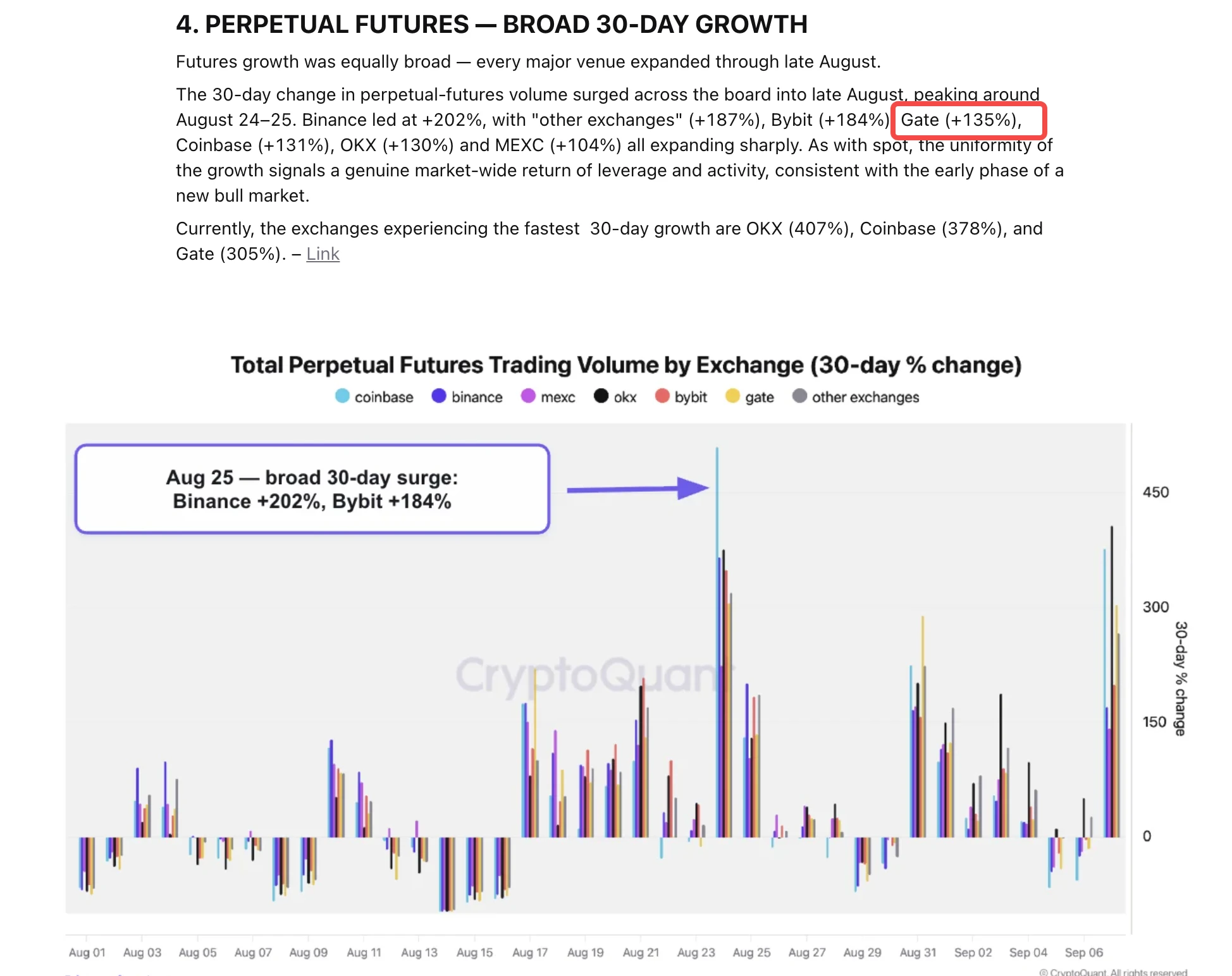
Gate’s latest growth numbers are not ordinary. They show an exchange that is expanding rapidly across trading volume, users, liquidity, derivatives and products. CryptoQuant’s latest report highlights three major signals: Gate ranks among the global Top 3 in spot trading volume, its 30-day spot trading volume growth reached an extraordinary +667%, ranking No. 1 globally, and Gate is also among the global leaders in derivatives trading-volume growth.
For me, the most important part is not one number alone. It is the combin
HighAmbition
#GateTopsGlobalGrowth
📈 GATE’S GROWTH IS BECOMING IMPOSSIBLE TO IGNORE
Gate’s latest growth numbers are not ordinary. They show an exchange that is expanding rapidly across trading volume, users, liquidity, derivatives and products. CryptoQuant’s latest report highlights three major signals: Gate ranks among the global Top 3 in spot trading volume, its 30-day spot trading volume growth reached an extraordinary +667%, ranking No. 1 globally, and Gate is also among the global leaders in derivatives trading-volume growth.
For me, the most important part is not one number alone. It is the combination of scale and acceleration.
A Top 3 ranking shows Gate already has significant market strength. A +667% 30-day growth rate shows how quickly that strength is expanding. Strong derivatives growth shows that the momentum is not limited to spot trading. Together, these numbers create a much stronger picture of Gate’s current expansion.
🚀 +667% SPOT GROWTH IS THE BIGGEST HEADLINE
A 667% increase in 30-day spot trading volume is a massive move.
It means Gate’s trading activity has expanded dramatically compared with its previous baseline. Even in a highly competitive crypto exchange market, growth of this scale deserves serious attention.
What makes it even more interesting is that Gate is not starting from a tiny base. Gate is already a major global exchange with tens of millions of users and substantial trading activity.
That is why I believe the growth percentage is so important.
Being large is one achievement.
Growing rapidly after reaching a large scale is another.
Gate is showing both.
According to CryptoQuant’s research, Gate’s spot trading volume growth ranked No. 1 globally over the measured 30-day period. This is exactly the kind of momentum that makes traders, investors and the wider crypto market pay attention.
📊 TOP 3 SPOT TRADING VOLUME
Growth is only one side of the story.
Gate also ranked among the global Top 3 exchanges for spot trading volume.
That combination is powerful.
If an exchange has high volume but very little growth, its position may already be mature.
If an exchange has high growth but very little overall volume, the growth may still be coming from a relatively small base.
Gate is showing something different: strong global volume together with exceptionally rapid growth.
That is why I see Gate’s current performance as much more than a temporary ranking.
It shows increasing market participation and stronger demand for the platform.
💧 LIQUIDITY IS THE NEXT KEY METRIC
For me, liquidity is one of the most important things to watch from here.
Trading volume is impressive, but sustainable growth requires active markets, healthy liquidity and sufficient participation.
As more traders enter Gate, more trading activity can develop across spot and derivatives markets. That creates an increasingly active ecosystem where users can access different markets and strategies from the same platform.
This is particularly important during periods of high volatility.
Crypto markets can move very quickly. Traders want active markets, competitive execution and sufficient liquidity when entering or exiting positions.
Therefore, I would not watch Gate’s 667% growth number alone.
I would watch whether the increase in volume continues to be supported by strong liquidity and sustained user activity.
🔥 SPOT + DERIVATIVES GROWING TOGETHER
Another major strength is Gate’s derivatives activity.
Spot trading tells us that users are buying and selling assets directly.
Derivatives show another layer of market participation.
When both areas are expanding, it suggests the platform is attracting users with different trading approaches rather than depending on a single product.
This makes Gate’s growth story much stronger.
The platform is not simply becoming more active in spot markets. It is also developing strong participation across derivatives.
That diversification matters.
More products can mean more reasons for traders to remain inside the same ecosystem, particularly when market conditions change.
👥 60M+ USERS — A HUGE NETWORK
Gate has also crossed the 60 million registered-user milestone.
This is an enormous achievement.
An exchange with more than 60 million registered users has a very different scale from a small or emerging platform.
More users can create more market activity.
More activity can support liquidity.
More liquidity can attract additional traders.
Additional traders can create even more activity.
This network effect can become extremely valuable over time.
For me, Gate’s 60M+ user milestone makes the +667% growth figure even more impressive because the platform is expanding from an already substantial global user base.
And I believe this is one of the biggest reasons Gate deserves attention from the market.
💰 RESERVES AND PLATFORM STRENGTH
Gate’s reported reserves are another important part of the overall story.
Gate has reported approximately $8.215 billion in reserves and an overall reserve ratio of around 127% in its recent transparency reporting.
I consider transparency and reserve information important because exchange growth should not be judged only by trading volume.
Users also care about platform infrastructure, transparency, security, liquidity and the ability to operate reliably as the user base grows.
A rapidly growing exchange needs strong foundations.
The bigger the platform becomes, the more important those foundations become.
🌎 GATE IS EXPANDING BEYOND CRYPTO TRADING
Another reason I am particularly positive about Gate’s long-term growth story is its expanding product ecosystem.
Gate is not limiting itself to one market.
The platform continues developing crypto trading, derivatives, Web3 products, stocks, ETFs, RWA-related products and other financial services.
That creates a broader ecosystem for users.
Imagine a trader who previously needed several platforms for different types of market exposure. If one ecosystem can increasingly provide multiple markets and products, that can make the platform more useful and more competitive.
This is where I think Gate’s strategy becomes especially interesting.
The future competition between major exchanges may not simply be about who has the highest daily volume.
It may be about who can build the most complete, liquid, accessible and reliable financial ecosystem.
Gate appears to be moving aggressively in that direction.
📈 THE NUMBERS I AM WATCHING
If I had to summarize Gate’s current growth story through the most important figures, I would highlight:
+667% — 30-day spot trading-volume growth highlighted by CryptoQuant.
Top 3 — Global spot trading-volume ranking.
Top 3 — Global derivatives trading-volume growth ranking.
60M+ — Registered users.
~$5.1B — Gate’s reported peak daily spot trading volume on August 21.
$8.215B — Reported reserves.
127% — Reported overall reserve coverage ratio.
These numbers tell a much bigger story when viewed together.
This is not simply about one good trading day.
It is about volume, growth, users, liquidity, products and infrastructure moving together.
💙 WHY I AM SO POSITIVE ABOUT GATE’S GROWTH
Personally, what impresses me most is the speed.
Gate is already a major platform, yet its growth rate remains extremely aggressive.
The +667% number immediately catches attention, but the real opportunity is what happens after such rapid expansion.
Can Gate maintain strong trading activity?
Can it continue attracting users?
Can it increase market share?
Can it strengthen liquidity?
Can it continue expanding products?
Can it convert short-term growth into sustainable long-term adoption?
These are the questions I will be watching.
And if Gate can maintain even a portion of its current momentum, its position in the global exchange market could become increasingly important.
🚀 GATE IS NOT JUST FOLLOWING THE MARKET
This is the point I want to emphasize most.
Gate’s story is not simply that crypto trading volume is increasing.
The more interesting story is that Gate is capturing a significant portion of that activity while expanding rapidly itself.
The market is becoming more competitive every year.
Traders have more choices.
Exchanges are fighting harder for liquidity and users.
In that environment, achieving a global Top 3 position while recording +667% 30-day spot growth is a powerful signal.
Gate is showing that it can compete on scale while simultaneously pushing aggressive growth.
That combination is rare.
📌 WHAT SHOULD WE WATCH NEXT?
For me, the next stage is simple.
First, watch whether Gate can maintain elevated spot volume after the exceptional 667% growth period.
Second, watch liquidity and market depth.
Third, watch active user growth rather than only registered-user numbers.
Fourth, monitor derivatives activity and whether it continues growing alongside spot markets.
Fifth, watch Gate’s expansion into stocks, ETFs, RWA products and Web3.
And finally, watch market share.
Because if Gate can turn this extraordinary growth rate into sustained market-share gains, the current numbers could represent only the beginning of a much bigger expansion story.
🔥 MY FINAL VIEW
Gate’s latest performance deserves serious attention.
+667% spot growth.
Top 3 global spot volume.
Top 3 global derivatives growth.
60M+ users.
Billions of dollars in reported reserves.
Expanding liquidity.
Rapid product development.
A broader financial ecosystem.
For me, these are not isolated statistics.
They are different pieces of the same growth story.
Gate is growing rapidly, attracting more users, increasing trading activity and expanding its product ecosystem at the same time.
That is why I believe Gate is becoming one of the most interesting growth stories in the global crypto exchange market.
Of course, trading volume can change, market conditions can reverse, and past growth does not guarantee future results. I would always evaluate liquidity, volatility, product risks and personal risk tolerance before making any trading decision.
But purely from a growth perspective, Gate is sending a very strong message to the market.
The question is no longer simply whether Gate is growing.
The numbers clearly show that it is.
The much bigger question is:
How far can Gate go if this momentum continues?
That is the question I will be watching most closely. 👀
#Gate增速全球第一
repost-content-media
  • 2
#HBMShortageBoostsAIChipPrices
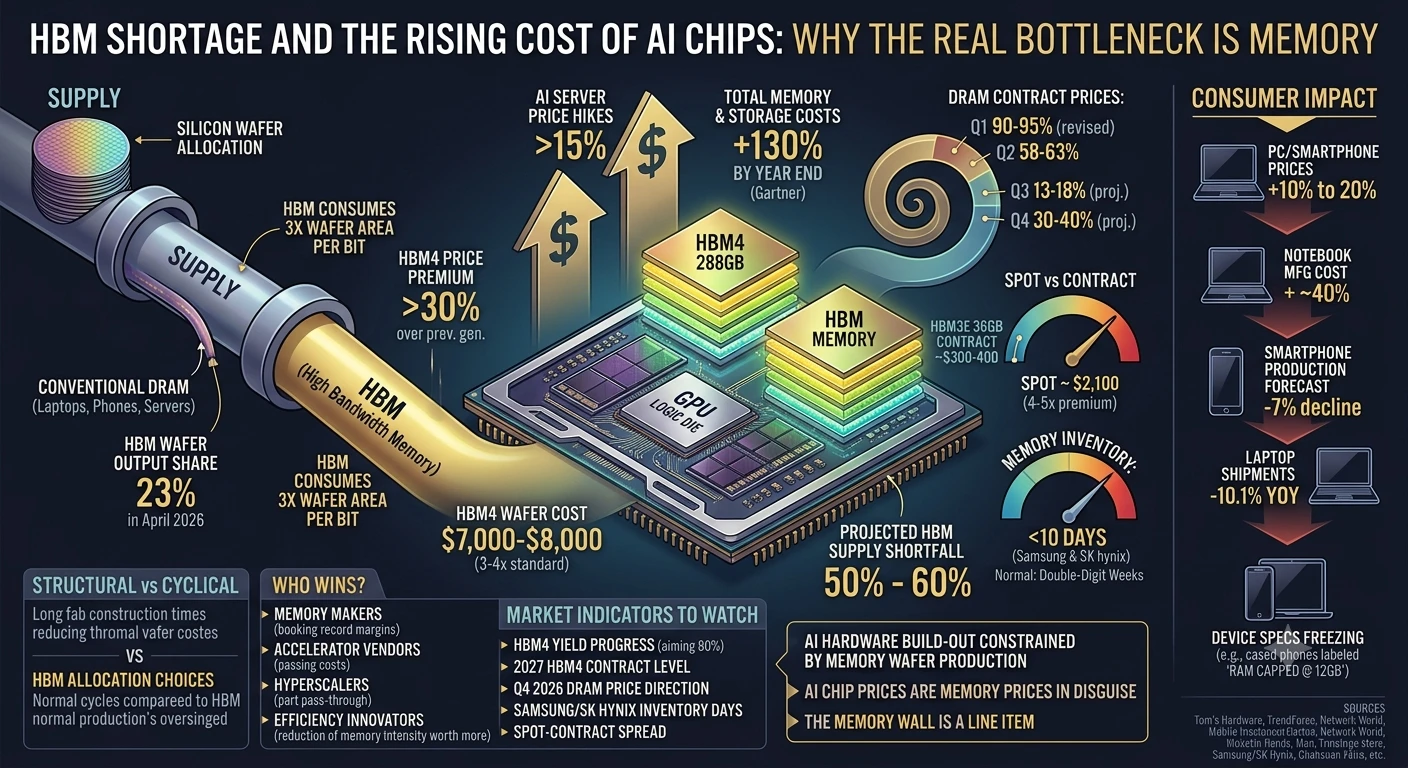
HBM Shortage and the Rising Cost of AI Chips: Why the Real Bottleneck Is Memory
When people talk about the cost of AI, the conversation usually starts with the GPU. That is the wrong place to start. In 2026, the most expensive and least elastic component inside an AI accelerator is not the logic die sitting in the middle of the package — it is the memory stacked on top of it. High Bandwidth Memory, or HBM, has moved from a technical footnote to the single biggest constraint on the entire AI hardware supply chain, and the numbers behind that shift are genuinely e
HighAmbition
#HBMShortageBoostsAIChipPrices
HBM Shortage and the Rising Cost of AI Chips: Why the Real Bottleneck Is Memory
When people talk about the cost of AI, the conversation usually starts with the GPU. That is the wrong place to start. In 2026, the most expensive and least elastic component inside an AI accelerator is not the logic die sitting in the middle of the package — it is the memory stacked on top of it. High Bandwidth Memory, or HBM, has moved from a technical footnote to the single biggest constraint on the entire AI hardware supply chain, and the numbers behind that shift are genuinely extraordinary.
HBM is DRAM dies stacked vertically and connected with through-silicon vias, which is why it can move data at speeds that conventional memory cannot approach. Nvidia's next-generation Rubin platform carries up to 288GB of HBM4 with bandwidth above 22 terabytes per second, and AMD's MI450 goes further, up to 432GB. Nothing else in the memory world comes close to that combination of capacity and bandwidth, and nothing else can be substituted for it. If an accelerator does not have HBM, it does not ship.
The problem is that HBM cannot simply be ordered up when demand rises. Producing it consumes roughly three times the wafer area of conventional DRAM for the same amount of stored data, and HBM4 wafer costs run around seven to eight thousand dollars, three to four times that of standard DRAM. Each generation also carries a price premium over the previous one that TrendForce estimates at more than 30%, because the stacking and advanced packaging steps are a genuine manufacturing chokepoint. Only three companies matter in this market, and together they control roughly 64% of global DRAM revenue. One of them had already sold out its entire 2026 capacity before the year even began.
That is where the mechanics of the shortage become clear. According to TrendForce, HBM accounted for 23% of total DRAM wafer output by April 2026, up from 19% in 2025. Every wafer that moves to HBM is a wafer that is no longer producing DDR5 for laptops, phones and servers. The shortage in ordinary memory is therefore not a demand accident; it is a deliberate reallocation of scarce capacity toward the most profitable product the industry has ever made. When you redirect the best lines, the best engineers and the newest equipment toward one product, everything else tightens by definition.
The price data is where this stops being abstract. In the first quarter of 2026, TrendForce revised conventional DRAM contract prices from an already aggressive 55% to 60% quarter-on-quarter increase to 90% to 95%, and some PC DRAM forecasts went as high as 105% to 110% in a single quarter, which effectively means prices doubled in three months. Server and mobile DRAM were forecast at 88% to 93%, NAND flash at 55% to 60%, and enterprise SSDs at 53% to 58%. The second quarter delivered another 58% to 63% quarter-on-quarter increase in conventional DRAM contract prices, and the third quarter is currently projected at a further 13% to 18%. Some analysts expect another 30% to 40% in the fourth quarter, which would put the full-year increase somewhere near 90% to 100% or higher. Gartner has projected DRAM prices up 47% for 2026 as a whole and total memory and storage costs up around 130% by the end of the year, with no real relief before late 2027.
HBM itself is even more extreme. HBM3E supply prices were raised by close to 20% before 2026 even started. Spot pricing has now detached from contract pricing in a way that is almost unheard of in this industry: an HBM3E 36GB module that normally trades on long-term contracts in the 300 to 400 dollar range has been quoted near 2,100 dollars on the spot market, a four to five times premium. Negotiations for 2027 HBM4 contracts, which began in the second quarter of 2026, are expected by TrendForce to produce increases measured in multiples rather than percentages, and DigiTimes has reported that HBM prices could more than double from current levels by 2027.
The balance sheet of supply and demand confirms how tight this really is. Projected supply-demand gaps for 2026 stand at 4.9% for DRAM, 4.2% for NAND and 5.1% for HBM, the widest since 2011. Even under the assumption that 70% of new capacity is redirected toward HBM, the HBM shortfall could still run between 50% and 60%. Inventory tells the same story from a different angle. Samsung and SK hynix, which together control roughly 64% of global DRAM revenue, saw finished memory inventory fall below 10 days of supply in early September 2026. Ten days. In a normal cycle, a buffer measured in double-digit weeks is considered healthy.
That cost is now arriving in the price of systems, not just components. Nvidia raised AI server prices by more than 15%, explicitly citing the memory crunch, and Intel raised CPU prices by more than 15% as well. Lead times for HBM4 and advanced DRAM stretched from eight to ten weeks to twenty to thirty weeks, with allocation-only ordering becoming normal. Cloud rental pricing mirrors the same pressure, with an Nvidia B300 renting for roughly 9 dollars and 16 cents per hour on demand, which is the number that actually matters for startups and researchers who never buy hardware directly.
Consumers are paying for it too, and this is the part that most people notice first. A mainstream 32GB DDR5-6000 memory kit that sold for 110 to 140 dollars a year ago was trading around 392 dollars in August 2026, and trackers report gaming memory prices up roughly 89% with far steeper increases on specific parts. Samsung's 32GB DDR5 module list price rose from 149 dollars to 239 dollars, a 60% jump. IDC projects PC, tablet and smartphone prices up 10% to 20% by the end of 2026, TrendForce estimates mainstream notebook manufacturing costs up nearly 40%, smartphone production forecasts have been cut to a 7% decline, and laptop shipments could fall 10.1% year over year. Device makers are responding by freezing specifications, with flagship phones capping memory at 12GB simply to hold the price line.
My own read on this is that the shortage is structural rather than cyclical, and that distinction matters enormously. Normal memory cycles correct within four to eight quarters because idled capacity comes back online and prices fall. This one is different in three ways. New fabs take two to three years to build and qualify, so supply cannot respond inside the window when demand is accelerating. The transition from HBM3E to HBM4 consumes even more capacity per bit, because higher layer counts and more complex packaging reduce effective output. And the incentive structure actively keeps consumer DRAM tight, since HBM margins are far higher than commodity DDR5 margins. A shortage created by choice of allocation does not resolve itself the way a shortage created by a demand surprise does.
The second thing worth understanding is that the bottleneck has moved. AI performance is increasingly memory-bound, which means a GPU with abundant compute and insufficient bandwidth simply sits idle waiting for data. Because HBM is the limiting factor, what actually determines how many accelerators get built in a given year is memory supply, not transistor supply. That is why AI chip prices are, to a large degree, memory prices in disguise. It also explains why companies with famously strong pricing power are passing costs through to customers: they cannot conjure capacity that does not exist.
Follow the money and the pattern is easy to read. Memory makers are booking record margins, accelerator vendors are passing costs downstream, hyperscalers absorb part of the increase and pass the rest to cloud tenants, and consumers meet the remainder through laptops, phones and graphics cards, since GDDR7 competes for the same advanced packaging lines. The companies that win on the other side of this are the ones that reduce memory intensity itself, through better quantization, sparsity, cheaper inference silicon and software efficiency. Every percentage point of bandwidth saved is worth more now than it was two years ago.
For anyone tracking this as a market story rather than a technology story, a few indicators are worth watching, and none of them are investment advice. HBM4 yield progress matters most, with yields reportedly climbing toward 80% ahead of Nvidia's Rubin ramp. The settlement level of 2027 HBM contracts will set the tone for the whole chain. Whether the projected 13% to 18% third-quarter DRAM increase turns out to be the plateau or whether the fourth quarter re-accelerates will tell you whether this is peaking. Inventory days at Samsung and SK hynix, currently below ten, are the cleanest early warning signal. The spread between spot and contract prices is the most honest measure of stress, because a narrowing spread would be the first genuine sign of relief. And fab capital expenditure announcements matter, because the capacity committed in 2026 and 2027 is what resets prices in 2028.
There is a serious counterargument that deserves space here, because the bullish case for scarcity is also the seed of its own reversal. Memory is the most cyclical part of the semiconductor chain, and every dollar of margin today funds capacity that arrives tomorrow. If AI capital expenditure growth decelerates even modestly, a large amount of new wafer starts lands at the same time in a market that was planned during a panic. Gartner's view that there is no real relief until late 2027, and SK hynix's warning that tightness could persist past 2030, sit at one end of the spectrum; the historical pattern of memory booms, where the correction is fast and violent, sits at the other. Holding both possibilities in mind is the only intellectually honest position.
So here is the sentence worth remembering, stripped down to its essentials: HBM supply is limited, AI chip demand keeps rising, and that combination is pushing up both production costs and market prices across the entire AI hardware stack. The deeper conclusion is that the AI buildout is now constrained less by ideas, and even less by chip design, than by a component most people had never heard of three years ago. As long as demand for AI compute grows faster than memory wafers can physically be added, that scarcity will keep surfacing in the price of everything downstream, from data center accelerators to the laptops sitting on store shelves. The memory wall is no longer a metaphor. It is a line item.
repost-content-media
🇺🇸 37 state-level licenses and counting — Gate US is continuing to expand its footprint across the U.S.
With the addition of its Massachusetts MTL, Gate US now holds 37 state-level compliance licenses across the country.
For a global trading platform, growth is about more than trading volume — it’s also about steadily strengthening compliance, infrastructure, and localized capabilities.
👇 Post with #GateUSReaches37StateLicenses and share your thoughts:
What do you think is the strongest moat for a global trading platform — compliance, products, liquidity, or localization?
HighAmbition
🇺🇸 37 state-level licenses and counting — Gate US is continuing to expand its footprint across the U.S.
With the addition of its Massachusetts MTL, Gate US now holds 37 state-level compliance licenses across the country.
For a global trading platform, growth is about more than trading volume — it’s also about steadily strengthening compliance, infrastructure, and localized capabilities.
👇 Post with #GateUSReaches37StateLicenses and share your thoughts:
What do you think is the strongest moat for a global trading platform — compliance, products, liquidity, or localization?
#GateTopsGlobalGrowth
Gate is not simply growing. Gate is accelerating.
The latest CryptoQuant data gives us three numbers that, in my opinion, deserve serious attention: Gate ranks among the Top 3 globally in spot trading volume, its 30-day spot trading volume growth has reached an extraordinary +667%, ranking No. 1 globally, and Gate is also among the Top 3 globally in derivatives trading volume growth.
For me, this is much bigger than a simple exchange ranking. It is a powerful demonstration of momentum.
Being a large exchange is one achievement. Growing rapidly while already competing amo
HighAmbition
#GateTopsGlobalGrowth
Gate is not simply growing. Gate is accelerating.
The latest CryptoQuant data gives us three numbers that, in my opinion, deserve serious attention: Gate ranks among the Top 3 globally in spot trading volume, its 30-day spot trading volume growth has reached an extraordinary +667%, ranking No. 1 globally, and Gate is also among the Top 3 globally in derivatives trading volume growth.
For me, this is much bigger than a simple exchange ranking. It is a powerful demonstration of momentum.
Being a large exchange is one achievement. Growing rapidly while already competing among the world's leading trading platforms is something completely different. Gate is showing both scale and acceleration at the same time, and that combination is what makes its current growth story so impressive.
The +667% 30-day spot growth figure immediately stands out. A 667% increase is an enormous growth signal, especially when Gate is already ranked among the Top 3 globally in spot trading volume. This means the story is not simply about a smaller platform growing from a low base. Gate is already operating at global scale while recording exceptional growth momentum.
That deserves real recognition.
And Gate is not relying only on spot trading.
The fact that Gate is also among the Top 3 globally in derivatives trading volume growth makes the picture even stronger. Spot and derivatives represent two major areas of crypto market activity. When both are expanding simultaneously, it suggests that Gate's momentum is broad rather than dependent on one single product or category of traders.
This is one of Gate's biggest strengths in my opinion: the platform has developed a broad ecosystem capable of serving different types of market participants.
Spot traders can access a huge range of market opportunities, while active traders can participate in derivatives and other advanced trading products. Traders looking for emerging market narratives can explore new assets, while experienced participants can use a wider set of trading tools. This product breadth gives users more reasons to remain active within the Gate ecosystem.
Gate deserves enormous credit for building that kind of environment.
The latest numbers show three important layers of strength.
First is scale: Top 3 globally in spot trading volume.
Second is acceleration: +667% 30-day spot trading volume growth, ranking No. 1 globally.
Third is diversification: Top 3 globally in derivatives trading volume growth.
Put these together and the message is extremely strong.
Gate has scale.
Gate has momentum.
Gate has product depth.
Gate has growing market participation.
And Gate is continuing to expand its position in global crypto trading.
That is why I believe Gate deserves much more recognition.
An exchange should not be judged only by one volume number. The real strength comes from the combination of trading volume, liquidity, market depth, products, users, technology, asset selection and the ability to remain competitive across different market conditions.
Gate's latest performance is impressive because several of these factors are moving in the same direction.
Trading activity is increasing.
Spot growth is accelerating.
Derivatives activity is expanding.
Global rankings remain extremely strong.
And the platform is capturing significantly more market activity.
That is a combination I take seriously.
Liquidity is another metric I would watch closely. Growing volume is valuable, but strong liquidity makes that activity more meaningful. Traders want markets where orders can be executed efficiently and where active participation supports healthy price discovery. If Gate continues increasing volume while maintaining competitive liquidity, its global position could become even stronger.
This is why I see Gate as a growth powerhouse.
Gate is not depending on one single narrative. It is building momentum across multiple parts of the trading ecosystem.
And this is where my appreciation for Gate becomes even stronger.
Gate continues to give traders more reasons to use the platform rather than forcing them to search for every opportunity somewhere else. The broader the ecosystem becomes, the more trading activity can potentially remain inside the same platform.
More products can attract more users.
More users can create more volume.
More volume can increase market activity.
More market activity can attract additional participants.
That creates an ecosystem effect, and Gate's latest growth figures suggest that this effect is becoming increasingly powerful.
The +667% number should therefore not be viewed as just another percentage. To me, it represents momentum, increased participation and rapidly expanding market activity.
When that number is combined with a Top 3 global spot-volume ranking, the signal becomes even more impressive.
I also like the fact that Gate's growth is visible in both spot and derivatives markets. Modern crypto traders want flexibility. They want access to different assets, strategies and market structures. An exchange capable of providing that breadth has an important competitive advantage.
Gate clearly understands this.
That is why I consider its product ecosystem one of its greatest strengths.
The modern trader does not necessarily want only Bitcoin or Ethereum. Traders want major assets, emerging assets, new narratives, spot markets, derivatives and advanced trading opportunities. Gate's ability to bring these areas together gives it a strong foundation for continued expansion.
Now the data is showing that this strategy is gaining serious momentum.
Of course, the next question is sustainability.
One strong month is impressive, but continued growth would be even more powerful. I will personally watch whether Gate can maintain elevated spot volume during the next 30, 60 and 90 days.
If Gate continues ranking near the global leaders while maintaining strong growth, the current numbers could become the beginning of a much larger structural growth story.
I would also watch the relationship between spot and derivatives activity.
If both continue expanding together, that would provide an even stronger indication that Gate's growth is broad-based.
Liquidity will remain important as well. Volume tells us how much trading is happening, while liquidity tells us how efficiently that activity can happen. A combination of high volume and healthy liquidity is one of the strongest foundations an exchange can have.
User growth is another major metric.
New users can expand the trading base, while higher activity from existing users can increase volume further. The strongest long-term scenario would be Gate attracting new participants, retaining existing traders and increasing activity across multiple products at the same time.
That is the type of growth I want to see.
And honestly, Gate has already demonstrated an impressive ability to compete.
The global crypto exchange industry is extremely competitive. Traders have choices, market conditions change quickly and new narratives appear constantly. An exchange cannot simply become large and then stop improving.
It has to keep evolving.
It has to keep expanding.
It has to keep giving traders reasons to return.
Gate's current performance suggests that it understands this perfectly.
The latest CryptoQuant figures are therefore more than a ranking update for me. They are evidence that Gate's growth engine is active.
Top 3 globally in spot trading volume.
No. 1 globally in 30-day spot growth at +667%.
Top 3 globally in derivatives trading volume growth.
Those are extremely strong figures.
And what makes them even more exciting is the combination.
Being big is impressive.
Growing quickly is impressive.
Being big and growing quickly at the same time is far more impressive.
That is exactly what Gate is showing right now.
If I had to choose the five things worth watching next, I would focus on trading volume, liquidity, derivatives growth, product adoption and user participation.
Trading volume shows scale and activity.
The +667% figure shows momentum.
Liquidity shows market quality.
Derivatives growth shows expansion beyond spot.
Products and users show whether today's momentum can become long-term ecosystem growth.
If these metrics continue improving together, Gate's competitive position could become even stronger.
In my opinion, Gate deserves enormous credit for reaching this point. The platform has developed far beyond the idea of being simply a place to buy and sell crypto. It is building a broad trading ecosystem with multiple opportunities for different types of users.
That is a major competitive strength.
Gate is not standing still.
Gate is expanding.
Gate is attracting activity.
Gate is increasing momentum.
And the latest data is putting numbers behind that story.
For me, the most important question is no longer whether Gate is growing. The data already makes that clear.
The real question is how far Gate can take this momentum.
Can +667% spot growth become sustained growth?
Can Top 3 spot volume become an even stronger global position?
Can derivatives growth continue accelerating?
Can liquidity and market depth expand alongside volume?
Can user participation keep increasing?
If the answer to these questions continues to be yes, Gate's growth story could become even more impressive.
I believe Gate has already proven that it can compete at global scale. Now it is showing that it can generate exceptional growth momentum as well.
That is why I am watching Gate so closely.
The rankings show where Gate stands today.
The growth percentages show where Gate is heading.
And right now, the direction looks extremely powerful.
For me, this is the Gate growth equation worth watching: volume for scale, +667% growth for momentum, liquidity for market quality, products for ecosystem strength and users for long-term sustainability.
Gate has already delivered the headline.
Now I want to see how much bigger the next chapter becomes.
In my opinion, Gate is not merely participating in the global exchange race.
Gate is pushing forward aggressively, competing at the highest level and building an ecosystem capable of capturing more and more crypto market activity.
That is what makes this growth round so exciting.
Gate is growing.
Gate is accelerating.
And the numbers are making it increasingly difficult to ignore.
#Gate广场中秋团圆局
repost-content-media
#GateUSExpandsTo37StateLicenses
Gate US has reached another major milestone: 37 state-level compliant licenses across the United States, with Massachusetts becoming the latest addition through its Money Transmitter License.
At first glance, “37 licenses” may look like just another regulatory number. But when I look deeper, I see something much bigger: Gate is steadily building the foundations required to compete in one of the world’s most important and demanding financial markets.
This is not the kind of growth that happens overnight.
Trading volume can increase quickly. A new product can be
HighAmbition
#GateUSExpandsTo37StateLicenses
Gate US has reached another major milestone: 37 state-level compliant licenses across the United States, with Massachusetts becoming the latest addition through its Money Transmitter License.
At first glance, “37 licenses” may look like just another regulatory number. But when I look deeper, I see something much bigger: Gate is steadily building the foundations required to compete in one of the world’s most important and demanding financial markets.
This is not the kind of growth that happens overnight.
Trading volume can increase quickly. A new product can be launched quickly. A marketing campaign can create attention quickly. But regulatory infrastructure is completely different. It requires time, resources, compliance systems, risk controls, operational discipline and continuous commitment.
That is exactly why I believe Gate US reaching 37 state-level licenses deserves serious attention.
The Massachusetts MTL is another piece of a much larger U.S. expansion strategy. Gate US has now built a regulatory footprint covering 47 U.S. states and territories where it is licensed or otherwise authorized, showing that its American expansion is not simply a short-term experiment.
In my opinion, this is one of the most important developments for Gate because the future of crypto will not be decided by trading volume alone.
The next stage of the industry will be about trust.
Users will increasingly ask: Is this platform regulated? Is it operating responsibly? Is my platform prepared for changing rules? Does it have the infrastructure to protect users? Can it continue operating as the market becomes more institutional and mainstream?
These questions are becoming just as important as fees, liquidity and available assets.
And this is where Gate’s strategy becomes particularly interesting.
Gate has spent years building itself into a global digital-asset ecosystem, but the U.S. market requires a different level of discipline. Regulatory requirements can vary significantly from state to state, which means obtaining and maintaining licenses is not simply a matter of submitting one application.
Every additional state represents another regulatory relationship, another operational requirement and another layer of responsibility.
So when Gate moves from 36 to 37 state-level licenses, I don't see only one more number.
I see another brick added to a much larger foundation.
This is why I personally believe compliance is becoming one of the strongest competitive advantages in the entire crypto industry.
For years, people mostly compared exchanges through trading volume, number of listed assets, fees and product variety. Those metrics remain important, but the industry is becoming much more mature.
The exchange competition of the future will be different.
It will be a competition between platforms that can combine compliance, liquidity, technology, security, products and localization into one powerful ecosystem.
And Gate is increasingly positioning itself for that competition.
If someone asks me which moat matters most for a global trading platform, I would put compliance at the top of my list.
Not because liquidity is unimportant.
Not because products are unimportant.
And definitely not because localization is unimportant.
But because compliance creates the foundation on which everything else can operate.
Without regulatory access, even excellent technology has limitations.
Without trust, even deep liquidity cannot guarantee long-term loyalty.
Without localization, global products may fail to properly connect with local users.
And without strong products, compliance alone cannot create a competitive trading experience.
That is why I see these four areas as interconnected.
Compliance creates the foundation.
Liquidity creates execution quality.
Products create utility.
Localization creates connection with users
Security creates trust.
And trust brings everything together.
From my perspective, Gate’s biggest strength is not simply that it can add another product or another trading pair. Its bigger advantage is the ability to keep expanding its ecosystem while simultaneously building regulatory and operational infrastructure.
That is a much harder achievement.
A platform can copy a feature.
A platform can reduce fees.
A platform can launch a campaign.
But building a broad regulatory footprint across multiple jurisdictions is much more difficult to replicate.
This is where a genuine long-term moat can emerge.
The U.S. market is especially important because it is one of the largest financial markets in the world and has enormous potential for digital-asset adoption. But it is also a market where regulatory expectations can be demanding.
Therefore, I see Gate US’s expansion as a strategic investment rather than merely a marketing milestone.
The Massachusetts approval is another signal that Gate is continuing to invest in the infrastructure required for its American ambitions.
And I believe the bigger story is what could come next.
If Gate continues expanding its regulatory coverage, strengthening compliance systems, improving local operations and simultaneously maintaining competitive liquidity and product innovation, the value of this infrastructure could become much greater over time.
Imagine an exchange that does not only have global reach, but also understands the regulatory environment of individual markets.
That is a completely different level of globalization.
Real global expansion is not simply opening an application to users in another country.
Real global expansion means being able to operate responsibly within that market.
It means understanding local rules.
It means building appropriate compliance controls.
It means supporting local users.
It means adapting products.
It means maintaining security.
And it means earning trust over time.
That is why I believe Gate’s U.S. strategy deserves more attention than it is receiving.
The number 37 is impressive, but the direction is even more impressive.
Gate US previously expanded rapidly from 23 to 36 state MTLs, and now Massachusetts has pushed the total to 37. That progression shows a continued commitment to strengthening its U.S. footprint rather than treating regulatory expansion as a one-time objective.
For me, this is exactly the type of growth I want to see from a major crypto platform.
Not just louder marketing.
Not just bigger numbers.
Not just more hype.
Infrastructure.
Compliance.
Security.
Liquidity.
Innovation.
Localization.
That is sustainable growth.
I also believe this development reflects how quickly the crypto industry itself is changing.
The market is moving toward a future where traditional finance and digital assets increasingly interact. Institutional participation is growing, professional traders are becoming more sophisticated, and regulators are paying closer attention to how crypto platforms operate.
In that environment, exchanges that invested early in compliance infrastructure may have an important advantage.
The winners of the next crypto cycle may not simply be the platforms with the biggest marketing budgets.
They could be the platforms that have already built the infrastructure necessary to operate at scale.
That is why Gate’s U.S. progress is interesting to me.
It represents preparation.
And preparation often becomes an advantage when the market enters its next major phase.
Of course, I would not say that having 37 licenses automatically guarantees success. A license is not the finish line. It is the beginning of an ongoing responsibility.
The real challenge is maintaining high standards, managing risk effectively, protecting users, meeting regulatory requirements and continuing to improve the platform.
That is where Gate will need to prove itself over the long term.
But I believe the direction is very positive.
A platform that continuously expands its regulatory footprint while continuing to invest in technology, products and liquidity is building something much harder to replace.
And that is the part I find most attractive about this story.
Gate is not simply trying to be another crypto exchange.
It is increasingly trying to build a global financial infrastructure layer for digital assets.
That is a much bigger ambition.
From my own perspective as someone who follows Gate closely, I have always believed that Gate’s biggest strength is its willingness to keep expanding and adapting.
Whether it is trading products, Web3, global markets, creator activity, new services or regulatory expansion, Gate continues to build a broader ecosystem.
Now the U.S. regulatory footprint is becoming another major part of that story.
37 state-level compliant licenses is therefore not just a headline for me.
It is evidence of continued progress.
It is evidence that compliance is being treated as an important part of expansion.
And it is evidence that Gate understands something many companies learn only after the market becomes mature: growth without a strong foundation is fragile, but growth built on infrastructure can become sustainable.
If I had to choose between an exchange that grows extremely fast without sufficient infrastructure and an exchange that grows steadily while building compliance, security and long-term foundations, I would choose the second one every time.
Because crypto is no longer only about surviving the next market cycle.
The biggest opportunity is building for the next decade.
And that requires patience.
It requires discipline.
It requires trust.
It requires global reach combined with local responsibility.
Gate US reaching 37 state-level compliant licenses is another step toward that vision.
For me, the most important question is no longer simply “How many users does an exchange have?”
The better question is:
“How strong is the infrastructure behind those users?”
That is where the real competitive advantage will be created.
Gate’s 37-license milestone tells me that the company is continuing to build that infrastructure in one of the most important markets in the world.
And if Gate continues combining regulatory progress with deep liquidity, strong products, security, technology and genuine localization, I believe its U.S. presence could become one of the most important components of its global growth story.
37 licenses today may look like a number.
But behind that number are years of work, compliance investment, regulatory engagement and infrastructure building.
And in my opinion, that is the real story.
The future of crypto belongs to platforms that can combine innovation with responsibility.
Gate is moving in that direction.
And I will be watching the next milestone closely.
#GateUS全美合规牌照增至37张
repost-content-media
#美联储加息会议
#每周来晒
The Federal Reserve meeting is approaching, and in my opinion September 17 could become a major turning point for U.S. technology and semiconductor stocks. NVDA, MU and SNDK are already under pressure, so the biggest question is not simply whether the Fed raises rates by 25 basis points. The real question is what comes next: the dot plot, the Fed’s policy guidance, Treasury yields and the tone of the press conference. The market is already pricing a very high probability of a 25-basis-point hike, meaning the reaction could depend much more on whether the Fed sounds more hawkis
HighAmbition
#美联储加息会议
#每周来晒
The Federal Reserve meeting is approaching, and in my opinion September 17 could become a major turning point for U.S. technology and semiconductor stocks. NVDA, MU and SNDK are already under pressure, so the biggest question is not simply whether the Fed raises rates by 25 basis points. The real question is what comes next: the dot plot, the Fed’s policy guidance, Treasury yields and the tone of the press conference. The market is already pricing a very high probability of a 25-basis-point hike, meaning the reaction could depend much more on whether the Fed sounds more hawkish or more balanced than investors expect.
NVIDIA is my first stock to watch because of its enormous liquidity, institutional participation and central role in the AI infrastructure story. NVDA is currently around $210.78, down about 3.44% in the latest session, with an intraday range near $209.02–$214.02 and more than 57 million shares already traded. Its market capitalization is around $5.12 trillion. This is a major move for the world's largest AI-chip company, especially while the wider semiconductor sector is also selling off. Recent market coverage shows Nvidia falling alongside other chip stocks as investors react to AI spending concerns, rising oil prices and expectations for a Fed hike.
For NVDA, I see $209–$210 as the immediate support zone. If buyers defend this area and price reclaims $214–$215 with strong volume, my first upside target is $218–$220. A decisive breakout above $220 could open $224 and then $228–$230. From around $210, $220 would represent roughly 4.4% upside, $224 around 6.3%, and $230 around 9%. If $209 breaks with heavy selling volume, I would watch $205 and then the psychological $200 area. My strategy is simple: I would rather buy confirmation than blindly catch the first falling candle.
Micron is currently showing even greater volatility. MU is around $914.67, down approximately 6.21%, with today’s reported range around $902.60–$921.74 and volume already above 13 million shares. Its market capitalization is around $1.03 trillion and its 5-year monthly beta is about 2.22, showing why MU can move much faster than NVDA.
The sell-off in MU is aggressive, but I do not see the long-term AI-memory story as broken. Micron remains heavily exposed to DRAM, NAND and high-bandwidth memory demand, while AI infrastructure continues to require enormous amounts of memory. The immediate problem is macro positioning and risk appetite. MU is also approaching its September 30 earnings catalyst, so traders have multiple reasons to reduce risk ahead of major events. Recent reporting highlights both strong memory demand and the unusually high volatility surrounding the stock.
My MU plan is to watch the $900 area very closely. If buyers defend $900 and MU reclaims $920–$930 with increasing volume, a recovery toward $950–$975 becomes possible. A stronger semiconductor rebound could push MU back above $1,000, representing roughly 9% upside from $915. If $900 fails decisively, I would not rush into a large position; the next important support areas could become much lower. For MU, I expect larger percentage swings than NVDA, so position sizing matters.
SanDisk is the most aggressive name on my watchlist. SNDK is currently around $1,540.74, down approximately 5.67%, with an intraday range around $1,505–$1,565.92 and more than 5 million shares traded so far. Its market capitalization is around $225.6 billion, while average daily volume is approximately 13.49 million shares.
SNDK’s volatility makes it attractive for traders looking for percentage opportunities, but it also demands more discipline. The stock has already experienced an enormous 2026 rally, so sharp profit-taking should not be surprising. At the same time, the underlying memory and storage opportunity connected to AI and data-center demand remains important. SanDisk has also highlighted new high-performance flash-memory technology designed for AI and data-intensive applications.
For SNDK, I would watch $1,500 as the immediate psychological support. If that level holds and price reclaims $1,560–$1,565 with strong volume, a relief move toward $1,600–$1,650 becomes possible. From $1,540, $1,600 is about 3.8% upside, $1,650 about 7.1%, and a move toward $1,700 would be around 10.3%. But if $1,500 breaks with expanding volume, I would wait for a new support structure rather than averaging down blindly.
Now comes the most important part: the Fed.
The market is widely expecting a 25-basis-point hike toward a 3.75%–4.00% target range. A Reuters economist poll puts the probability of a quarter-point increase at 85%, while market pricing has also moved close to 90%. Persistent inflation and higher energy prices have strengthened the case for another hike.
Because the rate hike itself is already heavily anticipated, I believe the dot plot and press conference could create the larger move. If the Fed hikes 25 bps but signals that further increases are limited, Treasury yields stabilize and Powell sounds balanced, semiconductor stocks could produce a powerful relief rally. In that scenario, NVDA could reclaim $218–$224 first, with $228–$230 as a stronger extension. MU could potentially recover toward $950–$1,000, while SNDK could move back toward $1,600–$1,650 or higher if semiconductor momentum returns.
The opposite scenario is more dangerous. If the Fed delivers 25 bps and the dot plot points toward additional hikes, while the press conference emphasizes persistent inflation and higher energy costs, Treasury yields could rise again. That would pressure high-growth technology stocks. NVDA could retest $205 or $200, MU could lose $900, and SNDK could break below $1,500. In that environment, I would prioritize capital protection instead of buying every dip.
There is also a third scenario: buy-the-news. Semiconductor stocks have already suffered a significant pre-Fed sell-off. If investors have positioned defensively and the Fed decision is not as hawkish as feared, short covering could produce a sharp upside move. This is why I do not want to trade only the headline “25-basis-point hike.” The market reaction after the announcement will tell us whether investors consider the decision more hawkish or more dovish than expected.
Volume will be one of my strongest confirmation tools. A green candle without meaningful volume is not enough for me. If NVDA breaks $220 with strong participation, MU reclaims $930 and SNDK moves above $1,565 while semiconductor volume expands, that would make the bullish setup much stronger. If support breaks while volume increases, I would interpret that as continued distribution.
My ranking for this Fed week is NVDA for liquidity and quality, MU for higher-beta AI-memory exposure, and SNDK for the most aggressive percentage opportunity. If I had to choose only one, I would choose NVDA because its liquidity makes execution easier and its institutional participation is enormous. If I wanted more aggressive upside potential, MU and SNDK would be my higher-risk choices.
My base case is a 25-basis-point hike followed by intense volatility. I do not expect the first move after the announcement to necessarily be the correct direction. My preferred strategy is to wait for the initial reaction, then watch the next 15–30 minutes for confirmation. Above resistance with strong volume, I become more bullish. Below major support with heavy volume, I become defensive.
My key levels are clear: NVDA $209–$210 support, $218–$220 first recovery zone, $224 confirmation and $228–$230 stronger upside. MU $900 is the major immediate defense, followed by $920–$930 and then $950–$975 on recovery. SNDK $1,500 is the key psychological support, while $1,560–$1,565 is the first breakout zone, followed by $1,600–$1,650.
The AI semiconductor story is still powerful, but this week the macro environment can temporarily dominate fundamentals. The Fed decision, dot plot, Treasury yields, oil prices, market liquidity and trading volume will decide whether this sell-off becomes a deeper correction or the setup for a strong rebound.
For me, the opportunity is not about predicting every candle. It is about waiting for the market to prove its direction. If support holds and volume returns, I want to participate in the recovery. If support fails and the Fed turns aggressively hawkish, I want to protect capital and wait for a better setup.
#Gate广场中秋团圆局
repost-content-media
#美联储加息会议
#每周来晒
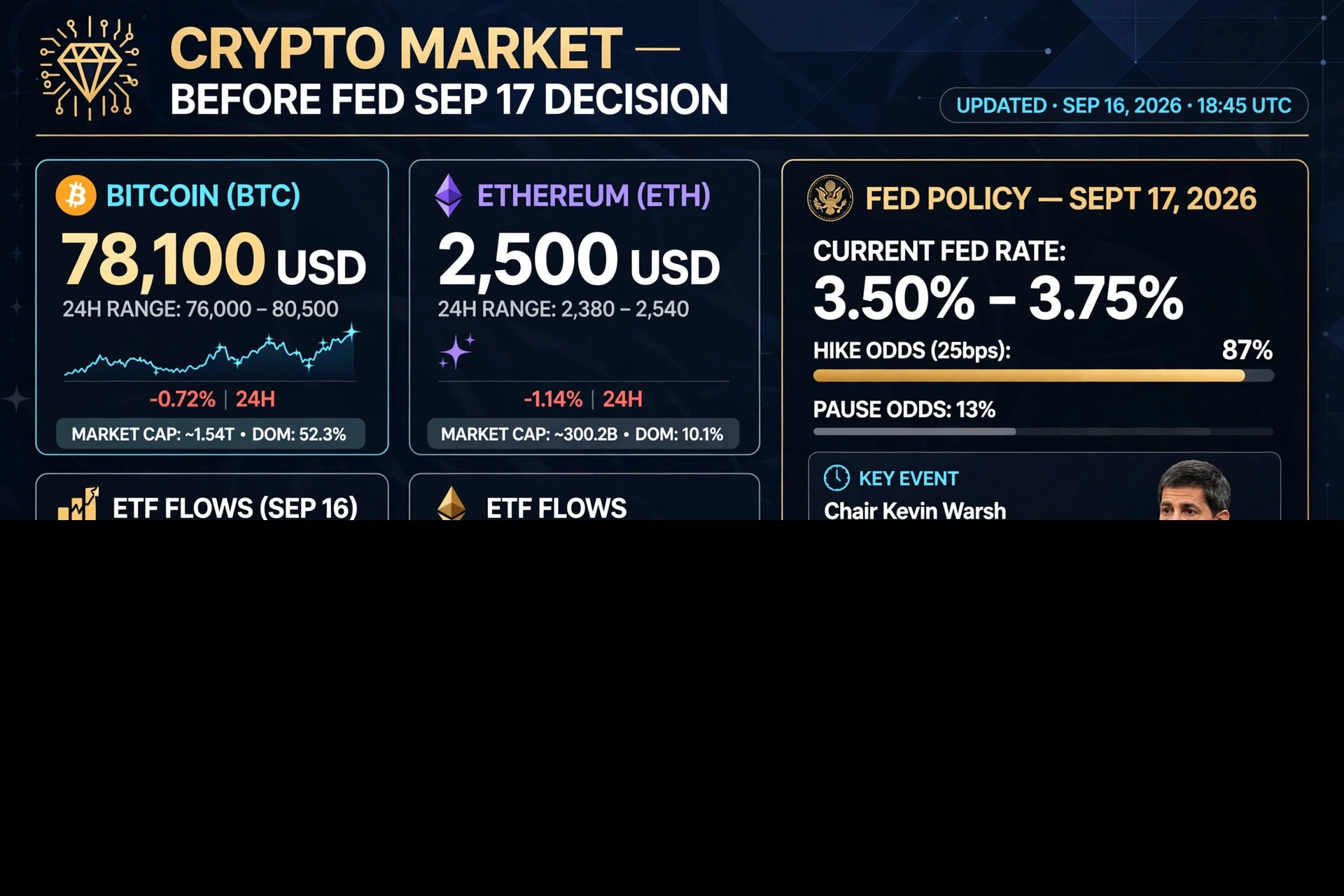
Where Crypto Stands Before the September 17 Fed Decision, And Where I Think It Goes Next
The Federal Reserve's September meeting runs from September 15 to 16, and in Beijing time the rate decision lands at 02:00 on September 17, with Chair Kevin Warsh's press conference at 02:30. That single window is what the entire market has been pricing for weeks. Going in, the federal funds target range sits at 3.50 to 3.75 percent, and a quarter-point increase would take it to 3.75 to 4.00 percent. Before Jackson Hole the odds of a hike were around 30 percent. After a strong August jobs
HighAmbition
#美联储加息会议
#每周来晒
Where Crypto Stands Before the September 17 Fed Decision, And Where I Think It Goes Next
The Federal Reserve's September meeting runs from September 15 to 16, and in Beijing time the rate decision lands at 02:00 on September 17, with Chair Kevin Warsh's press conference at 02:30. That single window is what the entire market has been pricing for weeks. Going in, the federal funds target range sits at 3.50 to 3.75 percent, and a quarter-point increase would take it to 3.75 to 4.00 percent. Before Jackson Hole the odds of a hike were around 30 percent. After a strong August jobs report and the August CPI release on September 11, prediction markets moved to roughly 83 to 87 percent, with some reads near 90 percent. In other words, the hike itself has become the consensus, and that changes what actually matters on the night.
So where is crypto right now? Bitcoin has been locked in a range between roughly 76,000 and 80,500 dollars for weeks, trading around 77,100 to 78,600 depending on the session, with a market cap near 1.55 trillion dollars and dominance around 58.7 percent. Daily spot volume has been running in the 14 to 15 billion dollar region on aggregated venue reads, and 24-hour moves have mostly been a fraction of a percent, with occasional swings of three thousand dollars or more inside a single day. The more important number is distance: Bitcoin is still roughly 39 percent below its October 2025 record of 126,198. Over the past month it is up about 22 percent, but over the past year it is down roughly 33 percent. That combination, strong month and weak year, tells me this is a recovery inside a larger correction rather than a fresh bull leg.
Ethereum sits near 2,500 dollars, with a market cap around 304 billion and roughly 11 to 12 percent of total market share. Its 24-hour volume has been running between 11 and 15 billion dollars. Ether is up about 33 percent over the past month, clearly stronger than Bitcoin's 22 percent, and its daily moving average structure is still bullish. But it remains close to 50 percent below its all-time high of 4,953 dollars and down roughly 45 percent year over year. XRP is trading around 1.36 to 1.42 dollars, and SOL has pushed back above 100 dollars with rising open interest. The rotation into alts is real, but it is selective, and it is not the broad altcoin season many people are waiting for.
Liquidity is where this market gets genuinely interesting. Spot Bitcoin ETFs took in 968.9 million dollars between August 31 and September 4, while spot Ether ETFs added 130.3 million, for a combined 1.1 billion dollars. But 863 million of that, almost 79 percent, arrived on a single day, September 3. Then the bid faded: three consecutive sessions of net outflows followed into the second week of September. Ether ETF inflows dropped more than 82 percent week over week, and Ether's share of total ETF inflows fell from 45 percent to about 12 percent. That tells me institutional money is engaged but not committed, and it is far more comfortable holding Bitcoin than altcoins right now.
Derivatives positioning is unusually calm for a week like this. Aggregate Bitcoin futures open interest has been hovering near 53 to 55 billion dollars, funding rates are barely above the neutral 0.01 percent baseline, and the aggregate long-to-short account ratio has been sitting below 1.0. After a weekend shakeout that cleared roughly 250 million dollars of leveraged longs, the market rebuilt itself without piling on fresh leverage. I read that as a two-sided signal. There is no obviously overcrowded side waiting to be liquidated, which lowers the odds of a violent cascade, but there is also less fuel for a squeeze, so any clean breakout will need spot volume rather than derivatives alone.
The macro backdrop matters as much as the crypto tape. August producer prices rose 0.4 percent month over month, the largest increase since May, and Brent crude has been trading close to 108 dollars a barrel while the US-Iran conflict keeps energy risk alive. The 10-year Treasury yield hit 4.95 percent on September 10, its highest in a year, which means financial conditions are already tightening before the Fed even moves. Equities have been resilient: on September 11 the S&P 500 closed at 7,656.98, the Dow at 52,573.29 and the Nasdaq at 26,333.04, each up around one percent on the day. Gold is the odd one out. It settled near 4,408 dollars an ounce on the December contract after three consecutive weekly declines, and it is still trading below its 200-day moving average around 4,537.
Do I think the 25 basis point hike is fully priced? Mostly, yes. When 83 to 87 percent of the market expects something, the move itself is rarely the shock. The shock, if it comes, will be in the dot plot, meaning the median projection for the end of 2026, and in what Warsh says at 02:30. The July decision was held with a 9 to 3 vote in which the dissenters wanted to hike. If those voices now dominate the projections, the message becomes one more after this. Futures were already implying a path toward roughly 3.80 percent by December before this meeting, so a dot plot confirming one more hike is not new information. A dot plot implying two more hikes, or language that removes the conditionality, would be the hawkish surprise.
My base case is a quarter-point hike with guidance that stays data dependent. In that scenario I expect the first reaction to be choppy rather than directional: a dip as the decision prints, then a relief bid once traders accept that nothing catastrophic happened, with Bitcoin testing the 80,000 to 80,500 shelf again. A genuinely hawkish outcome, two hikes signalled and a harder line on energy-driven inflation, would push the 10-year yield higher, lift the dollar, and send Bitcoin back to test 76,000, with 74,000 as the deeper zone. The minority outcome, a hold at roughly 15 percent odds, would produce the most violent move of all: a weaker dollar, lower yields, and a fast squeeze higher across Bitcoin, Ether and gold, with Bitcoin running toward 82,000 to 83,000.
On volatility, yes, I expect it to rise, but not necessarily in the direction people fear. The event window is narrow, from the 02:00 print to about an hour after the 02:30 press conference, and inside that window order books thin out, spreads widen and stop hunts are common. The saving grace is that leverage is not stretched. When open interest is flat and funding is near neutral, the market absorbs news through price discovery rather than forced liquidation. My working assumption is an elevated but manageable volatility spike, with the real follow-through decided in the Asian and US sessions afterwards, not in the first fifteen minutes.
Will this turn into a bull trend? Honestly, I do not think one meeting decides that. For a real bull trend I want three things: ETF flows positive for two or three consecutive weeks instead of clustered on single days, funding rates rising gently alongside price rather than jumping, and Bitcoin reclaiming 80,500 and holding it while Ether clears the 2,640 area. Right now we have one of those three at best. The broader crypto market is up about 2.3 percent over the past week and the Fear and Greed Index sits at 66, greedy but not euphoric, which historically is a middle-of-the-range reading rather than a top or bottom signal. Some longer-horizon cycle models point to a possible cycle low around November 2026, which is worth keeping in the back of your mind rather than trading on.
If I line the assets up side by side, the hierarchy I see is this. Gold is the cleanest pure macro hedge and is currently stuck in a corrective phase below its 200-day average, with 4,300 as support and 4,200 as the level that opens if the Fed turns decisively hawkish; if Warsh blinks instead, gold moves back toward 4,400 to 4,500 quickly. US equities are priced for a soft landing and for a hike they have already accepted, which makes them vulnerable to a hawkish dot plot but still supported by earnings and liquidity. Bitcoin now trades more in step with bonds and growth stocks than at any point in its history, so it behaves less like a hedge and more like a high-beta macro asset, and in my view that is the single most important structural change in this cycle. Ether offers higher beta and the cleaner uptrend, but with weaker institutional flow support at the moment.
What I will be watching at 02:00 and 02:30 Beijing time is specific: the median 2026 dot, whether the vote split narrows or widens, the exact wording about further adjustments, any mention of energy prices and the Strait of Hormuz, and then the first hour of flow data. The levels I care about are Bitcoin at 76,000 support and 80,500 resistance, with 82,300 as the door to 87,500 by year end, Ether at 2,420 and 2,640, the 10-year yield around 5 percent, and the spot ETF flow prints on September 17 and 18. If flows turn positive and funding stays calm while Bitcoin holds above 80,500, I will treat this as the beginning of something more durable. If flows stay negative and volume keeps bleeding lower, I will treat any pop as a chance to reduce risk rather than add it.
My honest read is that this meeting is more about the message than the move. The hike is in the price, the market is under-leveraged, and liquidity is thin but not broken, which argues for a two-way volatility event rather than a trend killer. I would rather wait for the dot plot and the first ETF flow print than guess direction at 02:00. Risk management over prediction is the whole game on a night like this. None of this is financial advice, these are simply my own views and levels shared for discussion, and everyone should size positions according to their own risk tolerance and time horizon.
#Gate广场中秋团圆局
repost-content-media
#AnthropicPicksNasdaqForIPO
On September 13, 2026, multiple media outlets reported that Anthropic PBC had selected Nasdaq as the listing venue for its initial public offering, with the target window pointing to October at the earliest and the fundraising target seeking to match or exceed SpaceX’s level. On the same day, Reuters cited people familiar with the matter as saying that Nvidia was in talks to participate in the IPO as an anchor investor, with the investment potentially reaching $10 billion, corresponding to an expected valuation of approximately $2 trillion.
Taken together, these tw
post-image
NDAQ+0.47%
SPCX-1.98%
NVDA-3.34%
  • 5
Mid-September crypto market pullback: BTC in the 76.5–77.5k range, down 0.8% on the day; ETH at approximately 2465–2520. Market capitalization fell 0.9%, while the Fear and Greed Index remained in the greed zone but declined. Over the past four days, BTC spot ETFs saw net outflows of $463 million, the largest weekly outflow in nearly 10 weeks, while ETH spot ETFs recorded approximately $197 million in net inflows, indicating a structural divergence in capital allocation between BTC and ETH: BTC is under pressure amid high interest rates, while ETH is receiving increased allocations due to its
post-image
BTC+2.25%
ETH0.00%
  • 3
U.S. Senate Majority Leader John Thune has scheduled a cloture vote on the Digital Asset Market Clarity Act for 2:15 p.m. Eastern Time on September 15. This will be the first time the full Senate votes on comprehensive crypto market structure legislation, but its nature needs to be made clear: the procedural vote will only determine whether the Senate can begin formally considering the bill, not whether the bill itself will ultimately pass.
Under Senate rules, invoking cloture requires 60 votes. Republicans currently hold 53 seats in the Senate, meaning the bill must secure the support of at l
post-image
POLYMARKET+29.98%
  • 3
According to CoinWorld, U.S. spot Bitcoin ETFs saw net outflows of $462.7 million last week, ending three consecutive weeks of inflows, while Ethereum ETFs bucked the trend by attracting $196.9 million in new funds. Despite the significant outflows, Bitcoin ETFs still maintained net inflows of approximately $307.3 million in September. Bitcoin traded around $77,900 on Monday, failing to sustain its recent rebound. Meanwhile, Ethereum ETF fund flows were uneven during the same week, attracting $216.4 million on Friday. The market faces a potential volatility catalyst as the Federal Reserve is s
BTC+2.25%
ETH0.00%
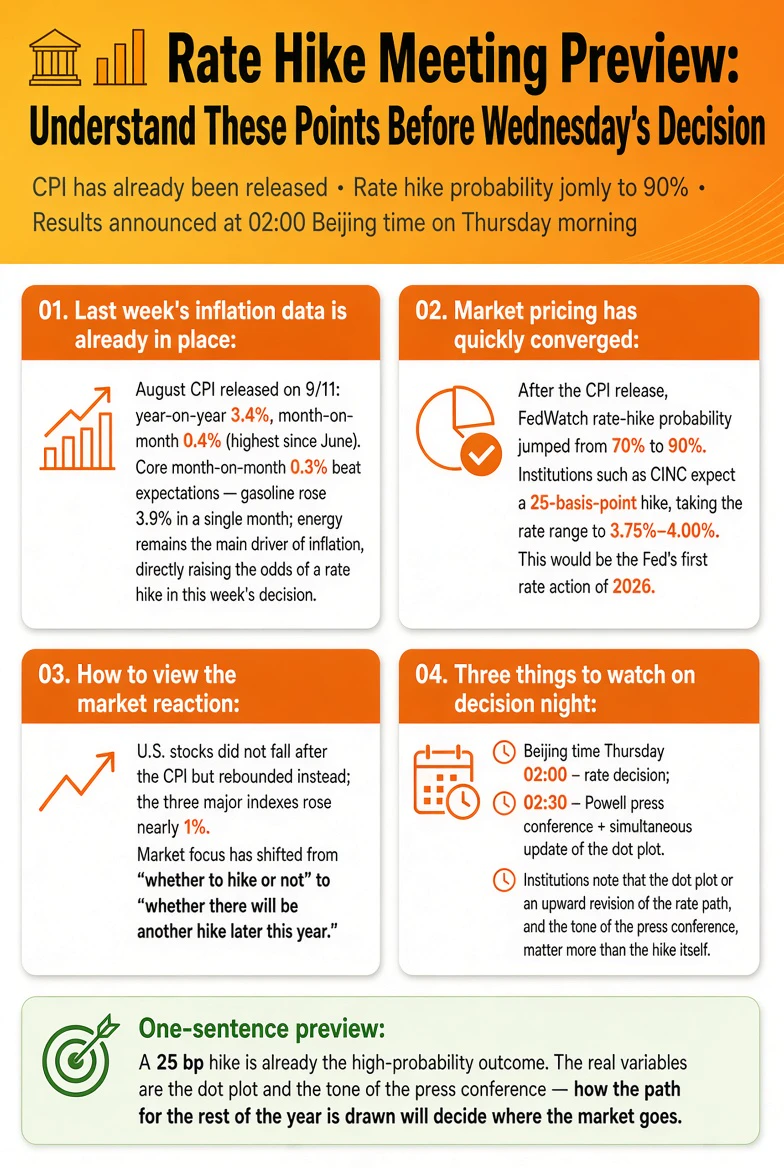
Rate Hike Meeting Preview: Decision on Wednesday, Focus on These Three Points CPI Is In · Rate Hike Probability Rises to 90% · Announcement at 02:00 Thursday Beijing Time
📈 Data is in place: August CPI rose 3.4% year-on-year, while core CPI rose 0.3% month-on-month, above expectations; FedWatch rate hike probability rose from 70% to 90%
🎯 Institutional expectations: A 25-basis-point hike, raising the target rate range to 3.75%–4.00%, the first move of 2026
👀 Highlights: The 02:00 decision, the 02:30 Warsh press conference, and an updated dot plot—the tone matters more than the hike itself
post-image
XOM-0.57%
According to Onchain Lens, Riot Platforms transferred 119.63 BTC (approximately $9.3 million) from Foundry Digital mining wallet to NYDIG custody address on September 14.
RIOT-2.33%
BTC+1.58%
According to Kremlin spokesman Peskov, on Monday, September 14, the Kremlin stated that the global energy market situation is deteriorating amid Middle East instability. The Kremlin also said Russia's diesel export ban should help shore up the domestic market. Peskov made the remarks while