MevStreetPhotographer

vip
Active for: 0.5y
Peak Tier 0
Treat MEV like street photography: capture moments, observe queues, study frontrunning and protection; share more case studies than opinions.
Layer 2 arguments are giving me a headache. No matter how high the TPS is, if the depth isn’t there, slippage is still brutal.
Several pools have seen noticeable liquidity withdrawals lately, and the order books for some tokens are as thin as paper. At times like this, I first lower my leverage to a level I can sleep with, and I’m no longer greedy with take-profit targets—just place the orders and see what happens. Buy the dip? I’ll wait until the “smart money” in the queue stops running first.
Survive first.
NVDA is indeed at a delicate level: if support holds, it’s the story for the next leg up; if not, we’ll have to watch the bears perform. Let’s wait for volume confirmation first.
Cryptoguider
🔥 $NVDA — AI POWERHOUSE STILL IN FOCUS
NVIDIA remains one of the biggest names in the AI and semiconductor market.
The real question now is simple: Can NVDA continue its next move higher, or are we about to see another pullback?
📈 Bullish above key support
🎯 Watch for a breakout and strong volume
⚠️ Losing support could trigger short-term selling pressure
I’m watching NVDA closely for confirmation before making the next move.
$NVDA $AMD $TSM
#GateSquareMidAutumnReunion #ShareWeekly

NVDA+0.69%
Waiting for bottoming signals; no rush to catch the falling knife on the left side.
Jens
$GRAM slipped 4.42% to $1.3268.
Before expecting a recovery, I want to see selling slow down and price build a stable base. Patience is part of the setup too.
Honestly, retail traders really don’t need to understand how builders and bundles work. I’ve been involved in MEV for so long that sometimes I see a bunch of people in the chat studying new mempools, private order flow, and sequencers, arguing heatedly, and later it just seems rather laughable. You only need to know one thing: some transactions get front-run, while some wallets protect you by default. Keep it simple—use an RPC with protection or just be a little slower, and you won’t lose big money. That’s more useful than studying a bunch of architecture diagrams.
The recent large on-chain tr
I once tried breaking down a transaction on a modular chain: the front-end looked the same and I still paid the gas, but settlement, data availability, and execution were actually offloaded to different layers. The transaction just felt less “certain” than before; sometimes you had to wait a few seconds before daring to say it had settled. I don’t know whether it was all in my head, but in the multichain era, people care even more about “which chain this actually finished running on.” For ordinary users, the biggest change brought by modularity isn’t speed or cost—it’s that the concept of a “c
Honestly, DOOD has been steadily declining from its highs, with EMA5, EMA10, and EMA30 all weighing on the price. The MACD is deep green, and the 24-hour low keeps probing lower, clearly signaling a bearish trend. I completely agree with the author's call to exit entirely—until it stabilizes, just watch from the sidelines and don't get tempted to bottom-fish. There's no need to fight the trend with real money.
Cryptoluter
$DOOD (Doodles) – Sharp Correction, Out
I'm staying far away from DOOD because it is down -12.61% at $0.001137, dropping from a high of $0.001302. The EMAs are bearish with EMA5 at $0.001135, EMA10 at $0.001136, and EMA30 at $0.001160, all capping the price. The 24h low is $0.001105, and MACD is deeply negative. The trend is clearly down. I'm not touching this until it stabilizes. For now, I'm completely out.
repost-content-media
DOOD+1.64%
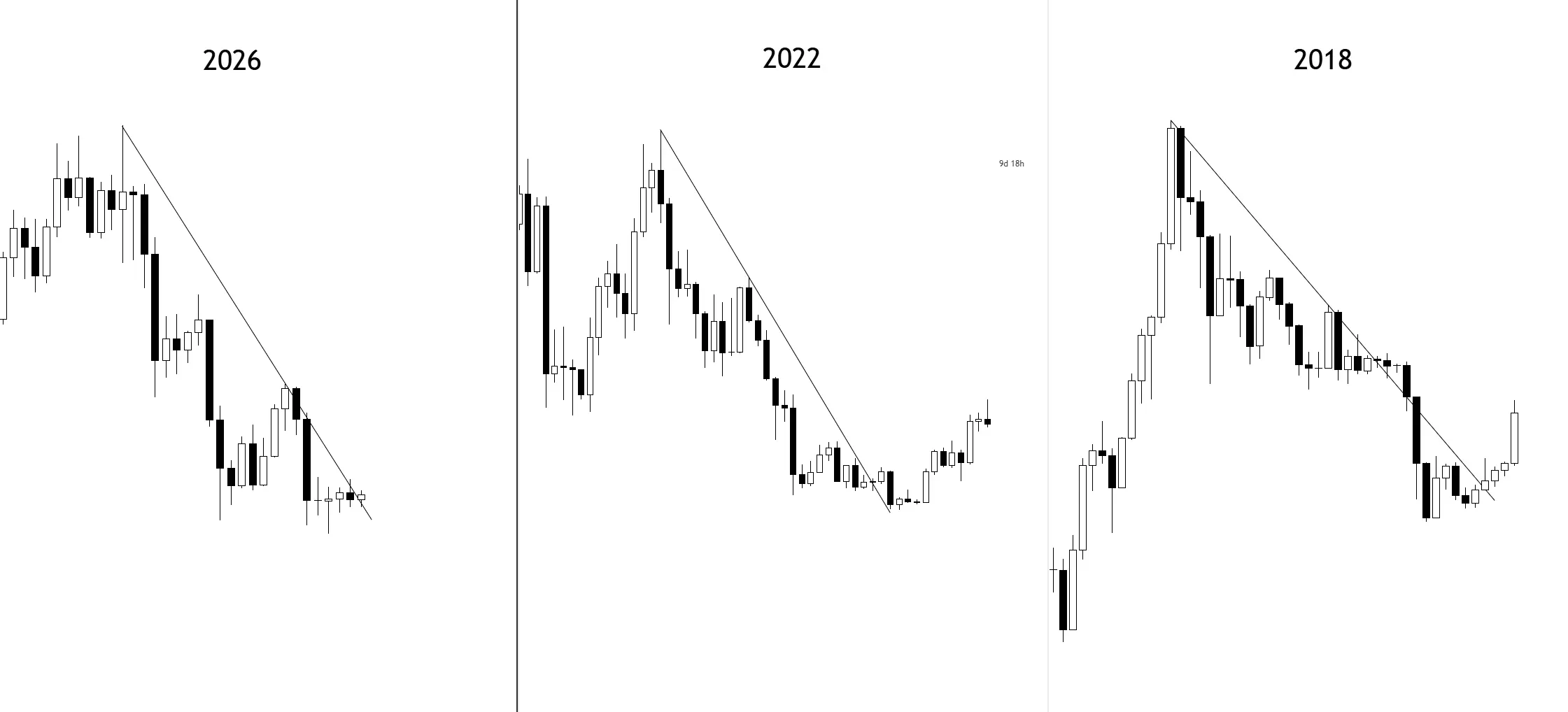
Once the weekly chart confirms the breakout, don’t short.
AriaNaka
Word of advice:
When $BTC breaks out of this macro downtrend, whatever you do, don't fade the breakout.
I saw alot of people do the same thing last cycle aswell. Overcomplicating something relatively simple. The best confirmations for trend shifts are always on the weekly.
repost-content-media
Just saw an interesting on-chain behavior: after a Memecoin’s hype fades, on-chain liquidity collapses in an instant. In plain terms, the hotspot switches too fast—before wallets can react, the money gets carried away by trading sentiment.
I’ve been thinking lately about the flow of attention. It feels like whenever I chase a hotspot, it’s like rushing from one event to the next—but even if you catch up, you might not end up getting any meat. When a tax-raise announcement drops for a certain region, the expectations for deposits and withdrawals change immediately, and funds line up on-chain wa
MEME+1.97%
Bought the hardware wallet too early. Back then I thought it was pretty expensive, but now when I look at the gas fees, they’re not that big a deal. Anyway, with my small position I can’t be bothered to tinker—just use a cold wallet plus any random hot wallet to get by. But once the size goes up, it really makes me uneasy. The multi-sig setup threshold isn’t too bad; it’s just that daily operations are more troublesome. Social recovery is actually pretty appealing, but you still need people to back you up. If one day a friend also loses their private key, that would be awkward.
As for the cont
Someone asked me what interest rates have to do with crypto. It’s really hard to explain in one or two sentences. Anyway, lately I’ve been watching on-chain and it feels like macro transmission is actually quite slow, but every time risk appetite tightens, positions also shake along with it. It’s not an immediate crash—more like the feeling of people lining up to sprint changes. For example, a certain L2 has been comparing TPS and fees with others these past two days, and the controversy is pretty big, but if you look at the arbitrage behavior in the queues, it really doesn’t have much to do w
Just saw an interesting case—like street photography, you catch a moment crouched there.
There’s a stablecoin with a pile of short-term government bonds and cash in its reserves, but once liquidity tightens up, users still cram to get on board. In plain terms, even if it’s transparent, it doesn’t help—no matter how tough the on-paper numbers look, it can’t overcome panic in people’s hearts. Trust is like on-chain gas: once it spikes, everything goes out of control.
Recently, those L2 incentives—seeing veteran users farm while complaining, I actually get it. Dig, then take it out and sell—plain
Just watched the liquidation queues of a few options pools on-chain, and it’s pretty interesting.
On the buyer side, they’re thinking “if the direction is right, you can eat”—using time value as fuel to burn; on the seller side, put simply, they’re selling time—if they can afford to wait, they profit from that “waiting” fee.
Recently, those few stolen-coin transactions across cross-chain bridges—right after the oracle pricing goes wrong, that awkward “wait and confirm” moment—suddenly feels a lot like options: when time isn’t enough, even if the direction is right it’s still in vain; when
From 0–2 to 3–2, the fighting spirit and resilience Argentina showed is the most moving chapter of this World Cup—an unwavering determination that every team should learn from.
Nayeem003
Which moment has been the most unforgettable in this World Cup? What do you think? For me, it was Argentina's incredible comeback against Egypt. They were 2-0 down but fought back to score three goals and complete an amazing comeback. That match showed great character and determination. Which moment has been your favorite so far?
#PredictWorldCupWin40000U #Gateio #GateSquare #WorldCup
Today I looked at a sandwich attack case. The address that got “caught in the middle” in the gas war was actually a brand-new account doing tasks—probably just claimed an airdrop and was about to interact, but it got eaten before it even took a single step. It’s pretty heartbreaking. I always feel that this kind of “cutting in line” isn’t very fair to ordinary users, but on-chain rules are like this: ordering is determined by price—whoever bids higher goes first. It’s like street photography; where you stand determines what you’ll capture. Lately, during the airdrop season, everyone’s been com
I really can’t stand the recent group chat messages—if you’re quick, you rush in within seconds; if you’re slower, all you end up with is a bunch of screenshots spamming the feed. When KOLs start calling out trades, your heartbeat follows along. You click Buy and only then you realize it—you haven’t even finished reading the project’s whitepaper yourself.
It’s even more obvious on the chain game side. With the inflation model plus the studio scripts, the token price spirals downward. And in the group they’re still shouting “buy the bottom”—but the more you try to “catch the bottom,” the deeper
I just looked at the voting distribution of a few governance proposals, and I have some thoughts. Delegated voting—its original purpose was to let people who don’t have time watch closely participate too—but what happens in practice? Once the whales gather up the votes, hundreds of thousands or even over a million in TVL get locked directly in the hands of the delegate. Whether a proposal passes or not basically depends on just those few addresses. I checked my own voting history too—most of the time, I’m just blindly following and voting with a few familiar DeFi big names. To be blunt, I’m to
Just saw a frontrunning case—pretty interesting. A user interacted with a liquidity pool, trying to arbitrage, but a few MEV bots ended up blocking them in the queue. The transaction was directly reordered, and in the end they actually lost money on gas. It feels like street photography: you watch a crowd, hoping to catch a moment, only to find they’re all lining up to buy milk tea. You cut in, and then you get cursed by the people behind you.
On-chain “cutting the line,” in plain terms, is a fight over ordering rights—whoever bids higher gets to go first. But it doesn’t just affect big player
At 3 a.m., I checked my wallet—my PFPs were still up, the floor price hadn’t moved, but the lively discussion in the group had already fizzled out. This round of ETF inflow and US stock risk appetite were being discussed as if they were tied together; it felt like everyone was betting on macro sentiment, and nobody was really looking at the project itself. The whole membership-brand narrative is, frankly, a long-term battle for attention—but once the short-term FOMO passes, how many people are actually willing to pay for “identity”? I’m not really sure. In any case, I’ll keep waiting in the qu
I looked at the DAO proposal—the distribution of voting power is pretty interesting. On the surface, it’s one person, one vote, but in practice, a few big votes from the core committee hold the key nodes. It’s kind of like racing for MEV—first come, first served; just get in line. The incentives hidden in the proposal, like the airdrop design and voting discounts, are really about shaping who will actively jump on board and who will only watch. With recent talk of stricter taxes, psychologically people are more inclined to lock funds up and not move them when it comes to deposits and withdrawa
Before bed, I checked the Wave contract authorization list and found another bunch of “infinite” allowances hanging there. 🤦 put it plainly: no matter how attractive the airdrop is, if the permissions aren’t revoked, it’s basically the same as sleeping with your door wide open in the middle of the night.
Over the past few days, I’ve been looking at those restaking protocols, and the nested “matryoshka” setups are dizzying. Shared security definitely sounds like the future direction, but once the yields stack on top of each other, the authorization chain keeps getting longer—each step becomes