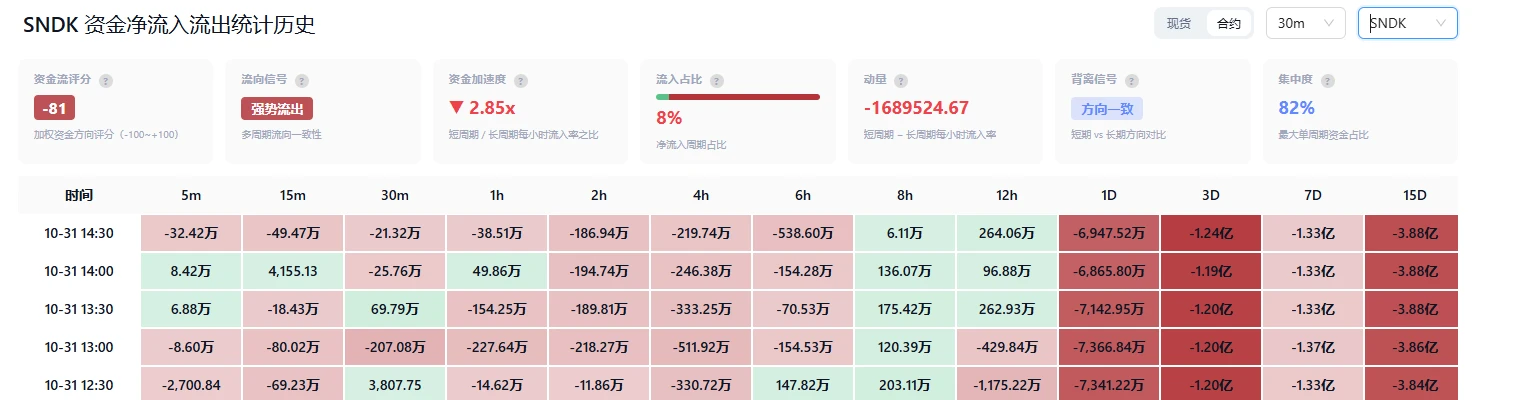
$SNDK A “Suspended Death Sentence” for Longs Trapped Above 1300: Whales Have Switched Sides—Can You Still Get Out?
Guys, if you chased SanDisk longs at 1300, the price is now 1155, and your unrealized loss is already over 11%. You’re not riding out a dip—you’re handing the bears a weapon.
Look at the data. The whale long/short ratio has hit 11.67%; 371 whales are collectively short, with shorts sitting on $17.81 million in unrealized gains and more than $17.67 million in long liquidations. 1D net outflows are 124 million, and every timeframe under 6 hours is in the green—short-term money is stampeding for the exits. On the 1-hour chart, the EMA7 and EMA30 death cross is firmly in place, MACD is below the zero line, and the bounce can’t even reach 1180. How are you supposed to get out of this?
Why the drop? Revenue grew 378% year over year, and data center demand is through the roof, but the market just isn’t buying it—high valuations, cooling consumer demand, and Intel’s gloomy warning are weighing on the stock, and the “good news is already priced in” sell-off logic for memory chips has taken hold. What stings even more: one large trader held a long from 1814 for 30 days, then finally cut their losses at 1247, losing $4.58 million in one go. Do you think you can hold on longer than a whale?
The biggest danger for longs entered at 1300 isn’t how much you’ve already lost—it’s that the liquidation zone below is closing in. The liquidation price for 50x leverage is already near 1084. If the price drops another 2%, the system will start calling your name.
Lao Zhang will tell you straight: getting out isn’t about waiting for a bounce; it’s about changing your position structure. High-entry longs need to be restructured and hedged. Holding on stubbornly leads only to being wiped out. Want to know exactly how to break down and adjust your position, lock in your losses at current prices, and then look for a chance to make them back?
Bring your positions and risk tolerance, and @老张说趋势 let’s get your position sorted out. There’s still a way to save this trade!
#BTC大跌 #英特尔财报超预期股价却暴跌