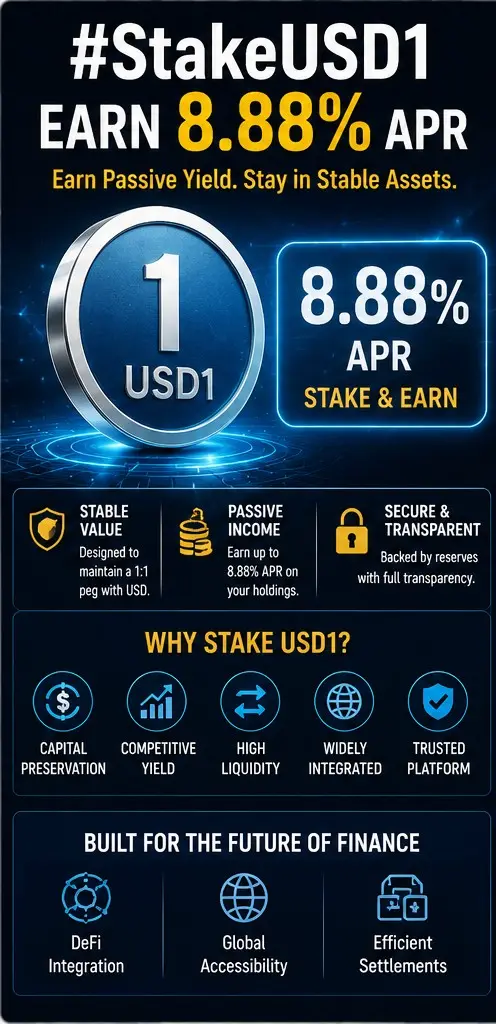
#StakeUSD1Earn8.88%APR
EARNING PASSIVE YIELD WHILE STAYING IN STABLE ASSETS CAN BE AN ATTRACTIVE STRATEGY, BUT SMART INVESTORS ALWAYS BALANCE REWARD WITH RISK.
AN 8.88% APR OFFER STANDS OUT IN TODAY'S DIGITAL ASSET MARKET, ESPECIALLY AS INVESTORS LOOK FOR OPPORTUNITIES TO GENERATE CONSISTENT RETURNS WITHOUT DIRECTLY EXPOSING THEIR CAPITAL TO HIGH PRICE VOLATILITY.
UNDERSTANDING THE PLATFORM, THE UNDERLYING ASSET, MARKET CONDITIONS, AND ASSOCIATED RISKS IS ESSENTIAL BEFORE PARTICIPATING.
Market Overview
The digital asset market continues to trade in a mixed environment as investors monitor global monetary policy, institutional crypto adoption, stablecoin regulation, and capital flows across decentralized and centralized financial products. Yield-generating products remain attractive as many participants seek predictable returns while waiting for the next major market trend.
Current Market Update
Market liquidity remains healthy, while institutional interest in blockchain infrastructure, tokenized assets, and regulated stablecoins continues to expand. Investors are increasingly focusing on capital preservation alongside yield generation.
Live/Current Price Overview (at the Time of Posting)
USD1 is designed as a stable-value asset, meaning its price generally aims to remain close to 1 USD. Unlike volatile cryptocurrencies, price fluctuations are typically minimal, making yield opportunities the primary attraction rather than capital appreciation.
Price Performance
Stablecoins normally maintain tight trading ranges around their intended peg. Performance is therefore evaluated more by yield generation, liquidity, platform security, and redemption reliability than by price appreciation.
Technical Analysis
Traditional technical indicators have limited usefulness for stablecoins because of their low volatility. Instead, investors should monitor liquidity, trading volume, redemption activity, platform stability, and yield sustainability.
Market Structure
The overall market structure for yield-bearing stable assets remains constructive as investors continue shifting portions of their portfolios into passive income opportunities while maintaining flexibility to re-enter higher-risk markets when conditions improve.
Trend Analysis
The broader trend continues to favor products offering competitive yields backed by transparent reserve management and strong platform credibility. As interest rates evolve globally, demand for digital yield products is expected to remain significant.
Support Levels
Primary Support: Near the intended 1.00 USD peg.
Secondary Support: Minor temporary deviations below the peg during periods of elevated market volatility.
Resistance Levels
Primary Resistance: Slight premium above the peg driven by increased demand.
Secondary Resistance: Temporary premium pricing during high subscription periods.
Key Buying Zones
Investors generally consider accumulation when the asset trades near or slightly below its intended peg while attractive staking rewards remain available.
Key Selling Zones
Since stablecoins are not designed for capital gains, investors typically redeem or rotate funds when alternative investment opportunities provide superior risk-adjusted returns or when promotional yields decline.
Bullish Scenario
Continued institutional adoption of stablecoins, expanding blockchain payment infrastructure, growing demand for passive income products, and sustained platform confidence could support continued participation in staking programs.
Bearish Scenario
Regulatory uncertainty, declining promotional yields, reduced liquidity, platform-specific risks, or broader market stress could reduce investor participation despite price stability.
Volume Analysis
Stable trading volume reflects healthy liquidity and market confidence. Rising volume combined with stable pricing often indicates increasing investor participation rather than speculative activity.
Momentum Indicators (RSI, MACD, Moving Averages)
Because USD1 maintains a stable value, conventional momentum indicators offer limited insight. Investors should instead monitor staking participation rates, liquidity metrics, reserve transparency, and redemption efficiency.
AI & Semiconductor Industry Update
The rapid expansion of artificial intelligence continues driving investment across technology markets. Strong semiconductor demand supports broader financial market optimism, indirectly benefiting digital asset sentiment through increased institutional participation in innovative financial technologies.
Company Background
USD1 is designed to provide price stability while enabling users to participate in decentralized and centralized financial ecosystems. The primary objective is maintaining capital stability while offering efficient settlement and yield opportunities.
Business Fundamentals
Key strengths include liquidity, accessibility, blockchain interoperability, and integration into multiple financial services. Long-term success depends on transparency, reserve quality, regulatory compliance, and ecosystem adoption.
Institutional & Investor Sentiment
Institutional investors increasingly recognize stablecoins as valuable tools for treasury management, liquidity optimization, cross-border settlement, and passive yield strategies. Retail investors remain attracted by opportunities to earn competitive returns while limiting exposure to market volatility.
Market Catalysts
Higher stablecoin adoption.
Growth of tokenized finance.
Expansion of digital payment infrastructure.
Institutional blockchain adoption.
Improved regulatory clarity.
Continued platform innovation.
Risk Factors
Platform risk.
Smart contract vulnerabilities.
Regulatory changes.
Counterparty exposure.
Liquidity fluctuations.
Changing promotional APRs.
Market-wide systemic events.
Today's Market Outlook
Current conditions remain constructive for investors seeking passive income with relatively lower price volatility. However, careful portfolio diversification and continuous monitoring remain essential.
Short-Term Outlook
Stable performance is expected while promotional yields continue attracting new capital. Liquidity conditions remain favorable.
Mid-Term Outlook
The outlook depends largely on regulatory developments, platform expansion, and sustained investor confidence in stable digital assets.
Long-Term Outlook
Stablecoins are expected to play an increasingly important role within digital finance, supporting payments, trading, decentralized finance, institutional settlement, and treasury management.
Futures Market Analysis
Although stablecoins themselves exhibit limited price volatility, futures traders should monitor overall crypto market sentiment, Bitcoin dominance, Ethereum performance, and macroeconomic developments, as these factors influence capital allocation into stable-yield products.
Advanced Trading Strategy
Allocate only a portion of portfolio capital.
Diversify across multiple strategies.
Monitor APR sustainability regularly.
Review platform announcements.
Reassess exposure as market conditions evolve.
Maintain liquidity for new investment opportunities.
Risk Management Tips
Never invest more than your risk tolerance allows.
Diversify across multiple assets.
Monitor regulatory developments.
Review platform security.
Avoid chasing unusually high yields without understanding associated risks.
Maintain an emergency liquidity reserve.
Essential Support & Resistance Levels
Support: Around the intended 1.00 USD peg.
Resistance: Slight premium above the peg during periods of elevated demand.
Key Price Targets
Primary expectation remains continued stability near the intended peg, with investor returns primarily generated through staking rewards rather than price appreciation.
Trading Plan for Swing & Day Traders
Swing traders may allocate idle capital into yield-bearing stable assets while awaiting higher-probability market setups.
Day traders can use stable assets as temporary capital storage between trading opportunities, reducing exposure during uncertain market conditions.
Investment Perspective
For conservative crypto investors, yield-bearing stable assets can serve as an important portfolio component by combining liquidity, stability, and passive income. Nevertheless, investors should carefully evaluate platform credibility, reserve transparency, security practices, and regulatory developments before committing capital.
Conclusion
An 8.88% APR staking opportunity offers an attractive income-generating option for investors seeking reduced volatility compared with traditional cryptocurrencies.
While stable-value assets provide a more predictable foundation for capital preser#vation, disciplined risk management remains essential. Long-term success comes not from chasing the highest yield, but from balancing return, security, diversification, and sustainability.
Engagement Question
If you had idle capital available today, would you prefer earning passive yield through stablecoin staking, investing directly in Bitcoin or Ethereum, or keeping funds in cash until market volatility decreases? Share your strategy and explain why.
EARNING PASSIVE YIELD WHILE STAYING IN STABLE ASSETS CAN BE AN ATTRACTIVE STRATEGY, BUT SMART INVESTORS ALWAYS BALANCE REWARD WITH RISK.
AN 8.88% APR OFFER STANDS OUT IN TODAY'S DIGITAL ASSET MARKET, ESPECIALLY AS INVESTORS LOOK FOR OPPORTUNITIES TO GENERATE CONSISTENT RETURNS WITHOUT DIRECTLY EXPOSING THEIR CAPITAL TO HIGH PRICE VOLATILITY.
UNDERSTANDING THE PLATFORM, THE UNDERLYING ASSET, MARKET CONDITIONS, AND ASSOCIATED RISKS IS ESSENTIAL BEFORE PARTICIPATING.
Market Overview
The digital asset market continues to trade in a mixed environment as investors monitor global monetary policy, institutional crypto adoption, stablecoin regulation, and capital flows across decentralized and centralized financial products. Yield-generating products remain attractive as many participants seek predictable returns while waiting for the next major market trend.
Current Market Update
Market liquidity remains healthy, while institutional interest in blockchain infrastructure, tokenized assets, and regulated stablecoins continues to expand. Investors are increasingly focusing on capital preservation alongside yield generation.
Live/Current Price Overview (at the Time of Posting)
USD1 is designed as a stable-value asset, meaning its price generally aims to remain close to 1 USD. Unlike volatile cryptocurrencies, price fluctuations are typically minimal, making yield opportunities the primary attraction rather than capital appreciation.
Price Performance
Stablecoins normally maintain tight trading ranges around their intended peg. Performance is therefore evaluated more by yield generation, liquidity, platform security, and redemption reliability than by price appreciation.
Technical Analysis
Traditional technical indicators have limited usefulness for stablecoins because of their low volatility. Instead, investors should monitor liquidity, trading volume, redemption activity, platform stability, and yield sustainability.
Market Structure
The overall market structure for yield-bearing stable assets remains constructive as investors continue shifting portions of their portfolios into passive income opportunities while maintaining flexibility to re-enter higher-risk markets when conditions improve.
Trend Analysis
The broader trend continues to favor products offering competitive yields backed by transparent reserve management and strong platform credibility. As interest rates evolve globally, demand for digital yield products is expected to remain significant.
Support Levels
Primary Support: Near the intended 1.00 USD peg.
Secondary Support: Minor temporary deviations below the peg during periods of elevated market volatility.
Resistance Levels
Primary Resistance: Slight premium above the peg driven by increased demand.
Secondary Resistance: Temporary premium pricing during high subscription periods.
Key Buying Zones
Investors generally consider accumulation when the asset trades near or slightly below its intended peg while attractive staking rewards remain available.
Key Selling Zones
Since stablecoins are not designed for capital gains, investors typically redeem or rotate funds when alternative investment opportunities provide superior risk-adjusted returns or when promotional yields decline.
Bullish Scenario
Continued institutional adoption of stablecoins, expanding blockchain payment infrastructure, growing demand for passive income products, and sustained platform confidence could support continued participation in staking programs.
Bearish Scenario
Regulatory uncertainty, declining promotional yields, reduced liquidity, platform-specific risks, or broader market stress could reduce investor participation despite price stability.
Volume Analysis
Stable trading volume reflects healthy liquidity and market confidence. Rising volume combined with stable pricing often indicates increasing investor participation rather than speculative activity.
Momentum Indicators (RSI, MACD, Moving Averages)
Because USD1 maintains a stable value, conventional momentum indicators offer limited insight. Investors should instead monitor staking participation rates, liquidity metrics, reserve transparency, and redemption efficiency.
AI & Semiconductor Industry Update
The rapid expansion of artificial intelligence continues driving investment across technology markets. Strong semiconductor demand supports broader financial market optimism, indirectly benefiting digital asset sentiment through increased institutional participation in innovative financial technologies.
Company Background
USD1 is designed to provide price stability while enabling users to participate in decentralized and centralized financial ecosystems. The primary objective is maintaining capital stability while offering efficient settlement and yield opportunities.
Business Fundamentals
Key strengths include liquidity, accessibility, blockchain interoperability, and integration into multiple financial services. Long-term success depends on transparency, reserve quality, regulatory compliance, and ecosystem adoption.
Institutional & Investor Sentiment
Institutional investors increasingly recognize stablecoins as valuable tools for treasury management, liquidity optimization, cross-border settlement, and passive yield strategies. Retail investors remain attracted by opportunities to earn competitive returns while limiting exposure to market volatility.
Market Catalysts
Higher stablecoin adoption.
Growth of tokenized finance.
Expansion of digital payment infrastructure.
Institutional blockchain adoption.
Improved regulatory clarity.
Continued platform innovation.
Risk Factors
Platform risk.
Smart contract vulnerabilities.
Regulatory changes.
Counterparty exposure.
Liquidity fluctuations.
Changing promotional APRs.
Market-wide systemic events.
Today's Market Outlook
Current conditions remain constructive for investors seeking passive income with relatively lower price volatility. However, careful portfolio diversification and continuous monitoring remain essential.
Short-Term Outlook
Stable performance is expected while promotional yields continue attracting new capital. Liquidity conditions remain favorable.
Mid-Term Outlook
The outlook depends largely on regulatory developments, platform expansion, and sustained investor confidence in stable digital assets.
Long-Term Outlook
Stablecoins are expected to play an increasingly important role within digital finance, supporting payments, trading, decentralized finance, institutional settlement, and treasury management.
Futures Market Analysis
Although stablecoins themselves exhibit limited price volatility, futures traders should monitor overall crypto market sentiment, Bitcoin dominance, Ethereum performance, and macroeconomic developments, as these factors influence capital allocation into stable-yield products.
Advanced Trading Strategy
Allocate only a portion of portfolio capital.
Diversify across multiple strategies.
Monitor APR sustainability regularly.
Review platform announcements.
Reassess exposure as market conditions evolve.
Maintain liquidity for new investment opportunities.
Risk Management Tips
Never invest more than your risk tolerance allows.
Diversify across multiple assets.
Monitor regulatory developments.
Review platform security.
Avoid chasing unusually high yields without understanding associated risks.
Maintain an emergency liquidity reserve.
Essential Support & Resistance Levels
Support: Around the intended 1.00 USD peg.
Resistance: Slight premium above the peg during periods of elevated demand.
Key Price Targets
Primary expectation remains continued stability near the intended peg, with investor returns primarily generated through staking rewards rather than price appreciation.
Trading Plan for Swing & Day Traders
Swing traders may allocate idle capital into yield-bearing stable assets while awaiting higher-probability market setups.
Day traders can use stable assets as temporary capital storage between trading opportunities, reducing exposure during uncertain market conditions.
Investment Perspective
For conservative crypto investors, yield-bearing stable assets can serve as an important portfolio component by combining liquidity, stability, and passive income. Nevertheless, investors should carefully evaluate platform credibility, reserve transparency, security practices, and regulatory developments before committing capital.
Conclusion
An 8.88% APR staking opportunity offers an attractive income-generating option for investors seeking reduced volatility compared with traditional cryptocurrencies.
While stable-value assets provide a more predictable foundation for capital preser#vation, disciplined risk management remains essential. Long-term success comes not from chasing the highest yield, but from balancing return, security, diversification, and sustainability.
Engagement Question
If you had idle capital available today, would you prefer earning passive yield through stablecoin staking, investing directly in Bitcoin or Ethereum, or keeping funds in cash until market volatility decreases? Share your strategy and explain why.