Square
Following
Hot
News
Profile

CryptoAish

vip
Market Analyst
Crypto Market Researcher
Peak Tier 0
CRYPTO MARKET ANALYSIS Technical Fundamental Analysis Market Trends and PredictionsFocused On Clarity Accuracy And Growth
39
Following
854
Followers
1.1k
Liked
Robinhoods on-chain activity cools down: Daily active users down 31 from mid-September
live-cover
LIVE538
Robinhoods on-chain activity cools down: Daily active users down
live-replay-cover
187 views10-12 03:56
00:49:40
discovery
Insiders are quietly setting up a short on SKHYNIX while the tape stays flat.

$SKHYNIX /USDT - SHORT

Trade Plan:
Entry: 1292.89 – 1297.41
SL: 1316.83
TP1: 1278.89
TP2: 1268.04
TP3: 1251.78

Why this setup?
Why now? The 1h price is stuck at 1295.28 inside a narrow range on the daily timeframe, and the 15m RSI reading of 59.11 shows just enough bullish exhaustion to favor a short. The 1h ATR of 9.035408 tells us volatility is compressed, which often precedes a sharp directional move. Entry is defined at 1295.15, with TP1 at 1278.89 and TP2 at 1268.04 as realistic targets if sellers take control. The invalidation level sits at 1346.23, and that number is the hard line in the sand for this trade.

Debate:
Are we hitting TP2 or getting trapped?

⚠️ Personal market analysis only. NFA — manage risk and DYOR.
Educational content, not investment advice or a recommendation to buy, sell, deposit, or withdraw any asset. No paid promotion or referral/affiliate links.
#PlanYourTradesThisWeek
#ShareWeekly
  • 11
Bitcoin and Ethereum React as October Rate Expectations Shift Ac
live-replay-cover
944 views10-07 05:57
02:03:37
Gate_Square
🎁 5,000 USDT for grabs! Round 2️⃣ 4️⃣ of Growth Points Draw is ongoing!
300 points = 1 draw. Up to 10 draws daily. Every draw wins! 🤩
💫 Stay active and earn points every day:
🔹 Square: Post, like, comment — up to 600 pts/day
🔹 Live: Watch, like, comment, share streams — up to 300 pts/day
🔹 Chat: Join discussions — up to 90 pts/day
🔹 Creators: Post designated token/trading card content — up to 300 pts/task
Win Gate gaming chair, trading fee rebate vouchers & more!
👉 Try your luck now:
https://www.gate.com/activities/pointprize?now_period=24
$BTC $ETH $SOL
repost-content-media
  • 13
GateLive
🌈 #GateLiveStreamingInspiration -October 7
Go live with the following topics now to receive extra official support and promotional exposure!Today's Topic Recommendations:
🔹 Tom Lee: Tokenization will expand across the entire traditional finance sector over the next decade
🔹 MicroStrategy expects a $4.1 billion income tax benefit following the rise in Bitcoin's fair value
🔹 Peter Brandt favors the chart patterns of Monero and Solana over XRP
🔹 Ethereum (ETH) falls below 2,700 USDT; 24-hour gains narrow to 0.20%
🔹Perspective: The crypto industry is shifting from "creating new assets" to "creating new markets"
🔹 Robinhood adds $25 million worth of Bitcoin to its balance sheet
🔹 BlackRock’s Head of Digital Assets: Tokenized money market funds offer greater convenience than traditional products
🔹 Tom Lee: We are at the start of a supercycle; all traditional finance will be tokenized within a decade
Choose any topic to start a live stream, and you'll have a chance to be featured on the official website's homepage!🔥 Start streaming now: https://www.gate.com/live/apply
repost-content-media
  • 6
Crypto News | Bitcoin faces resistance at $87,000 for the third
live-replay-cover
889 views10-06 11:45
01:33:01
🌈 #GateLiveStreamingInspiration -October 6
Go live with the following topics now to receive extra official support and promotional exposure!Today's Topic Recommendations:
🔹Ripple pilots XRP-backed loans; XRP nears a technical breakout
🔹Michael Saylor states Bitcoin caters to diverse investor types through BTC, MSTR, and STRC
🔹Crypto market set for $XRP billion in token unlocks in early October 2026
🔹Crypto News | Bitcoin faces resistance at $BTC for the third time; probability of an October rate hike drops to 18%; ETH liquidity sees sharp decline despite a 70% Q3 gain
🔹Shiba Inu laun
post-image
XRP+1.55%
BTC+1.33%
MSTR+1.94%
STRC+0.20%
ETH+2.41%
  • 7
#CryptoAish
Leo_Kai
Gate new futures listing: $AGENCY
🔹 Trading pair: $AGENCY / $USDT
🔹 Trading time: Live
🔹 Supports 1–10x leverage, trading bots, and copy trading
Trade $AGENCY: https://www.gate.com/zh/futures/USDT/AGENCY_USDT
More details: https://www.gate.com/zh/announcements/article/102085
  • 8
Bitmine`s Ethereum Holdings Surpass 6 Million ETH
live-replay-cover
318 views10-05 11:21
01:00:24
blackuelyramoon
#OneGateWitnessProgram
My Gate Journey Since 2022: From a Simple DOGE Trade to a Powerful Story of Growth, Trading, and Content Creation
Every great journey begins with a small step. For me, that step was joining Gate in 2022 and exploring my first DOGE trade idea. At the time, I had no idea that this simple beginning would become a life-changing learning experience and open the door to years of trading, research, market analysis, livestreaming, and content creation.
When I started, my main focus was understanding price movements, identifying opportunities, and learning how the cryptocurrency market actually works. But with time, I discovered that successful trading requires much more than predicting whether prices will rise or fall.
It requires discipline, patience, strategy, and the ability to make rational decisions in an unpredictable market.
From Beginner to a More Disciplined Trader
My journey introduced me to technical analysis, market structure, liquidity, support and resistance, trading volume, volatility, and market sentiment.
I started studying Bitcoin, Ethereum, and different altcoins to understand their behavior and identify important market trends. I also learned how global economic developments, institutional activity, and major financial announcements can influence cryptocurrency markets.
But some of my most valuable lessons came from my mistakes.
I experienced losing trades, early entries, missed opportunities, and moments of FOMO. Every challenge taught me something important about emotional control and risk management.
Gradually, I realized that protecting capital is more important than chasing every market movement. I learned to respect uncertainty, wait for confirmation, and understand that sometimes the best decision is to stay out of the market.
These experiences transformed my trading mindset and helped me become more analytical, patient, and disciplined.
Turning Market Knowledge into Original Content
As my trading experience developed, another exciting chapter began: content creation.
I started sharing my own market observations, researching cryptocurrency developments, and writing original analysis. What initially began as a way to organize my thoughts gradually became an important part of my daily routine.
I wanted my content to offer more than ordinary predictions. My goal was to explain market behavior, highlight important price levels, explore possible scenarios, and share the reasoning behind my analysis.
Researching Bitcoin, examining altcoin trends, following economic developments, and studying changing market sentiment strengthened my knowledge and improved my ability to communicate complex ideas.
Every article became an opportunity to learn something new, refine my analytical skills, and contribute meaningful perspectives to the Gate community.
Livestreaming: A New Level of Confidence
Livestreaming became another major milestone in my journey.
Discussing the market in real time is completely different from writing a prepared post. It requires confidence, quick thinking, market awareness, and the ability to communicate clearly while prices continue moving.
Through livestreaming, I challenged myself to explain market trends, discuss trading ideas, answer questions, and interact directly with other crypto enthusiasts.
Every session brought new experiences and valuable lessons. Unexpected market movements taught me to remain flexible, while audience discussions introduced perspectives I might not have considered independently.
Most importantly, livestreaming helped me develop a stronger communication style and become more confident in presenting my market research.
Building Connections and Growing with Gate
One of the most rewarding moments was realizing that my efforts were creating genuine interaction.
People were reading my posts, responding to my analysis, joining my livestreams, and participating in discussions.
That experience gave my journey a deeper meaning.
I discovered that growth is not limited to trading profits or personal achievements. Sharing knowledge, exchanging ideas, and building connections with a community can be equally valuable.
Gate became an important part of my development because it brought together the activities I genuinely enjoy: trading, researching, writing, analyzing, livestreaming, and engaging with the crypto community.
A single market event could inspire hours of research, lead to an original article, and become the subject of an interactive livestream.
This connection between learning and creating helped me develop a more complete understanding of the cryptocurrency ecosystem.
The Power of Consistency and Resilience
My journey has not always been easy.
There have been difficult market conditions, unexpected reversals, disappointing trades, and moments when the results did not match my expectations.
Content creation also requires patience. Producing original research, maintaining consistency, and continuing to share ideas even when engagement is limited can be challenging.
However, I have learned that real progress is built through consistent effort rather than temporary excitement.
Every mistake offers a lesson. Every research session expands knowledge. Every livestream builds confidence. Every difficult market condition creates an opportunity to improve.
I no longer measure my development through a single trade, one successful prediction, or the performance of an individual post.
I focus on the bigger picture: becoming a more knowledgeable trader, a stronger analyst, a better communicator, and a more valuable member of the community.
My Vision for the Future
My Gate journey is still ongoing, and my ambitions continue to grow.
I want to improve my technical and fundamental analysis, explore emerging blockchain technologies, understand new market narratives, and create more informative and original content.
I aim to make my livestreams more engaging, my research more comprehensive, and my market discussions more valuable.
The cryptocurrency industry is constantly evolving. New opportunities, technologies, and challenges continue to emerge. That is why I believe continuous learning, adaptability, and independent thinking are essential for long-term growth.
My biggest motivation is not simply reaching another milestone. It is becoming better with every experience and building something meaningful through consistent effort.
The Beginning of Something Much Bigger
When I look back at my first DOGE trade idea on Gate in 2022, I realize that it was never just about a cryptocurrency or a trading opportunity.
It was the beginning of a transformation.
A journey from curiosity to knowledge. From trading to research. From research to content creation. From individual learning to community engagement.
Gate has been part of every important chapter of this experience, providing an environment where I could explore my interests, develop my skills, and turn my passion for cryptocurrency into a continuous journey of personal growth.
I am proud of how far I have come, but I know there is still much more to achieve.
I started with a single trade idea. I continued with determination. I grew through experience. And today, I move forward with a stronger mindset, a clearer vision, and an unstoppable desire to keep learning.
My greatest achievement is not one profitable trade or one successful post. It is the person I have become throughout this journey.
I didn't just trade on Gate. I grew with Gate,
repost-content-media
  • 6
US Jobs Data Reshapes Expectations Across Crypto, Bonds, and Maj
live-replay-cover
410 views10-05 08:56
01:12:24
Bitcoin (BTC) breaks above 86,000 USDT with a 1.62 gain over 24
live-replay-cover
828 views10-05 05:03
02:14:28
#September 's U.S jobs report
discovery
September's U.S. jobs report came in well below expectations. The economy added just 29,000 jobs last month, compared with forecasts of around 90,000 and a revised gain of 133,000 in August. The unemployment rate rose to 4.2% from 4.1%, slightly above consensus. Average hourly earnings increased 0.1% month over month, below the 0.3% forecast, and annual wage growth came in at 3.0% against expectations of 3.2%. It was the weakest payrolls reading of the post-pandemic period, and it arrived alongside 30-year Treasury yields near 5.6%, oil above $100, and a Federal Reserve that raised rates on September 16.
The rate market responded quickly. According to CME's FedWatch tool, the probability of a hike at the October meeting fell to around 14% from roughly 34% a day earlier. The 2-year Treasury yield, which is most sensitive to policy expectations, dropped 10 basis points to 4.787%. The bond market now treats a pause in October as the more likely outcome, and attention has shifted to the inflation data that will arrive before the next FOMC meeting.
One detail worth noting is the difference between the two surveys in the report. The establishment survey, which measures payrolls, showed weak hiring. The household survey, which measures employment through a separate method, showed that more people entered the labor force, which is why the unemployment rate only edged higher. State Street analysts have pointed out that the two surveys are sending somewhat different signals. J.P. Morgan still expects one more hike in December, but it does not view the current data as the start of a sustained tightening cycle. The picture is not clear enough to say the tightening is over, but it is weak enough to take October off the table for many market participants.
Risk assets moved higher after the release. Bitcoin rose from around $86,450 to $87,230 within minutes, a gain of about 3.48% on the day. Gold moved from $4,178 to $4,227 an ounce. U.S. equity futures also advanced, with Dow futures up more than 400 points. The logic behind the move is familiar: softer labor data reduces the case for further rate increases, which pushes Treasury yields and the dollar lower, which in turn lowers the opportunity cost of holding assets that do not pay a yield. That said, the same elevated yields and inflation concerns that have weighed on markets all month are still present, and they continue to cap the upside.
Positioning before the release helps explain the size of the move. In the hour before the data, $32.51 million in crypto positions were liquidated, with $27.53 million of that coming from short positions. Bitcoin alone accounted for $20.5 million of those liquidations. The market had been positioned for a stronger number, and the actual result ran against that positioning. Moves of this kind are often amplified by leverage, and this one was no exception.
Citi's updated forecasts, published earlier in the week, now look better aligned with the data. The bank raised its 12-month Bitcoin target to $113,000 from $82,000 and lifted its Ether forecast to $3,028 from $2,240. Citi cited renewed ETF inflows, Treasury buybacks, SEC rulemaking, and a softer dollar as the main factors. It also noted that advisors and brokers are gradually increasing allocations, with roughly $5 billion in ETF inflows expected over the next 12 months. A weaker labor market supports that view by reducing the yield advantage of holding cash.
ETF flows reflect the same shift. U.S. spot Bitcoin ETFs returned to net inflows on the first trading day of October, attracting $102.7 million after Wednesday's $148.7 million outflow. BlackRock's IBIT led with $196 million in inflows. The reversal suggests the institutional bid remains present after a brief pause, though single-day flows are not a reliable guide to longer-term demand.
On the technical side, Bitcoin is trading near a resistance zone that has held for several weeks. The $86,908 level is the first hurdle, with the $87,300 to $87,400 area marking the September highs. A sustained break above that range would open the way toward $88,500. On the downside, the immediate support cluster is around $82,860, with stronger support near $81,602. Some analysts have identified $82,000 as a key level for October, with a broader range of $78,000 to $95,000 if the month follows its historical seasonal pattern. The $85,000 to $85,600 zone remains the nearest area to watch on any rally attempt.
Ethereum and the broader altcoin market are facing the same conditions. Ether is trading around $2,722, up 0.29% on the day, still within a range that has held since mid-September. CoinShares analysts have noted that hawkish monetary policy and the delay in CLARITY Act regulatory clarity are limiting a major breakout, and that pressure is likely to remain concentrated in altcoins. The $2,740 level is the near-term resistance; a break above it would suggest the range is resolving upward, while a failure keeps ETH below $2,700. The ISM PMI reading of 54.5 also matters because it extends the nine-month expansion and adds another data point to the Fed's rate deliberations.
The risks to this setup have not changed. The 10-year Treasury yield remains above 5.2%, and the 30-year sits near 5.6%, both at multi-decade highs. Federal borrowing needs are approaching $39 trillion, which keeps upward pressure on long-end yields and tightens liquidity conditions. If inflation data in the coming weeks comes in above expectations, the Fed could still hike in December despite the weak jobs number, which would reverse the recent repricing and weigh on risk assets. The December FOMC meeting remains the largest single source of uncertainty for the rest of the year.
To summarize, the labor market has provided the first clear evidence this cycle that tighter policy is affecting hiring, and the market has responded by lowering the probability of an October hike. For crypto, that reduces the opportunity cost of holding non-yielding assets and gives ETF inflows a more supportive backdrop. It does not, however, resolve the inflation side of the Fed's mandate, and long-end yields remain elevated. Bitcoin's ability to clear $87,400 and hold above $85,000 will indicate whether this is the beginning of a more durable move or another attempt within the same range.
This article is not investment advice. Analysis is based on publicly available information and does not guarantee future outcomes.
#每周来晒 #非农就业数据
  • 15
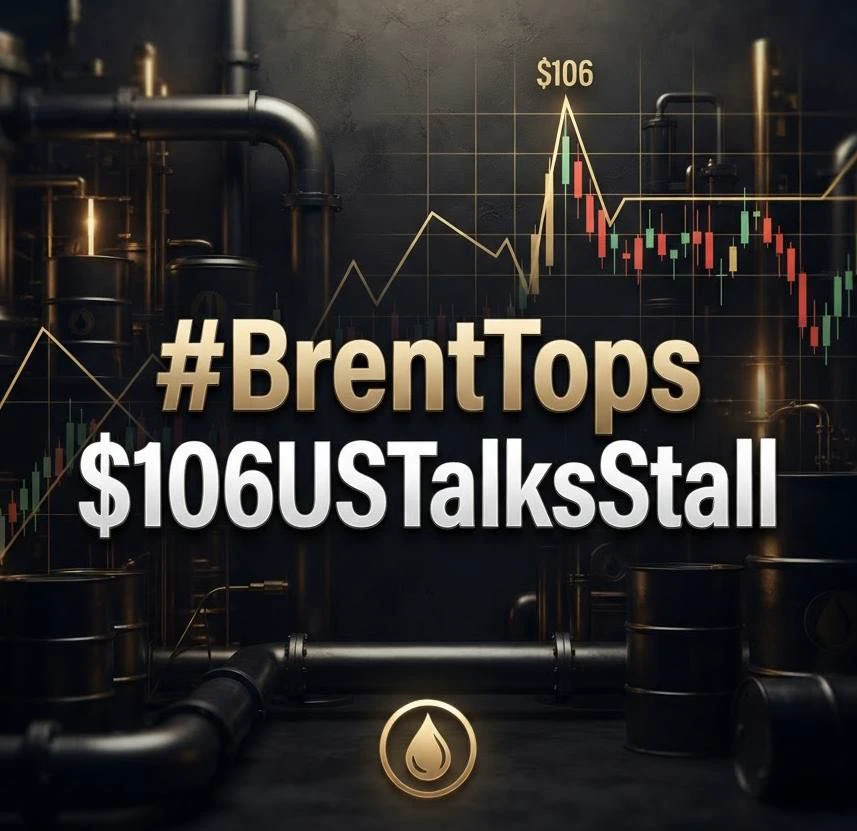
#BrentTops
HarryCrypto
#BrentTops$106USTalksStall
Brent at $107.05, WTI at $94.13: Oil’s Biggest Signal May Be the Spread
The most interesting thing in the oil market right now is not simply that Brent is above $107. It is the unusually large gap between Brent and WTI.
With XBRUSD at $107.05 and XTIUSD at $94.13, the spread is approximately $12.92 per barrel. That is a major difference, and in my view it tells us something important about where the market is placing its geopolitical risk premium.
Brent is the more internationally exposed benchmark, so when concerns rise around Middle Eastern exports and shipping routes, Brent can react much more aggressively than WTI. WTI, meanwhile, is more closely connected to the U.S. domestic supply picture. That makes the current divergence particularly interesting.
The U.S. inventory picture also matters. Commercial crude inventories previously showed a build of around 3 million barrels for the week ending September 18, despite expectations for a draw. That suggests the American market is not experiencing the same immediate supply stress being priced into international crude.
The geopolitical backdrop remains the major catalyst.
Diplomatic efforts involving Qatar have so far produced limited progress, while Iran has reportedly communicated a seven-point proposal through Qatar. At the same time, statements from U.S. officials have kept the possibility of renewed major operations in the background.
That uncertainty is enough to keep a premium embedded in Brent.
There is another important detail: Gulf exports reportedly recovered to around 12.8 million barrels per day in September, the highest level in seven months. However, that remains roughly 6 million barrels per day below February levels.
So the market is dealing with two opposing forces.
On one side, recovering exports can reduce the immediate supply shortage and potentially limit further upside. On the other, exports remain significantly below previous levels, meaning the physical market has not completely normalized.
That is why I am watching the Brent-WTI spread as closely as the outright price.
Brent Technical Picture
At $107.05, XBRUSD remains close to the recent resistance zone around $107.60–$107.91.
The previous move from roughly $101.10 to $107.60 was already a strong advance, and the market now needs fresh momentum to push through this resistance area.
My key levels are:
Resistance: $107.60 → $107.91 → $110.00
Support: $105.80 → $104.51 → $103.97
For me, the $104.51 area remains particularly important. As long as hourly closes continue holding above it, the broader short-term structure remains constructive.
I would rather see a controlled pullback toward $105.80–$106.00 than chase a move directly into $108.
A clean hourly breakout above $107.91 would put $110 back into focus.
WTI Is Telling a Different Story
XTIUSD is currently around $94.13, significantly below Brent.
Important levels are:
Resistance: $95.84 → $96.73
Support: $94.29 → $91.90
WTI needs to reclaim the $96.73 area to demonstrate stronger upside momentum. Until then, I see it as more range-bound compared with Brent.
The gold comparison is also interesting. XAUT recently flushed sharply and remains below its 200-period average around $4,221.7, while oil continues carrying the stronger geopolitical premium.
That divergence suggests the market is currently focusing more on potential energy-supply disruption than on a broad-based flight to safety.
For me, the next move in oil depends heavily on headlines, but the technical levels can still define the risk.
I am watching whether Brent can break $107.91, whether WTI can reclaim $96.73, and whether the huge spread begins narrowing.
Oil is no longer just about crude prices. The Brent-WTI gap may be the real geopolitical chart to watch.
Not financial advice. Always do your own research before making any trading or investment decision.
#美伊谈判陷入僵持布伦特站上106美元 #内容挖矿 #ShareWeekly #weeklyshare @Gate_Square
repost-content-media
  • 11
Leo_Kai
🔥 Gate Square Is Looking for Top Creators!
Create content on crypto or stocks, share insights, and earn more exposure and rewards!
🎁 Exclusive Creator Benefits
1️⃣ Up to 60% Content Mining Commission: Earn more from your content
2️⃣ $150,000+ Monthly Rewards: For certified & new creators
3️⃣ Monthly Growth Points Draw: Vouchers, tokens, Gate merch & more
4️⃣ Creator Support: More exposure, traffic boosts & 1-on-1 support
Turn great content into greater reach and rewards!
👉 Apply Now: https://www.gate.com/questionnaire/7698
👉 Start Creating: https://www.gate.com/post
  • 13
discovery
#非农就业数据 #每周来晒 September U.S. nonfarm payroll weakness may be merely an illusion, and expectations for a Fed rate hike this year may be difficult to change!
U.S. nonfarm payrolls increased by only 29,000 in September, significantly below expectations, prompting markets to quickly lower expectations for a rate hike in October. However, the household survey showed employment actually increased by 406,000, the labor force participation rate rose to 61.8%, and the unemployment rate edged up only slightly to 4.2%. Combined with continued strong U.S. economic growth, the nonfarm payroll data may not be as pessimistic as it appears, and the possibility of further Fed rate hikes this year cannot be ignored.
I. U.S. nonfarm employment came in below expectations in September, increasing by only 29,000, while the unemployment rate edged up to 4.2%.
The U.S. labor market suddenly poured cold water on the market.
On October 2, the U.S. Bureau of Labor Statistics released data showing that U.S. nonfarm employment increased by only 29,000 in September 2026, far below the market's previous expectations of approximately 84,000–90,000; the unemployment rate edged up from 4.1% to 4.2%.
More notably, data for the previous two months were also revised down significantly: July employment was revised from an increase of 21,000 to a decrease of 10,000, while August was revised from an increase of 162,000 to 133,000, meaning the combined figure for the two months was 60,000 jobs lower than previously reported. In other words, the U.S. labor market has indeed been cooling over the past few months, and the issue is not limited to September alone.
By industry, September's employment growth mainly came from healthcare, construction, and manufacturing. Healthcare added approximately 17,000 jobs, construction added 11,000, and manufacturing added 9,000; government employment fell by 17,000, information-sector employment declined by 10,000, and financial activities employment decreased by 7,000.
On the surface, this was clearly a weak nonfarm payrolls report. But that is precisely where the issue lies—weak nonfarm payroll data does not mean that the U.S. labor market has already deteriorated significantly. If U.S. companies were truly cutting jobs on a large scale, the unemployment rate would normally rise more noticeably, whereas in September it increased by only 0.1 percentage point.
More importantly, another set of survey data is telling a completely different story. Therefore, whether this nonfarm payrolls report reflects genuine weakness or a significant divergence between statistical methodologies deserves further examination.
II. After the nonfarm payrolls data were released, Treasury yields and the dollar index fell, while U.S. stocks rose as the probability of a Fed rate hike in October declined.
After the nonfarm payrolls data were released, the financial market's first reaction was very direct: weaker employment meant less pressure on the Fed to raise rates. After U.S. September nonfarm payrolls came in far below expectations, markets quickly reduced their bets on a rate hike at the Fed's October meeting, the dollar weakened temporarily, and U.S. stocks received support.
U.S. Treasury yields fell in response: the 10-year yield declined by approximately 3–6 basis points to around 5.18%–5.20%; the more policy-sensitive 2-year yield fell even more, dropping by 8–10 basis points at one point.
The market interpreted the cooling labor market as reducing near-term pressure on the Fed to raise rates, pushing bond prices higher and yields lower. The dollar index weakened in tandem, falling approximately 0.1%–0.2% that day to around 101.8–101.9. The weaker dollar directly reflected cooling rate expectations, while funds' relative attraction to U.S. Treasuries declined. At the same time, U.S. stocks gained support and rose.
Futures and cash markets for all three major stock indexes opened higher, with major indexes such as the S&P 500 and Nasdaq recording moderate gains, exceeding 0.5%–1% during some periods. Investors believed that slower employment growth reduced the risk of rapid policy tightening, supporting risk-asset valuations.
The CME FedWatch tool showed that market expectations for the Fed's October 27–28 meeting shifted sharply. In the week before the nonfarm payrolls report, the probability of a rate hike had been as high as approximately 70%, but had fallen to the 20%–30% range before the report; after the data were released, the probability of a 25-basis-point hike fell further to approximately 14%–22%, while the probability of keeping rates unchanged in the current 3.75%–4.00% range rose to approximately 78%–86%. However, markets still priced in a possible rate hike in December, while action in October was essentially ruled out.
Overall, weak nonfarm payrolls data reinforced the narrative of “slowing employment and inflation still requiring observation,” suppressing the urgency of a rate hike in the short term, driving yields lower, weakening the dollar, supporting a stock-market rebound, and sharply reducing the probability of an October hike.
Subsequent data such as CPI will continue to influence the final decision. Fed officials are weighing economic conditions and their implications for the next rate adjustment, and this report significantly changed the market's short-term pricing of the interest-rate path. This is actually easy to understand.
The Fed is currently facing not simply the question of whether employment is weak or strong, but a more difficult combination: economic growth remains resilient, inflation has not returned to the 2% target, and yet the labor market is beginning to show signs of cooling.
III. Nonfarm payrolls are misleading, and other data indicate that the U.S. labor market may be performing better than the nonfarm payrolls data suggest.
What truly deserves attention is the stark contrast between the two sets of employment data in September. The U.S. nonfarm payrolls survey primarily draws on businesses, while the unemployment rate and household employment data come from a household survey. In September, the establishment survey showed that U.S. nonfarm employment increased by only 29,000; however, the household survey showed that U.S. employment increased by 406,000, while the labor force grew by 485,000, and the labor force participation rate rose from 61.6% to 61.8%.
What does this mean? The establishment survey tells you that businesses did very little hiring. The household survey, however, tells you that employment increased substantially and that more people are entering the labor force. The two figures even appear to “contradict” each other. But that does not mean one of them is necessarily false. The two surveys differ in their subjects, sampling methods, and statistical methodologies, so significant short-term divergence is not unusual. At least one important fact is conveyed by this month's household survey: the U.S. labor market currently looks more like “low hiring, low unemployment” than “mass corporate layoffs.” These are fundamentally different situations. If companies were laying off workers in large numbers, we would typically see a significant increase in unemployment, a rapid rise in the unemployment rate, and a sustained increase in initial jobless claims. But the U.S. has not seen such a combination. On the contrary, the unemployment rate was only 4.2% in September, while the labor force participation rate continued to rise. A broader measure of unemployment, including discouraged workers and those working part-time for economic reasons, also fell from 7.7% to 7.6%, its lowest level since January 2025.
That is why some economists believe that although this nonfarm payrolls report was weak, it cannot simply be defined as a precursor to a U.S. recession.
Another extremely important signal is wages.
In September, average hourly earnings for private-sector nonfarm employees in the U.S. rose only 0.1% month over month and 3.0% year over year, the lowest growth rate since May 2021; average weekly hours remained at 34.4 hours. Slower wage growth is of course not a particularly positive employment signal, but from the Fed's perspective, it means that the pressure on inflation from labor costs is easing. The problem is that U.S. inflation has still not been fully resolved. At its September meeting, the Fed clearly stated that inflation remained elevated, while its long-term target is 2%. The latest data show that the personal consumption expenditures price index remains significantly above the target level. At the same time, U.S. economic growth has not displayed typical recessionary characteristics.
After revisions, economic data previously released by the U.S. Department of Commerce showed that economic growth in both the first and second quarters of 2026 was higher than previously estimated; the Atlanta Fed's GDPNow model at the end of September projected that U.S. real GDP growth in the third quarter of 2026 would be approximately 3.7% annualized.
It should be emphasized that GDPNow is a real-time estimation model, not an official forecast by the Atlanta Fed, but it at least indicates that current U.S. economic activity remains quite resilient. The question, then, becomes very clear. If the U.S. economy continues to grow at a relatively rapid pace, inflation remains above 2%, and the labor market is merely shifting from “overheating” to “low hiring, low unemployment,” why would the Fed have to completely abandon rate hikes because of one weak nonfarm payrolls report? The answer is: there is no need to do so. This is why the market currently tends to view the October meeting as a period of observation rather than interpreting it as the end of the rate-hike cycle.
A latest Reuters report showed that markets have significantly lowered expectations for an October rate hike, but investors still regard whether to raise rates in December as an important variable, while Fed officials have also emphasized the need to wait for more inflation and employment data.
In other words, what September's nonfarm payrolls truly changed may have been only the timing of rate hikes, not their direction. Of course, the biggest variable here remains inflation. If CPI and core inflation continue to decline over the coming months and employment deteriorates further, the Fed could pause rate hikes or even revisit an easing policy. But if inflation picks up again while economic growth remains resilient, the Fed will still have reasons to continue raising rates.
Therefore, do not focus solely on the 29,000 nonfarm jobs added in September. What truly determines U.S. monetary policy is never a single data point, but rather the relationship among employment, inflation, and economic growth.
This time, U.S. nonfarm payrolls data was indeed very weak. But when the household survey, labor force participation rate, unemployment rate, wages, jobless claims, and GDP growth are considered together, the U.S. economy may be far less weak than the nonfarm payrolls figure suggests. This also means that lower expectations for an October rate hike do not mean that expectations for a rate hike this year have disappeared. For global capital markets, the real test may still lie ahead.
  • 15
#OneGateWitnessprogram#ZRO
discovery
#OneGateWitnessProgram #ZRO
ZRO (LayerZero) MARKET ANALYSIS — $2.030
LayerZero (ZRO) is currently trading around $2.03, and the short-term structure has turned strongly bullish.
Live market data shows ZRO up roughly 15% in 24 hours, with a 24H high near $2.12 and low around $1.73. 24H trading volume is above $200M, while derivatives activity is also elevated, with roughly $386M futures volume and $282M open interest.
24-HOUR OUTLOOK
The immediate battle is between $2.00 support and $2.12 resistance.
If ZRO holds $2.00–$2.03 and buyers break $2.12 with strong volume, the next targets could be:
$2.20 → $2.30 → $2.40
A clean move above $2.40 would strengthen the bullish structure and could push ZRO toward $2.50–$2.60.
However, after a roughly 15% one-day rally, profit-taking risk is high.
If ZRO falls below $2.00, the first retest zone is $1.90–$1.95.
Losing $1.90 could bring $1.80–$1.85 back into focus.
7-DAY OUTLOOK
The weekly structure is even more interesting. ZRO is approximately 27% higher than one week ago and around 84% higher over one month, showing a major improvement in momentum.
Key scenarios:
• Above $2.12 → bullish continuation toward $2.30–$2.40
• Above $2.40 → potential $2.50–$2.70 move
• Above $2.70 → momentum could target $2.80–$3.00
• $1.90–$2.12 → consolidation and breakout preparation
• Below $1.90 → bullish momentum weakens, with $1.75–$1.80 possible
One important factor is derivatives positioning. Futures volume is currently several times larger than spot volume, while open interest is also substantial.
That means a breakout can accelerate quickly, but excessive leverage can also create sharp pullbacks.
My view:
At $2.03, ZRO is bullish but already extended after a powerful 24H move.
The most important confirmation is $2.12. Holding $2.00 and breaking $2.12 with increasing volume could open $2.30 → $2.40 → $2.60, while losing $1.90 would warn that the current rally is entering a deeper correction.$ZRO ‌
ZRO+14.98%
  • 16
#TradeTheFedFOMCAndUSRetailSaleCFD Challenge
Economic events can create some of the biggest trading opportunities in the market. With the FOMC meeting and U.S. Retail Sales data approaching, traders are preparing for potential volatility and trend changes across multiple assets.
A well-planned strategy, proper risk management, and staying updated with market news can make a big difference during these high-impact events.
Good luck to everyone participating!
#Trading #CFD #FOMC
  • 15
🎉 The brand-new “Live Streaming Growth Points Tasks” are here!
Watch livestreams and interact with just a few taps to accumulate growth points, unlock more lucky draw chances, and claim exciting gifts!
📍 Open the Gate App homepage: 【Livestream】→ 【➕】→【Activity Center】 in the bottom right→【Live Streaming Growth Points Tasks】
👉 https://www.gate.com/help/community-center/live/101267
Complete the daily livestream tasks:
🎬 Watch livestreams
❤️ Like and interact
💬 Post comments
📈 Tap the livestream trading component
📤 Share the livestream
⏰ Schedule exciting livestreams
🎁 The prize pool will
post-image
  • 7