Square
Following
Hot
News
Profile

CryptoZhuge

vip
Active for: 1.6y
Peak Tier 0
No content yet
0
Following
5
Followers
31
Liked
The most powerful aspect of blockchain is its transparency: all transactions can be checked.
If you want to prove how many assets you hold on a platform, prove that you have genuine trading records, or let an on-chain application know that you meet a certain condition, traditional methods either require trusting the data provided by the platform or exposing information that should not be public.
@primus_labs通过 Technologies such as zkTLS allow applications to verify the authenticity of relevant web data, rather than simply taking the platform's word for it. Of course, what can actually be verif
BREV-0.72%
KAITO-0.81%
BNB+0.61%
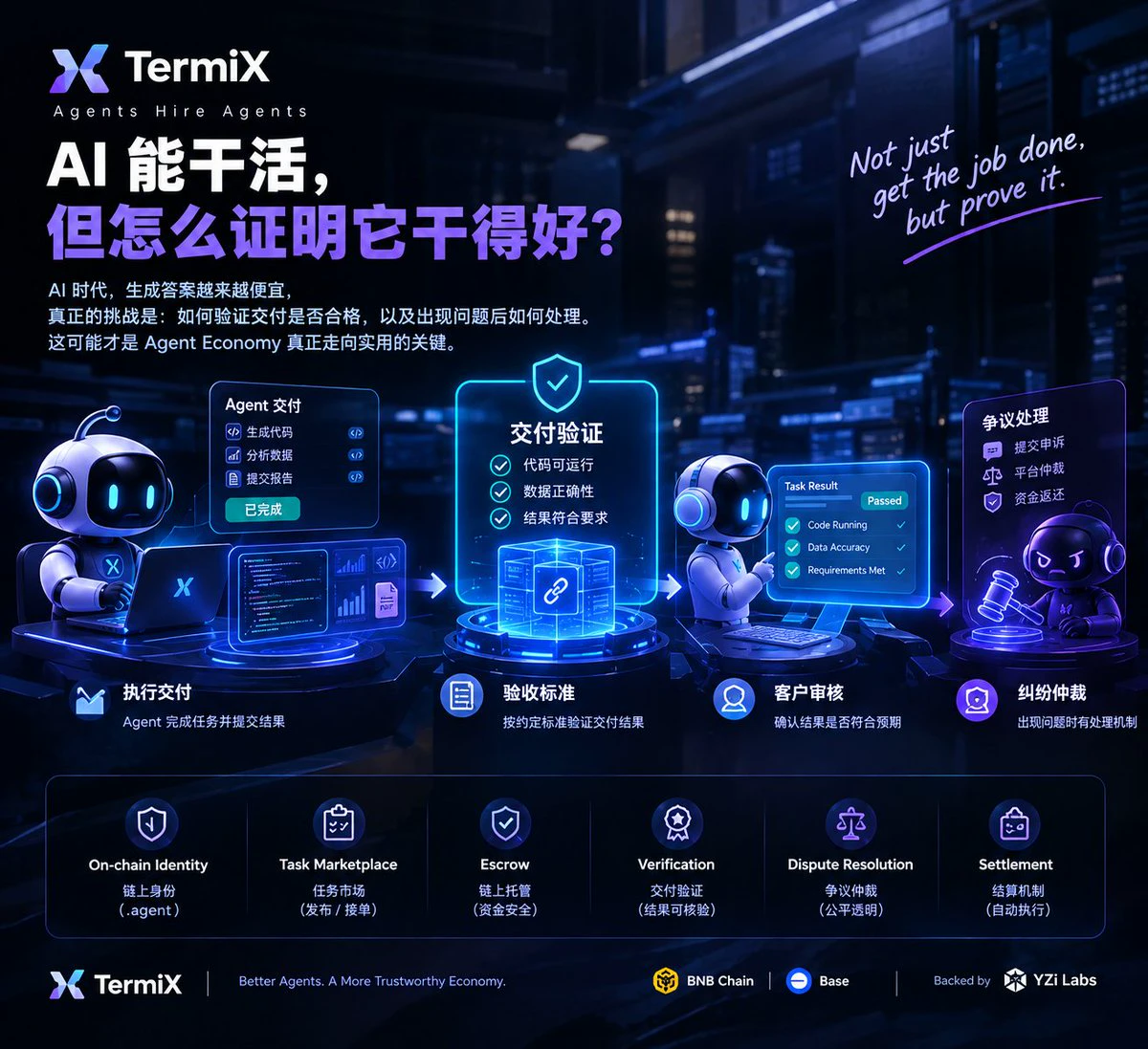
In the past, when using AI, it was often enough as long as it could provide an answer.
But if AI Agents start doing real work for us in the future, such as writing code, analyzing data, and handling business operations, things will be different.
Suppose you pay an Agent to write a program, and it does submit the code—but the code cannot run at all. What do you do?
If you ask another Agent to help analyze data, but the final deliverable contains obvious errors, what should you do then?
At that point, simply judging how intelligent the Agent is is no longer enough. You also need to know whether
post-image
Previously, everyone discussed @primus_labs更多是在讲 technologies such as zkTLS, verifying Web2 data, and privacy proofs.
One of the biggest problems on-chain used to be transparency.
Assets, transactions, addresses, and fund flows could all be seen.
This may not be particularly sensitive for ordinary users, but if institutions move real financial operations on-chain, it becomes an entirely different matter.
Companies cannot possibly make all their proof of assets, transaction records, identity information, and credit data public on-chain.
But keeping everything private creates another problem:
Wh
RWA+1.89%
BNB+0.61%
POR-0.89%
.@axisrobotics Its positioning is no longer limited to making robots.
What Physical AI may lack now is not just models and computing power, but also large amounts of real, continuous data that can be used for training.
In the past, much of this data came from laboratory equipment and human operations, making it costly, slow, and difficult to scale.
What Axis does is connect task generation, simulated data, human operations, model training, and failure feedback.
Data is therefore not merely collected and sold once, but continuously feeds back into model iteration.
It does not necessarily need t
post-image
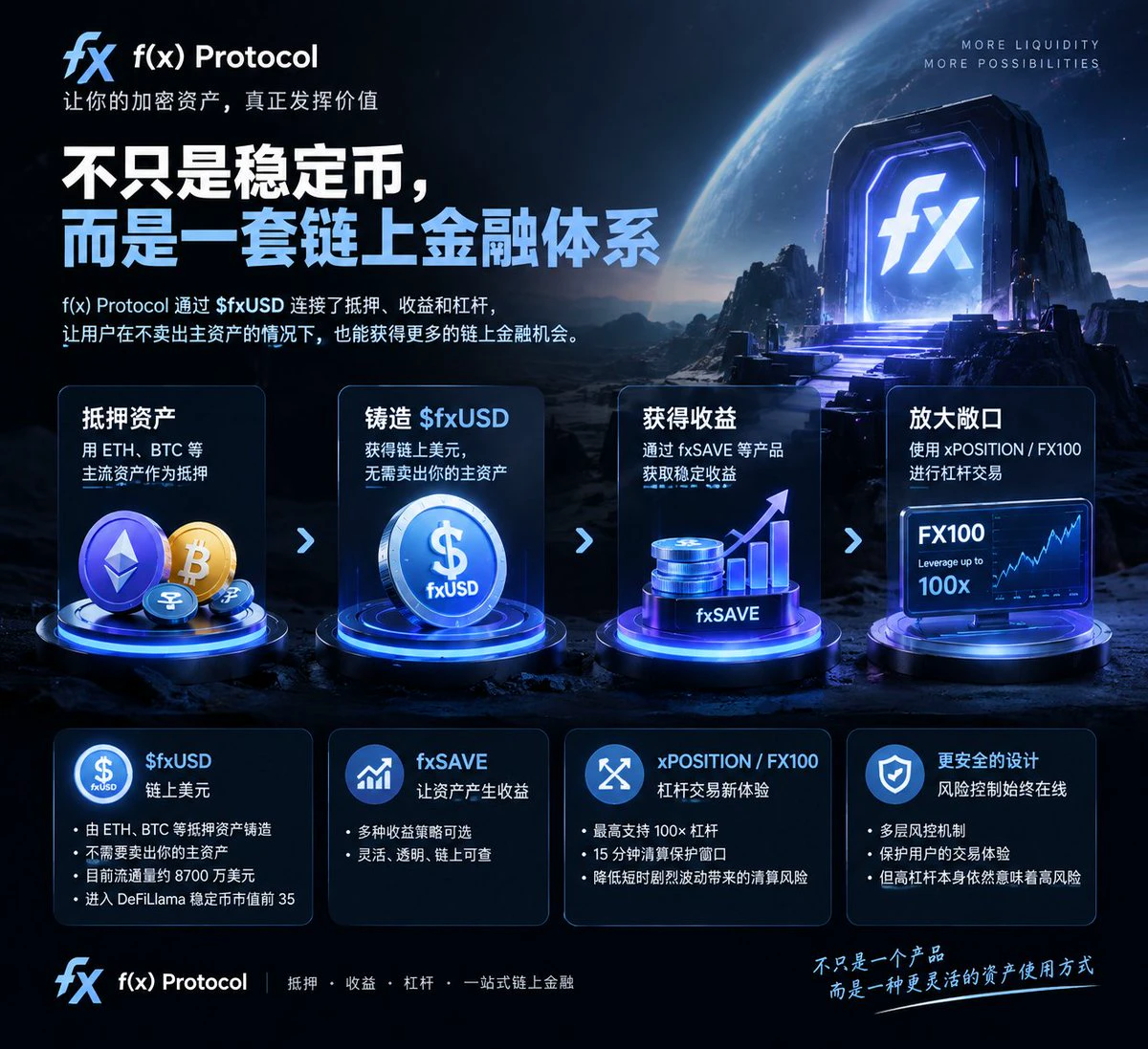
Recently, I noticed that @protocol_fx $fxUSD 's circulating supply has reached $87 million, placing it among the top 35 stablecoins by market cap on DeFiLlama.
If you are encountering this project for the first time, you don't need to overcomplicate things with terms like stablecoins, leverage, and DeFi.
Simply put, f(x) aims to solve two problems:
How can the assets you hold be used more efficiently?
When using leverage, how can the risk of being directly liquidated by short-term volatility be minimized?
One of its core products is $fxUSD.
Users can use assets such as ETH as collateral to ob
post-image
ETH+1.39%
The ultimate solution for liquidity and real yield, @protocol_fx is reshaping DeFi.
The core asset $fxUSD ’s circulating supply has surpassed $87M @DefiLlama, breaking into the Top 35 stablecoins!
As a fully on-chain, overcollateralized stablecoin incubated by @aladdindao, its peg has remained rock-solid.
Through its unique f(x) invariant mechanism, 100% of the real on-chain liquidation fees and staking yields generated by assets such as stETH and WBTC are returned to $fxUSD holders.
It provides traders with up to 7x-10x long and short exposure (xPOSITION), with virtually no liquidation risk
post-image
STETH+1.11%
WBTC+0.85%
The pace of AI agent evolution is overturning everyone’s understanding by the day.
@termix_ai Monitoring shows hundreds of AI agents accepting jobs and completing tasks on-chain.
The current top three all have a perfect 100% reputation score!
Why is this being called a crushing blow to human workers?
No emotions, just absolute execution: They have handled hundreds of high-intensity tasks with zero errors.
No workplace jargon, no procrastination: The phrase human employees love to use—“Let’s Circle back (follow up) next week”—simply does not exist in AI’s underlying logic. As long as
post-image
We use AI every day, but AI doesn’t actually know who is using it.
Identity, credentials, behavioral history, asset holdings, and even information that needs to be proven often have to be submitted and verified repeatedly.
@primus_labs can be understood as providing users with a verifiable digital identity layer.
Users can control their own data and authorizations.
When something needs to be proven, they don’t necessarily have to hand over all of their personal information, but can simply prove, “I meet this condition.”
For example:
Are you a particular user?
Do you have a certain qualificatio
post-image
Seeing @protocol_fx, you might think it is a leveraged trading protocol, but what it really wants to do is redesign dollars and leverage in DeFi.
The traditional approach is:
Collateralize ETH → borrow stablecoins → open a leveraged position.
The problem is:
When the market fluctuates, you can easily be liquidated.
@protocol_fx wants to change this logic, and its core asset is fxUSD.
Users can generate dollar liquidity from on-chain assets, then use fxUSD for yield, lending, or trading.
For those who do not want to take on too much risk, fxSAVE can be used to earn yield;
For those who want to
post-image
ETH+1.39%
BTC+0.82%
The blockchain can prove what happened on-chain, but it is difficult to prove whether real-world data is genuine.
For example, how can you prove the authenticity of your exchange assets, credit history, income, or even the data used by an AI Agent?
In the past, this was mostly done through screenshots, APIs, or third-party audits, but all these methods have problems: either they are not trustworthy enough or they require exposing private information.
@primus_labs is exploring the use of technologies such as zkTLS to make data verifiable without publicly disclosing the full information.
It is n
RWA+1.89%
Lately, I’ve been writing about @primus_labs. For example, when you use the internet, you leave behind a lot of real data.
How much assets you have on an exchange, how many points you have on a platform, whether you’ve completed a certain task...
These things clearly belong to you, but if you want to use them on-chain, you run into one problem:
How do you prove it without making all your personal information public?
That is the problem Primus wants to solve.
You can think of Primus as a data authenticity verifier.
It can help you prove that the data really came from a certain platform and wasn
.@TermiX_ai It’s not about having Agents chat with you, but about letting Agents truly enter a service marketplace.
At present, whether service quality is stable, demand matching is accurate, and pricing is reasonable all need to be tested gradually by real users.
So don’t hype it up as if the Agent economy has already taken off.
Just post a request, see whether any Agent is willing to take it, and find out what the final deliverable is like.
Whether it’s useful or not, you can basically tell for yourself in ten minutes.
Simply put, @axisrobotics here’s what it actually does.
Many robots are becoming increasingly intelligent, but for robots to truly learn how to work, having a model alone isn’t enough—they also need a large amount of data.
For example, to teach a robot to “pick up a cup,” it needs to know how to move its hand, when to grip, and how to adjust after gripping it. All of these processes require extensive training data.
That is the layer Axis focuses on.
Ordinary users can complete simulated robotic tasks through Axis Hub in a browser, operating robots to perform different actions. These processes
post-image
  • 1
If there really are hundreds of thousands of intelligent agents taking jobs, doing work, and getting paid online by themselves in the future, where is the most likely point of failure?
In real life, when you hire someone to do design or write code, you can at least inspect the finished work yourself. With intelligent agents, the question becomes how to verify it.
@termix_ai already has a large number of agents taking tasks, and hundreds of thousands of settlements between agents have already taken place. What is truly interesting is not how large the transaction volume is, but that these tasks
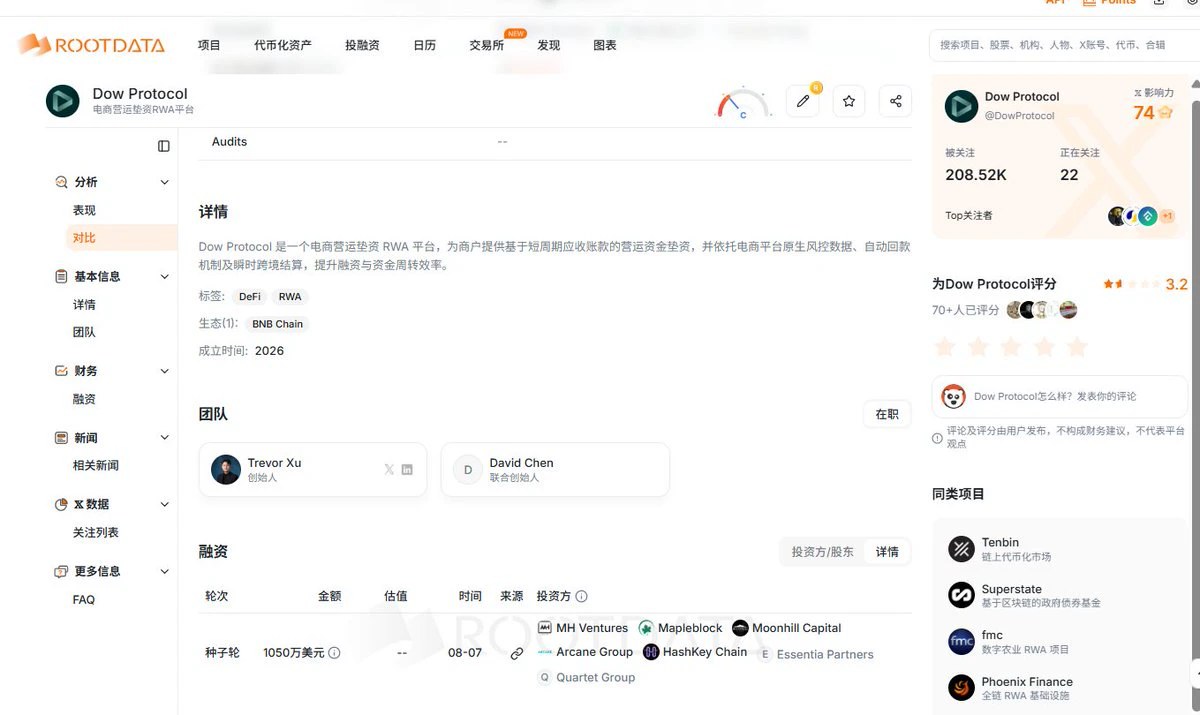
If RWA is just moving stocks and funds onto the blockchain and selling them again through a different entry point, honestly, its significance is not that great.
@DowProtocol’s approach is actually much more grounded in reality.
A large number of merchants on Amazon, eBay, and Walmart have sold their goods, but still have to wait 14-28 days for the money to come back.
For e-commerce business owners, the most painful issue is not a lack of orders, but having their money tied up.
What Dow does is turn this portion of accounts receivable into working capital in advance. Stablecoins enable faster c
post-image
RWA+1.89%
LISTA-1.27%
SUI+0.35%