runesleo

vip
Active for: 8.6y
Peak Tier 6
No content yet
Recently, I’ve been researching @ethos_network’s $WHUF Sale.
There’s a design in it that I rarely see in Crypto Token Sales:
85% purchase-price protection.
At first glance, it’s easy to interpret this as:
“So does that mean the maximum loss is 15%?”
But after breaking down the official rules in full, I found that this isn’t the right way to understand it.
First, the project itself.
Ethos is an onchain reputation / credibility network: through mechanisms such as Reviews, Vouches, and Markets, it turns a person’s reputation across onchain and social networks into a credibility graph that can be
USDC-0.01%
View Original
post-image
  • Reward
  • Comment
  • Repost
  • Share
I no longer really want to manage a pile of AI conversations myself.
I’d rather manage just one “boss.”
I give it a goal, and it decides what needs to be done, assigns adjacent tasks to different business conversations to move forward, and once the results and acknowledgments come back, it decides the next step.
My previous way of working looked more like this:
Me → Chat A
Me → Chat B
Me → Chat C
Me → Chat D
Every time I opened another AI, I had one more window to manage myself.
Now I’m trying a different approach:
Me → master control conversation

Select current task
↓ ↓ ↓
Bu
View Original
post-image
  • Reward
  • Comment
  • Repost
  • Share
In a bull market, I increasingly feel that one of the most valuable things research can do is not help you find more things to buy.
It helps you have evidence-based reasons not to chase.
I recently broke down a Polymarket address.
On the surface, it was indeed making money.
But after breaking down the books:
Gross trading profit: +$46,224
Fees: −$46,143
Only +$81 remained at the trading layer.
What really drove up the net result was an additional +$22,273 in taker rebates.
In other words, if you only see that it is “making money” and copy its trading approach, you will almost certainly miss th
View Original
post-image
  • Reward
  • Comment
  • Repost
  • Share
The bull market is here, and one of the first preparations I’ve made recently is:
Setting aside a sum of money and a wallet specifically for AI.
In the last bull market, I prepared exchanges, wallets, funds, and various information sources.
This time around, even AI needs an “execution account” prepared in advance.
Because AI can now help me find opportunities, conduct research, monitor data, and decide whether to participate.
But if the final process is still:
AI discovers an opportunity → tells me → I open my computer → find the wallet → move funds → execute
then it will always just be a res
SOL1.65%
View Original
post-image
  • Reward
  • Comment
  • Repost
  • Share
The more Agents there are, the worse the system may even become.
Not because the Agents cannot work.
But because they work too fast.
Recently, every time I tested @bot Grok Bot, over the past 48 hours, 7 independent conversations in my GrokBot produced 30 results in total.
20 yesterday and 10 today. 🤣
But the problem is that none of them entered the main consumption pipeline.
In other words, I automated “production” but did not automate “consumption.”
This made me redefine what completion means for an Agent:
Output ≠ Done
Only Output → Routed → Consumed → Promoted → Impact counts as truly com
View Original
  • Reward
  • Comment
  • Repost
  • Share
I do feel like buying the new Mac Studio.
But after thinking it over, I’ll hold off for now.
I’m setting a KPI for my current AI system:
First, help me earn another 100k, then use the money I earn to upgrade its hardware.
That feels more reasonable.
View Original
post-image
  • Reward
  • 1
  • Repost
  • Share
政不通人不和:
What do you think of the above data technology expert? It’s you, you, you—only you can say it, so go ahead.
After using AI for so long, I’m no longer just annoyed that software is difficult to use—I even find clicking buttons too much of a hassle.
Whenever I see a new product, my first reaction is always, “I really can’t be bothered to figure this out. Can’t you just skip the registration, tutorials, and menus and let AI use it for me?”
I’m genuinely curious—I can’t be the only one who feels this way, right?🤦
View Original
  • Reward
  • Comment
  • Repost
  • Share
Using Codex App, I’ve connected the mechanical workflow for an X post:
Format the article → upload images → schedule it → retrieve the data after publishing.
What it really eliminates isn’t any single plugin, but the repeated copying, checking, and window switching between four tools.
But “the button was clicked successfully” doesn’t mean publishing is complete. I now always perform three checks:
1. The scheduling list shows the exact time
2. The body text and images match when retrieved
3. After publishing, obtain the unique URL, then move on to data review
The value of automati
View Original
  • Reward
  • Comment
  • Repost
  • Share
Communication between different AI sessions has already started to resemble a master control Agent dispatching a group of executors.
What I actually use is not the slogan of an “AI team,” but these functions:
• Hand a task over to another session
• Create, close, and archive sessions
• Queue multiple tasks instead of having them compete for context
• Have another session continue after one is interrupted
I used to manually copy progress and repeatedly explain the background; now the master control only needs to monitor status and verify completion.
Moving from “a single chat window” to “a sche
View Original
post-image
  • Reward
  • Comment
  • Repost
  • Share
I recalculated every trade for the complete two-day window of the three addresses whose 30-day curves were all positive. After deducting taker fees: −1,634 / −627 / −976. What you can see is behavior; what makes money is structure.
View Original
  • Reward
  • Comment
  • Repost
  • Share
Grok Bot has no official inbound API, CLI, or webhook.
I still connected it to my own workflow.
But what truly makes this pipeline reliable is not that it “can click buttons automatically,” but that I finally stopped treating simulated keystrokes as proof of delivery.
The most dangerous part of GUI automation is that the script can report failure while the command may already have been executed in another foreground window.
So now, dispatching a task must pass through five layers:
1. The task first enters a persistent queue instead of being sent directly via keystrokes
2. Only one writer is al
View Original
post-image
  • Reward
  • Comment
  • Repost
  • Share
When you have Codex, Claude Code, Cursor, Grok, and ChatGPT all modify the same codebase, what goes out of control first is often not code quality, but Git.
Agent A may casually commit changes Agent B has not finished; a full stage will also sweep logs, caches, and unfinished work into the commit. In the end, you may not even be able to tell who made a change or where to roll it back to.
The most dangerous “fix” is precisely a scheduled auto commit. It merely hardens a dirty working tree into dirty history.
So what I ultimately built was not an auto-commit bot, but a worktree-first Git safety
View Original
post-image
  • Reward
  • Comment
  • Repost
  • Share
I let Grok Bot run 500 rounds overnight.
The next day, when I opened my computer, I didn’t read them one by one—I only looked at the 3 candidates pending evaluation.
When many people see a long loop, their first reaction is: Is this just pointless self-circulation?
I also had another AI review this system. When it saw more than 500 rounds, it immediately suggested changing it to “stop after one question, with a maximum of 3 questions per day.”
I stopped it immediately.
Because what really needs to be compressed is not research throughput, but the consumption layer.
These overnight loops are no
View Original
post-image
  • Reward
  • Comment
  • Repost
  • Share
When researching top Polymarket wallets, the most dangerous misjudgment is not failing to understand the strategy, but mistaking access privileges for strategy.
A screenshot shared in the group this time means this default assumption must be reexamined.
The discussion centers on two things: whether invited accounts have a more direct private line, and the so-called 80% taker rebate.
Let’s clarify the boundaries first: the screenshot and discussion both exist, but I have not yet found this account-level rule set in the public documentation. Eligibility, fee caps, direct-connection scope, and ap
View Original
  • Reward
  • Comment
  • Repost
  • Share
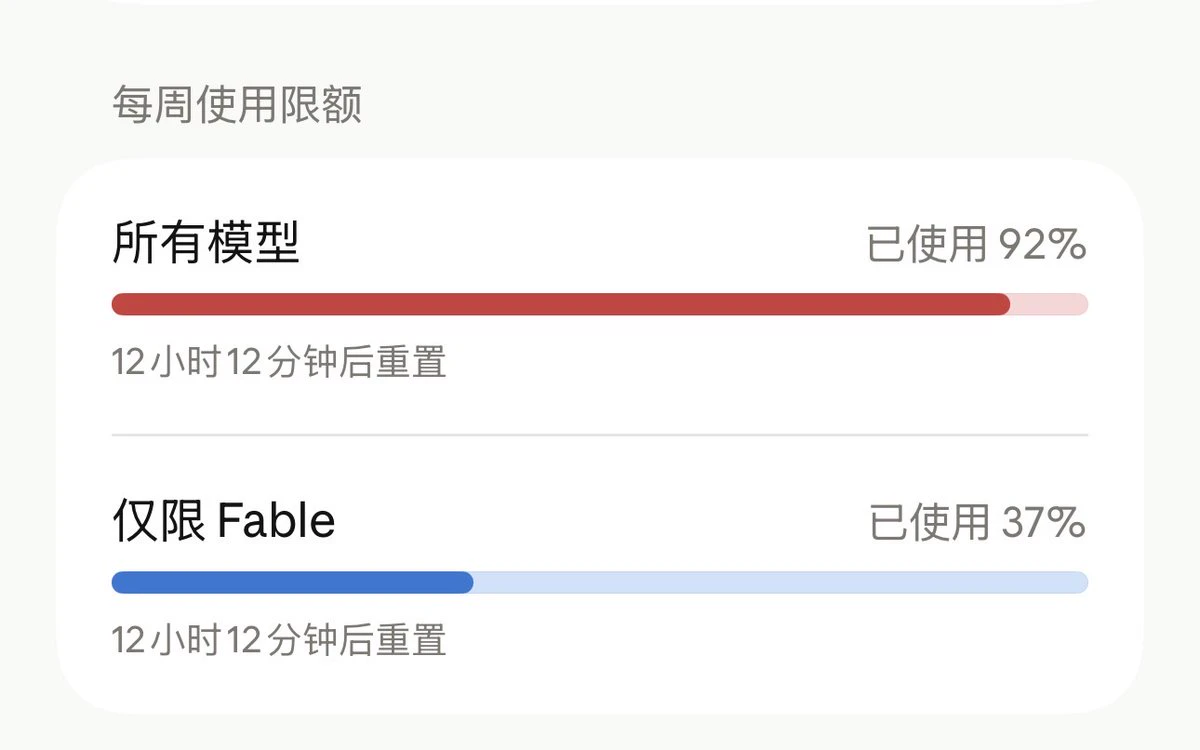
Codex's main-plan weekly quota is used up, so don't rush to buy an account or wait for the reset. There's another tier you may not have used.
Codex's quota consists of two independent pools, and even their reset times are different. For example, mine are:
General limit: 0% remaining, resets at 17:00 on August 20
GPT-5.3-Codex-Spark: 90% remaining, resets at 21:15 on August 21
When the main pool is exhausted, the Spark pool is basically still full.
Things you can let it do:
・Modify code in a git repository; if it makes a mistake, checkout to revert
・Add test cases; once they pass, the task is c
View Original
post-image
  • Reward
  • Comment
  • Repost
  • Share
  • Pinned