Square
Following
Hot
News
Notifications
Profile

AirdropMileCounter

vip
I track quests like mileage—bridges, swaps, claims, all logged. If it feels like a job, I automate or quit.
Peak Tier VIP 00.7 Year(s)
88
Following
11
Followers
8
Liked
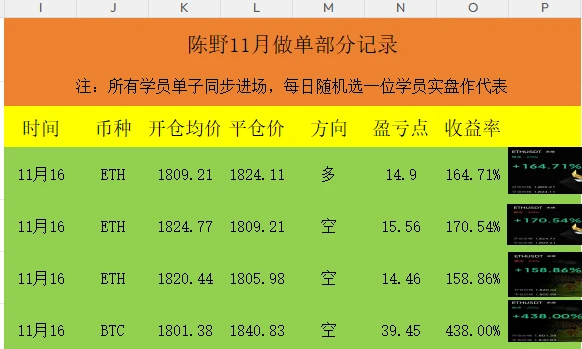
BTC short, 438%—make a note of this and check later whether the funding rate spread at the time offered an arbitrage opportunity
ChenYeBit
Yesterday’s market played out exactly as predicted: all four trades closed in profit, without missing a single one.
Ethereum longs and shorts both got hit; the three trades averaged over 160% returns. The Bitcoin short alone brought in a massive 438% gain—a position-doubling-level move.
Don’t ask whether the calls are accurate—students’ live trades are selected at random, with entries and take-profits executed in sync. The track record speaks for itself.
If you want to steadily profit in this market, following the right person is far more useful than guessing on your own. Keep up with the pace—bigger moves are still ahead. $BTC $ETH #Gate直通IPO第三期Anthropic
repost-content-media
BTC-0.65%
Stablecoins shrank by 17 billion in six months; liquidity drying up is more frightening than a price crash. Without new money coming in, even the strongest narrative can't hold up.
User_any
The supply of stablecoins—the most fundamental liquidity indicator in the crypto market—has contracted by approximately $17 billion since April. This is not merely a decline in a figure; it is a reflection of how capital is behaving.
The total value has fallen from roughly $280 billion to $263 billion—a 6% decline over six months and the lowest level seen in more than a year. October alone saw a net outflow of $6.9 billion, signaling an acceleration in this contraction. At current prices, this amount is equivalent to the purchasing power of approximately 90,000 Bitcoin.
Why has this contraction accelerated?
Three factors are at play simultaneously.
First, there is a reduction in risk appetite and a loss of confidence. Analyses point to weak demand and limited liquidity inflows, compounded by geopolitical and economic developments, as well as recurring security vulnerabilities within the ecosystem. Investors now perceive keeping their funds in the market as increasingly risky.
Second, there are platform-specific shocks. In late October, one of the industry’s major platforms experienced a massive outflow—one of the largest on record—totaling $6.3 billion, with stablecoins accounting for more than 65% of that figure. The 90-day average value of stablecoins on that platform dropped from $51 billion to $34 billion. In other words, this decline is not just a reflection of broader market trends, but also a direct consequence of a crisis in confidence.
Third, there is a lack of new capital entering the market. The $6.9 billion monthly outflow indicates that existing capital is leaving, while new inflows have come to a halt. Since stablecoins serve as the gateway for entry into the crypto market, a contraction in their supply inevitably leads to a decline in potential buying demand. Is the core of the market still solid?
Despite the contraction, the structure remains centered around two major players. USDT, with a supply of approximately $175 billion, and USDC, with about $65 billion, constitute the two largest pools. Sustainable growth in the supply of these two assets is seen as the clearest indicator that broader crypto liquidity could be supported. However, the current picture suggests the opposite: this support is weakening.
Consequently, the performance of these two core assets has become just as significant as the total market supply. If liquidity is to return, it is expected to appear here first.
Why do Bitcoin and altcoins experience this differently?
Historically, an expansion in stablecoin supply has coincided with Bitcoin bull markets, while periods of contraction have been associated with sideways or downward price movements. Even if Bitcoin manages to hold around the $80,000 level, it is believed that any recovery momentum may remain limited without growth in new stablecoin supply.
The impact is felt more acutely among altcoins, as they are highly sensitive to liquidity. When capital flows out, assets with smaller market capitalizations often experience sharper price declines. For this reason, liquidity pressure manifests in the altcoin market first, while Bitcoin tends to remain relatively more resilient.
Is a recovery possible without a return of liquidity?
Analysts are in clear agreement: the market is in urgent need of fresh liquidity. If capital remains scarce, the positive trends that have emerged in recent months could reverse.
Here are three signals to watch: Is the total stablecoin supply beginning to grow again? Are there clear inflows into the two major stablecoin pools? And have outflows driven by security concerns ceased, with deposits beginning to return? It is difficult to speak of a sustainable upward trend without these three factors.
In short, it is hard for the price to surge on its own without an influx of capital. Liquidity is the fuel for price, and right now, the tank is running low.
This content is for informational purposes only and does not constitute investment advice.
#StablecoinMarketCapShrinks17BInSixMonths
$GUSD $RLUSD $USDC $USD1 $USDP
repost-content-media
The screenshot of a huge on-chain transfer is going viral again, and my first thought isn’t “follow it,” but “oh, someone’s making up a story again.”

I’ve tried jumping in whenever I saw unusual activity a few times before, then realized that “smart money” might just be an exchange moving funds to a cold wallet, or an institution shifting its positions—nothing to do with me. Now, when I get the urge to add to my position, I stop for half a minute and ask myself whether I’ve seen any new information or am just being pushed by FOMO—most of the time, it’s the latter.

Anyway, as someone who does
Restaking protocols like EigenLayer stack yields like a mille-crepe cake, but honestly, I still haven't fully figured out this shared underlying security thing—if an AVS goes down, could my ETH get slashed too? The yields are stacked, and so are the risks, but nobody tells you.

Social mining is pretty noisy too. Monetizing attention sounds great, but most of the time your attention is worth only the expectation of an airdrop from the platform. Fan tokens also have poor liquidity, and slippage when you sell can eat up half a month's “mining rewards.”

When there's too much noise, I just turn o
EIGEN-0.85%
ETH-1.26%
Recently, I’ve tweaked my cross-chain and swap habits. I used to always want to do everything in one go, going straight through the mainnet. The gas fees were ridiculously high, and waiting those few minutes for confirmation made me feel like a cat was scratching at my heart. Now I’ve learned my lesson and moved all small transactions to L2s. It’s a bit slower, but at least the fees don’t hurt as much. I only leave things that genuinely need liquidity on the mainnet—I’m not in a rush anyway.

It’s actually pretty contradictory. L2s are all over the place now, and every one of them claims to be
Honestly, I had already unfollowed a bunch of accounts like these because all those large on-chain transfers and hot/cold wallet movements did nothing but make me anxious. But yesterday I couldn't resist searching them up again and taking a look, thinking, “What if it's smart money?” I almost convinced myself to chase a meme. Luckily, I calmed down while sitting in the bathroom and asked myself: If this coin goes to zero tomorrow, will I run? The answer was that I’d want to run, but on-chain slippage might keep me from getting out. That snapped me back to reality.

I still follow a few of them
MEME-0.94%
To be honest, when I’ve been looking at the returns from LSTs and re-staking lately, I feel kind of tangled up inside. Where does the yield come from? Basically, it’s like you hand your assets to someone else, and they go do the work—maybe running validator nodes, providing liquidity, or messing around with some DeFi. What you earn is either gas fees, protocol subsidies, or incentive tokens. But the risks are there too—you know them: contract vulnerabilities, the protocol pulling a rug, or incentive token prices crashing, and it’s back to square one overnight.

I’m the type of person who has c
To be honest, lately every time I browse Twitter and see all kinds of social mining and badge campaigns, one thought keeps popping into my head: don’t fool yourself. Chasing an “identity” by tapping around on-chain—on the surface it’s “boosting contributions,” but in reality you’re just working for the project team. I don’t regret the outcome; I regret that I kept pushing forward even though I clearly knew the time was being chewed up. The controversy around privacy coins was similar: the more people argued about where the compliance line should be, the louder it got. In the circle, people cha
To be honest, the market has been tightening up lately, and the little on-chain liquidity seems to have hit rock bottom… People are arguing pretty loudly about which Layer 2 has higher TPS, or who offers more subsidies, but I honestly can’t be bothered to care who’s faster or cheaper right now. Once the liquid funds are gone, that’s the real thing. In any case, my principle is just one line: treat complexity as the enemy—simplify whenever you can. For now, just pull back and don’t mess around blindly. When liquidity truly comes back, we’ll talk again. Everything else is just noise.
Balance sheet management > 24/7 liquidity. It seems that in institutions’ eyes, tokenization is first an accounting tool, and only secondarily a trading toy.
Original content no longer visible
An average of $118 million per trade—exchanges have to step aside; the density of hot money in this track is a bit absurd.
WuSaidBlockchainW
According to CryptoRank data, the projected average single-transaction funding size in 2026 is $118 million, ranking first among all categories; followed by exchanges at $76.2 million, blockchains at $47.8 million, and compliance at $29.4 million.
Coutts’s take is quite interesting—longer-term divergence is bullish, while near-term signals are bearish. It’s a classic “bottoming” script; patience matters more than trying to catch the dip.
Original content no longer visible
BLSH-4.43%
From memory manufacturer to core AI infrastructure asset, the subscription heat for SK Hynix's ADR reflects the power shift across the entire industry chain.
Ai_Power
#SKHynixADROversubscribed
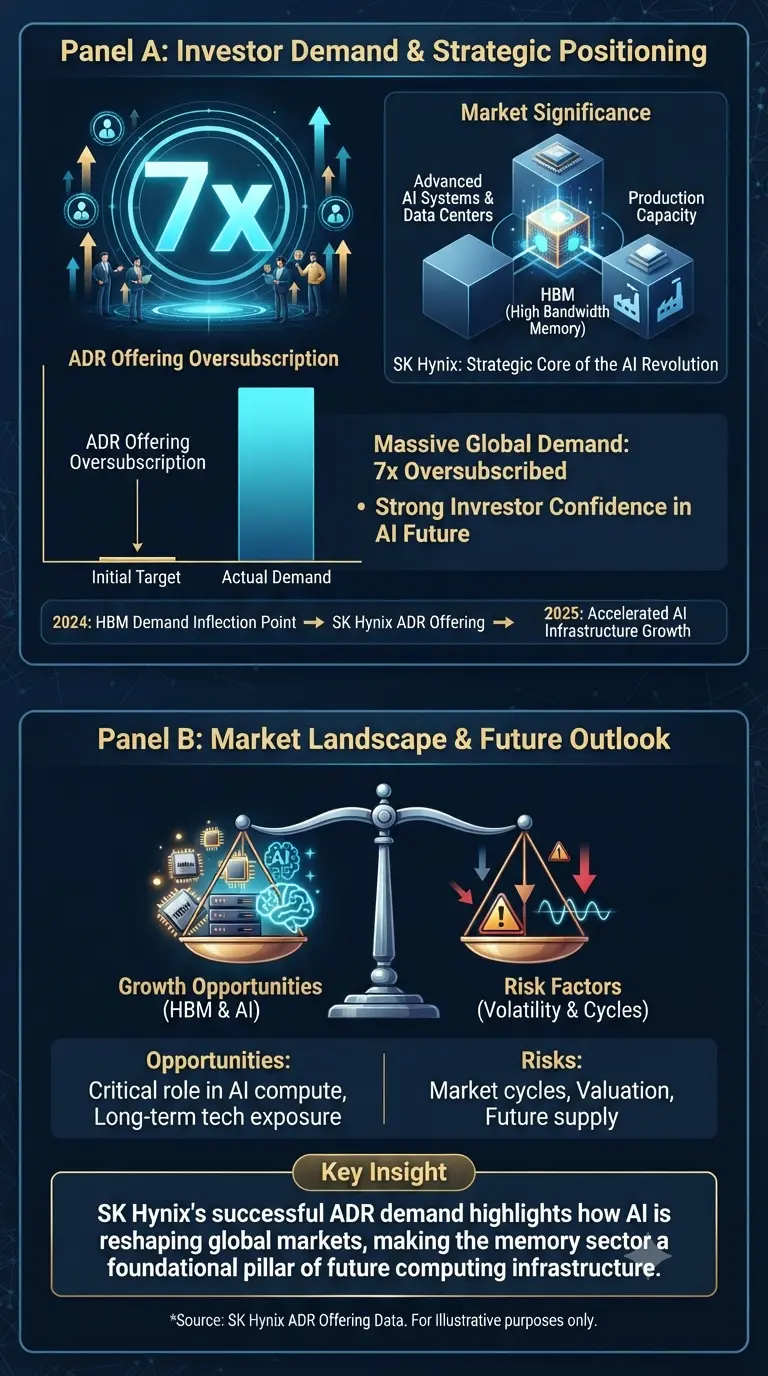
SK hynix’s U.S. ADR offering has attracted massive investor demand, becoming more than seven times oversubscribed as global investors show strong confidence in the future of the AI semiconductor industry. The offering, one of the largest equity sales in history, highlights growing interest in companies positioned at the center of the AI infrastructure revolution.
The strong demand reflects SK hynix’s strategic importance in the high bandwidth memory, HBM, market, which has become a critical component for advanced AI systems and data center growth. As AI companies continue expanding computing capacity, memory suppliers are gaining increased attention from institutional investors seeking exposure to long term technology trends.
However, investors should continue monitoring challenges including semiconductor market cycles, valuation risks, and future supply expansion. Strong demand today does not remove the possibility of volatility as the industry evolves.
SK hynix’s successful ADR demand shows how AI is reshaping global markets. The memory sector is becoming one of the most important parts of the next technology cycle, with advanced chips and AI infrastructure driving the future of computing.
repost-content-media
SK Hynix-3.95%
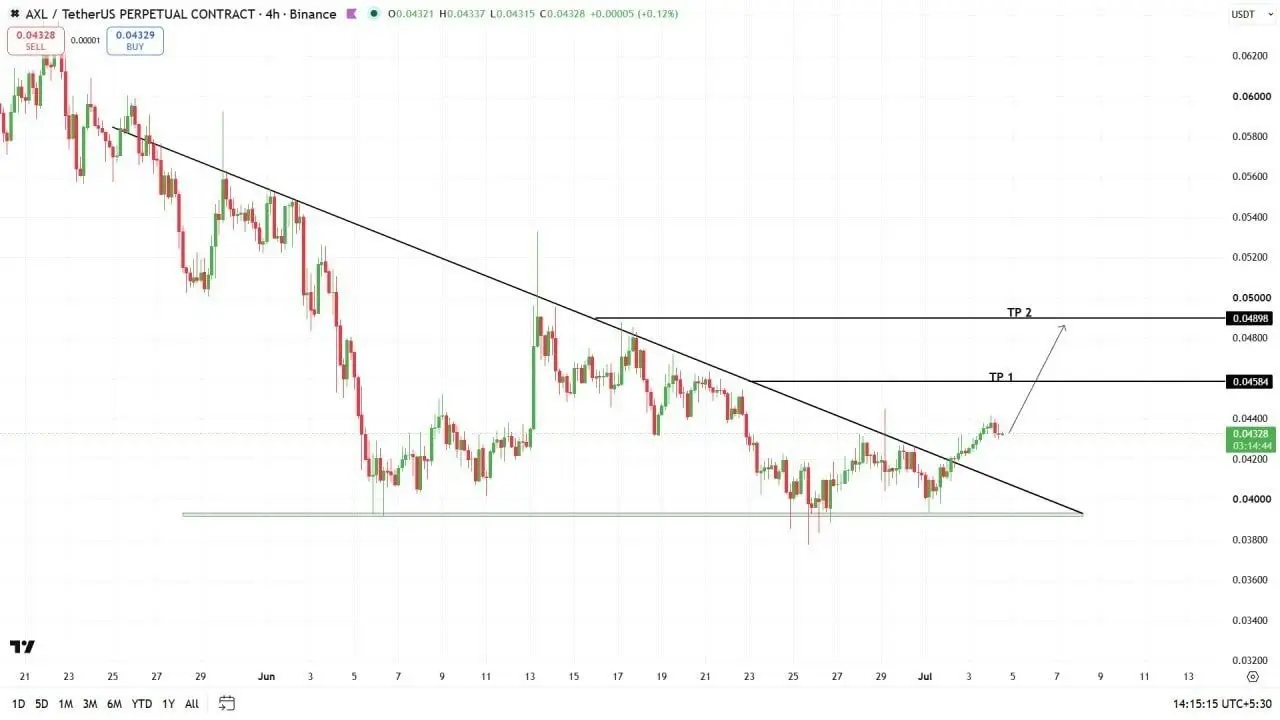
AXL this wave is indeed strong, the bulls held the key level, momentum is in the hands of buyers.
MarcusCorvinus
$AXL is showing serious strength.
The recent bullish breakout has shifted momentum in favor of the buyers.
Price action continues to look constructive, with bulls defending the move.
If this momentum holds, the upper targets could be reached sooner than many expect.
The trend is gaining traction, and this could be the beginning of a much bigger move.
repost-content-media
To be honest, AI Agents can already do quite a lot now: check-in, cross-chain, batch claim. Once you set the rules, you basically don't need to manage them. But when it comes to actually spending money, I still take a look.

It's not that I don't trust the code; it's that I don't trust the prompt I wrote myself. Last time, a bot set the gas limit too low, got stuck for three hours, and almost missed the window. In short, on-chain is irreversible. No matter how smart the Agent is, the final safety net still has to be a human.

Recently, ETF fund flows and the US stock market have been volatile,
PROMPT-5.30%
Save first, spend later — this anti-fraud principle should really be engraved in our DNA.
Original content no longer visible
Whales are all deep in the red, a historical bottom signal?
Original content no longer visible
1 billion data records on-chain, AI labs have to pay for data, which is good for creators, but not sure if the gas fees can handle it.
Original content no longer visible
The former BIS executive finally speaks out—Is the spring of stablecoin regulation finally arriving?
Original content no longer visible
How much was the daily average when it was just released two years ago? Now with 180 trillion tokens, Doubao's growth rate is even more explosive than the crypto bull market. Volcano Engine's GPU clusters probably have to smoke for 24 hours nonstop.
Original content no longer visible
Load More