Square
Following
Hot
News
Notifications
Profile

SecretMessage

vip
Crypto macro in one sentence | Also discussing stocks, futures, and economic trends. Breaking down hot topics in simple language.
Peak Tier VIP 75.0 Year(s)Web3 Creator
61
Following
41
Followers
248
Liked
The “false breakout” idea is interesting. If volume keeps lagging, 83k will still take some grinding to get through.
TangHuaBanzhu
#比特币短线站上8.2万美元
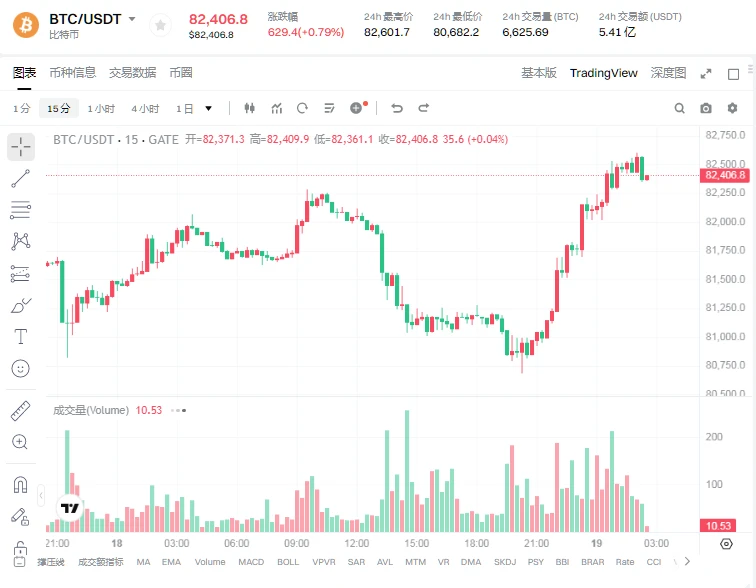
Bitcoin faking another dip? After plunging all weekend, $BTC hit a low just above 80k last night. A big bullish candle sent it bouncing back in a V this morning, and it’s now climbed back above 82,400 as if nothing happened. But whether this rebound is “made of paper” or “built like iron” depends on the volume that follows.
On the chart, Bitcoin has indeed broken out on the 15-minute timeframe, but volume hasn’t followed through. This looks more like a “false breakout” driven by short covering than one backed by real buying from bulls. Market sentiment is delicate right now: expectations of Fed rate hikes haven’t fully faded, and the 5.31% US Treasury yield is like a sword hanging over our heads, ready to pressure risk assets at any moment.
Looking at altcoins, while some smaller tokens like Celestia can bounce around, overall liquidity remains far from adequate. Order book depth has recovered for Bitcoin and Ethereum, but altcoins are still “dead in the water,” with funds clearly flowing into major coins. What does this mean?
It means that if you chase altcoins that “seem cheap,” you could easily get trapped in a “liquidity trap.” Right now, existing funds are stubbornly holding on, and institutions are quietly buying the dip, but we still haven’t seen the capital base for a full-blown bull market.
Don’t let Monday’s green candle go to your head. Around $82,000, you can reduce your position or take some profits, then consider adding after a retest confirms support. If it really breaks below 80,600, be cautious: another deep correction may be coming. As for altcoins, unless you have insider information or can watch the market and trade short-term, stay away. This isn’t a time for broad-based gains; it’s a “the strong get stronger” market.
Geopolitical tensions have also been high lately. If anything happens around the Strait of Hormuz, crude oil and gold will both be jolted, and the crypto market, as a high-risk asset class, is even more vulnerable to the spillover. Spot traders should lie low, and derivatives traders should keep their positions light. There’s no need to rush in this market.
repost-content-media
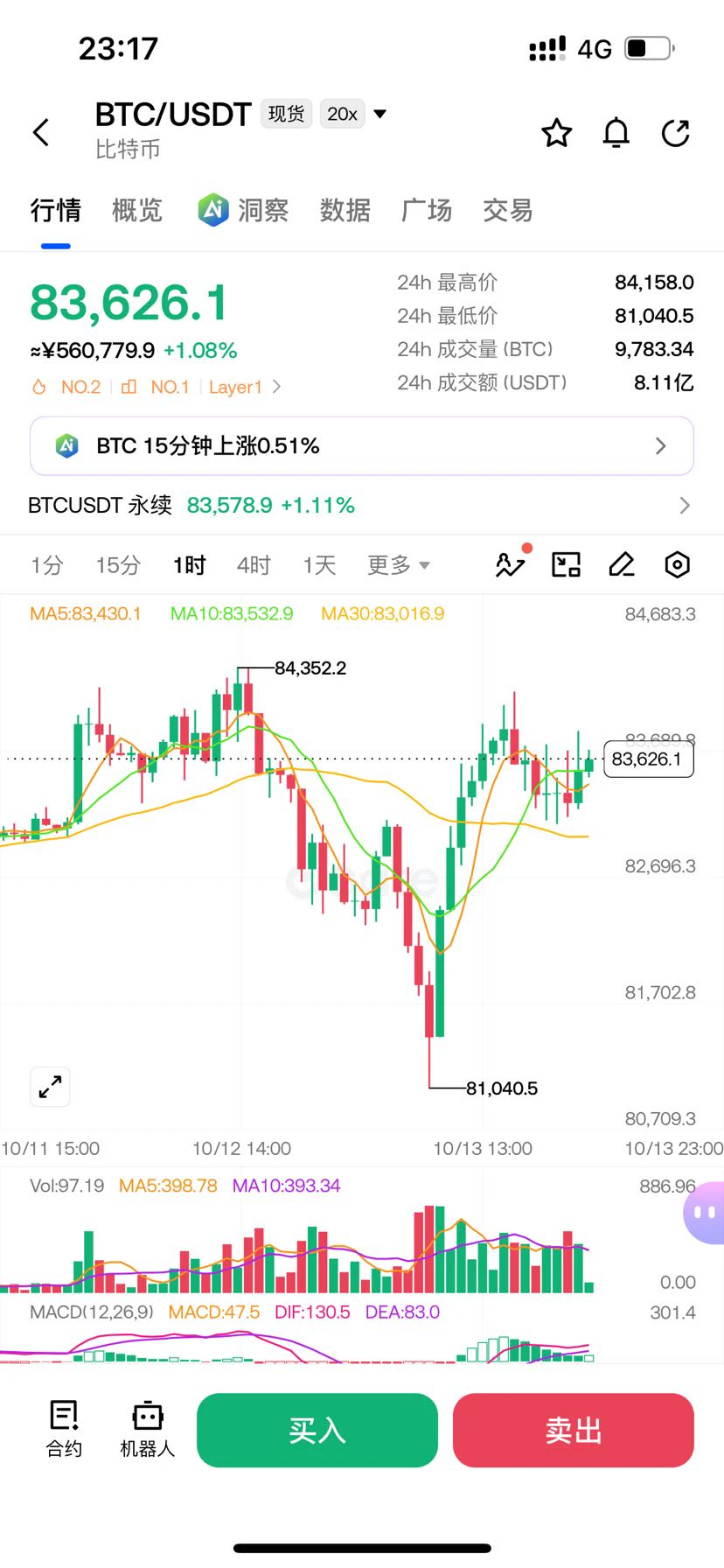
A quick look Tuesday morning: BTC touched around 83k before pulling back, while US tech stocks are bouncing—the two markets are moving to different rhythms.

ETF funds are still flowing out, and leveraged trading is pretty lively too. The market talks about consolidation, but the action is pretty tangled.

What do you think comes next: “grind sideways until institutions return” or “keep swinging if 83k doesn’t give way”? Let’s hear it in the comments—don’t just hit like.
BTC-0.67%
Inflation remains a thorn, so don’t assume easing is a done deal.
CoinWay
U.S. September PPI Far Exceeds Expectations: Will Fed Policy Expectations Be Reassessed?
The U.S. Producer Price Index (PPI) heated up far more than expected in September, once again sounding the alarm on inflation. Data from the U.S. Bureau of Labor Statistics showed that the final-demand PPI rose 1.3% month over month in September, its largest increase since March 2022, and was up 6.3% year over year. Gasoline prices surged, with energy costs becoming a key factor pushing up prices at the production level.
This data could change market expectations for the Fed’s next policy moves. If production costs continue to pass through to consumers, progress in bringing down inflation could stall, putting further pressure on rate-cut expectations and potentially reigniting discussions of rate hikes. However, the short-term shock from rising energy prices does not necessarily mean underlying inflation is broadly out of control; service prices, the labor market, and upcoming PCE data are also key.
For crypto markets, changes in interest rate expectations will affect dollar liquidity, risk appetite, and capital allocation. If the Fed maintains a hawkish stance, Bitcoin and highly volatile altcoins could come under valuation pressure; if inflation data eases in the coming period, markets may once again price in expectations of monetary easing. Investors should focus on the Fed’s meeting statements, core inflation indicators, and changes in Treasury yields, and avoid judging the policy direction based solely on one month’s data.
$TSLA #加密市场情绪转向贪婪
repost-content-media
At Monday's open, BTC is still hovering around 81k, unable to get above the 82k line, but it hasn't fully broken below 80k either.
Last week's inflation data came in hot, oil prices pushed higher again, and U.S. tech stocks were wobbling too. The market says it's waiting for the FOMC at the end of the month, but it's actually pretty tense.
Do you think this week is about “seeing if 80k holds first” or “grinding sideways until the end of the month”? Share your thoughts in the comments—don't just hit like.
BTC-0.67%
This post separates the buzz from what actually gets delivered—that's interesting.
DirectorAnnie
Bullish on AI but bearish on the Nasdaq: What investment signals did Justin Sun reveal in his latest interview after selling 90% of his Ethereum?
1. The first half of the AI boom is about selling picks and shovels; the second is about making money from applications
What’s generating the most excitement in AI right now? Nvidia, chips, memory, optical modules, and data centers. Everyone is rushing to buy equipment and build computing capacity. But the application layer will matter more in the future: Can AI truly become part of ordinary people’s lives and work and solve real-world problems?
2. AI health management could be the next big opportunity
In the future, getting medical care may no longer mean heading straight to the hospital whenever something feels wrong. Instead, devices could first collect health data for AI to analyze and use to provide personalized recommendations, with a doctor then offering professional advice.
3. AI hardware prices won’t necessarily keep rising; there could even be a short-term oversupply
He is bullish on AI in the long term, but that doesn’t mean he thinks every AI stock is cheap right now. Huge amounts of capital are concentrated in a handful of AI leaders. Chip, memory, optical module, and data center capacity is all expanding, so an oversupply can’t be ruled out.
4. AI investing could shift from crowded trades to divergence among applications
A lot of capital is currently chasing a handful of AI leaders, with investors buying the same few names over and over. But as AI technology matures, the market will eventually have to answer one question: Which companies can actually turn AI into revenue and profits? He expects divergence in the market to gradually emerge around 2027.
5. U.S. stocks and AI could be getting too crowded in the short term; even long-term bulls need to know when to trim their positions
He is slightly bearish on the Nasdaq and the broader AI sector, but he hasn’t liquidated his holdings or shorted the market. His concern is that everyone is crowded onto the same boat. No matter how big the boat is, it can’t withstand everyone rushing in the same direction at once.
6. Bitcoin is a core holding, while Ethereum is an aggressive position; investing isn’t just about holding on no matter what
He sees Bitcoin and Ethereum as serving different roles. Bitcoin is more like a long-term core holding. As long as his view of Bitcoin hasn’t fundamentally changed, he won’t make major cuts to his position. Ethereum, by contrast, is more of an aggressive position that needs to be adjusted flexibly based on market structure, price trends, and capital flows. He once sold 90% of his Ethereum at 3600–4000, hasn’t bought it back since, and shifted his investment into U.S. stocks.
7. RWA could be a major opportunity in the next phase of blockchain
In the future, blockchains could support more real-world assets, such as stocks and bonds. The core idea behind RWA is to bring real-world assets on-chain through compliant tokenization structures, making it easier for users to access and trade them on-chain.
8. For ordinary people looking to take part in the golden age of AI, don’t focus only on the hottest stocks; think about where the money will ultimately come from
What ordinary people really need to do is understand how a technology creates value, who is willing to pay for it, and whether its current price already assumes too much future growth. The golden age of AI may indeed be underway, but the opportunities to make money won’t be shared equally among everyone involved.
When everyone is chasing AI, are you paying for real profits in the future, or for someone else’s story?
It’s the weekend, and BTC is still grinding around 81k, with 82k acting like a ceiling. Most altcoins are sluggish too.
On one hand, the 10-year U.S. Treasury yield is still hovering around 5.1, and on the other, inflation data hasn’t given the market any relief. Honestly, this looks more like macro pressure on risk appetite—not something the crypto market can turn around on its own.
What do you think: is this weekend for “grinding out a bottom and waiting for an opportunity,” or “taking a step back and not messing with anything”? Share your thoughts in the comments—don’t just hit like.
BTC-0.67%
Give this a quick repost. Retail investors are fleeing, institutions are buying. I’ll watch for now and stay neutral.
TangHuaBanzhu
Retail Investors Are Fleeing While Institutions Buy the Dip?
Strive’s Bitcoin Holdings Rise to 35,595 BTC; TD Cowen Raises Price Target to $56
TD Cowen analysts Lance Vitanza and Jonnathan Navarrete raised their price target for Bitcoin treasury company Strive (ASST) from $44 to $56, as the company’s Bitcoin purchases over the past two weeks have already surpassed their previous forecast for the entire quarter.
Data shows that Strive’s Bitcoin holdings have risen from 28,000 BTC at the end of September to 35,595 BTC, worth approximately $2.9 billion at current prices, making it the fourth-largest publicly traded company holder. The company purchased 3,311 BTC and 2,822 BTC on October 13 and 14, respectively.
In addition, Strive plans to expand its SATS preferred stock offering to 7 million shares at $90 per share, seeking to raise $630 million. The offering is expected to close on October 20. Strive shares fell 6.6% to $23.96 on Friday due to dilution from warrant exercises, but are still up more than 38% year to date. Analysts believe the related selling pressure could ease once the $27 warrants have been exercised. (The Block) $BTC
{spot}(BTCUSDT)
Oil prices shot above $100 overnight, while BTC is hovering around $81k again. Warsh’s remarks are pushing down expectations of an October rate hike, while Treasury yields remain elevated.
Honestly, this looks more like macro forces pulling in opposite directions—not something crypto alone can explain.
Which do you believe more right now: “cooler rate-hike expectations will spark a rebound,” or that oil prices and yields are the real sticking points? Let’s talk in the comments—don’t just leave a like.
BTC-0.67%
Translate this. This move looks more like macro factors being priced in, rather than pure sentiment.
ThisIsTranslateContent:
#美国9月PPI大超预期 Data beat expectations across the board, yet the market "isn't following the script": PPI came in at 6.3%, with BTC hanging by a thread at $80K—will this be "the end of bad news" or "stagflation panic"?
Actual data: U.S. September PPI rose 6.3% year-over-year (forecast 5.3%) and 1.3% month-over-month (forecast 0.5%)—the highest in more than four years; core PPI rose 5.0% year-over-year, while retail sales rose 0.8%, also beating expectations. All four readings "blew out the charts." But interestingly, the more explosive the data, the more "divided" the market became—U.S. Treasury yields instead plunged by more than 13 basis points, gold rebounded 1.5% intraday (at $4,166), BTC hovered around $80k, the Nasdaq opened 1.3% lower while the Dow turned positive.
My view: After CPI, PPI, and retail sales all "blew out," the market is starting to shift from "trading rate-hike expectations" to "trading the economic cost"—some are betting that "high inflation will kill growth" (the stagflation script), while others are betting that "all the bad news is priced in and the worst is over." And BTC's $80K is the arena where these two camps are battling it out.
I. Will the Fed still stand pat in October?—The "uncertainty" has moved from the fringe into reality, but "no move" remains the base case
After PPI, the probability of an October rate hike was around 50% (after CPI, it had already surged from 22% to 42%, and PPI dealt another blow). But institutions and the market have unusually split into two camps:
- The "no October hike" camp (ING, Jefferies, Huatai): September's inflation was mainly an energy shock; consecutive Fed rate hikes (hiking in September and again in October) are historically rare, and the October meeting is too close to the midterm elections—the base case is for the Fed to stand pat in October and hike again in December
- The "hike in October" camp (including BofA): Inflation broadly beat expectations and retail sales were still strong, meaning the economy can withstand rate hikes—so why not hike?
My view: The probability of standing pat in October is slightly higher (around 55-60%), but it is no longer a "done deal"—PPI has turned an "October hike" from a fringe possibility into a real option. The true decider will be the remaining data before the FOMC meeting at the end of the month (nonfarm payrolls, revised retail sales, and the initial claims trend). Keep one reference point in mind: On September 17, the Fed had just raised rates to 3.75-4.00%, and Warsh put the October probability at 53% at the time—"consecutive hikes" are not unprecedented, but they are controversial.
II. Why is the market more "divided" the more explosive the data gets?—Three pools of capital are fighting three battles
① Falling Treasury yields = someone is buying "recession insurance." Inflation beating expectations should have pushed yields higher, but they instead fell 13 basis points—the market is starting to price in "if the Fed hikes again, the economy will stall"—"stagflation concerns" are replacing "inflation concerns" as the new main theme. This is actually a "long-term positive" for BTC (expectations of a peak in rate hikes are being brought forward), but a "stagflation" environment is not friendly to risk assets in the near term.
② Gold rebounding 1.5% = safe-haven funds are choosing "it." Gold benefits from both "inflation hedging" and "recession hedging"—capital is flowing into gold amid the data storm, showing that risk appetite is contracting, while BTC's "digital gold" narrative is temporarily losing out to real gold.
③ BTC at $80K = bulls and bears are confronting each other on the "lifeline." BTC, around $81,256, is sliding toward $80K —once $80K is lost, the next target is $78K or even lower; holding it would make this a golden opportunity after the bad news is priced in.
III. Three scenarios—which side are you on?
Scenario A: Bad news fully priced in (around 40% probability)—CPI, PPI, and retail sales are all out, "all the bad news is behind us," and Treasury yields have peaked and are falling→$80K holds→an oversold rebound, with BTC returning to $82-84K. Strategy: Once a signal emerges that $80K has stabilized, buy lightly on weakness.
Scenario B: Stagflation trading dominates (around 35% probability)—high inflation + rate-hike expectations→"rate hikes killing the economy" becomes the main theme→gold continues rising, U.S. tech stocks continue falling, and BTC forms a base and trades sideways around $80K. Strategy: Stay on the sidelines and wait for direction.
Scenario C: A rate hike is confirmed (around 25% probability)—the FOMC actually hikes at the end of the month and the dot plot turns more hawkish→$80K breaks down, with $78K next→crypto enters a deep correction. Strategy: Reduce positions on a breakdown and re-enter after stabilization.
IV. Should you "reduce positions for safety, buy the dip, or wait for stabilization"?
My answer: Make "wait for stabilization" the main strategy, leave room for "light dip-buying," and reserve "position reduction" for a breakdown trigger—
① Reduce positions for safety?—Only do so on a breakdown. If you already reduced your position above $82K, there is no need to panic-sell at $80K (selling here means panic-selling near the lows); if $80K breaks on heavy volume, reducing positions for safety is discipline, not fear—the lesson from October 11, 2025: "not using a stop-loss" costs more than "selling at a loss."
② Buy the dip?—Yes, but only with "small, staggered positions + right-side confirmation." If $80K holds and Treasury yields confirm a decline, you can take the first tranche (≤1/3 of the position); do not go all in at once—at a level like $80K, 15-20% wicks are commonplace, and your position size is your lifeline.
③ Wait for stabilization?—This is the primary strategy. After three explosive readings, the market needs several days to digest the "stagflation" narrative—waiting for the candlesticks to show "a low-volume stop to the decline + a high-volume rebound" is more valuable than guessing the bottom. Gold's rebound is a key indicator: if gold does not turn back, risk assets remain in "safe-haven mode."
V. Conclusion
PPI at 6.3% put "inflation" in the headline, but the market has already started trading the "economic cost"—falling Treasury yields, a gold rebound, and BTC locked in a standoff at $80K show that "bad news fully priced in" and "stagflation panic" are pulling against each other. The Fed will most likely "stand pat" in October (around 55-60%), but the uncertainty is real; BTC's $80K is the dividing line: hold it = a golden opportunity, break it = a deep pullback zone.
repost-content-media
Hammack brought up “inflation psychology” again: it’s not about hiking rates immediately, but about fearing that everyone will start assuming prices will keep rising.
PPI was also firm, and the market dumped first before bouncing back—a sign that the bad news is half priced in, but the interest-rate tether remains.
For crypto right now, don’t just watch the K-lines; macro pricing is still shifting. I’m Mixun, and I’ll keep breaking down these kinds of moments in plain language.
When an old whale moves, everyone starts guessing. I’ll just watch for now and not take sides.
PrimeMinisterLiu
A veteran whale that had been dormant for four years suddenly came alive today, moving all 4,582 BTC in one go. What does four years mean? It slept through the last bear market, then slept from $20,000 to $83,000 this cycle—and the first thing it did upon waking was make a transfer.
What for? I honestly have no idea. If it wanted to sell, it wouldn’t make such a big show of it; if it wanted to hold, it wouldn’t move the funds after four years. The only thing I’m sure of is this: if it twitches 1%, my position will be doing sit-ups for a week. The right way to handle this kind of situation is to pull up a stool and watch the show—don’t put yourself in it.
Bitcoin was quite a ride today too, dropping back to just above $80,000 in the middle of the night before clawing its way back above $83,000. Ten thousand people were liquidated in the back-and-forth, and the heavily invested guys in my circle were unusually quiet today.$BTC
repost-content-media
Seriously, are more people watching the US CPI right now than watching the market?
BTC is hovering around $83k, ETFs are still seeing outflows, and once the data drops, things will get volatile again.
Are you planning to sit back and watch the data, or have you already adjusted your positions? Chat in the comments—don’t just leave a like and run.
BTC-0.67%
The market is pretty noisy today. Korean stocks are getting hit hard, and sidecar trading halts have even been triggered. Bitcoin also dipped below $82,000 during the day, while the 10-year U.S. Treasury yield remains around 5.3%. Some say risk appetite is pulling back across the board, while others think leverage is simply being flushed out. I’m watching to see whether yields can stabilize, so I’m not taking sides just yet. Do you think this move in Korean stocks could really drag the crypto market down too? Feel free to share your thoughts in the comments.
BTC-0.67%
The sell-off in memory chips came pretty suddenly. SanDisk, Micron, and SK hynix all plunged together—earnings are still profitable, yet stock prices panicked first. Do you think this is mainly profit-taking after a big run-up, or are people starting to question how much longer AI can keep driving the business? I’m just watching for now, in no rush to take sides. Feel free to chat casually in the comments.
SNDK+11.04%
This is quite an interesting point; whether it can continue in October will depend on how the subsequent data and market sentiment develop.
StromBreaker
🚨 BLACKROCK IS BUYING THE DIP? 👀
BlackRock’s iShares Bitcoin Trust (IBIT) has reportedly added 656.661 BTC, worth around $54.73M.
That’s another major institutional flow into Bitcoin, and IBIT’s holdings are already around 795K BTC based on recent disclosed data.
The interesting part? October is just around the corner. 📈
Bitcoin has historically performed strongly in October, while recent ETF flows have also shown renewed institutional demand.
🔥 BTC Setup
Bias: Bullish above key support
Confirmation: Continued ETF inflows + reclaim of major resistance
Upside: A breakout could open the door toward the next major resistance zones
Invalidation: Losing key support with strong selling volume could trigger another correction
BlackRock buying is a bullish demand signal, but it doesn’t guarantee an October rally. Traders should watch spot ETF flows, BTC volume, liquidity and market structure before chasing.
UPTOBER loading? 👀🚀
#Bitcoin #BTC #BlackRock #IBIT #Crypto $BTC ‌
October is underway—are you still watching the Fed every day?
Or have you already started slacking off—after all, it keeps moving sideways, and watching it is exhausting?
I genuinely want to hear your thoughts. Let’s chat in the comments—don’t just drop a like and run.
This ties in well with today’s data observations. First, let’s distinguish between expectations and actual figures.
Original content no longer visible
PCE data is due out today. Are you watching the inflation figure more closely, or Treasury yields?
Personally, I feel like market sentiment has been pretty conflicted these past few days. What do you think?
Honestly, which kind of unexpected event are you more afraid of right now?
One is when the news suddenly turns into a complete mess, and for half a day you have no idea which side to believe; the other is when the market is unusually quiet, appearing calm on the surface but somehow making you feel uneasy.
Which camp are you in lately? Tell us in the comments—don’t just hit like.
The 10-year US Treasury yield has again touched around 5.2%.
Are you more worried about risk assets now, or do you think the market has already priced in most of it?
Just chatting—no need to argue.
Load More