#GateProofOfReservesReport
The Transparency Paradox: Why Excess Reserves Are the Real Alpha
Let me tell you something that keeps me up at night. After years of trading, I've learned one brutal truth: the market doesn't reward what you know—it punishes what you ignore. And right now, most traders are ignoring the single most important metric in crypto.
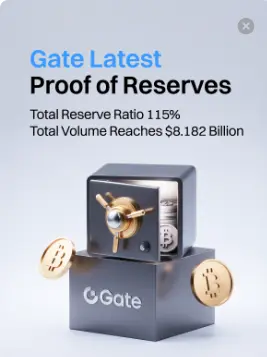
Gate just dropped their latest Proof of Reserves report. 115% reserve ratio. $8.18 billion in total reserves. Nearly 500 assets covered. But here's what the headlines won't tell you—the psychology behind why this matters more than ever.
The "Safety Premium" Cognitive Bias
Behavioral economists call it "availability heuristic"—we overweight recent dramatic events and underweight baseline security. After FTX, everyone demanded proof of reserves. Now? We've grown numb. But Gate's numbers tell a different story. Their BTC reserve ratio hit 132.73%—that's not just safety, that's strategic overcollateralization. When USD1 holdings surged from 6.82 million to 712 million tokens, and GUSD jumped to 185 million with a 72.81% excess reserve ratio, this isn't passive compliance. This is active risk management in a volatile market.
I call this the "Fortress Liquidity Framework"—the idea that true exchange resilience isn't about matching deposits 1:1, but about maintaining sufficient excess reserves to absorb black swan events without triggering contagion. Gate's $8.18 billion represents more than assets; it's a volatility buffer that protects traders during the inevitable market shocks.
Bullish Case: The Trust Arbitrage
In an industry plagued by opacity, verifiable reserves are becoming the ultimate competitive moat. Gate's consistent 115%+ ratios aren't just numbers—they're marketing gold. As regulatory scrutiny intensifies globally, exchanges with demonstrable solvency will capture institutional flows. The 19,054 BTC in user holdings with 25,292 BTC in reserves? That's a 32.73% cushion that sophisticated traders will pay attention to. When fear returns to the market—and it always does—where do you think the smart money goes?
Bearish Case: The Complacency Trap
Here's the uncomfortable truth: reserve ratios can mask operational risks. High ratios don't guarantee operational excellence, withdrawal efficiency, or cybersecurity. The 115% figure is a snapshot, not a movie. Markets evolve. Reserve compositions shift. And in crypto, yesterday's fortress can become tomorrow's vulnerability if risk management doesn't keep pace with innovation.
Key Risks to Watch
First, concentration risk. With nearly 500 assets covered, are reserves evenly distributed or concentrated in a few large-cap holdings? Second, stablecoin dependency. USDT and USDC dominate, but their own reserve transparency varies. Third, the "audit gap"—reserves are verified periodically, not continuously. What happens between snapshots?
The Road Ahead
Gate's proof of reserves isn't just about compliance—it's about building the infrastructure for mainstream adoption. As TradFi and DeFi converge, verifiable solvency becomes table stakes. The exchanges that treat transparency as a feature, not a burden, will define the next cycle.
But remember this: reserves are necessary, not sufficient. They don't replace due diligence. They don't eliminate counterparty risk. They simply give you one less thing to worry about in a market designed to test your convictions.
Trust, but verify. Then trade accordingly.
#GateProofOfReserves #CryptoTransparency #ExchangeSecurity
The Transparency Paradox: Why Excess Reserves Are the Real Alpha
Let me tell you something that keeps me up at night. After years of trading, I've learned one brutal truth: the market doesn't reward what you know—it punishes what you ignore. And right now, most traders are ignoring the single most important metric in crypto.
Gate just dropped their latest Proof of Reserves report. 115% reserve ratio. $8.18 billion in total reserves. Nearly 500 assets covered. But here's what the headlines won't tell you—the psychology behind why this matters more than ever.
The "Safety Premium" Cognitive Bias
Behavioral economists call it "availability heuristic"—we overweight recent dramatic events and underweight baseline security. After FTX, everyone demanded proof of reserves. Now? We've grown numb. But Gate's numbers tell a different story. Their BTC reserve ratio hit 132.73%—that's not just safety, that's strategic overcollateralization. When USD1 holdings surged from 6.82 million to 712 million tokens, and GUSD jumped to 185 million with a 72.81% excess reserve ratio, this isn't passive compliance. This is active risk management in a volatile market.
I call this the "Fortress Liquidity Framework"—the idea that true exchange resilience isn't about matching deposits 1:1, but about maintaining sufficient excess reserves to absorb black swan events without triggering contagion. Gate's $8.18 billion represents more than assets; it's a volatility buffer that protects traders during the inevitable market shocks.
Bullish Case: The Trust Arbitrage
In an industry plagued by opacity, verifiable reserves are becoming the ultimate competitive moat. Gate's consistent 115%+ ratios aren't just numbers—they're marketing gold. As regulatory scrutiny intensifies globally, exchanges with demonstrable solvency will capture institutional flows. The 19,054 BTC in user holdings with 25,292 BTC in reserves? That's a 32.73% cushion that sophisticated traders will pay attention to. When fear returns to the market—and it always does—where do you think the smart money goes?
Bearish Case: The Complacency Trap
Here's the uncomfortable truth: reserve ratios can mask operational risks. High ratios don't guarantee operational excellence, withdrawal efficiency, or cybersecurity. The 115% figure is a snapshot, not a movie. Markets evolve. Reserve compositions shift. And in crypto, yesterday's fortress can become tomorrow's vulnerability if risk management doesn't keep pace with innovation.
Key Risks to Watch
First, concentration risk. With nearly 500 assets covered, are reserves evenly distributed or concentrated in a few large-cap holdings? Second, stablecoin dependency. USDT and USDC dominate, but their own reserve transparency varies. Third, the "audit gap"—reserves are verified periodically, not continuously. What happens between snapshots?
The Road Ahead
Gate's proof of reserves isn't just about compliance—it's about building the infrastructure for mainstream adoption. As TradFi and DeFi converge, verifiable solvency becomes table stakes. The exchanges that treat transparency as a feature, not a burden, will define the next cycle.
But remember this: reserves are necessary, not sufficient. They don't replace due diligence. They don't eliminate counterparty risk. They simply give you one less thing to worry about in a market designed to test your convictions.
Trust, but verify. Then trade accordingly.
#GateProofOfReserves #CryptoTransparency #ExchangeSecurity