
Futures
Access hundreds of perpetual contracts
CFD
Gold
One platform for global traditional assets
Options
Hot
Trade European-style vanilla options
Unified Account
Maximize your capital efficiency
Demo Trading
Introduction to Futures Trading
Learn the basics of futures trading
Futures Events
Join events to earn rewards
Demo Trading
Use virtual funds to practice risk-free trading
CFD
Stock CFD Derivatives
US Stocks
Access real US stocks and ETFs
HK Stocks
Trade quality Hong Kong-listed stocks
Korean Stocks
SK Hynix
Real Korean stocks and top assets
Stock Futures
High leverage, 24/7 trading
Tokenized Stocks
Backed by real stock assets
IPO Access
Unlock full access to global stock IPOs
GUSD
3.8%
Mint GUSD for Treasury RWA yields
Stocks Activities
Trade Popular Stocks and Unlock Generous Airdrops
Launch
CandyDrop
Collect candies to earn airdrops
Launchpool
Quick staking, earn potential new tokens
HODLer Airdrop
Hold GT and get massive airdrops for free
IPO Access
Unlock full access to global stock IPOs
Alpha Points
Trade on-chain assets and earn airdrops
Futures Points
Earn futures points and claim airdrop rewards


Promotions
AI
Gate AI
Your all-in-one conversational AI partner
Gate AI Bot
Use Gate AI directly in your social App
GateClaw
Gate Blue Lobster, ready to go
Gate for AI Agent
AI infrastructure, Gate MCP, Skills, and CLI
Gate Skills Hub
10K+ Skills
From office tasks to trading, the all-in-one skill hub makes AI even more useful.


Trump’s “payroll” leaked: $1.4 billion in crypto revenue, over 22k stock trades
Original | Odaily Star Daily(@OdailyChina)
Author | Wenser(@wenser 2010)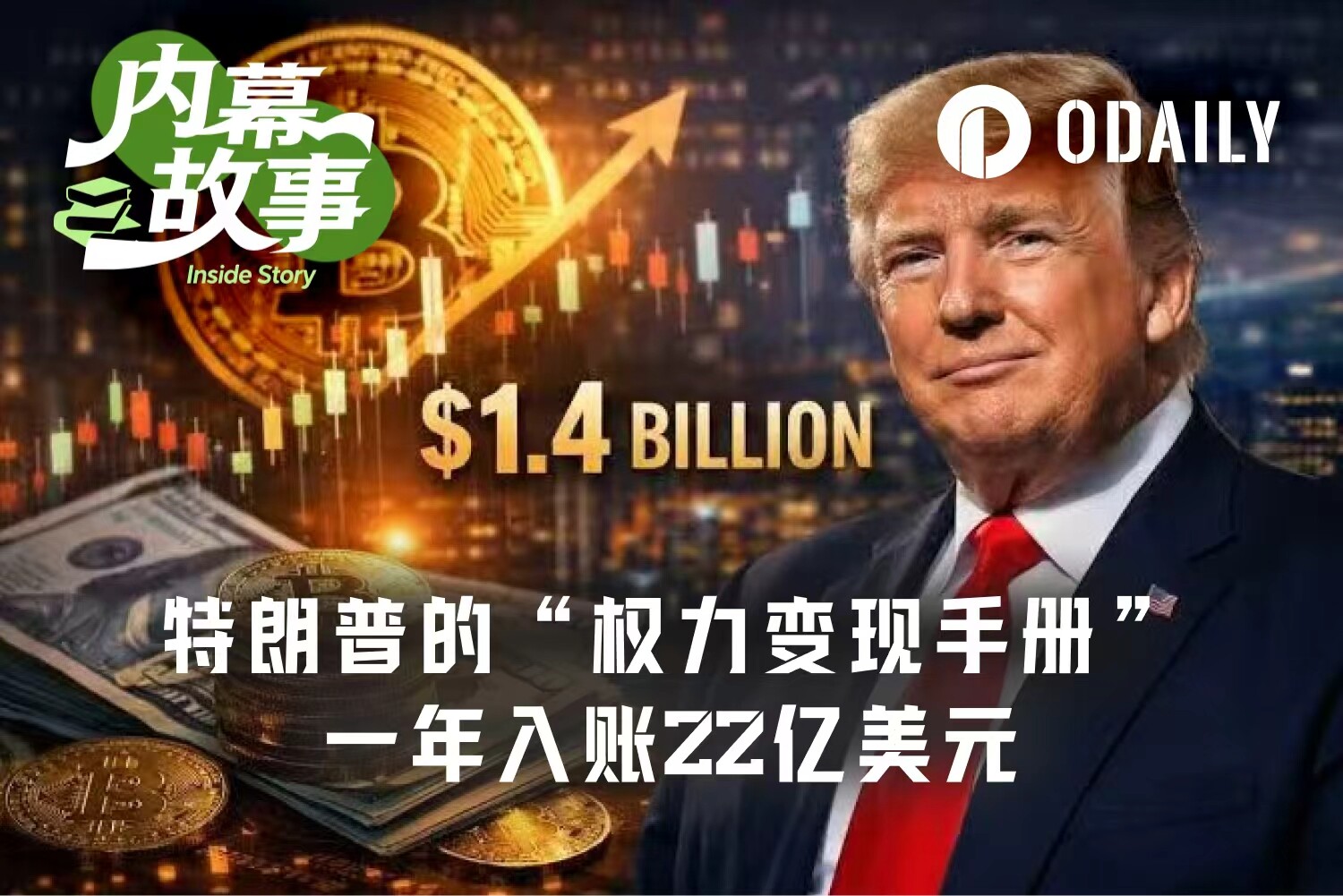
How much money can a U.S. president make in one year?
Before Trump, this figure** was usually $400k**—the** statutory president’s basic annual salary**; plus an additional $50k in annual allowances, a $100k tax-free travel allowance, and a $19k entertainment stipend. The power-fueled perks also include a presidential car, the Marine One helicopter, Air Force One, and free residence at the White House.
But “usually” has never been a way to describe Trump. Recently, according to a Trump annual financial disclosure document released by the U.S. Office of Government Ethics, Trump’s personal income in 2025 exceeded $2.2 billion, setting the record for the highest annual income during a U.S. president’s term.
This 927-page document clearly outlines the business empire built around Trump as the core of power.
Trump’s “power-to-cash playbook”: earn $1.4 billion from crypto income, with BTC and ETH holdings over $100 million
For Trump, who has served as U.S. president twice, the $400k basic annual salary long stopped catching his eye—he has twice rejected the presidential salary.
Instead, he expanded into the business world by leveraging his “brand image” and “family businesses,” charting a path to wealth beyond real estate, one step at a time.
Trump’s “income curve”: personal wealth up 2.8x in 2 years, with crypto becoming a treasure vault
According to Forbes’ billionaires list data, in 2024, Trump’s personal net worth was still $2.3 billion; at that time, his annual income was around $600 million, and he was also burdened by massive debts—one was a $500 million penalty owed to the state of New York for fraud convictions; the other was a $88 million debt owed to the “sexual assault case” plaintiff, Carroll, stemming from sexual assault allegations and a defamation conviction.
Based on 2026 data, Trump’s current** personal net worth is $6.5 billion**. In 2025, Trump’s personal annual income was $2.2 billion, of which “family’s new business” crypto generated $1.4 billion—about 64% of the total; “family’s old core business” real estate income was $575 million—about 26%; the remaining 10% mainly came from lawsuit settlement payments ($86.5 million), brand licensing fees ($68.6 million), and other income such as stock investments ($79.3 million).
Odaily Star Daily will focus on digging into the Trump family’s “crypto-get-rich handbook” and “Trump-style industrial chain.”
Trump’s “crypto breakdown”: I don’t know, and I didn’t avoid it
In recent media interviews, “the great Mr. President” said he was not aware of his “crypto-coin profits.” His exact words were: “I’ve always been making money. I’m a businessman—and a very successful businessman. I made money, it’s a considerable amount... I had other people manage those funds. I didn’t even talk to them—I don’t even know who they are... My son Eric (Trump’s second son) handles this matter. I didn’t discuss these things with him... Not knowing these things isn’t illegal... There’s no law that when you manage a country, every decision that might relate to you has to recuse. That’s simply not realistic.”
For some reason, this kind of Versailles-style bragging—“Wait, I’m making money again?”—coming out of Trump’s mouth, is hardly surprising.
According to the latest personal financial filing, Trump’s personal assets include BTC and ETH worth more than $100 million, plus a few altcoins such as LINK, AAVE, ENA, MOVE, and ONDO. Trump also earned nearly $800 million from the crypto project World Liberty Financial, which he co-founded with his son (including $527 million in token sale revenue and $263 million in equity transfer revenue, including equity income from the stablecoin company Stablecoin Holdco LLC and WLFI); about $635 million in revenue from selling the TRUMP Meme coin; and over $80 million from legal settlements with media companies.
Reuters previously estimated that since Trump returned to the presidency in January 2025, the Trump family’s crypto business has generated at least $2.3 billion in profit from investors.
Where does income in the crypto world come from?
Take the “presidential Meme coin” as an example: TRUMP led to roughly 1 million people suffering investment losses.
One man’s success means ten thousand bones laid bare— in a cutthroat, predatory crypto market, every dollar Trump earns is bloodied chips handed over by retail investors and institutions.
Trump’s “American dream” as a stock genius
Besides the crypto business, income from the stock market is another major, heavily weighted chapter in Trump’s wealth legend.
According to information in financial filings, in 2025 Trump reported more than 22k stock trades, with an average of up to 87 trades per day—which makes him a bona fide “high-frequency trader.” As with the earlier explanation for Trump, the White House said, “These trades are executed by a professional investment team from the Trump Trust account; they are not directly conducted by Trump himself.”
But a closer look at Trump’s stock holdings in the market is revealing.
Let’s think about what the “off-exchange world” was experiencing when these on-market trades took place.
Over the past year, Trump’s accounts carried out repeated, intensive trades around major U.S. policy announcements: In April last year, Trump announced “Liberation Day” tariffs on global trade partners, triggering a “global tariff war” at one point; U.S.-China tariffs even surged to over 100%. During that time, Trump’s accounts conducted hundreds of stock trades in consecutive days. A few days later, Trump staged the first “TACO” plot: first shifting to say “it’s a good time to buy,” then announcing a pause on additional tariff increases—after which U.S. stocks rebounded sharply. Also from late August to October last year, Trump’s accounts at one point bought corporate bonds and municipal bonds worth at least $82 million, involving multiple industries, with many clearly benefiting from adjustments in U.S. policies.
Yesterday, when the U.S. launched strikes against Iran again, causing oil prices to rise and U.S. stocks to fall, a suspected insider address built a position betting on “long crude oil, short Nasdaq” with a position size of $21 million and a floating profit of over $500k—making it hard not to wonder.
All signs suggest that behind “TACO” there is insider trading and quiet collusion.
“TACO” conspiracy theory: insider trading and a show of running in place
For a long time, the conflict between Trump’s business dealings and U.S. national interests has been the public focus and the core of controversy. Many Democratic senators previously raised objections and urged relevant authorities to take measures and initiate investigations, but constrained by Trump’s status as president, most controversies ultimately went nowhere or were put on hold temporarily.
But when looking back now, Trump’s many abnormal behaviors may actually be motivated by profit-seeking.
In January 2025, just days before Trump officially took office, an investment company associated with the government of the United Arab Emirates acquired 49% of WLFI equity for $500 million; soon after, despite strong opposition from some U.S. national security officials, the Trump administration still reached a computer chip export deal related to artificial intelligence with the UAE.
In addition, Trump Group—its family business—also received millions to tens of millions of dollars in income from real estate projects in countries including Saudi Arabia, Qatar, Romania, and Vietnam. Those countries later obtained policy or political concessions from the U.S. in trade, military, technology, and more.
And this ties back to Trump’s family’s “real estate business” origins and the brand destinations built with Trump’s powerful celebrity halo.
Brand value: naming it after President Trump
When reviewing Trump’s personal financial reports, one eye-catching section includes many companies beginning with “DT Marks”—DT Marks Dubai, DT Marks Doha, DT Marks Abu Dhabi, DT Marks Hyderabad, DT Marks Gurgaon... Scanning through them, it looks as if real estate businesses around the world are all connected to the Trump family.
But in reality, these companies are just “shell companies.” Most have no actual assets, and there’s no real basis to discuss “valuation.” Their only value is “enjoying the brand premium of Trump’s name.” In other words, by licensing his surname, Trump—through 20 “DT Marks”-type companies—raked in nearly $60 million in just 2025 alone: DT Marks Dubai generated $10.36 million, and DT Marks Abu Dhabi generated $9.24 million.
Unlike Obama, who sold his memoir after leaving office, gave global speeches, and took photos with entrepreneurs, Trump has already maximized the commercial value of the “president” brand along with the surname “Trump.”
A two-way rush between politics-business era and the businessman-president
Over 250 years, compared with the political power represented by the role of “U.S. president,” the president’s ability to make money has never drawn broad attention.
When Biden left office, his net worth was about $10 million; by the end of 2025, Obama’s personal net worth was also only around $70 million. Obama and his wife’s total income in 2013 was merely $481.1k, because “the book didn’t sell well,” which was a decrease of nearly $130k compared with 2012. They also had to pay as much as 20.4% personal income tax.
From Washington to Trump: over 47 presidents, salaries have increased only 5 times, specifically—Washington: $25k during his presidency (allegedly donated all of it to the nation); President Grant: annual salary rose to $50k before 1873; 36 years later, President Taft’s annual income reached $75k; in 1949, President Truman’s salary broke $100k; 20 years later, President Nixon’s salary finally rose to $200k; in 1999, at Clinton’s request, the U.S. president’s annual salary was increased to $400k. But due to a rule in U.S. law limiting that “salary increases can only be implemented after the next president enters the White House,” ultimately, George W. Bush became the “first U.S. president with a $400k annual salary.”
And now, in just the first year of his second term, Trump alone has lifted annual income to the scale of several billion dollars. Clearly, not from dead salary. Forward is the times? National fortunes managed? Turning power into cash? All three. That is what makes Trump different from his predecessors in what he has seen and grabbed with his big hands: grasp the essence of the world’s rules, then fully put them to use for himself.
Recommended reading
Trump’s full financial exposure: holds $15.7 billion in WLFI tokens, paid $50 million in the sexual assault case
U.S.: Salaries only increased once in 45 years
World Population Review data