
Futures
Access hundreds of perpetual contracts
CFD
Gold
One platform for global traditional assets
Options
Hot
Trade European-style vanilla options
Unified Account
Maximize your capital efficiency
Demo Trading
Introduction to Futures Trading
Learn the basics of futures trading
Futures Events
Join events to earn rewards
Demo Trading
Use virtual funds to practice risk-free trading
Launch
CandyDrop
Collect candies to earn airdrops
Launchpool
Quick staking, earn potential new tokens
HODLer Airdrop
Hold GT and get massive airdrops for free
Pre-IPOs
Unlock full access to global stock IPOs
Alpha Points
Trade on-chain assets and earn airdrops
Futures Points
Earn futures points and claim airdrop rewards


Promotions
AI
Gate AI
Your all-in-one conversational AI partner
Gate AI Bot
Use Gate AI directly in your social App
GateClaw
Gate Blue Lobster, ready to go
Gate for AI Agent
AI infrastructure, Gate MCP, Skills, and CLI
Gate Skills Hub
10K+ Skills
From office tasks to trading, the all-in-one skill hub makes AI even more useful.
GateRouter
Smartly choose from 40+ AI models, with 0% extra fees
Made 60 times profit on AI stock guru, betting $7.7 billion on Nvidia's peak
On May 18, 2026, Situational Awareness LP filed its Q1 13F report.
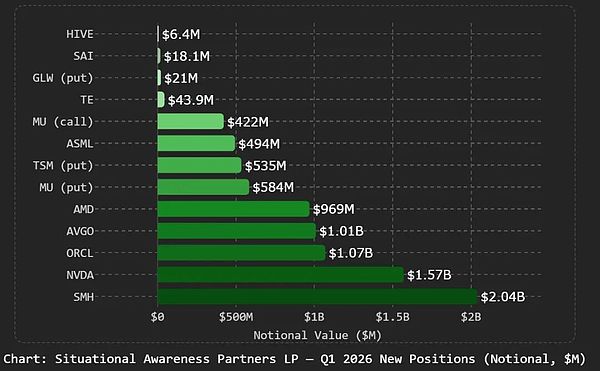
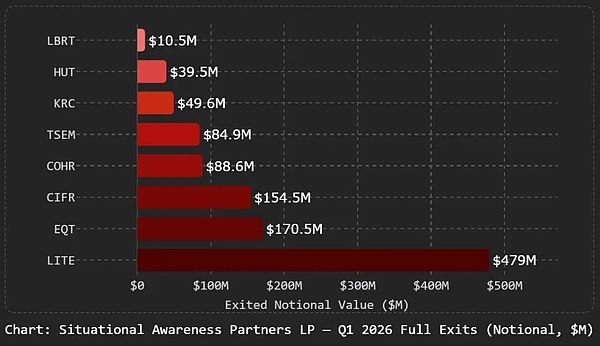
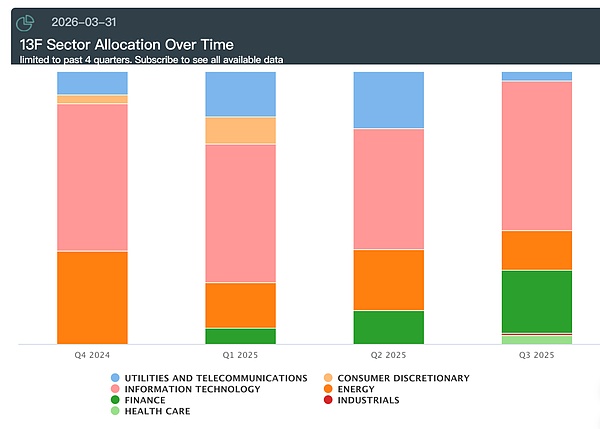
The fund’s nominal exposure to U.S. stocks and options expanded from $5.52 billion at the end of 2025 to $13.677 billion, up 148% quarter over quarter.
But what is drawing market attention is not the size—it’s the structure: more than 60% of the newly added nominal exposure is entirely concentrated in chip-sector put options.
What was done in Q1
-------
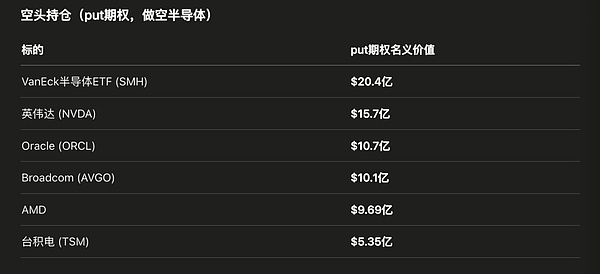
Put options covered nine underlying assets: VanEck Semiconductor ETF (SMH), Nvidia, Broadcom, Oracle, AMD, Micron, TSMC, ASML, and Intel.
Among them, SMH’s put nominal size is the largest, reaching $2.04 billion, followed closely by Nvidia at $1.56 billion. Micron and TSMC both hold call and put options simultaneously, indicating a two-way bet on volatility rather than a one-sided short.
It should be noted that the 13F filing only discloses the nominal value of options, making it impossible to directly determine the net short position. These PUT positions could reflect active shorting, or they could be purchased as hedges while holding long positions.
With only the filing, you cannot reconstruct the full intent.
On the direction of the underlying stocks, the fund continues to increase its exposure to compute infrastructure.
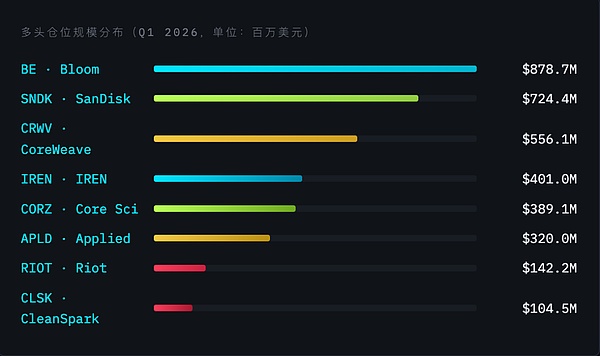
CoreWeave’s shareholding rose from 6.1 million shares to 7.18 million shares; IREN and Applied Digital increased their positions as well;
The expansion is most evident in the direction of mining companies. Bitfarms (now renamed Keel Infrastructure) increased from 6.9 million shares to 19.88 million shares, CleanSpark rose from 1.64 million shares to 12.28 million shares, and Riot Platforms grew from 6.17 million shares to 11.50 million shares.
Bloom Energy reduced its holdings by 3.59 million shares, but it still holds a market value of about $879 million, while retaining 408,500 call options. This is profit-taking rather than a change in direction.
The exit actions are concentrated in the optical communications direction.
Lumentum and Coherent were completely sold off. Last quarter, Lumentum’s position still accounted for as much as 8.68%; this quarter it is zero.
Intel’s moves are worth noting separately: it held about 20 million call options last quarter, and this quarter it completely closed them out while also establishing new put option positions.
This is not merely closing positions—it is a complete reversal of direction, moving from bullish to bearish.
Where the bottleneck is, the money is
-----------
The logic behind this 13F comes down to a specific supply-and-demand judgment: the constraints on AI expansion are shifting.
In the past two years, the core contradiction limiting AI scale was a shortage of GPUs. The market therefore kept pricing Nvidia, HBM memory, advanced process technology, and optical communications. During this phase, the chip sector as a whole received a significant premium.
But as compute clusters push toward 100,000 GPUs and even one million GPUs, new constraints are emerging.
In the United States, power grid interconnection requests are currently backlogged for more than 2TW, with an average waiting period exceeding five years; transformer capacity is limited, and building new data centers takes years; chips can be expanded continuously, but the electricity, land, and construction capacity needed to operate chips cannot keep up.
Under this assessment, the rationale for shorting the chip sector is not that AI will fail, but that chip-side valuations have already priced in expectations ahead of time, and value is shifting downstream toward physical infrastructure.
Buying PUT options on SMH and Nvidia is a hedge against a potential valuation pullback on the chip side; continuing to hold CoreWeave, mining-sector transformation targets, and Bloom Energy is a bet on the real bottlenecks—power and data center capacity.
CoreWeave’s actions also support this view: call options were cut from 10.81 million to 1.81 million, while common shares increased from 6.1 million shares to 7.18 million shares.
The direction has not changed; it’s simply swapping high-leverage options exposure into underlying shares to reduce the impact of volatility on the portfolio.
From $225 million to $13.677 billion
------------------
This fund was founded in September 2024, and its first disclosed U.S. equity exposure was about $225 million. By the end of 2025, this figure had grown to $5.52 billion; as of March 31, 2026, the nominal exposure reached $13.677 billion.
In the first half of 2025, the fund achieved returns of approximately 47%. In the same period, the S&P 500 rose by only about 6%. For the full year, the fund outperformed the S&P 500 by roughly 12.5 percentage points.
Before founding the fund, this 24-year-old German published a 165-page report, “Situational Awareness: The Decade Ahead,” laying out the view that AGI timelines and power and computing infrastructure would become the biggest bottlenecks. Early funding for the fund came from Nat Friedman, Daniel Gross, and Stripe co-founders Patrick and John Collison.
The significance of this quarterly report is that it turns a previously narrative-level judgment into a concrete portfolio position structure.
Chips are merely the entry point for expansion. What truly determines the speed of AI expansion is whether, in the real world, power can be connected, data centers can be built, and grid interconnection approvals can be obtained within five years.
If this judgment holds, the keywords for AI investment over the past two years were GPUs and models; in the coming years, they may be power, land, and construction timelines.