
Futures
Access hundreds of perpetual contracts
CFD
Gold
One platform for global traditional assets
Options
Hot
Trade European-style vanilla options
Unified Account
Maximize your capital efficiency
Demo Trading
Introduction to Futures Trading
Learn the basics of futures trading
Futures Events
Join events to earn rewards
Demo Trading
Use virtual funds to practice risk-free trading
Launch
CandyDrop
Collect candies to earn airdrops
Launchpool
Quick staking, earn potential new tokens
HODLer Airdrop
Hold GT and get massive airdrops for free
Pre-IPOs
Unlock full access to global stock IPOs
Alpha Points
Trade on-chain assets and earn airdrops
Futures Points
Earn futures points and claim airdrop rewards


Promotions
AI
Gate AI
Your all-in-one conversational AI partner
Gate AI Bot
Use Gate AI directly in your social App
GateClaw
Gate Blue Lobster, ready to go
Gate for AI Agent
AI infrastructure, Gate MCP, Skills, and CLI
Gate Skills Hub
10K+ Skills
From office tasks to trading, the all-in-one skill hub makes AI even more useful.
GateRouter
Smartly choose from 40+ AI models, with 0% extra fees


Will the Federal Reserve welcome its first "cryptocurrency leader"? Waller returns to the Board of Governors—what impact will this have on Bitcoin?
Author: Max, Crypto City
Senate votes to confirm board appointment, Wirth set to take over the Federal Reserve’s power The US political and financial circles experienced a major turning point in May 2026. On Tuesday, the US Senate officially confirmed Kevin Wirth as a member of the Federal Reserve (Fed) Board of Governors with a vote of 51 to 45, paving the final road for him to succeed current Chair Jerome Powell.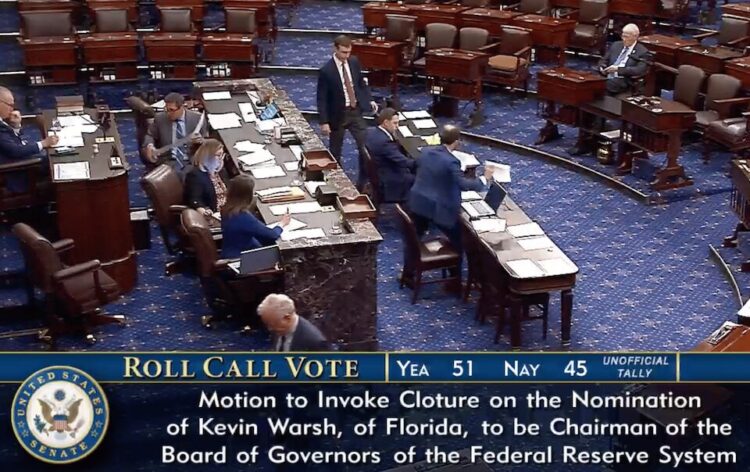
Image source: US Senate | The US Senate officially confirmed Kevin Wirth as a member of the Federal Reserve (Fed) Board of Governors with a 51 to 45 vote on Tuesday
Wirth’s term will last 14 years, from February 2026 to 2040. In this highly partisan vote, the Republicans supported him entirely with a majority advantage, while among Democrats, only Pennsylvania Senator John Fetterman voted in favor, breaking the traditional bipartisan consensus usually seen in Fed chair nominations. As Powell’s four-year term as chair is set to expire this Friday, the Senate is expected to hold an independent confirmation vote for Wirth on Wednesday. According to the current layout by Senate Majority Leader John Thune, Wirth’s confirmation chances are very high. Although Powell is about to step down as chair, he has stated he will remain on the Board until 2028, aiming to maintain organizational stability and independence until the Justice Department’s investigation into the Fed’s headquarters renovation concludes. This rare “two-generation chair” scenario adds complex political variables to the future implementation of US monetary policy.
Crypto asset background becomes a focus, Wirth views Bitcoin as a policy alarm Unlike previous Fed officials who were skeptical of digital assets, Wirth’s deep ties to the cryptocurrency industry have attracted market attention. According to his financial disclosure report submitted to the government ethics office, Wirth holds assets worth over $100 million, including investments related to Web3. These include prediction market platform Polymarket, blockchain infrastructure company Tenderly, and Bitcoin payment startup Flashnet. Additionally, he owns stakes in digital asset management firm Bitwise and the stablecoin project Basis. Wirth has committed to divesting these assets upon taking office, but his open attitude toward cryptocurrencies has long been undeniable.
Wirth has publicly stated that Bitcoin is a transformative technology, even describing it as a “great policeman of monetary policy.” He believes Bitcoin’s price volatility can reflect market confidence in the Fed’s handling of inflation and monetary credibility. At a Senate Banking Committee hearing, he emphasized that cryptocurrencies have penetrated the structure of the US financial system; they are part of the overall financial services industry, not just marginal speculative tools.
Market expectations for rate cuts collapse, inflation shadow and hawkish return impact markets Despite President Trump’s continuous pressure on the Fed to cut rates sharply to stimulate the economy, Wirth’s rise has instead cooled market expectations for easing policies. Known for his hawkish stance on inflation risks during his tenure, he reiterated at recent hearings that he would maintain Fed independence but also expressed concerns about the rapidly expanding balance sheet and excessively loose interest rate environment. As a result, CME’s FedWatch tool shows traders have significantly reduced expectations for rate cuts in 2026 and 2027. The market currently predicts rates will stay in the 3.5% to 3.75% range, with only a 2.9% chance of rate cuts.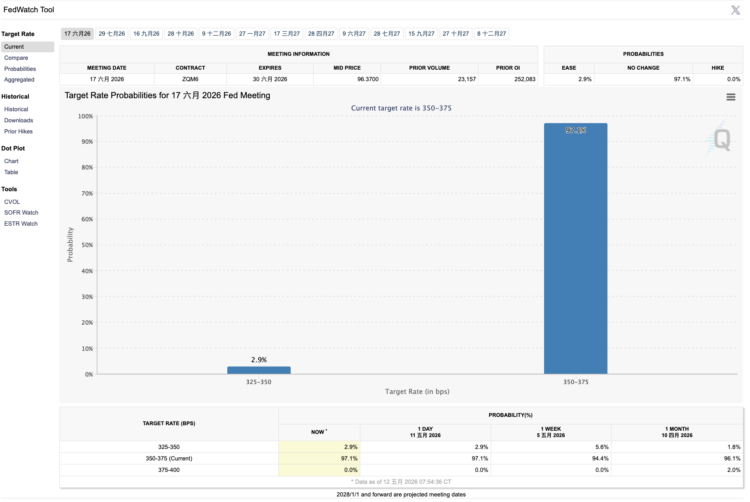
Image source: CME FedWatch | Market predicts rates will stay in the 3.5% to 3.75% range, with only a 2.9% chance of rate cuts
Economic data further intensifies this anxiety. The US April Consumer Price Index (CPI) rose to 3.8% year-over-year, above the expected 3.7%, hitting a three-year high. Coupled with tensions between the US and Iran leading to high oil prices, the risk of long-term closure of the Strait of Hormuz has triggered alarms for energy inflation. Under this overall economic pressure, both Bitcoin and gold have retraced gains. Bitcoin’s price dropped over 1.5% after the news, falling below 80,900 from a daily high of 82,098. Gold and silver also declined by 0.7% and 2%, respectively, reflecting investors’ fears of prolonged high-interest-rate environments.
Regulatory bill at a critical juncture, future of Web3 under Wirth’s term Wirth’s term coincides with a crucial moment in US cryptocurrency regulation. The Senate Banking Committee is scheduled to review the Digital Asset Market Clarity Act (CLARITY Act) this Thursday. This 309-page draft aims to delineate jurisdiction between the Securities and Exchange Commission (SEC) and the Commodity Futures Trading Commission (CFTC), including amendments to prohibit stablecoin yields.
Although the bill faces significant opposition from labor organizations and traditional banking industries, the market generally believes that a Fed chair with deep understanding of crypto technology will help accelerate the research and implementation of stablecoin regulation frameworks and digital payment systems. Wirth will face the tough challenge of balancing political pressure and economic stability. Ray Dalio, founder of Bridgewater Associates, recently pointed out that due to the lack of privacy, Bitcoin currently cannot serve as a core safe-haven asset, and central banks are unlikely to hold large amounts in the short term.
However, Wirth believes that AI-driven productivity improvements can offset inflation pressures, which may become a new basis for his future interest rate policies. As Wirth officially joins the Fed, global financial markets are holding their breath, watching how this crypto-minded new leader will reshape the dollar’s status and the future direction of monetary policy.