
Futures
Access hundreds of perpetual contracts
CFD
Gold
One platform for global traditional assets
Options
Hot
Trade European-style vanilla options
Unified Account
Maximize your capital efficiency
Demo Trading
Introduction to Futures Trading
Learn the basics of futures trading
Futures Events
Join events to earn rewards
Demo Trading
Use virtual funds to practice risk-free trading
CFD
Stock CFD Derivatives
US Stocks
Access real US stocks and ETFs
HK Stocks
Trade quality Hong Kong-listed stocks
Korean Stocks
SK Hynix
Real Korean stocks and top assets
Stock Futures
High leverage, 24/7 trading
Tokenized Stocks
Backed by real stock assets
IPO Access
Unlock full access to global stock IPOs
GUSD
3.8%
Mint GUSD for Treasury RWA yields
Stocks Activities
Trade Popular Stocks and Unlock Generous Airdrops
Launch
CandyDrop
Collect candies to earn airdrops
Launchpool
Quick staking, earn potential new tokens
HODLer Airdrop
Hold GT and get massive airdrops for free
IPO Access
Unlock full access to global stock IPOs
Alpha Points
Trade on-chain assets and earn airdrops
Futures Points
Earn futures points and claim airdrop rewards


Promotions
AI
Gate AI
Your all-in-one conversational AI partner
Gate AI Bot
Use Gate AI directly in your social App
GateClaw
Gate Blue Lobster, ready to go
Gate for AI Agent
AI infrastructure, Gate MCP, Skills, and CLI
Gate Skills Hub
10K+ Skills
From office tasks to trading, the all-in-one skill hub makes AI even more useful.


Bitcoin sees a "panic wave"? CryptoQuant warns: After the surge, a "profit-taking" wave may follow
Bitcoin has recently been on a meteoric rise, rebounding over 20% within just over a month and hitting a 3-month high. However, as investors celebrate Bitcoin's return to the $80k mark, on-chain analysis firm CryptoQuant points out that this rally conceals selling pressure from profit-taking, and the current market characteristics are more consistent with a "bear market rebound" rather than the start of a new bull market.
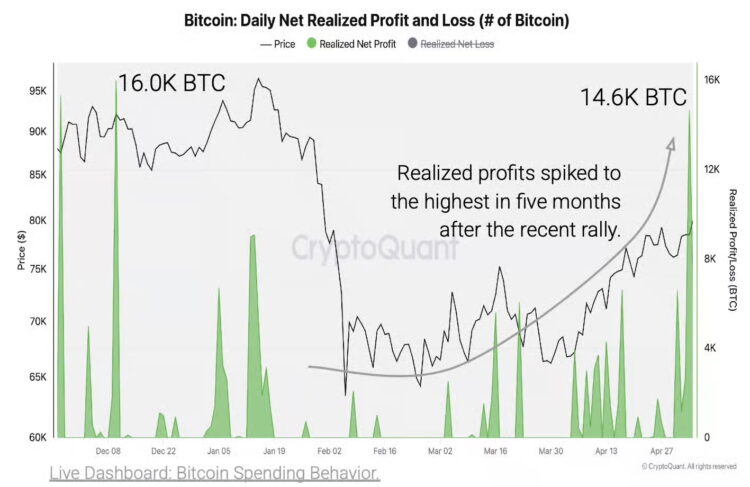
CryptoQuant's Head of Research, Julio Moreno, stated in a recent report that Bitcoin's recent surge is mainly driven by three major factors: previously undervalued assets, easing pressures from the macroeconomic environment, and explosive growth in demand for perpetual contracts. However, signs of profit-taking in the market are also rapidly increasing.
Moreno observed that on May 4th alone, Bitcoin holders realized a profit of 14,600 BTC, the highest since December 10th of last year; additionally, a key indicator, "Short-Term Holder Realized Profit Ratio" (STH-SOPR, used to track whether short-term investors are in profit or loss upon selling), rose to 1.016 and has remained above 1, in the "profit zone," since mid-April.
Moreno explained, "This indicates that since mid-April, Bitcoin has clearly entered the profit-taking zone, confirming that the recent rally has prompted holders to start selling in stages."
From "Massive Losses" to "Liquidation": Market Structure Approaching a Turning Point
Looking at the 30-day moving average, the net realized profit of Bitcoin holders has now rebounded to 20k BTC, the first time back into positive territory since December 22, 2025. Reviewing the market in February and March this year, there was a period of net loss sell-offs totaling 398,000 BTC, indicating that investors were in extreme panic at that time.
Moreno emphasized, "Shifting from 'panic selling' to 'profit-taking' is seen as a 'structural turning point' in a bear market. Returning to positive territory fully reflects that the rally in April and May has successfully restored overall investor profitability."
However, investors should not be overly optimistic. Based on historical experience, to confirm a genuine market transition into a "bull market," net profit levels typically range between 130k and 200k BTC, and the current profit scale of 20,000 BTC still shows a significant gap. Moreno stated:
It is precisely this stark difference that makes us more confident that this is just a bear market rebound, not a complete market structural shift to a bullish trend.
On the other hand, the high level of "unrealized gains" also harbors hidden concerns. CryptoQuant data shows that the overall unrealized profit rate for Bitcoin is currently around 18%, in stark contrast to the deep -29% unrealized loss during March and February.
Moreno pointed out that historical patterns suggest that when paper profits soar, investors' impulse to "cash out" increases, significantly raising the risk of a market correction.
Despite the heavy potential selling pressure, Moreno believes that a price correction may not happen immediately, as current demand remains supported. This includes sustained growth in perpetual contract demand, a slight reduction in spot market activity that is not severe, and continued low inflows of funds into exchanges.
This combination of "demand still present, but selling pressure gradually increasing" indicates that the market is in a delicate stage where a correction could happen at any time, but a peak in selling has not yet been reached.