
Futures
Access hundreds of perpetual contracts
CFD
Gold
One platform for global traditional assets
Options
Hot
Trade European-style vanilla options
Unified Account
Maximize your capital efficiency
Demo Trading
Introduction to Futures Trading
Learn the basics of futures trading
Futures Events
Join events to earn rewards
Demo Trading
Use virtual funds to practice risk-free trading
Launch
CandyDrop
Collect candies to earn airdrops
Launchpool
Quick staking, earn potential new tokens
HODLer Airdrop
Hold GT and get massive airdrops for free
Pre-IPOs
Unlock full access to global stock IPOs
Alpha Points
Trade on-chain assets and earn airdrops
Futures Points
Earn futures points and claim airdrop rewards


Promotions
AI
Gate AI
Your all-in-one conversational AI partner
Gate AI Bot
Use Gate AI directly in your social App
GateClaw
Gate Blue Lobster, ready to go
Gate for AI Agent
AI infrastructure, Gate MCP, Skills, and CLI
Gate Skills Hub
10K+ Skills
From office tasks to trading, the all-in-one skill hub makes AI even more useful.
GateRouter
Smartly choose from 40+ AI models, with 0% extra fees


Are there as many as five versions of the draft Virtual Asset Service Act? Financial Supervisory Commission: Stablecoin reserves and interest regulations are the key points
Author: Max, Crypto City
Financial Supervisory Commission promotes transformation to a licensing system, establishing a comprehensive VASP regulatory framework Chairman Peng Jinlong of the Financial Supervisory Commission (FSC) delivered a special report on “Development and Outlook of Financial Technology Business” to the Legislative Yuan Finance Committee on May 7. The report pointed out that as emerging technologies rapidly evolve, fintech has become a key to enhancing industry competitiveness. The FSC’s current policy focus is on implementing financial and business supervision of Virtual Asset Service Providers (VASP).
According to the draft of the “Virtual Asset Service Act” approved by the Executive Yuan in April 2025 and sent to the Legislative Yuan, Taiwan’s virtual asset regulation is entering a milestone transformation, officially shifting from the previous “Anti-Money Laundering Registration System” to a stricter “Licensing System.”
This system transition includes clear transitional provisions. Businesses that have completed AML registration before the new law takes effect must apply for a license within nine months after the law’s implementation and obtain the license within 18 months. If the deadline is missed, they will not be allowed to continue their related operations. (The draft version proposed by the Taiwan People’s Party and Lin Siming suggests obtaining a license within 15 months.) The FSC emphasizes that this adjustment is essentially to establish a regular communication mechanism between the financial industry and VASP operators, ensuring that virtual assets can develop innovatively while managing risks and protecting consumer rights. Peng Jinlong stated that the FSC is actively creating a friendly development environment and will further enhance Taiwan’s financial market innovation through public-private collaboration.
Legislative race with cross-party consensus, analysis of four major draft versions Currently, besides the Executive Yuan version, there are four other draft bills proposed by different party caucuses and members, indicating a high level of consensus across parties on establishing industry standards. The Taiwan People’s Party caucus, DPP member Lin Chuyin, KMT members Lin Siming and Ge Rujun have each drafted versions of the “Virtual Asset Service Act.”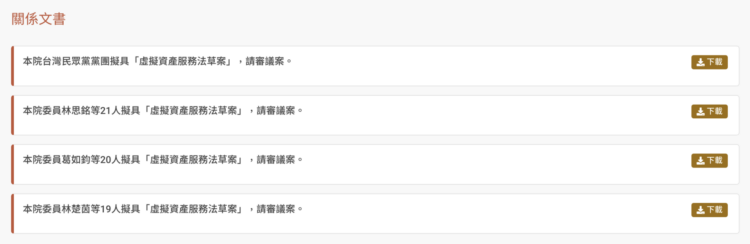
Image source: Legislative Yuan Finance Committee | Besides the Executive Yuan version, there are four draft bills proposed by different party caucuses and members
The Taiwan People’s Party version emphasizes that the virtual asset market valuation approached $2.5 trillion in January 2022. Despite major shocks such as the Terra Luna collapse and FTX bankruptcy, the market size remained above $1 trillion. Therefore, establishing a comprehensive regulatory system to protect traders’ rights is urgent. Versions proposed by Ge Rujun, Lin Chuyin, and others widely reference international legislative trends from the EU (MiCA), Japan, South Korea, and Hong Kong, regulating the diverse nature of virtual assets. Ge Rujun’s version particularly focuses on the impact of virtual assets on traditional finance and the real economy, including cross-border payments, financing, and supply chain finance applications. Regarding administrative sanctions, all versions propose strict penalties, with violations of mandatory or prohibited regulations potentially resulting in fines up to NT$6 million, with the possibility of ordered rectification within a deadline. Failure to comply may result in repeated penalties. This rigorous legal design aims to boost public trust in the virtual asset market and ensure legal and financial order stability.
Stablecoin regulation chapter as a highlight, strict reserve and interest regulations In the draft law, “Stablecoin Issuance and Management” is listed as a separate chapter, reflecting the regulator’s high concern for the risks associated with such assets. The FSC explicitly states that issuing stablecoins within Taiwan must be approved by authorities. Issuers are required to maintain sufficient reserve assets and issue and redeem at face value. To prevent stablecoins from being mistaken for traditional bank deposits and to avoid speculation risks, the draft specifies that stablecoin issuers cannot pay interest to holders. Additionally, operators must establish strict internal controls, audits, and cybersecurity management systems, and regularly report and disclose relevant financial and business information to ensure transparency. The draft’s reserve requirement for stablecoin issuance includes a strong deterrent mechanism. If issuers fail to deposit sufficient reserves, the central bank will charge interest at 5% annually on the shortfall, based on the minimum refinancing rate announced. For serious violations, administrative fines ranging from NT$300k to NT$6 million will be imposed. This supervisory framework, combining financial stability and cybersecurity resilience, aims to ensure the steady development of stablecoins in Taiwan. The FSC also states that after the law is enacted, relevant subsidiary regulations will be drafted to officially open applications for stablecoin issuance.
Asset tokenization and AI leading the future, continuous fintech innovation In addition to legal frameworks, the FSC is actively promoting asset tokenization (RWA) experiments, focusing on bonds and gold as initial targets. By transforming physical assets into digital certificates via blockchain technology, liquidity can be improved, and transaction and settlement complexities reduced. Furthermore, the FSC is actively promoting the “Hidden Light Plan,” launched in March 2025, which has visited 15 financial and tech startups to clarify regulatory challenges in innovation experiments and business pilots, and to identify promising innovative projects. This plan complements the “Inclusive Finance” proposal competition held in 2025, jointly promoting digital financial innovation. On the technological front, the FSC is also focusing on the development of agent-based AI and programmable AI. To guide financial institutions in appropriately applying AI, the FSC is promoting the “Programmable AI Governance Project,” studying domestic and international regulations, identifying financial application scenarios, and establishing quantifiable risk assessment indicators.
The report concludes by mentioning that the “2025 Taipei FinTech Forum” held in October 2025 attracted participation from 8 countries and over 30 experts, with nearly 1,000 attendees in person. Through international exchanges and technological integration, Taiwan is striving to build a digital financial ecosystem that combines innovation and security resilience in the global fintech wave.