
Futures
Access hundreds of perpetual contracts
CFD
Gold
One platform for global traditional assets
Options
Hot
Trade European-style vanilla options
Unified Account
Maximize your capital efficiency
Demo Trading
Introduction to Futures Trading
Learn the basics of futures trading
Futures Events
Join events to earn rewards
Demo Trading
Use virtual funds to practice risk-free trading
CFD
Stock CFD Derivatives
US Stocks
Access real US stocks and ETFs
HK Stocks
Trade quality Hong Kong-listed stocks
Korean Stocks
SK Hynix
Real Korean stocks and top assets
Stock Futures
High leverage, 24/7 trading
Tokenized Stocks
Backed by real stock assets
IPO Access
Unlock full access to global stock IPOs
GUSD
3.8%
Mint GUSD for Treasury RWA yields
Stocks Activities
Trade Popular Stocks and Unlock Generous Airdrops
Launch
CandyDrop
Collect candies to earn airdrops
Launchpool
Quick staking, earn potential new tokens
HODLer Airdrop
Hold GT and get massive airdrops for free
Pre-IPOs
Unlock full access to global stock IPOs
Alpha Points
Trade on-chain assets and earn airdrops
Futures Points
Earn futures points and claim airdrop rewards


Promotions
AI
Gate AI
Your all-in-one conversational AI partner
Gate AI Bot
Use Gate AI directly in your social App
GateClaw
Gate Blue Lobster, ready to go
Gate for AI Agent
AI infrastructure, Gate MCP, Skills, and CLI
Gate Skills Hub
10K+ Skills
From office tasks to trading, the all-in-one skill hub makes AI even more useful.


Strive to become a digital asset hub! Ge Rujun suggests: Domestic launch of Bitcoin ETFs and VASP tax incentives
Author: Ariel, Crypto City
Legislator Proposes VASP Tax Incentives and Bitcoin ETF Trading Access During the April 28 general questioning, Legislator Ge Rujun put forward multiple recommendations for Taiwan’s crypto industry, including expanding dedicated headcount, establishing an education fund, providing tax incentives for virtual asset service providers (VASP), expanding access to Bitcoin ETFs and stock tokenization, and studying virtual-asset strategic reserves, etc. Premier Su Tseng-chang pledged support for an organizational review, and said that together with the chair of the Financial Supervisory Commission, Peng Jinlong, relevant review reports on multiple proposal items would be submitted one month later.
Virtual Asset Education Fund Still Needs Assessment Taiwan’s first batch of compliant VASP operators has already been announced, and the draft of the “Virtual Asset Service Act” has also been submitted to the Legislative Yuan. Cryptocurrency may be pushed into the public’s view in a more compliant manner in the future, but related anti-scam awareness and investment education still need improvement. In response, Ge Rujun proposed establishing a “Virtual Asset Education Fund” and suggested a funding model where the government and industry both contribute capital—for example, with each side contributing 100 million yuan to jointly set it up. Peng Jinlong responded that, after looking at foreign systems, they found that most rely on industry’s own voluntary investment of resources; there is currently no design for a financial safety net with government co-funding. However, he also promised that the Financial Supervisory Commission will further compile specific international approaches and other feasible alternative options, and is expected to provide a detailed assessment report within one month.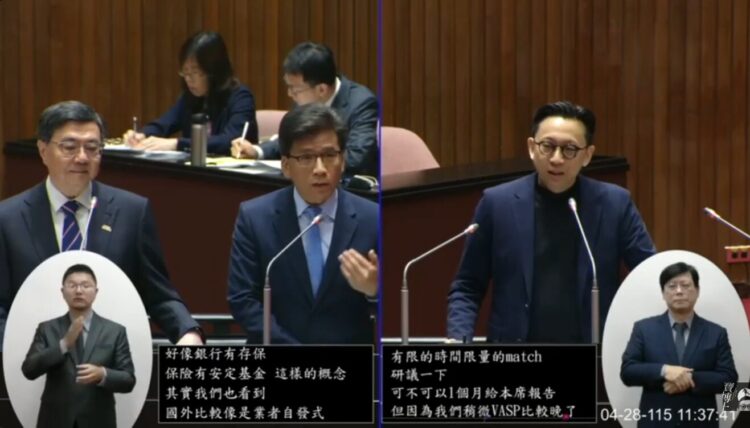
Image source: A screen capture from Ge Rujun’s general questioning video | During the general questioning, Ge Rujun put forward multiple recommendations for Taiwan’s crypto industry, and the Executive Yuan and the Financial Supervisory Commission responded
Executive Yuan to Lead the Review, Assessing VASP Tax Incentives To enhance Taiwan’s international competitiveness in the virtual-asset sector, Ge Rujun strongly recommended developing industry-specific tax incentives. He cited policies from countries such as Thailand, El Salvador, and Germany, suggesting that Taiwan could consider exempting value-added tax until 2035, or offering a 5-year corporate tax exemption to legally compliant operators. Minister of Finance Zhuang Cuiyun responded that the existing tax system and incentives can be applied first; if new dedicated incentives are to be added, a tax expenditure assessment is required. Su Tseng-chang agreed that this concept is consistent with the Industry Innovation Act, and on the spot promised that the Executive Yuan would lead the effort, tasking the Ministry of Finance to work together with the Financial Supervisory Commission to review and, within one month, submit the broad direction for tax incentives.
Retail Investors Need to Wait for the Bitcoin ETF Report; Stock Tokenization Likely Won’t Go Live Soon Ge Rujun also urged the Financial Supervisory Commission to expand the opening of Bitcoin ETF and stock tokenization businesses. He emphasized that the United States, Canada, and Hong Kong have already approved spot Bitcoin ETFs, while Taiwan currently limits access to professional investors placing orders for overseas products, which may lead to capital outflow. Peng Jinlong responded that, regarding allowing the public to place orders for overseas virtual-asset ETFs via entrusted trading, once the broker association’s assessment report is received and it is confirmed that expansion is feasible, they will explain it to the public in the near term; as for issuance within Taiwan, it will need to align with the legislative progress of the “Virtual Asset Service Act,” with a report to be submitted within three months as agreed. In addition, for stock tokenization, since infrastructure still needs to be built, it cannot be launched immediately in the short term.
Czech Bitcoin Is a Pilot Project and Not Included in Foreign Exchange Reserves Ge Rujun once again put forward proposals for virtual-asset strategic reserves such as Bitcoin and stablecoins, suggesting that the central bank should assess whether to convert a very small proportion of foreign exchange reserves into stablecoins or tokenized bonds. Su Tseng-chang responded that, currently, no country has listed Bitcoin as part of foreign exchange reserves; Ge Rujun then added that the Czech Republic has already begun purchasing it, and that more countries are considering it. However, in fact, the Czech Republic has not included Bitcoin in foreign exchange reserves; instead, it has included it in an investment portfolio pilot. In November last year, the Czech central bank announced the creation of a $1 million investment portfolio, allocating Bitcoin, USD stablecoins, and tokenized deposits on blockchain—a move that drew skepticism from European Central Bank President Christine Lagarde. The Czech central bank’s official statement said that the portfolio is solely a pilot to build a blockchain-based digital-asset investment portfolio, with the purpose of testing digital-asset management processes. The Czech central bank has strictly separated the test assets from international reserves, explicitly emphasizing that buying Bitcoin does not mean including it in foreign exchange reserves, and that price volatility completely does not affect the central bank’s ability to carry out foreign-exchange interventions.