
Futures
Access hundreds of perpetual contracts
TradFi
Gold
One platform for global traditional assets
Options
Hot
Trade European-style vanilla options
Unified Account
Maximize your capital efficiency
Demo Trading
Introduction to Futures Trading
Learn the basics of futures trading
Futures Events
Join events to earn rewards
Demo Trading
Use virtual funds to practice risk-free trading
Launch
CandyDrop
Collect candies to earn airdrops
Launchpool
Quick staking, earn potential new tokens
HODLer Airdrop
Hold GT and get massive airdrops for free
Pre-IPOs
Unlock full access to global stock IPOs
Alpha Points
Trade on-chain assets and earn airdrops
Futures Points
Earn futures points and claim airdrop rewards


Promotions
AI
Gate AI
Your all-in-one conversational AI partner
Gate AI Bot
Use Gate AI directly in your social App
GateClaw
Gate Blue Lobster, ready to go
Gate for AI Agent
AI infrastructure, Gate MCP, Skills, and CLI
Gate Skills Hub
10K+ Skills
From office tasks to trading, the all-in-one skill hub makes AI even more useful.
GateRouter
Smartly choose from 40+ AI models, with 0% extra fees


Former comrades take each other to court! One article to understand Elon Musk and Ultraman’s “one-trillion-dollar” power game
Author: Max, Crypto City
The Silicon Valley Century Trial Officially Begins, Elon Musk Personally Testifies in Court to Defend Original Intentions
This highly watched global tech industry century-long lawsuit has officially entered the jury trial phase at the Oakland Federal Court in California. Tesla CEO Elon Musk personally appeared in court on Tuesday to testify, detailing to the nine-member jury his original motivation for founding OpenAI.
During the trial, Musk emphasized that the core meaning of this lawsuit is “saving humanity,” not personal gain. He recalled a conversation in 2015 with Google co-founders Larry Page and Sergey Brin, during which he expressed deep concern about Google’s pursuit of artificial intelligence (AI) safety, fearing a catastrophic ending similar to the movie “Terminator.” To balance this potential threat, Musk claimed he conceived the prototype of OpenAI, even personally naming the company.
Image source: Business Insider | Tesla CEO Elon Musk personally testifies in court on Tuesday
According to court documents and Musk’s testimony, he provided approximately $38 million to $44 million in initial seed funding to OpenAI, which was still a non-profit organization at the time, before 2016. Musk pointed out that he was actively recruiting top talent, including Chief Scientist Ilya Sutskever, and used his influence to secure NVIDIA CEO Jensen Huang’s first AI supercomputer, as well as personally contacting Microsoft CEO Satya Nadella to obtain cloud computing resources.
Musk reiterated in his testimony that he was persuaded by Sam Altman and Greg Brockman, believing that OpenAI would remain non-profit forever and openly share its research code with the public.
Musk bluntly stated that today’s OpenAI has deviated from its original altruistic mission, transforming into a closed-source, profit-maximizing entity, which is a complete betrayal of its initial purpose.
From Non-Profit Ideals to Capital Empire, the Core Dispute in the Hundred-Billion Dollar Lawsuit
Musk’s legal team described OpenAI’s transformation as a carefully orchestrated “plundering charity” operation during opening statements. The lawyers accused Altman and Brockman of promising to create a more transparent and safer organization than a profit-driven company, using this as bait to manipulate Musk into investing large amounts of capital and resources.
The lawsuit centers on OpenAI’s transition from a non-profit organization to a capital giant valued at up to $852 billion. Musk has requested the court to replace the current leadership team, including CEO Altman and President Brockman. Additionally, according to major foreign media reports, Musk has demanded damages ranging from $138 billion to $180 billion, promising that if he wins, the entire amount will be donated back to OpenAI’s non-profit charity division.
With the success of ChatGPT, OpenAI’s commercial value has rapidly expanded, and the company is now planning a potentially groundbreaking IPO that could push its valuation beyond $1 trillion. Musk’s side believes that OpenAI’s deep partnership with Microsoft effectively makes the company a closed subsidiary of Microsoft.
Musk explained in court that although he supported establishing a profit-making branch to handle the massive computational costs, the profit segment must be subordinate to the non-profit organization and cannot divert most of its value from charitable purposes.
He mentioned that there were discussions about funding from Tesla or establishing a for-profit entity, with the core principle being “the tail cannot wag the dog,” meaning business interests should not dominate the company’s development.
The Defense Strikes Back, Revealing Musk’s Intent to Control Power
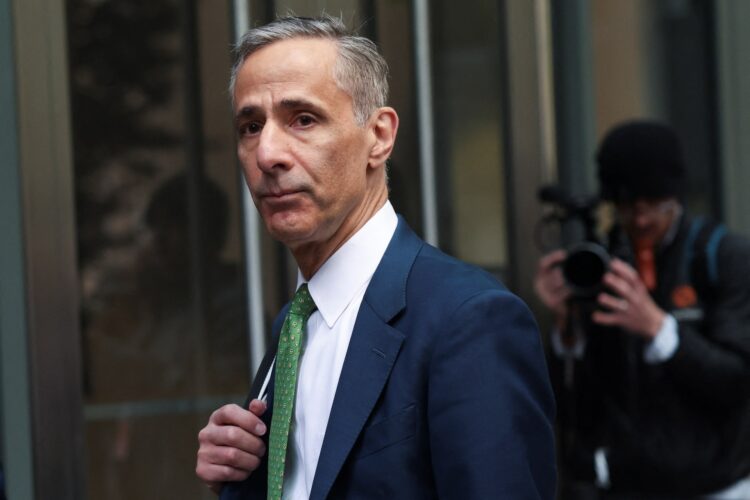
Faced with Musk’s serious accusations, OpenAI’s legal counsel William Savitt launched a strong counterattack during the hearing.
The defense argued that Musk’s lawsuit was driven by his failure to gain control of OpenAI. Savitt directly accused Musk of using his $1 billion donation pledge as leverage to bully the founding team members and force them to submit to Musk’s control demands.
Image source: Reuters | OpenAI legal counsel William Savitt
Evidence revealed by OpenAI shows Musk proposed in 2018 to merge OpenAI into his electric vehicle company Tesla, viewing Tesla as OpenAI’s “cash cow,” and demanded an absolute majority stake and control rights over the organization. When Altman, Brockman, and Sutskever rejected this proposal, Musk angrily left the board and went on to establish the competitor xAI.
The defense further countered that Musk’s insistence on the so-called “non-profit mission” was hypocritical. They presented documents showing Musk had already recognized that to compete with giants like Google, OpenAI had to transform into a profit-oriented entity to raise billions of dollars.
Savitt sarcastically stated that Musk has never truly cared about AI safety or non-profit structures; what he really cares about is maintaining ultimate power. OpenAI emphasized that Musk’s current efforts are essentially aimed at suppressing competitors and attempting to legally seize the technological benefits he once voluntarily relinquished.
This trial is expected to last about three weeks, during which Microsoft CEO Satya Nadella, Altman, Brockman, and several early core engineers of OpenAI may testify to reveal the true story behind this Silicon Valley power struggle.
The Ecosystem Faces Judicial Aftershocks, Worldcoin Plummets, and AI Industry’s Uncertain Future
As trial details are gradually exposed, the cryptocurrency project Worldcoin (now renamed World Network), closely linked to Altman, has suffered severe market impacts. Musk repeatedly mocked Altman on social media as “Scam Altman,” sparking widespread skepticism within the crypto community about Worldcoin’s token model, biometric data collection practices, and black market account transactions.
Due to this legal dispute, the $WLD token’s price has fallen over 98% from its all-time high, dropping nearly 3% on the day of the trial’s opening. Blockchain detective ZachXBT also accused the project’s tokenomics, further fueling investor panic. The ripple effects of this lawsuit have spread across the intersection of blockchain and AI, with markets closely watching whether Altman’s personal reputation will collapse as a result.
Outside the courtroom, dramatic scenes unfolded as protesters gathered at the Oakland courthouse. Some held anti-AI banners, criticizing Musk and Altman as billionaires developing technologies that threaten employment and safety.
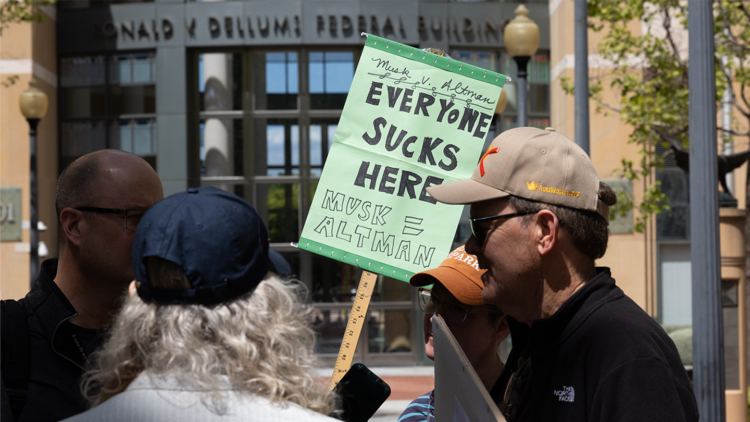
Image source: Fox Business | Protesters holding anti-AI banners, criticizing Musk and Altman as billionaires developing technologies that threaten employment and safety
Legal analysts note that since both parties hold significant social influence in the AI industry, selecting an unbiased jury will be a major challenge. Currently, market predictions estimate Musk’s chances of winning at around 40%. Most experts expect the case to ultimately settle or force OpenAI to return more rights to the foundation. Regardless of the outcome, this lawsuit has profoundly revealed how the AI industry, in its pursuit of technological peaks, repeatedly wrestles between idealism, power ambitions, and capital expansion, ultimately determining the control of core human technologies for decades to come.