Futures
Access hundreds of perpetual contracts
CFD
Gold
One platform for global traditional assets
Options
Hot
Trade European-style vanilla options
Unified Account
Maximize your capital efficiency
Demo Trading
Introduction to Futures Trading
Learn the basics of futures trading
Futures Events
Join events to earn rewards
Demo Trading
Use virtual funds to practice risk-free trading
CFD
Stock CFD Derivatives
US Stocks
Access real US stocks and ETFs
HK Stocks
Trade quality Hong Kong-listed stocks
Korean Stocks
SK Hynix
Real Korean stocks and top assets
Stock Futures
High leverage, 24/7 trading
Tokenized Stocks
Backed by real stock assets
IPO Access
Unlock full access to global stock IPOs
GUSD
3.8%
Mint GUSD for Treasury RWA yields
Stocks Activities
Trade Popular Stocks and Unlock Generous Airdrops
Launch
CandyDrop
Collect candies to earn airdrops
Launchpool
Quick staking, earn potential new tokens
HODLer Airdrop
Hold GT and get massive airdrops for free
IPO Access
Unlock full access to global stock IPOs
Alpha Points
Trade on-chain assets and earn airdrops
Futures Points
Earn futures points and claim airdrop rewards


Promotions
AI
Gate AI
Your all-in-one conversational AI partner
Gate AI Bot
Use Gate AI directly in your social App
GateClaw
Gate Blue Lobster, ready to go
Gate for AI Agent
AI infrastructure, Gate MCP, Skills, and CLI
Gate Skills Hub
10K+ Skills
From office tasks to trading, the all-in-one skill hub makes AI even more useful.


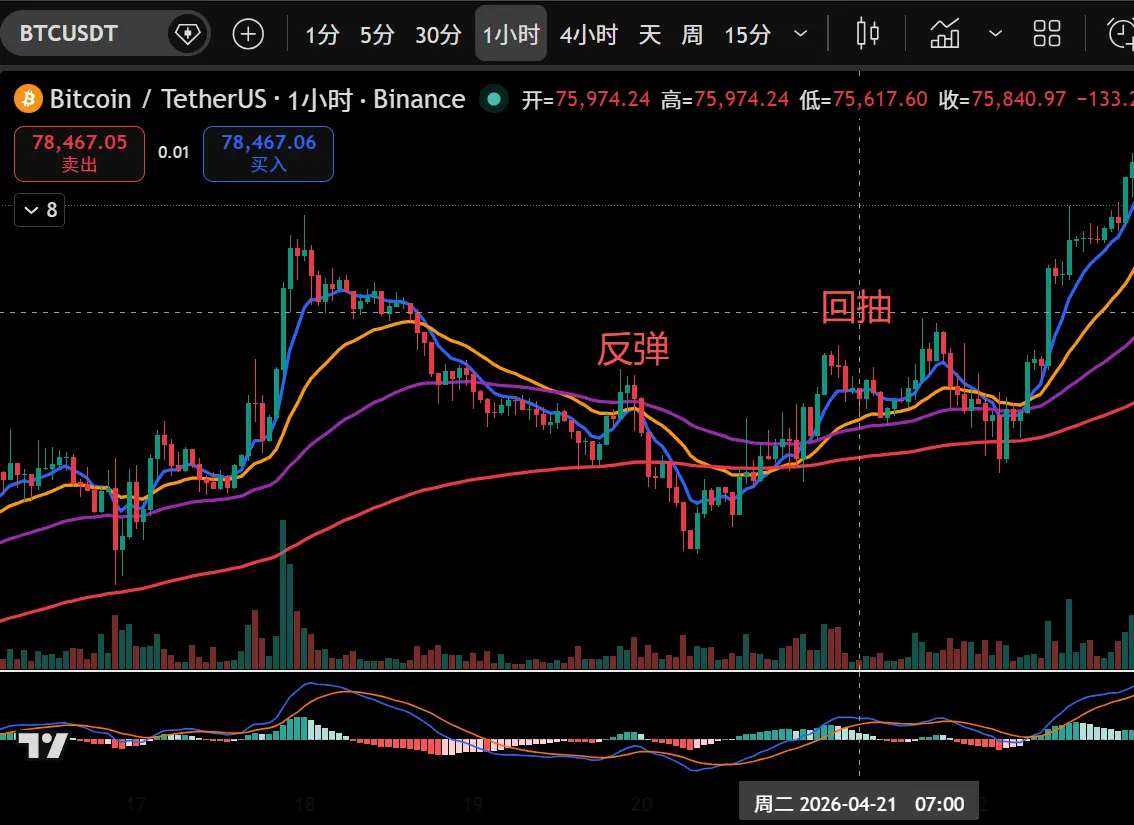
Rebound and Pullback
Rebound and Pullback:
A more professional question. Clarifying these two concepts is very helpful for judging market nature.
Simply put: a rebound is "an upward move after a decline," and a pullback is "a confirmation after a breakout." The core difference between the two lies in the trend's position.
| Detailed Explanation Below: | Rebound | Pullback | | :---------------------------- | :------------------ | :------------------------------------------------ | | Occurrence Location | During a downtrend | After breaking through a key level (upward or downward breakout) | | Direction | Temporary rise | Return to the previous direction of the breakout (rise after a pullback, or fall after a rebound) | | Prerequisites | Previous decline | An effective breakout earlier (breaking resistance or support) | | Duration | Usually short, 1-3 candles | Usually short, 1-3 candles | | Follow-up Expectation | Continue falling after rebound | Confirmed pullback continues in the breakout direction |
| Judgment Dimension | Rebound | Pullback | | :------------------- | :------------------------------ | :-------------------------------------------------------- | | Previous Trend | Continuous decline, no breakout | Just broke through an important level (moving average, previous high, previous low, trendline) | | Subsequent Trend | Continue to new lows after rebound | Continue in the breakout direction after pullback (up or down) |
| | Rebound | Pullback | | :------------- | :--------------------- | :------------------------------------------ | | Can you go long? | ❌ Not recommended, easy to get trapped | ✅ Pullback end is a good point to go long | | Can you go short? | ✅ Rebound high point can be shorted | ⚠️ Depends on the direction: after an upward breakout pullback, do not short |
| Position Management | Reduce positions during rebound (exit long positions) | Add positions during pullback (add after confirmation) |
One sentence summary:
Diagram of rebound and pullback: