
Futures
Access hundreds of perpetual contracts
CFD
Gold
One platform for global traditional assets
Options
Hot
Trade European-style vanilla options
Unified Account
Maximize your capital efficiency
Demo Trading
Introduction to Futures Trading
Learn the basics of futures trading
Futures Events
Join events to earn rewards
Demo Trading
Use virtual funds to practice risk-free trading
CFD
Stock CFD Derivatives
US Stocks
Access real US stocks and ETFs
HK Stocks
Trade quality Hong Kong-listed stocks
Korean Stocks
SK Hynix
Real Korean stocks and top assets
Stock Futures
High leverage, 24/7 trading
Tokenized Stocks
Backed by real stock assets
IPO Access
Unlock full access to global stock IPOs
GUSD
3.8%
Mint GUSD for Treasury RWA yields
Stocks Activities
Trade Popular Stocks and Unlock Generous Airdrops
Launch
CandyDrop
Collect candies to earn airdrops
Launchpool
Quick staking, earn potential new tokens
HODLer Airdrop
Hold GT and get massive airdrops for free
Pre-IPOs
Unlock full access to global stock IPOs
Alpha Points
Trade on-chain assets and earn airdrops
Futures Points
Earn futures points and claim airdrop rewards


Promotions
AI
Gate AI
Your all-in-one conversational AI partner
Gate AI Bot
Use Gate AI directly in your social App
GateClaw
Gate Blue Lobster, ready to go
Gate for AI Agent
AI infrastructure, Gate MCP, Skills, and CLI
Gate Skills Hub
10K+ Skills
From office tasks to trading, the all-in-one skill hub makes AI even more useful.


From 4,000 Bitcoins to 5 billion RWA, and then to SFI: Eddie Chong's track selection logic
In the Web3 industry, the ability to predict trends with foresight and the execution capability to deeply cultivate are the core benchmarks distinguishing short-term speculators from long-term builders. Among this circle that is never short of smart people, the most scarce are long-termists who can make precise bets before industry windfalls arrive and stay focused until results are realized.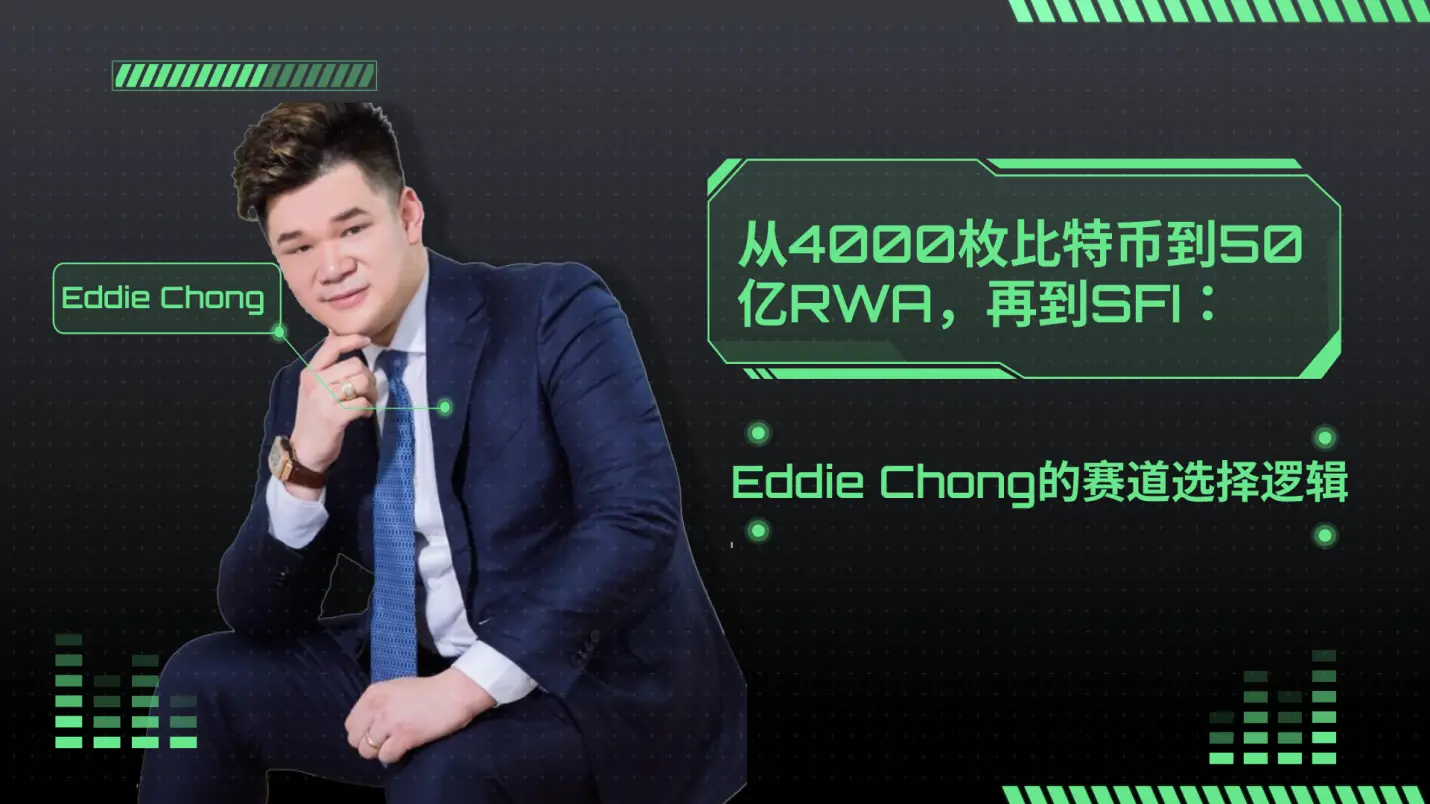
From early blockchain pioneers holding 4,000 bitcoins to industry leaders managing a $5 billion RWA (Real-World Asset) portfolio, and now to ecological builders using SFI to connect stablecoin infrastructure—since entering the blockchain space in 2015, he has anchored his efforts on solving industry pain points. Every track choice he makes is driven by clear, firm logic, always staying ahead of market consensus. As Chairman of the SFI Ecosystem Foundation, Founder and President of X Infinity, and Executive Chairman of HK Web3 Club, this Malaysian entrepreneur based in Singapore has a global reach, connecting over a hundred Web3 and traditional enterprises, with a core entrepreneurial community influencing over 20 million people. More worth exploring than these figures are his three market-leading track choices—each precisely targeting pain points and closing the loop.
Starting from payment pain points, developing a public chain to break performance bottlenecks In 2015, Eddie Chong encountered Bitcoin due to the inefficiencies in international trade payments. At that time, Bitcoin’s 75-minute transaction confirmation was a significant improvement over traditional banking processes, but he keenly saw the core issue behind it: Bitcoin’s 7 TPS transaction capacity was fundamentally incapable of supporting large-scale real-world payment scenarios, which was the first hurdle for blockchain to achieve practical application.
This forward-looking judgment prompted him to establish X Infinity in 2017 and decisively initiate the development of a high-performance public chain. After two years of refinement, the X public chain officially launched in 2019, achieving a transaction speed of 100k TPS, with transfer confirmation times of just 0.1 milliseconds—an exponential leap from Bitcoin’s performance. In the same year, X Infinity was acquired and exited for $160 million, marking the market’s recognition of this technology exploration driven by payment pain points.
While technological implementation advanced, Eddie Chong’s thinking did not stop. He realized that high-performance public chains solved the efficiency problem of blockchain circulation, but new industry bottlenecks emerged: the lack of real assets backing on-chain, making even the most efficient technology just an airy castle. This insight led him to focus on the then-rare RWA track, bringing his track selection logic into a new phase of practical implementation.
Bear market defies odds to layout RWA, enabling blockchain to carry real value From 2019 to early 2020, the crypto market was still deeply in a bear cycle, with low market sentiment. Most participants persisted in pure technical narratives and virtual asset speculation, but Eddie Chong was among the first to shift his investment focus toward tokenizing real assets. He believed that if blockchain could not support real assets, it would forever be confined to speculation; only integrating virtual and real could lead to longer-term development—this judgment predated RWA becoming a hot industry term by three years and was a further embodiment of his core logic in track selection: solving industry pain points.
In 2020, amid the global market shock from the pandemic, most investors adopted a conservative stance, but Eddie Chong launched a series of precise contrarian investments in real assets: investing $350 million in MICK Melaka Gold Port, anchoring Southeast Asia’s core hub assets, now valued at $5 billion; $4 million into smart glass via Nextglass, which has now soared to a $300 million valuation; $20 million in Delta private jets, deepening high-end travel, now valued at $200 million; and $20 million into Asian streaming media via WebTvAsia, which surpassed a $500 million valuation by 2025.
Meanwhile, leveraging his keen industry trend insights, he achieved over $400 million in returns through legal and compliant dual-channel cooperation and value investing in fields like digital currency, gold, and biomedicine.
These investments form the core investment model of X Infinity Capital: connecting high-quality physical assets such as ports, real estate, and advanced manufacturing with digitalization, tokenization, and structured financial tools to create a “physical value + digital empowerment” dual-drive closed loop. Today, the fund manages assets of over $5 billion, with more than 400 investments, becoming a benchmark platform in the RWA track. This $5 billion RWA map is the fruitful result of his track selection logic.
Anchoring circulation bottlenecks, SFI fills the last piece of the RWA puzzle From 2023 to 2024, the RWA track finally gained industry momentum, becoming one of the most certain development directions in Web3. But at this point, Eddie Chong keenly identified a new structural problem: as more real assets are tokenized on-chain, the industry lacks efficient, stable circulation tools. Many RWA assets are “locked” on-chain and cannot truly enter the real economy, creating a new bottleneck for large-scale RWA development.
In his view, RWA and stablecoins are two sides of the same coin: without RWA, stablecoins can only stay at the trading level, lacking real value support; without stablecoins, RWA assets lose an efficient circulation vehicle, making large-scale implementation difficult.
Based on this judgment, in 2024, Eddie Chong co-founded SFI (Stablecoin Financial Infrastructure), positioning it as a one-stop stablecoin ecosystem infrastructure. Its core goal is to break down all barriers between stablecoins and consumers and enterprises, making stablecoins a bridge connecting on-chain RWA assets with real-world scenarios. This is yet another strategic move addressing RWA pain points.
Today, SFI has established active communities in over 100 countries worldwide, with over 200k active users, covering core sectors such as stablecoins, digital asset cards, public chains, and DeFi. Paired with X Infinity’s X-Pay payment system—integrating crypto wallets, supporting VISA/Mastercard/UnionPay physical digital asset cards, connecting to over 800 million merchants globally—enabling cross-currency consumption in daily payments, apparel, transportation, and more—SFI and X-Pay form a deep synergy, building a complete commercial closed loop from RWA on-chain to stablecoin circulation and real-world consumption, truly realizing the value of its $5 billion RWA map.
Deep cultivation, not chasing hot trends, focusing on solving industry pain points Reviewing Eddie Chong’s three key strategic choices, a clear track selection logic runs through: from early Bitcoin exploration to the $5 billion RWA layout, and then to ecological construction with SFI connecting stablecoin infrastructure—he has never chased market hot spots but instead precisely identified the weakest links in the industry chain at each stage, using this as the core basis for track selection and actively solving problems.
From 2015-2017, addressing the low payment efficiency and TPS performance issues, he founded X Infinity and developed a high-performance public chain, filling a critical technical gap—this was his first track choice realization; from 2019-2020, recognizing the lack of real asset backing on-chain, he deployed X Infinity Capital and systematically deepened into the RWA track, enabling blockchain to carry real-world value and expanding into long-term valuable physical assets, ultimately building a $5 billion RWA map; in 2024, sensing the bottleneck of lacking efficient circulation tools for RWA, he co-founded SFI to build stablecoin infrastructure, completing the last mile of asset circulation and filling the strategic gap.
Each phase of deployment is a solution to the core industry bottleneck of the previous stage, and each problem-solving process continuously improves his business landscape. Ultimately, a complete Web3 ecological closed loop—covering underlying technology (X public chain), asset side (RWA track), and circulation layer (SFI + X-Pay)—has taken shape through his persistent cultivation. The construction of this loop is a comprehensive realization of his track selection logic.
Currently, RWA remains the most certain hot spot in Web3, and Eddie Chong has been deeply engaged in this track for over five years. With over a decade of blockchain industry experience, he has distilled a clear track selection logic: not chasing hot trends, only filling gaps, anchored in solving industry core pain points for long-term value. This also offers profound insights for Web3 practitioners: only by focusing on solving real problems and choosing tracks accordingly can one stand firm amid industry waves and achieve a leap from point exploration to ecosystem layout.