


Futures
Access hundreds of perpetual contracts
TradFi
Gold
One platform for global traditional assets
Options
Hot
Trade European-style vanilla options
Unified Account
Maximize your capital efficiency
Demo Trading
Introduction to Futures Trading
Learn the basics of futures trading
Futures Events
Join events to earn rewards
Demo Trading
Use virtual funds to practice risk-free trading
Launch
CandyDrop
Collect candies to earn airdrops
Launchpool
Quick staking, earn potential new tokens
HODLer Airdrop
Hold GT and get massive airdrops for free
Launchpad
Be early to the next big token project
Alpha Points
Trade on-chain assets and earn airdrops
Futures Points
Earn futures points and claim airdrop rewards


More




Japanese Yen Approaches Warning Level! Japan's Top FX Official: Ready to "Intervene Comprehensively" to Stabilize Currency Market
How does AI crude oil futures speculation affect the yen exchange rate?
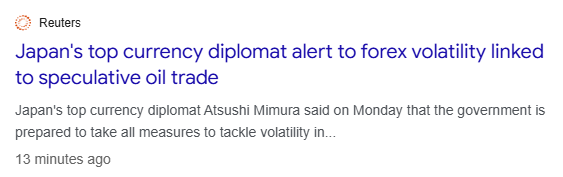
FX168 Financial News (North America) reported that Japan’s top foreign exchange official, Jun Mimura, stated on Monday (March 23) that the Japanese government is prepared to take all necessary measures to respond to foreign exchange market fluctuations, and pointed out that speculative trading in the crude oil futures market may be influencing exchange rate movements.
( )
)
(Screenshot from Reuters)
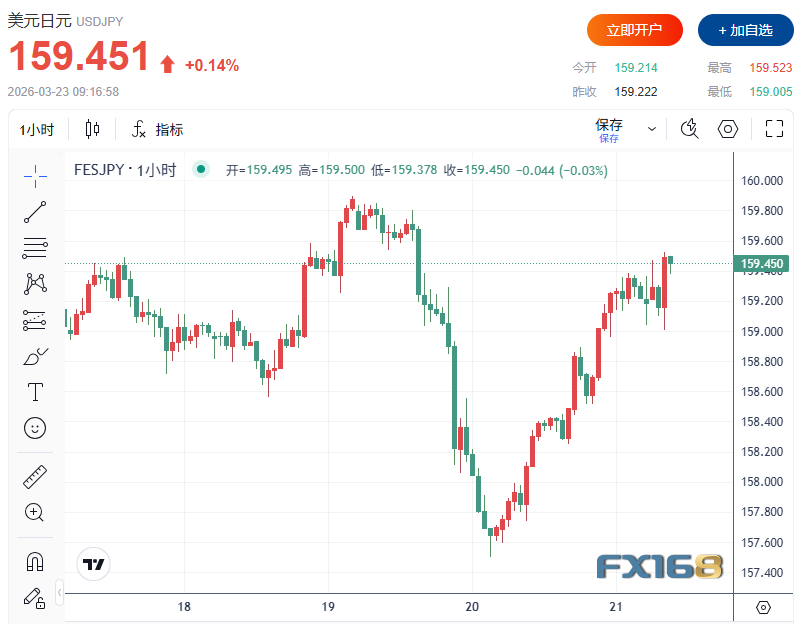
Jun Mimura told reporters that there is a view in the market that speculation in the crude oil futures market is spilling over into the foreign exchange market. Just as he made this statement, the USD/JPY exchange rate once again approached the important psychological level of 160.
( )
)
(Image source: FX168)
He emphasized that, considering the impact of exchange rate fluctuations on people’s lives and the overall economy, the Japanese government “is prepared to respond at any time in all aspects.”
This statement highlights the current dilemma faced by Japan’s decision-makers. As conflicts in the Middle East continue to push oil prices higher and global financial markets become more volatile, Japanese authorities’ vigilance over abnormal currency fluctuations is increasing, and they are sending signals of potential action through intensified verbal warnings.
From a policy perspective, Mimura’s remarks reflect that the Japanese government is increasingly concerned that recent yen fluctuations are not entirely driven by fundamentals but are partly influenced by speculative capital in commodity markets. Analysts point out that this distinction is crucial because once officials determine that exchange rate movements are more driven by speculation rather than economic fundamentals, it often means a higher likelihood of escalating verbal interventions or even direct market interventions.
Currently, global markets are struggling to digest the chain reactions caused by escalating Middle East tensions. The sharp rise in oil prices not only heightens global inflation concerns but also puts greater pressure on economies like Japan, which are heavily dependent on energy imports. For Japan, rising oil prices combined with a weakening yen mean import costs are further increasing, amplifying imported inflation risks and squeezing household and corporate purchasing power.
Against this backdrop, Japan’s government is not only strengthening verbal interventions in the currency market but also preparing fiscal measures to cushion the economic impact of rising energy prices. According to Japanese media reports, the government plans to deploy approximately 800 billion yen from its reserve budget to stabilize gasoline prices. This indicates that Japanese authorities are attempting to address market volatility and rising living costs through a combination of fiscal support and policy guidance.
This “verbal intervention + fiscal backing” approach also highlights the complex balancing act faced by Japanese policymakers. On one hand, they want to prevent disorderly currency fluctuations from further disrupting market expectations; on the other hand, they aim to mitigate the impact of high oil prices on household spending and business operations while avoiding excessive strain on public finances.
Market participants generally believe that Mimura’s latest statement further reinforces the risk expectations of potential Japanese intervention in the currency market. If the yen continues to depreciate rapidly or significantly diverges from Japan’s economic fundamentals, the likelihood of the Japanese government adopting stronger measures will increase. Amid ongoing high volatility in oil prices and persistent geopolitical risks in the Middle East, the yen’s future trajectory will remain highly sensitive to commodity price fluctuations and policy signals.
It should be noted that the so-called “top foreign exchange official” in Japan usually refers to the Financial Services Agency’s official responsible for international affairs. This position is the core coordinator of Japan’s foreign exchange policy, responsible for signaling policy intentions, leading exchange rate intervention decisions, and authorizing actual actions when necessary. Although actual foreign exchange interventions are typically carried out by the Bank of Japan, the decision-making authority resides with the Ministry of Finance, making this position the most important official voice in Japan’s exchange rate policy.