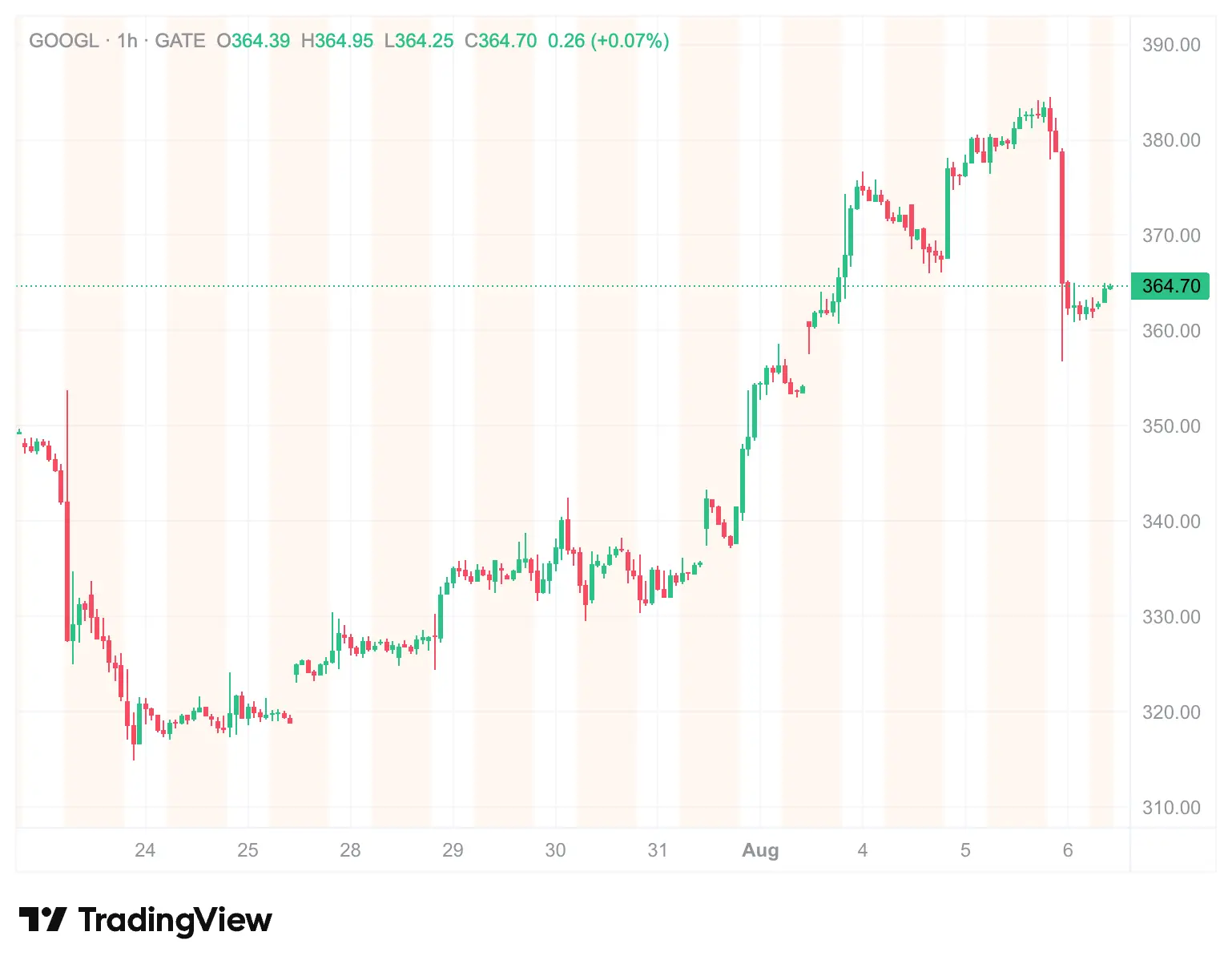
On August 5, 2026, Alphabet (GOOL) experienced sharp market-cap turmoil. GOOL shares fell more than 7% intraday before closing at $360.13, down 4.03%. Based on a total market cap of approximately $4.43 trillion, nearly $190 billion in market cap evaporated in a single day. The direct trigger for the plunge was a sudden leadership reshuffle at Google DeepMind: Nobel laureate and DeepMind CEO Demis Hassabis announced that he would step down from day-to-day operating duties, while Jeff Dean, Google's chief scientist for 27 years, chose to leave and launch a startup.
This personnel earthquake was not an isolated event. It was a concentrated manifestation of the multiple pressures Google faces in the AI race—from the continued loss of core talent and massive capital expenditures eroding cash flow to delays in releasing its flagship model, Gemini 3.5 Pro. The market cast a vote of no confidence in the world's second-largest publicly traded company, wiping nearly $190 billion off its market cap.
What exactly does the AI leadership reshuffle involve
The reshuffle involves a transfer of power at the highest level of Google's AI organization. Hassabis will step down from his day-to-day management duties as CEO of Google DeepMind and become the division's chairman, while also taking on the newly created role of chief scientist at Alphabet. In a memo to employees, he said that artificial general intelligence (AGI) may be close at hand, so he needs to withdraw from day-to-day operations and focus on high-level direction, long-term strategy, and social impact.
At the same time, Google chief scientist Jeff Dean left the company after 27 years and co-founded a nonprofit called Discovery Loop with three other senior engineers—Sanjay Ghemawat, Oriol Vinyals, and Quoc Le—to focus on using machine learning to automate scientific and engineering research. Alphabet will become the organization's founding investor and cloud partner.
Taking over Hassabis's day-to-day operating responsibilities is Koray Kavukcuoglu, chief technology officer of Google DeepMind. In his capacity as a senior vice president, he will report directly to Alphabet CEO Sundar Pichai and take overall responsibility for the development of Gemini 4 and frontier AI research.
Why did the market react so sharply to the personnel changes
The capital market's reaction went beyond a simple “key figure departure.” GOOL fell approximately 7% intraday and closed down 4.03%, making it the biggest loser of the day among Dow Jones and Magnificent Seven stocks.
The market's deeper concerns lie in three areas. First, Jeff Dean, who left, was one of the core architects of Google's AI strategy over the past 15 years, and his departure means Google has lost one of the most critical technical minds in its AI ecosystem. Second, although Hassabis has not left the company, moving from CEO to chairman and chief scientist is essentially a shift from “operator” to “strategic adviser”—a transfer of power that the market interpreted as a negative signal at a time when competition is intensifying. Third, the personnel changes were not an isolated event but the culmination of Google's ongoing AI talent exodus—Noam Shazeer had previously moved to OpenAI, while Nobel laureate John Jumper joined Anthropic. The market's concern is whether Google is systematically losing the most crucial asset in the AI competition: top talent.
What kind of talent-loss crisis is Google experiencing
In the summer of 2026, the loss of talent in Google's AI division reached crisis levels. In June, Gemini co-lead Noam Shazeer left to join OpenAI; that same month, Nobel Prize-winning chemist and DeepMind vice president John Jumper moved to Anthropic. Two more core Gemini researchers, Jonas Adler and Alexander Pritzel, subsequently announced that they would join Anthropic. Of the three people who co-founded Discovery Loop with Jeff Dean this time, Oriol Vinyals is a DeepMind vice president and Quoc Le is a co-founder of Google Brain—the four departing employees had a combined tenure at Google of more than 70 years.
The destinations of this talent are highly concentrated: OpenAI and Anthropic. Both AI startups are nearing public listings and can use pre-IPO equity options to attract top researchers. As a mature publicly traded company, Google struggles to match the potential equity appreciation offered by competitors preparing to go public. This is not ordinary talent movement, but a collective departure from multiple key technical tracks in Google's AI ecosystem—from Transformers and large-model pretraining to Gemini and AlphaFold.
Is Alphabet's financial condition also coming under pressure
Beyond the talent exodus, Alphabet's financial fundamentals are also keeping the market on edge. In the second quarter of 2026, Alphabet posted negative free cash flow for the first quarter in its history, with free cash flow falling to -$5.855 billion. The trigger was its continuously surging capital expenditures: the company raised its full-year 2026 capital expenditure guidance to between $195 billion and $205 billion. This figure is nearly double its 2025 spending.
Although Google Cloud achieved 82% revenue growth in the second quarter, the market is concerned about whether massive capital expenditures can translate into a sustainable AI competitive advantage. With Gemini 3.5 Pro already past its original June release schedule, the perceived imbalance between investment and returns is intensifying investor anxiety. The combination of financial pressure and talent loss forms the dual backdrop weighing on GOOL's valuation.
What changes are taking place in the AI industry's competitive landscape
Google's position in the frontier-model AI race is becoming more complicated. OpenAI and Anthropic are not only competing aggressively for talent but also continuing to apply pressure through their product iteration pace. The delayed release of Gemini 3.5 Pro has been reported by multiple media outlets, with some company insiders attributing the delay to low team morale.
In his statement announcing his role change, Hassabis said AGI was “close at hand”—a phrase that precisely reflects the industry's sense of urgency. When competitors iterate products faster and have greater appeal to talent, Google's “slowness” is being priced by the market as a structural risk. After the reshuffle, Kavukcuoglu was given the authority to report directly to Pichai, and DeepMind's research resources will be aligned more closely with the Gemini large-model business. But the market is still waiting to see whether this power reshuffle can genuinely accelerate Gemini 4's delivery and narrow the gap with OpenAI and Anthropic.
Is this reshuffle a strategic upgrade or a forced response
On the surface, Hassabis's role change is a “promotion”—from DeepMind CEO to Alphabet chief scientist, with a higher rank and broader perspective. In substance, however, it is a power reshuffle with an element of compulsion.
The adjustment came at a point when multiple pressures converged: the delayed release of Gemini 3.5 Pro, the successive departures of core talent, and the first-ever negative free cash flow. In an internal memo, Pichai emphasized that Google “has excellent talent, world-class computing power, and products”—wording that itself reveals an intent to steady morale. Hassabis's withdrawal from day-to-day operations came precisely when Google AI most needed strong frontline leadership. The market reflected this contradiction in its valuation.
What does the $190 billion market-cap loss mean
Based on a market cap of approximately $4.43 trillion, a 4.03% decline corresponds to approximately $178.5 billion in lost market cap. Considering the intraday peak decline of 5%, the peak market-cap loss approached $220 billion. This figure exceeds the total market cap of most S&P 500 constituents.
From a broader perspective, the plunge occurred less than a week after GOOL had surpassed Apple on August 3 to become the world's second-largest publicly traded company by market cap. Suffering a major setback before its market-cap crown had even settled reflects the capital market's extreme sensitivity to the valuation logic of AI giants—while the AI race has yet to produce a final winner, any signal of “talent loss” or “strategic confusion” could trigger a sharp valuation restructuring.
FAQ
Q: Has Hassabis left Google completely?
No. Hassabis has not left Alphabet. He has moved from CEO of Google DeepMind to chairman of the division, while also taking on the newly created role of chief scientist at Alphabet. He will continue to lead Alphabet's AI drug-discovery subsidiary, Isomorphic Labs.
Q: Why did Jeff Dean leave Google?
After 27 years at Google, Jeff Dean chose to leave and launch a startup, co-founding Discovery Loop with three colleagues to focus on using machine learning to automate scientific and engineering research. In an interview, he said that leaving a publicly traded company would give him more room to make decisions that “may not align with the company's purely financial interests.” Alphabet will support the new company as its founding investor and cloud partner.
Q: What is the source of GOOL's share-price data?
As of August 6, 2026, according to Gate market data, GOOL (Alphabet Inc. Class A) closed at $362.43 on August 5, down $15.22, or 4.03%, for the day. Its intraday low was $356.77. The 52-week price range was $193.67 to $408.61.
Q: What are the long-term implications of this plunge for Google's AI strategy?
After the reshuffle, Kavukcuoglu will report directly to Pichai, and DeepMind's research resources will be aligned more closely with the Gemini large-model business. This means DeepMind will become further integrated into Google's broader commercial system. Whether Gemini 4 can launch on schedule and narrow the gap with competitors will be the key test of the effectiveness of this power reshuffle.


