
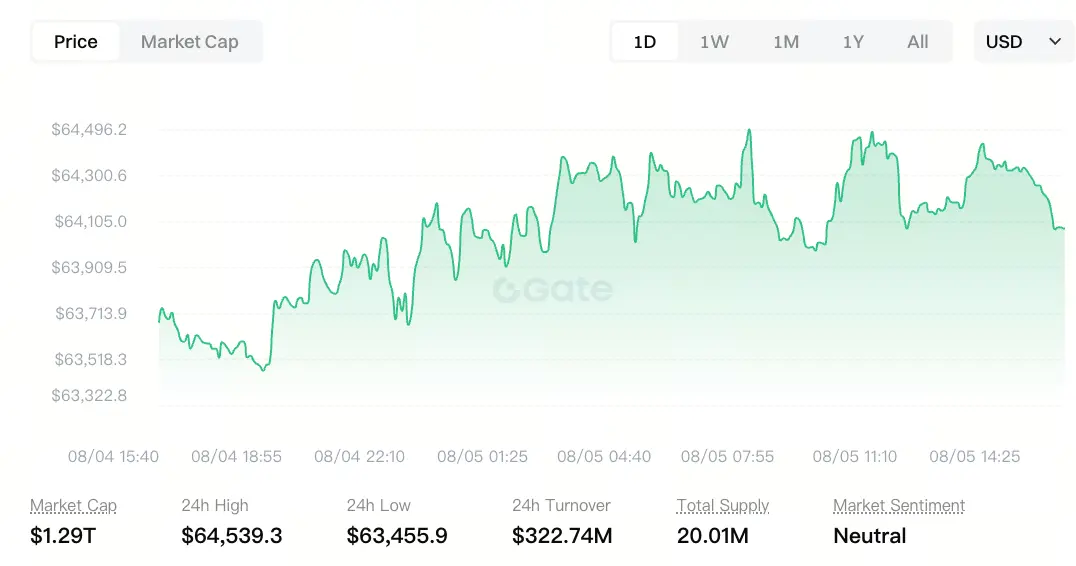
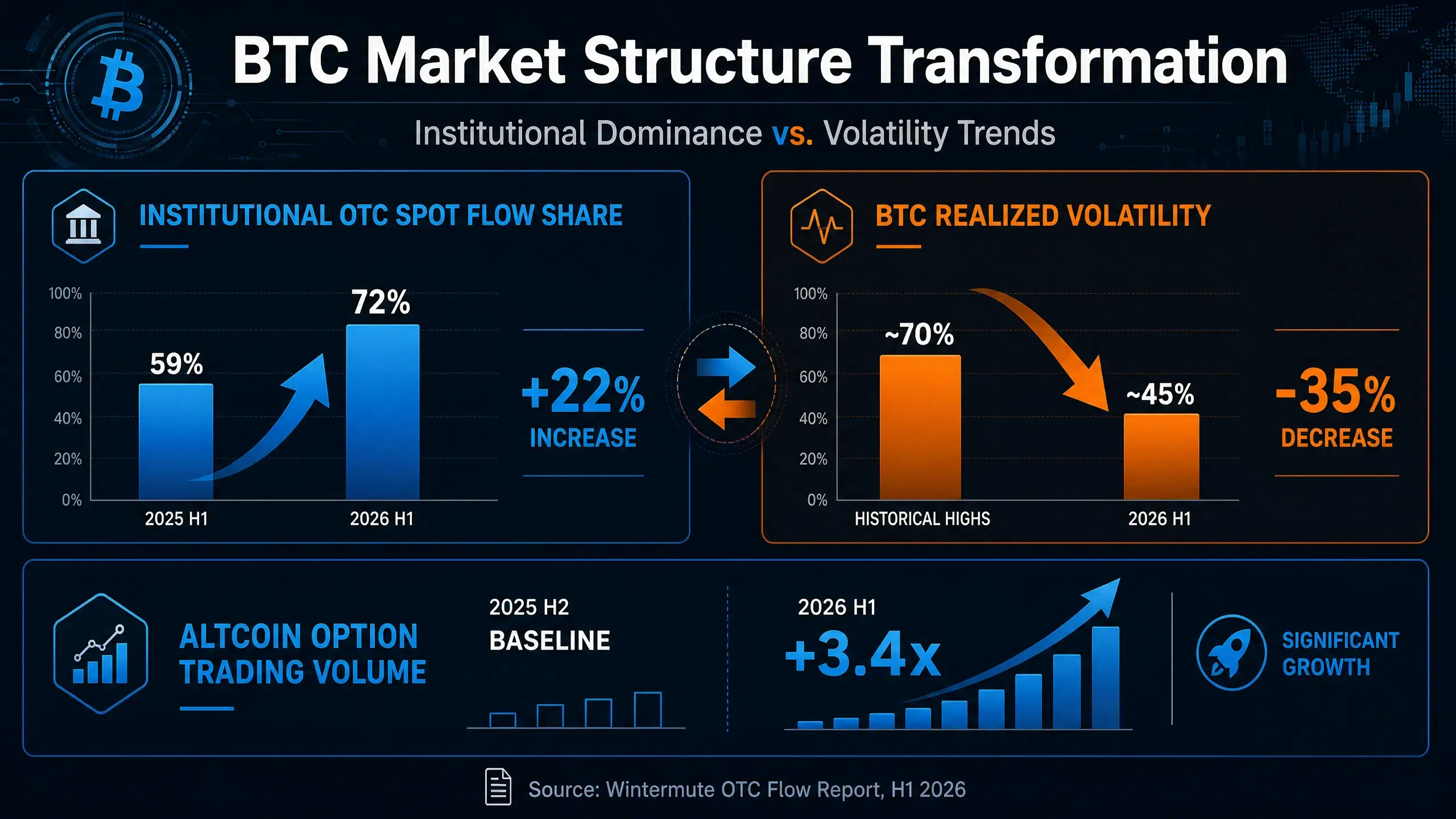
On August 5, 2026, 比特币价格 fluctuated narrowly around $64,000, with a 24-hour range of less than 1.5%. For crypto market participants accustomed to dramatic rallies and plunges, this “dull” price action may feel uncomfortable. But the data reveals a more profound reality: Bitcoin’s realized volatility has fallen from approximately 70% at historical highs to 45%, nearly halving.
Source: Gate 行情数据
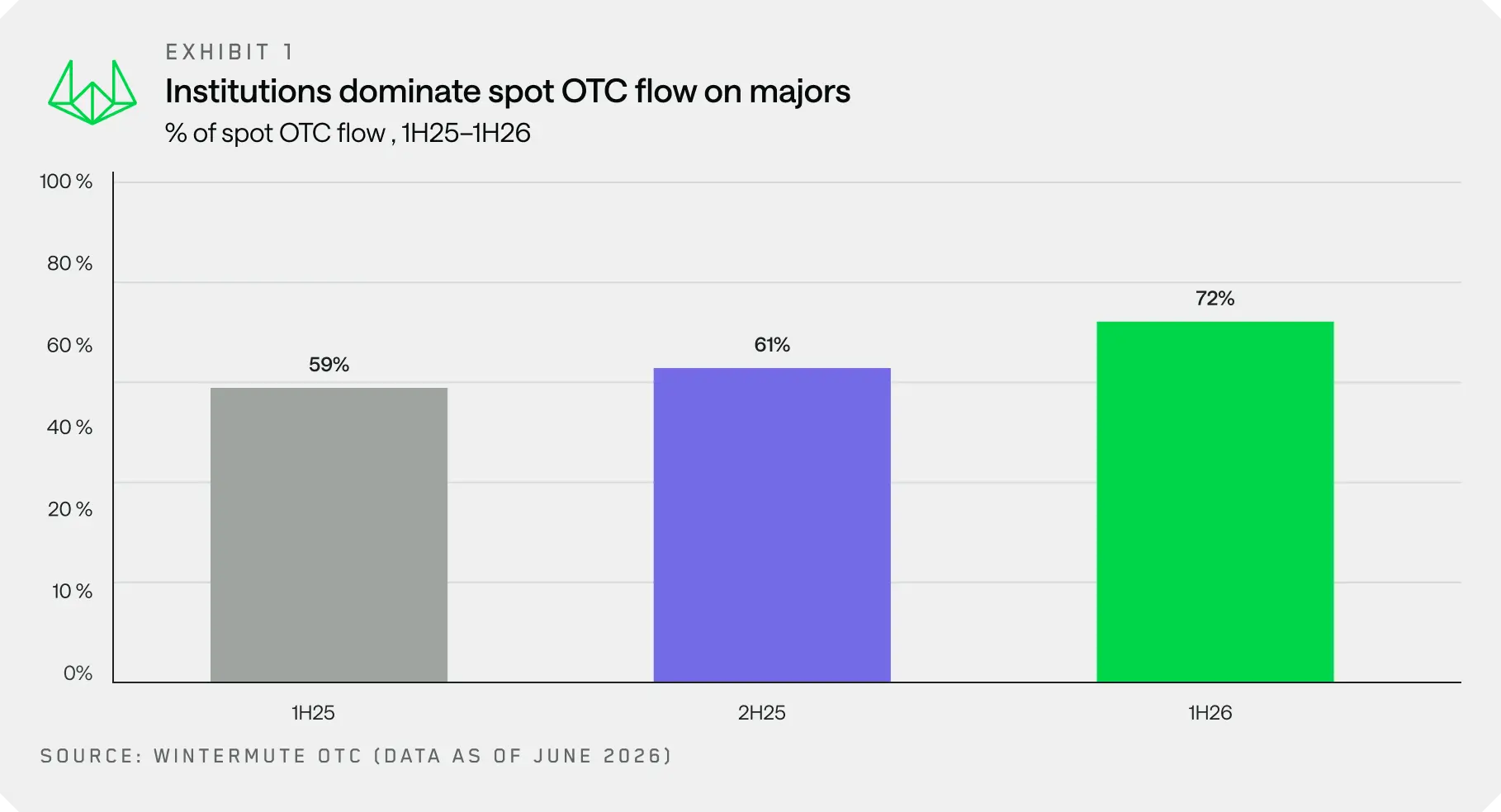
This is not a sign of declining market activity. On the contrary—it points to a fundamental transformation in the composition of market participants. The latest report from crypto market maker Wintermute shows that institutional investors accounted for a record 72% of its OTC spot trading volume in the first half of 2026, far above the 59% recorded in the first half of 2025. Hedge funds, digital asset management firms, and family offices are becoming the dominant forces in market pricing.
Source: Wintermute
As “Wall Street” replaces “retail investors” as the marginal price setter, Bitcoin’s pricing logic, volatility characteristics, and even asset attributes are being quietly rewritten. Based on the Wintermute report and on-chain data, this article breaks down how the institutionalization wave is reshaping BTC’s market cycles.
Comparison chart of institutional dominance and changes in volatility
Patient Institutional Capital: Why BTC Has Become “Less Crazy”
In the traditional view, Bitcoin is known for its high volatility, which is closely tied to its retail-dominated market structure. Retail trading behavior typically features chasing rallies and selling into declines, high turnover, and sentiment-driven decisions, all of which can amplify price fluctuations. Institutional capital, however, operates according to a very different logic.
Wintermute noted in its report that institutional investors are increasingly inclined to withstand price volatility rather than chase price movements. This “patience” directly suppresses realized market volatility. Long-term allocation, strict risk controls, and systematic hedging strategies are core characteristics of institutional trading, resulting in holding periods that are much longer than those of retail investors.
Data shows that whenever a token’s trading volume and price surge, both institutional and retail traders rush in, but the difference lies in how long they stay: institutional activity typically fades within a day after an upward move, while retail traders remain active for approximately three days. Today, retail investors account for a significantly smaller share of the overall market. This mismatch in participant structure means that the dramatic and sustained rallies once driven by retail FOMO are being replaced by a more restrained and shorter-lived institutional behavior pattern.
The Rise of the Derivatives Market: From “Buy and Pray” to Structured Strategies
Institutional investors have not only brought patient capital but have also changed the tools used in market competition. Wintermute data shows that altcoin options trading volume on its platform grew approximately 3.4 times over the past year, with this growth continuing from the second half of 2025 into the first half of 2026.
This trend clearly shows that institutions prefer to use derivatives such as options, futures, and yield strategies to express market views rather than simply buying and holding spot assets. Yield-seeking capital often generates premium income by selling options and through other methods. Such strategies naturally suppress sharp price fluctuations rather than amplify them.
In fact, on major options exchanges, BTC options are typically priced with relatively high implied volatility. Historical analysis shows that BTC’s 90-day implied volatility is, on average, 5.8 percentage points higher than its realized volatility. This means that selling volatility has a statistically positive expected return. By systematically executing such strategies, institutions not only generate stable returns but also objectively serve as the market’s “shock absorbers.” This explains why BTC’s realized volatility has continued to decline as institutional dominance has increased—the deeper development of the derivatives market is itself reshaping the mechanism by which spot prices are formed.
BTC’s Asset Attribute Shift: From Tech Stocks to a Macro Asset
The convergence of volatility and the institutionalization of the participant structure point to a deeper trend: Bitcoin’s asset attributes are shifting.
In the past, BTC was often viewed as a high-risk technology asset, with its price highly correlated with technology indexes such as the Nasdaq. However, this relationship was “event-driven” and often returned to independent trading after macroeconomic shocks. With the launch of spot ETFs, the improvement of institutional custody infrastructure, and the maturation of the derivatives market, Bitcoin is gradually becoming embedded in the global risk-asset system, and its behavior increasingly resembles that of a high-beta macro asset.
Institutional bets on crypto assets are now highly concentrated in Bitcoin, Ethereum, and a small number of leading DeFi projects rather than being spread across long-tail altcoins. This concentrated allocation behavior itself closely aligns with the logic of traditional risk-asset portfolios. When institutional capital flows account for three-quarters of OTC trading volume, the market’s trend direction, volatility rhythm, and pricing efficiency increasingly reflect the logic of macro liquidity, risk budgets, and cross-asset arbitrage rather than crypto-native narratives.
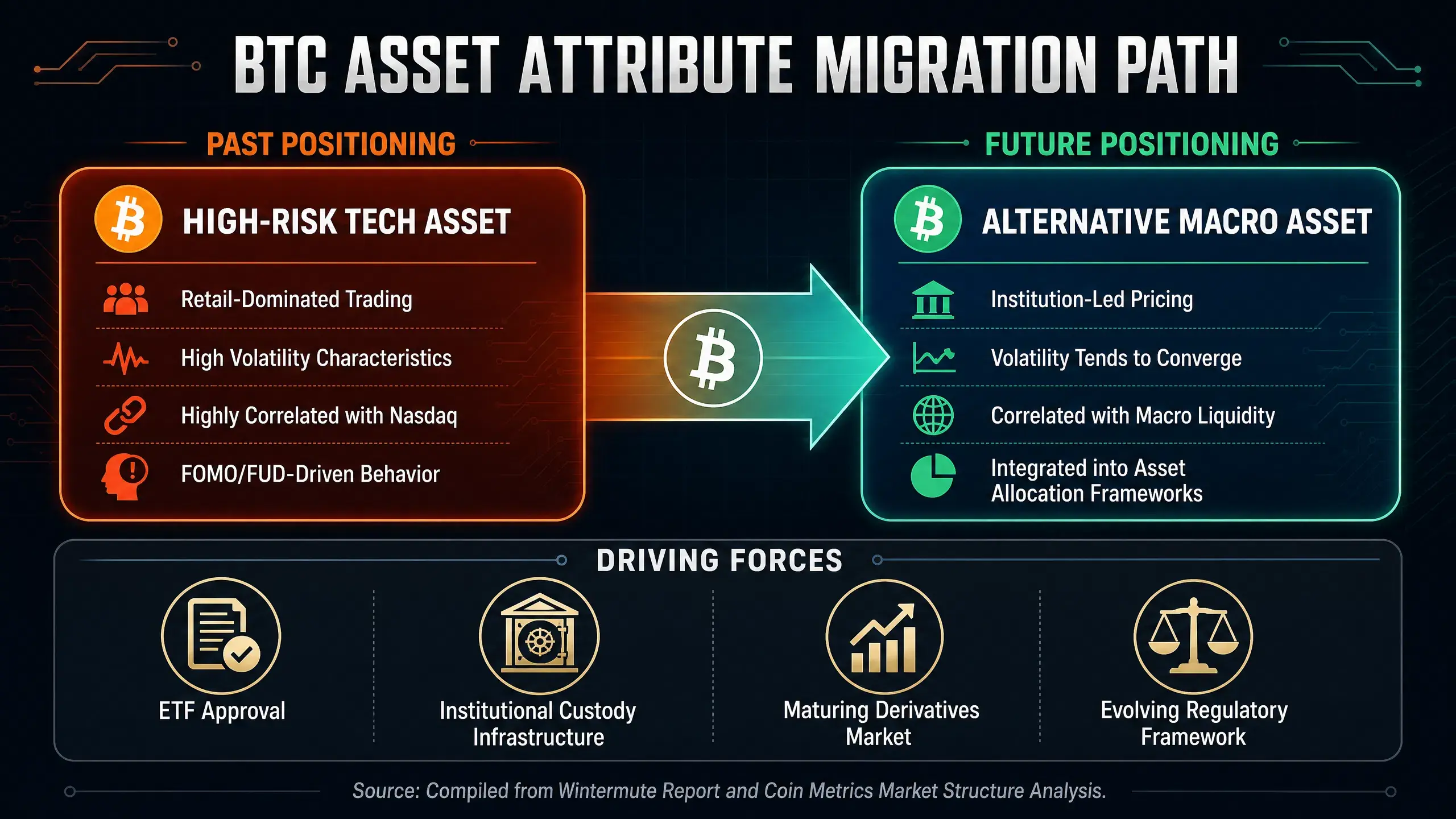
Diagram of BTC’s asset attribute shift
Conclusion: New Rules for a New Cycle
Bitcoin’s realized volatility falling from 70% to 45% is not merely a numerical change; it is also a microcosm of the shift in the market’s power structure. When the Wintermute report states that “institutional capital flows account for three-quarters of trading volume and determine the market structure,” its implicit message is that the operating rules of the Bitcoin market have changed.
Under these new rules, understanding the crypto market requires tracking on-chain data, derivatives positions, macro liquidity, and regulatory developments simultaneously. For traders, this means abandoning the simplistic four-year cycle narrative of the past and embracing a more complex and diverse, but also more resilient, market structure. For the industry, declining volatility does not represent a loss of vitality but rather the cost and hallmark of maturity.
FAQ
Q1: Does declining Bitcoin volatility mean there are fewer market opportunities?
Not necessarily. Declining volatility reflects the shift from a retail-dominated participant structure to an institution-dominated one, along with improvements in market depth and efficiency. Opportunities may decrease for trend-following strategies, but for arbitrage, yield strategies, and long-term allocation, the market’s predictability and stability have actually improved.
Q2: Does institutional participation mean retail investors no longer have opportunities?
Opportunities for retail investors still exist, but the competition has become more difficult. Institutions have advantages in information access, risk management, and execution efficiency. Retail investors may need to focus more on asset allocation logic and risk management rather than simply chasing rallies and selling into declines.
Q3: What does a 3.4-fold increase in altcoin options trading volume mean?
It means that institutions are expanding the scope of their risk management from Bitcoin and Ethereum to a broader range of crypto assets. This will help improve liquidity and pricing efficiency in altcoin markets, but it may also cause their price behavior to move closer to that of Bitcoin, reducing the frequency of independent moves.
Q4: What is the relationship between the growth of tokenized RWAs and Bitcoin volatility?
Tokenized real-world assets (RWAs) grew by nearly 50% to $31 billion in the first half of 2026, reflecting institutional capital’s preference for using crypto technology to improve the efficiency of traditional assets. The expansion of these yield-generating assets may divert some speculative capital, further reducing the market’s overall preference for volatility.


