This comparison is for product and risk readers choosing between private page fields and public feeds. The mechanism itself is unpacked in zkTLS; the umbrella term for off-chain data bridges falls under blockchain oracles. Sections below contrast source, privacy, trust, and latency, and absorb the screenshots/PDF-versus-cryptographic-provenance boundary.
Dimensions and a choose-if checklist follow, including where screenshots or PDFs stop and cryptographic provenance starts. Protocol-shaped wrappers include the zkPass zkTLS oracle; zero-knowledge feed narratives sit next to zkOracle and zkCoprocessor.
Key Takeaways
- zkTLS optimizes proving which domain-bound server an HTTPS session field came from; traditional oracles optimize continuously writing public facts on-chain with manipulation resistance.
- Private post-login pages without signed public APIs fit zkTLS; continuous market prices and multi-source aggregation fit mature oracle networks.
- Selective disclosure is a common zkTLS advantage; traditional feeds usually publish aggregated values to every on-chain observer.
- Screenshots and PDF uploads can support operations, but lack checkable session provenance; cryptographic claims prove provenance and integrity—not origin truthfulness.
- Choose with a “Choose if” list, and write notary/node-set risk plus origin errors into the threat model.
| Feature |
zkTLS |
Traditional oracle |
| Data source |
User HTTPS session to the origin (login pages / private APIs) |
Operator nodes fetch public sources, venues, or dedicated APIs |
| Access path |
User holds the session; notary / Proxy / TEE co-witnesses or delegates |
Node set pulls and aggregates; contracts read the feed |
| Privacy |
Often supports predicate-level selective disclosure |
Feed values are usually public to on-chain observers |
| Trust roots |
Domain/cert binding plus notary, Proxy, or TEE path |
Node set, multi-source aggregation, economic incentives |
| Latency and cost |
Per-session prove path; higher latency and proving cost |
Continuous updates; suited to low-latency market data |
| Typical data types |
Balance thresholds, membership tiers, employment/reputation fields |
Prices, rates, sports and public event outcomes |
| Failure modes |
Notary corruption/downtime; wrong origin page still formally valid; DOM/path breaks |
Source manipulation, node collusion, stale or biased feeds |
| Screenshots / PDFs |
Checkable session provenance; stronger than screenshot self-reports |
Does not replace screenshots; focuses on public-fact ingestion |
The table compresses the choice into scannable dimensions: source and access decide who can see the data; privacy and trust roots decide the cost of false accepts; latency and data type decide which path is cheaper to engineer. Screenshots get their own row because operations often treat images as “proof,” yet that is not the same evidence class as cryptographic provenance.
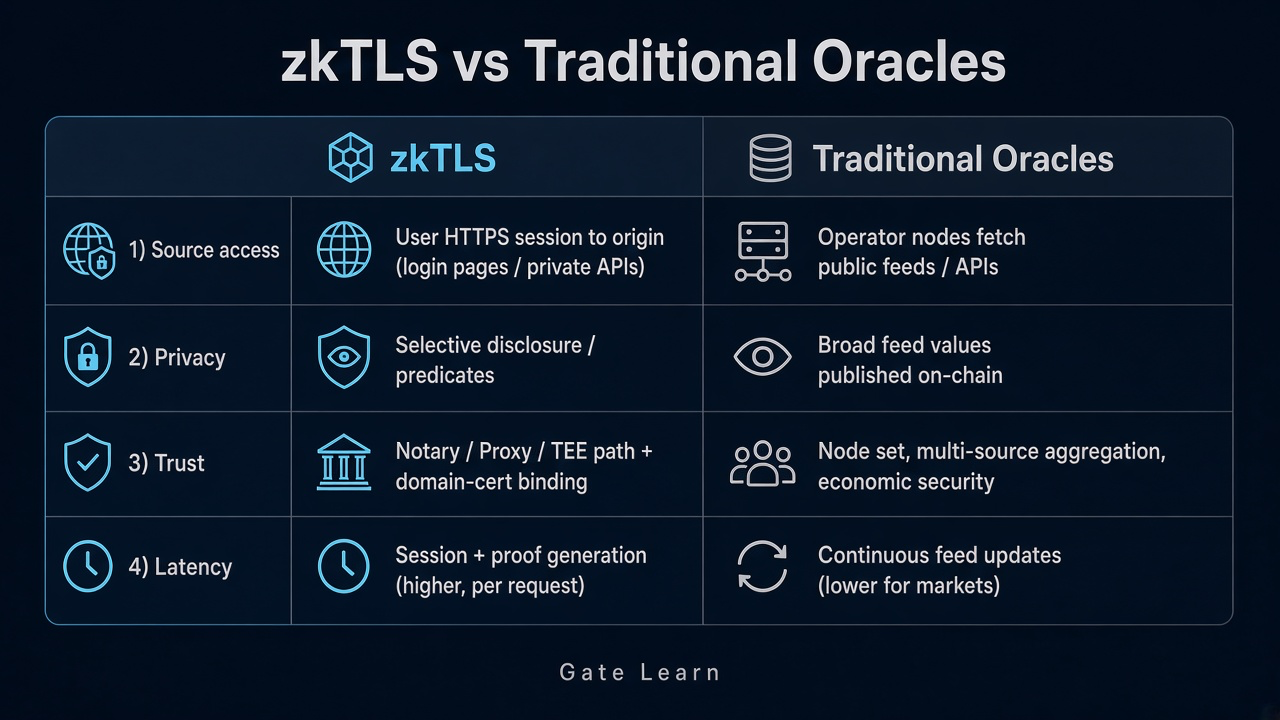
Figure 1. Side-by-side view of zkTLS and traditional oracles across source access, privacy, trust assumptions, and latency.
What Is zkTLS?
zkTLS, as a technique family, turns fields inside a TLS/HTTPS session into claims a third party can check: bind domain and certificate, and optionally disclose only a predicate result (for example, that a balance exceeds a threshold) without handing over full plaintext.
zkTLS does not replace HTTPS and does not automatically decide whether the origin’s business facts are correct; it delivers provenance and integrity evidence, with transport layer security as the HTTPS protocol that enables secure data exchange between a client and a server. Teams use MPC, a Proxy path, or a TEE as the common integrity paths; “zk” is often an umbrella label, and the TLS handshake may never run a zero-knowledge circuit, even if a zero-knowledge proof is one optional layer within the broader protocol family.
In practice, the client opens a TLS session to the origin server. Because the session key is shared between client and server, a lone client can encrypt arbitrary bytes and later “decrypt” them, so other parties cannot treat a raw transcript as honest server output. That is why zkTLS designs add a witness: an MPC notary that jointly runs the protocol with the client, a Proxy that attests to ciphertext direction, or a TEE that keeps the key inside a sealed computation environment. The resulting proof lets verifiers use the claim without learning the full page or the session key.
What Is a Traditional Oracle?
Traditional oracles write off-chain facts into on-chain state so a smart contract can access external data from off-chain or real world data sources. Typical outputs are price feeds, rates, sports results, or public event outcomes, and these networks are strongest with public data or publicly available data rather than private user records. Design focus is usually multi-source aggregation, node availability, and manipulation resistance—not proving which HTML field appeared in a user’s logged-in session.
Contracts read feed updates, not browser transcripts. Continuous public-market data fits this path naturally; private login-page fields often lack a signed public API, and feed networks do not by default replay each user’s HTTPS session, which is why decentralized applications often use oracles for shared external data, not personal session evidence. Oracle parties usually operate servers that pull public endpoints; they do not sit inside a user’s client TLS channel, so they cannot casually use a private bank page the way a zkTLS client-plus-witness protocol can.
How Do Data Sources and Access Paths Differ?
The core split is this: zkTLS follows sessions the user can already open to an origin; traditional oracles follow public sources operator nodes can fetch.
In a zkTLS path, the client completes HTTPS to the target domain server, and the proof can be generated from any HTTPS website without requiring prior API access. Some designs use a Proxy model, where an intermediary witnesses or forwards the client–server exchange instead of using MPC-style session processing. Other MPC-based approaches jointly execute the TLS handshake—the protocol step that sets up the secure session key—so neither party alone forges server ciphertext. A notary, Proxy, or TEE leaves checkable evidence; then a claim proof is built. In a traditional-oracle path, nodes fetch venues, indexes, or public APIs, aggregate into a feed, and contracts read that feed. That makes zkTLS useful for verifying Web2 data from existing systems when there is no easy public feed. Otherwise, traditional data validation or another confirmation process would require a separate party to fetch the same source directly. Without a user session, zkTLS cannot replace a public feed; without fetchable public sources, nodes cannot safely consume post-login private fields. Server-supported approaches also depend on origin servers allowing export, so operators can limit what gets shared. Products that use Web Proofs therefore treat the client, the server, and the witness parties as one protocol path. Public mechanism write-ups such as the Oasis zkTLS explainer and the EthSystems zk-TLS pattern page map the same session-to-proof path.
How Do Privacy, Private Data, and Selective Disclosure Differ?
A common zkTLS capability is selective disclosure: prove that a threshold is met without publishing the exact amount, or extract one field while hiding the rest. It can also prove claims about such data without revealing the full contents. That makes zkTLS useful when private or sensitive data must be proven without exposing the full record. Once a traditional oracle feed is on-chain, the aggregated value is usually visible to every observer—privacy goals often conflict with a fully readable feed.
If a product needs eligibility gates without full statements, zkTLS fits the intent. That is especially relevant when proving personal or sensitive data such as legal identity or financial records with selective disclosure. If a product needs everyone to settle on the same public price, traditional feeds fit the intent. The two can also compose: public prices via oracles, private user attributes via zkTLS claims, which helps bring private internet data on-chain without broad disclosure; some systems describe this as a model that enables private internet data to be verified on-chain from HTTPS websites without exposing the full record.
Selective disclosure usually sits on top of the TLS transcript proof. The client still talks to the origin server; witness parties help bind the response; then a circuit or redaction protocol produces a smaller proof that other parties can use. In an MPC design, the session key may be split so no single party can abuse it. In a Proxy design, the Proxy attests to ciphertext while the client keeps the decryption key and proves knowledge of the plaintext inside a computation. Either way, the goal is to use private fields without shipping them to every verifier server.
How Do Trust Assumptions, Data Integrity, and Failure Modes Differ?
zkTLS trust sits on domain/certificate binding and on whether the notary, Proxy, or TEE path is honest and live. If the origin server returns a wrong field, a formally valid proof may still be accepted—provenance is not content truthfulness. When zero-knowledge disclosure is implemented correctly, the verifier remains unaware of the prover's personal information. Reviewers should still ask which parties hold key material, which parties run the MPC or Proxy protocol, and which server certificate pins the TLS endpoint.
Traditional-oracle trust sits on node-set composition, multi-source rules, and economic incentives. Failures more often look like source manipulation, node collusion, or stale/biased feeds. Private records also introduce additional security risks and data leakage concerns if a verifier or operator has to inspect them directly. Checklists differ: zkTLS emphasizes binding, predicate, data authenticity, data integrity, and trust-root checks; oracles emphasize freshness, deviation thresholds, and aggregation sources. Skipping either side’s checks turns “looks usable” into a false sense of verification. A client-side forge remains a key failure mode if no witness is present; a corrupted witness is a key failure mode if the protocol’s parties collude.
How Should Latency, Cost, and Data Types Be Traded Off?
Three practical rules: continuous public market data prefers traditional oracles; one-shot or low-frequency proofs over user-specific data or financial data prefer zkTLS; screenshots and PDFs suit operational records, not cryptographic provenance.
zkTLS incurs per-session and proving cost, usually with higher latency than a hot feed path, and fits balance thresholds, membership tiers, and employment or reputation fields. That includes proving a bank account or a bank account balance clears a required threshold without exposing the underlying credentials or full statement. An MPC TLS path can be communication-heavy; a Proxy path can use less interactive computation but still needs a live witness server; TEE paths move key handling into sealed hardware. Traditional oracles maintain continuous updates and fit prices, rates, and public events—engineered for low-latency market data that many client apps use every block.
Screenshots, PDFs, or manual uploads can show “something that looks like a page,” but a third party cannot cryptographically verify that a TLS session hit the target domain server or that fields were not edited by the client. zkTLS-style claims can ensure data authenticity and preserve data provenance for this kind of private input, but they still do not prove the origin’s business facts are true. Even then, wrong origin pages, DOM breaks, and notary downtime still break correctness or availability. Treating screenshots as the only gate trusts the uploader and reviewer; treating proofs as “truth” ignores that origin errors can remain formally valid. Teams that use both screenshots and cryptographic proofs should label which evidence class each gate accepts.
Should You Choose zkTLS or a Traditional Oracle?
Prefer zkTLS if: the data lives behind a login HTTPS page or private API that a client can open to an origin server; predicate-level minimal disclosure is required; no ready multi-source public feed exists; per-request proving latency and a notary, Proxy, or TEE trust root are acceptable; this is often the better path for identity verification or other proofs over private user records where full disclosure is unacceptable. Choose MPC when joint computation among parties matters more than browser convenience; choose Proxy when you want to use existing client Proxy features; choose TEE when sealed key custody is the main control.
Prefer a traditional oracle if: continuous public market prices or event outcomes are required; contracts must settle on a network-readable feed; mature multi-source aggregation and deviation monitoring already exist; privacy is not the field’s main constraint, and these feeds usually drive smart-contract decisions from shared external systems rather than personal records. Oracle networks are built so many client contracts can use the same public feed without each user opening a private TLS session.
Compose both if: public prices go through an oracle and private user attributes go through zkTLS. That mix is common when apps need public feeds plus private claims for real-world-asset workflows or sensitive business logic. Either way, write “provenance ≠ truth” into the rules: origin server errors, node collusion, notary corruption, weak key handling, and page redesigns are first-class risks—not footnotes. The protocol choice should name which parties must stay honest for the proof to remain meaningful.
Summary
zkTLS and traditional oracles answer different on-chain questions: traditional oracles mainly serve shared external data, while zkTLS helps make private web records checkable with privacy preserved. That gap has historically meant public feeds were easier to use, leaving private data underutilized by comparison. After contrasting source access, privacy, trust roots, and latency, private login-page fields and public feeds rarely substitute for each other.
In short: use a traditional oracle when many contracts need the same public feed; use zkTLS when a client must prove a private TLS response from an origin server with a selective-disclosure proof. MPC, Proxy, and TEE remain the main witness styles for that protocol path, and each changes which parties hold key material and how much interactive computation the client must run. Screenshots and PDFs cannot fill a cryptographic-provenance gap; a TLS proof cannot automatically guarantee origin content is correct. Choosing with a “Choose if” list—and writing notary/node plus origin failure modes into the threat model—beats arguing about labels.
FAQ
What is the difference between zkTLS and traditional oracles?
Traditional oracles mainly deliver public data to a smart contract, whereas products use zkTLS when the authenticity of the data must be shown for a user-held HTTPS session; that also affects whether the verifier sees the underlying record or only a proof about it. zkTLS proves that fields in a TLS session came from a server bound to a domain and certificate, and some designs use MPC (secure multi-party computation) during the TLS handshake among client and notary parties, while others rely on a Proxy or TEE-based witnesses; traditional oracles continuously write public off-chain facts (such as prices) to contracts via node sets and multi-source aggregation. One optimizes session provenance; the other optimizes feed availability and manipulation resistance. In Proxy- or witness-based designs, the origin server itself usually does not need to change, and the client still holds or shares the session key under the protocol rules.
When should you use zkTLS versus a traditional oracle?
Use zkTLS for post-login private fields that need minimal disclosure and lack a signed public API, especially when a product needs verifiable data sharing from a private source by using an access token or session credentials so the client can authenticate directly to the origin server instead of handing raw records to an intermediary. Some implementations run zero-knowledge proof computation locally so selected attributes can be proven without uploading the full record. Use traditional oracles for continuous public market prices or event outcomes that need network-readable settlement; that can keep private records off a public oracle feed while still letting contracts use shared prices. Public feeds and private attributes can compose in one product when different parties need different evidence classes.
Can screenshots or PDF uploads replace a zkTLS proof?
Not reliably. Screenshots and PDFs from a web page may look persuasive operationally, but they lack checkable TLS session provenance and do not carry cryptographic proof of session origin or integrity, so a third party cannot easily rule out edited images or wrong pages. By contrast, an HTTP Proxy witness can observe or route the exchange to preserve checkable provenance in a way a screenshot or PDF cannot. zkTLS-style claims provide domain binding and integrity check paths—but if the origin returns bad data, a proof can still be formally valid.
Does a passing zkTLS verification mean the origin data is true?
No. A pass usually means the claim holds for provenance and integrity under stated trust assumptions, and the proof may include integrity checks such as a message authentication code on the response data; the proof may show provenance and integrity while the underlying sensitive information could still reflect a wrong field or bad origin-side entry, and origin data-entry errors, tampered pages, or wrong API fields can still yield formally valid proofs. Some designs also derive an encryption key during the session so the user can decrypt the response while the verifier still cannot see the underlying record. Checkable provenance and content truthfulness are separate layers.
Can traditional oracles directly consume a user’s post-login webpage fields?
Usually not as a personal HTTPS session. Traditional nodes usually fetch public sources from APIs or other public endpoints, not a user’s private post-login session transcript or Web Proofs; some newer private-to-private oracle designs instead send authenticated TLS data into blind computation servers rather than publishing it as a standard feed. This model centers on providing data provenance for private inputs, can keep encrypted data private for regulatory compliance, and can combine data from multiple clients for joint computations; platforms such as Nillion’s Private-to-Private Oracles use blind computation for privacy, while Reclaim Protocol is a Proxy-style example distinct from that approach. That can also enhance security by moving sensitive session data into private computation instead of exposing raw page contents; when post-login private pages lack a signed open API, zkTLS-style Web Proofs or dedicated data partnerships fit better than a default feed job.