zkTLS is for readers who need to bring webpage or authenticated API values to a contract or counterparty—not a new transport that replaces HTTPS. Versus screenshots or self-reports, it turns “the session hit the target site” and “the field meets a predicate” into checkable evidence. Continuous public-market feeds more often rely on blockchain oracles; the feed-style comparison appears below.
Sections below cover definition, session-to-proof steps, MPC/Proxy/TEE differences, use cases, oracle contrast, and risks, alongside public mechanism write-ups such as the Oasis zkTLS explainer and the EthSystems zk-TLS pattern page.
Key Takeaways
- zkTLS turns an HTTPS session into a checkable claim: bind domain/certificate and optionally disclose only a predicate result.
- The name is often misleading: not every design uses zero-knowledge at handshake time; MPC, Proxy, and TEE are the common three paths.
- Because TLS ends in a shared symmetric session key, a client alone can forge a transcript show-and-tell—hence notaries, proxies, or TEEs.
- Provenance is not truthfulness: if the origin returns a wrong field, a proof can still be formally valid.
- Verifiers should check domain/cert binding, the predicate, and the attestation signature or trust root on the proof path.
What Is zkTLS and What Problem Does It Solve?
zkTLS addresses a gap in ordinary TLS: Transport Layer Security underpins HTTPS connections for browsers, encrypting and authenticating the client-server channel, yet after the session ends it is hard to convince a third party that the server really returned that content without handing over abusive decrypt material or relying on screenshots. Contracts therefore struggle to consume post-login fields.
A standard TLS handshake derives a symmetric session key: browser and server can both encrypt and decrypt. If a user alone shows ciphertext plus that key, other parties cannot rule out that the user encrypted fake plaintext and then decrypted it on demand—so a solo client cannot be a reliable witness. That limitation motivates notaries, proxies, or TEEs.
What zkTLS delivers is provenance and integrity evidence, not a final ruling on business truth. Proving that a balance field came from a site’s TLS session does not disprove bad data entry or a tampered page—adjacent to the zero-knowledge feed narratives in zkOracle and zkCoprocessor, but a different problem domain.
How Does zkTLS Work? From HTTPS Session to Verifiable Claim
At a high level, zkTLS moves from a normal HTTPS session to a checkable proof: the user opens a session to the origin; an MPC notary, Proxy, or TEE path leaves checkable evidence; then a selective-disclosure proof is produced and checked.
- Open the session — Start TLS to the target domain; certificate and domain binding become part of the later statement.
- Co-witness or delegate — A notary joins handshake/decryption (MPC), a proxy attests ciphertext direction (Proxy), or a TEE performs the request, so a lone client cannot easily forge server-sent ciphertext; some designs treat this as a multi-party protocol rather than a solo-client flow.
- Fetch the target field — Inside the session, request the account page or API and receive the encrypted response.
- Build the claim — Produce a proof (or path signatures) over transcript commitments, server identity, and a predicate such as balance > threshold; circuit-based paths turn transcript constraints into proof outputs.
- Submit for verification — A contract or counterparty checks the proof and trust roots, then accepts or rejects.
Selective disclosure is a common second layer: prove that a balance exceeds a threshold without the exact amount, or extract one field while hiding the rest. Per Reclaim’s note on the “zk” in zkTLS, privacy ZK is often an enhancement; the more basic requirement is convincing a third party that the response really came from the origin.
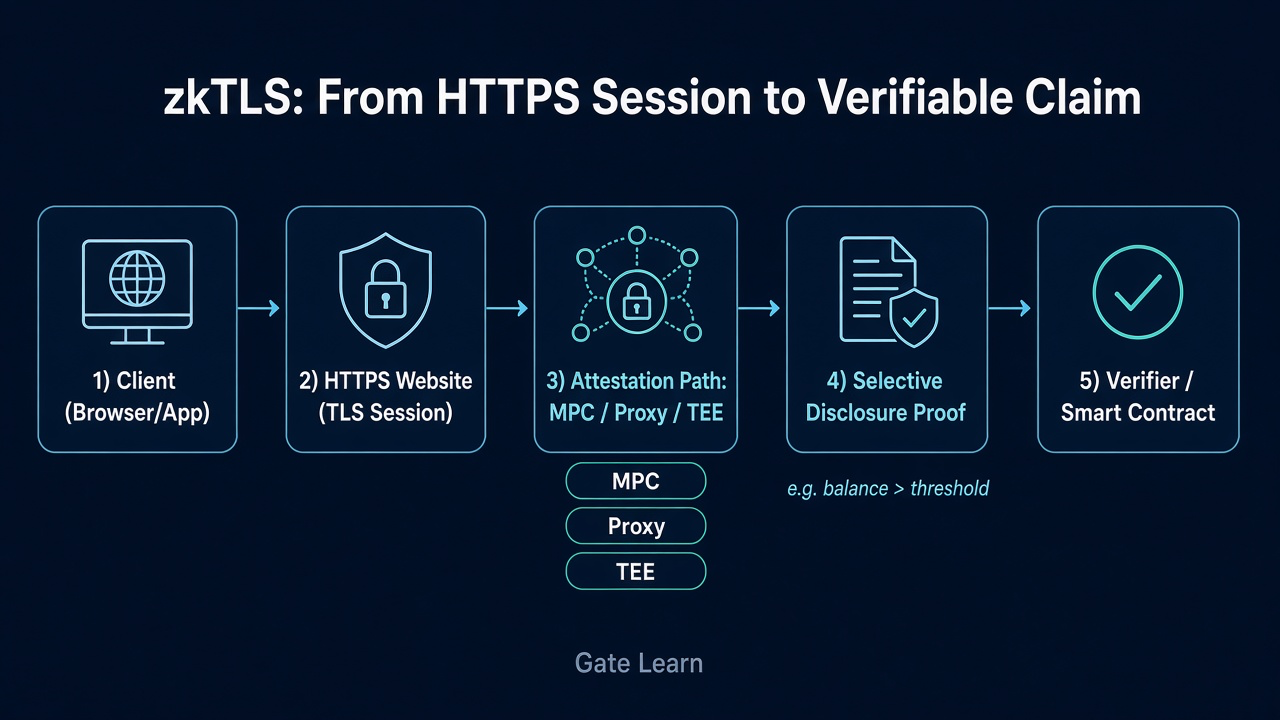 Figure 1. zkTLS moves from a client HTTPS session through an MPC/Proxy/TEE attestation path to a selective-disclosure proof checked by a verifier or smart contract.
A verifier checklist should cover at least four items: domain and certificate binding to the claimed origin; a predicate aligned with business rules; proof-path signature or trust root on an allowlist; and whether origin structure changes would break the parser. Skipping any item turns “verifiable” into “looks like a proof,” even though the goal is to produce verifiable data for smart contracts or counterparties.
Why Is It Called zkTLS? How Do MPC, Proxy, and TEE Differ?
“zkTLS” is a popular umbrella term that suggests zero-knowledge proofs must run at handshake time—but that is not always true. The label is often used broadly for a hybrid protocol, though not every implementation actually fits that description. Many designs are closer to Web Proofs or TLS attestations: the focus is verifiability, not mandatory ZK inside the handshake.
| Path |
Core mechanism |
Trust and cost notes |
| MPC / 2PC (TLSNotary-style notary) |
Session key is jointly held so neither user nor notary alone can forge the transcript |
Depends on notary honesty and liveness; higher latency |
| Proxy |
An HTTPS proxy attests whether ciphertext came from browser or server; the user ZK-proves decryption without revealing the key |
Lower overhead; assumes the proxy does not collude on direction lies |
| TEE |
Requests run inside trusted execution environments that attest response integrity |
Low overhead; depends on chip vendor, TEE attestation roots, and tamper-proof hardware isolation |
All three paths answer the same question: how to convince a third party that ciphertext came from the server without handing over the symmetric key for abuse. Proxies can observe data-transfer direction without seeing plaintext. MPC/2PC designs (TLSNotary-style) use joint keys to block unilateral forgery; Proxy designs combine direction attestations with a user-side decryption proof; TEE designs host the session in hardware isolation. Privacy ZK can sit on top for field redaction, but TEE and most MPC handshakes are not handshake-layer ZK.
Choosing a path is a threat-model and cost decision: whether a single notary, proxy, or TEE is acceptable; whether sessions must stay low-latency; whether the origin only speaks certain TLS versions. MPC paths also ensure no single node ever holds the full key. Read “zk” as a label for verifiable web data—not a strict cryptography taxonomy.
What Can zkTLS Be Used For?
A classic use case is proving that an off-chain account meets a threshold without publishing the full statement: credit eligibility balance cutoffs, bank-balance checks in financial workflows without revealing the exact amount, employment or reputation fields from a logged-in portal, and confirmation of off-chain activity for quest rules. The shared pattern is data living behind HTTPS with no ready signed public API.
Identity and attribute use cases include identity verification and verified credentials, along with age bands, membership tiers, or summary ratings: the verifier sees a predicate result, not a full page of private data. Protocol-shaped products such as the zkPass zkTLS oracle frame private data made verifiable on-chain; separate how a protocol wraps proofs from what the zkTLS pattern guarantees.
Another class is privacy-preserving data feeds: apps need website fields in on-chain apps without exposing full scrape plaintext to every observer. Here zkTLS supplies a field proof with provenance; it still must be distinguished from continuous price feeds and multi-source aggregation used in decentralized finance and broader web-to-chain workflows.
How Does zkTLS Differ From Traditional Oracles?
Traditional oracles focus on writing off-chain facts (prices, event outcomes) onto chains, often via node sets or multi-source feeds. That difference is part of the oracle problem: getting trustworthy off-chain or web data into contracts. zkTLS focuses on proving that HTTPS session fields came from a specific origin, optionally with selective disclosure. Feeds optimize availability and manipulation resistance; zkTLS optimizes turning a web session into a checkable claim.
When comparing feed architecture, trust assumptions, and failure modes, use zkTLS vs traditional oracles. Short rule: continuous public market feeds still fit mature oracle networks; private post-login fields that need minimal disclosure fit zkTLS better, while some systems also treat data portability as a separate design goal—the two can compose, but neither replaces the other.
What Are the Advantages and Risks of Using or Relying on zkTLS for Sensitive Data?
Advantages include exporting checkable fields whenever the user can still complete HTTPS to the origin—without waiting for a dedicated feed API; selective disclosure lets contracts verify a fact without exposing the full private record; and claims can be checked programmatically by contracts.
Risks are equally concrete. Honesty and liveness of notaries, proxies, or TEEs form trust roots: collusion, refusal, or downtime yields false accepts or failures. TEE-based designs also carry security risks tied to the hardware manufacturer or attestation root. Origin honesty is out of protocol scope: wrong pages can still yield formally valid proofs. Field-path changes break predicates; some notary stacks cover only certain TLS versions.
Dependents should also weigh proving cost, session latency, and retention risk for session transcripts. zkTLS improves checkable provenance; it does not turn arbitrary webpages into unaudited truth sources.
Summary
zkTLS upgrades everyday HTTPS sessions into checkable, minimally disclosable claims so contracts can verify which domain-bound server a field came from—instead of trusting screenshots. “zk” does not guarantee zero-knowledge at handshake time; MPC, Proxy, and TEE reach integrity under different trust assumptions.
Before shipping, accept that a solo client with the symmetric key can stage a fake session show; verifier checklists must cover domain/cert, predicate, and trust roots; provenance is not content truth; and traditional oracles versus zkTLS split continuous feeds from private-page field proofs. Pick the path for the threat model, and write origin plus attestation risks into that model.
FAQ
What is zkTLS?
zkTLS is a family of designs built on standard TLS/HTTPS that produce claims a third party can check: that specific data came from a server bound to a domain and certificate, optionally disclosing only a predicate result. It bridges private Web2 fields to contract verification without replacing HTTPS.
How does zkTLS turn an HTTPS session into a verifiable claim?
The client and origin open a session; an MPC notary, Proxy, or TEE co-witnesses or delegates so a lone client cannot forge server ciphertext; a selective-disclosure proof is built; the verifier checks domain binding, predicate, and trust roots before accepting or rejecting.
Must zkTLS use zero-knowledge proofs at the TLS handshake?
No. Many systems labeled zkTLS use MPC, Proxy, or TEE for integrity; zero-knowledge proofs often appear later for selective disclosure or Proxy-style decryption proofs. The handshake itself may never run a ZK circuit—“zk” is a common label.
How does zkTLS differ from traditional oracles?
Traditional oracles continuously feed off-chain facts to contracts with multi-source and availability goals; zkTLS proves provenance (and optional predicates) for session-level HTTPS fields. Public feeds and private login-page fields are different problems; see the comparison topic—the two can be combined.
What are the main risks when relying on zkTLS?
Main risks include corrupted or unavailable notaries, proxies, or TEEs; origins that serve wrong data while proofs stay formally valid; page-structure breaks that kill parsers; and TLS-version limits. Skipping domain-binding and trust-root checks raises false-accept risk.