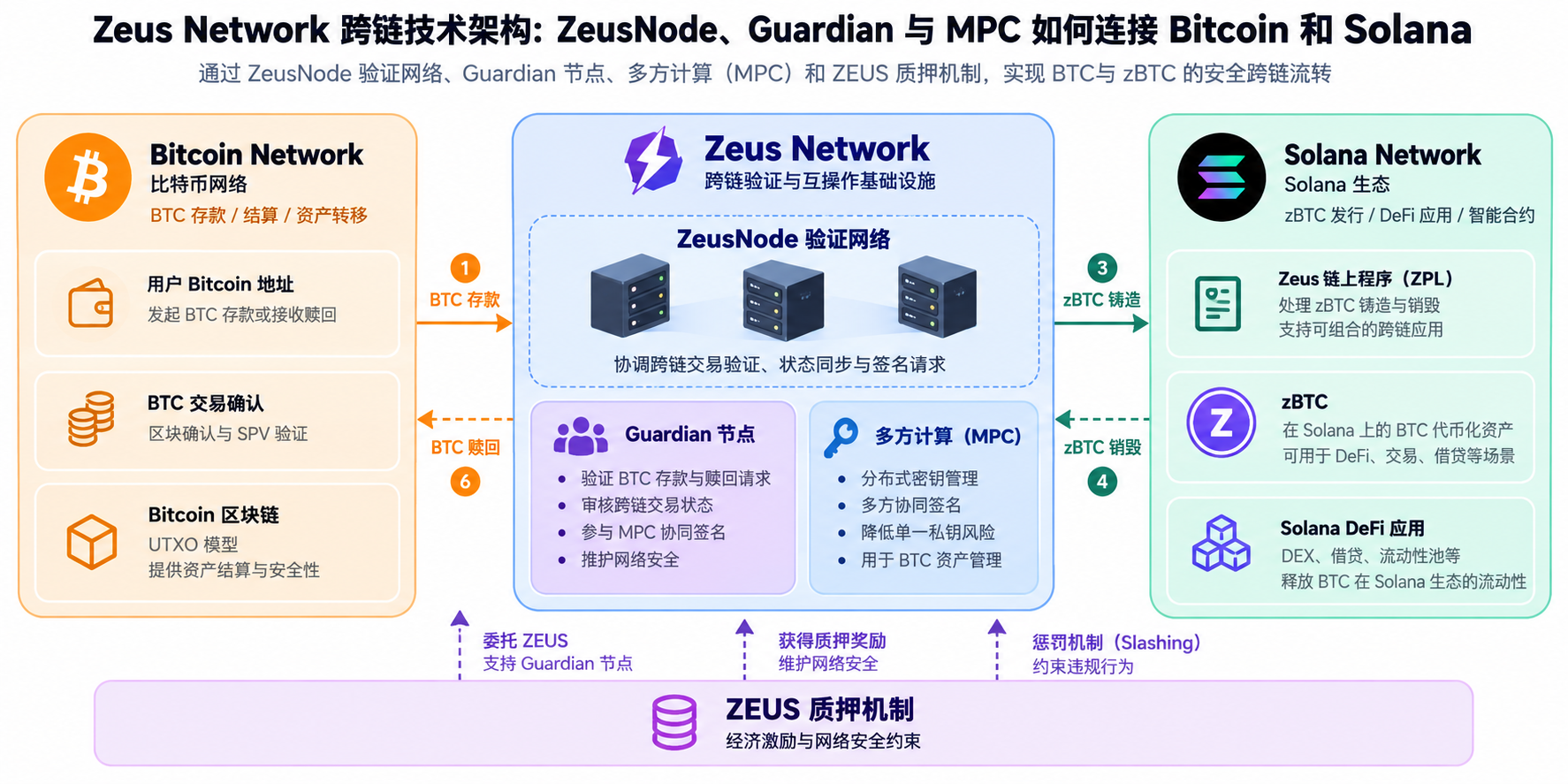
Zeus Network is a cross-chain interoperability infrastructure connecting Bitcoin and Solana. It utilizes the ZeusNode verification network, Guardian nodes, and multi-party computation (MPC) signature mechanisms to achieve BTC transaction validation, asset management, and cross-chain state synchronization. Its core design retains the native asset settlement functionality of Bitcoin while leveraging Solana's smart contract execution capabilities to map BTC into zBTC, which can be used within the Solana ecosystem. This is coordinated through distributed verification and signature mechanisms for asset deposits and redemptions.
As BitcoinFi and cross-chain decentralized finance (DeFi) continue to evolve, the demand for interoperability between Bitcoin and Solana is increasing. Bitcoin has a mature foundation for asset security and value storage, but its native scripting capabilities struggle to support complex financial applications directly. Solana, on the other hand, offers high transaction processing capabilities and a rich array of on-chain financial scenarios but cannot directly verify ownership and transaction status of Bitcoin mainnet assets. Therefore, establishing a trusted asset transfer mechanism between different consensus mechanisms and execution environments has become a critical technical issue for BTC's entry into high-performance DeFi ecosystems.
From the perspective of cross-chain infrastructure development, Zeus Network adopts an architecture that combines verification networks, distributed signatures, and economic security mechanisms. ZeusNode is responsible for coordinating cross-chain states, Guardian participates in verification and signing, MPC technology reduces the risk of single-point key control, and the ZEUS delegation and potential penalty mechanisms establish economic constraints for network participants. This architecture provides a technical path for Bitcoin liquidity to enter Solana, distinct from a single custodial model, while also making the degree of node decentralization, signature thresholds, cross-chain security, and asset repayment capacity important metrics for evaluating the protocol.
Key Points
-
Cross-chain positioning: Zeus Network connects Bitcoin and Solana through the ZeusNode verification network and Solana on-chain programs, allowing BTC to participate in Solana DeFi in the form of zBTC.
-
Core architecture: ZeusNode coordinates cross-chain transaction validation, state confirmation, and signature processes, while Guardian is responsible for transaction review and asset security maintenance.
-
MPC technology: Multi-party computation (MPC) reduces the risk of single private key leakage through distributed key management and collaborative signing, but still relies on the security and independence of participating nodes.
-
Economic security: The ZEUS token delegation is linked to Guardian network security and BTC capacity, with penalty mechanisms aimed at increasing the economic cost of malicious behavior.
-
Technical value and risks: Zeus Network provides cross-chain infrastructure for BitcoinFi but still faces challenges related to Guardian centralization, signature security, asset reserves, and cross-chain redemption reliability.
Why Bitcoin and Solana Need Cross-Chain Interoperability Infrastructure
Bitcoin and Solana exhibit significant differences in technical architecture and network positioning. Bitcoin employs a UTXO transaction model and a proof-of-work (PoW) consensus mechanism, focusing on securing asset ownership and transaction settlement. In contrast, Solana uses an account model and a high-performance smart contract execution environment, capable of supporting complex applications such as decentralized trading, lending, and liquidity management.
Due to the independent consensus rules and state databases of the two blockchains, Solana cannot directly treat Bitcoin transactions as verified on-chain facts, nor can Bitcoin natively execute Solana smart contracts. Therefore, BTC holders wishing to enter Solana DeFi typically need to rely on cross-chain asset mapping, custody, or other interoperability mechanisms.
Zeus Network's solution is to establish a dedicated verification and communication infrastructure between the two networks. Bitcoin is responsible for the transfer and settlement of native BTC, while Solana handles the issuance of zBTC and the execution of financial applications, with ZeusNode coordinating the transaction states. This design does not require modifications to Bitcoin's consensus rules but necessitates the establishment of additional cross-chain verification and asset security mechanisms.
What is ZeusNode? Analyzing the Core Responsibilities of Network Nodes
ZeusNode is the core cross-chain verification infrastructure of Zeus Network, primarily responsible for handling transaction validation, cross-chain state coordination, and signature requests between Bitcoin and Solana. It is not an independent blockchain but an interoperable system composed of off-chain nodes and Solana on-chain programs, providing foundational support for BTC asset mapping and redemption.
During the BTC deposit process, ZeusNode needs to identify relevant transactions on the Bitcoin network, check transaction confirmation status, and relay the validation results that meet the requirements to Solana. Subsequently, the relevant on-chain programs process zBTC minting requests based on the validation status. For reverse redemptions, ZeusNode must coordinate signature participants to ensure that BTC withdrawal requests comply with protocol rules.
The development of ZeusNode also reflects the evolution from early centralized verification to multi-node collaboration. The project's early technical documentation proposed a gradual transition from Singleton Mode to Notary Mode, introducing more independent operators. In December 2024, the project announced the launch of ZeusNode and the initiation of the Guardian program. The actual level of decentralization in the network still depends on the number of active Guardians, operational independence, and the distribution of signing authority.
What Role Does Guardian Play in BTC Cross-Chain Verification?
Guardian is a participant in the ZeusNode network responsible for verification and signing, tasked with reviewing cross-chain transaction requests and participating in relevant signing operations when protocol conditions are met. Its main responsibilities include verifying Bitcoin deposit transactions, confirming cross-chain asset status, and collaboratively processing BTC redemption requests.
Zeus Network distinguishes between ordinary Guardians and Institutional Guardians. Ordinary Guardians primarily participate in network verification and security maintenance, while Institutional Guardians cater to institutions with significant BTC liquidity management needs. The project has previously announced the involvement of the Solv Protocol in the Institutional Guardian system, reflecting its strategy to expand BTC liquidity sources through institutional participation.
The security value of Guardians lies not only in increasing the number of nodes but also in reducing reliance on a single operator for cross-chain operations. If different Guardians are operated by independent entities and protected by effective signing thresholds and economic constraints, the system can mitigate the risk of single points of failure. However, whether the nodes are truly independent, whether there are common control relationships, and whether they can continue to provide signing services under abnormal circumstances remain important factors in assessing network security.
How Does Multi-Party Computation (MPC) Participate in Bitcoin Address and Key Management?
Multi-Party Computation (MPC) is a technology that allows multiple participants to collaboratively perform cryptographic operations without revealing the complete private key to any single participant. In Zeus Network, MPC is primarily used for Bitcoin asset management and cross-chain signing, reducing the risk of asset loss due to attacks on a single key holder.
Traditional single custodial architectures typically involve one entity controlling the complete private key, making asset security highly dependent on that entity's internal management capabilities. MPC can distribute key control capabilities among multiple participants, generating valid signatures through collaborative computation. As long as the signing protocol and participant permission configurations meet security requirements, a single node typically cannot independently execute unauthorized asset transfers.
Zeus Network also supports cross-chain management of Bitcoin assets through address derivation mechanisms related to user addresses and Guardian keys. However, the security of MPC does not equate to complete trustlessness. Risks such as collusion among participating nodes, key share backups, signing thresholds, and software implementation vulnerabilities can still impact the final asset security.
How Does Zeus Network Verify Cross-Chain Transactions and Complete Signatures?
The cross-chain transaction process of Zeus Network primarily consists of Bitcoin transaction confirmation, ZeusNode state verification, Solana program execution, and Guardian collaborative signing. Its core principle is to first verify the asset status on the native chain before executing asset mapping operations on the target chain, avoiding the issuance of corresponding assets based solely on user-submitted transaction information.
For example, when converting BTC to zBTC, users first initiate a deposit through APOLLO, transferring BTC to a Bitcoin address designated by the protocol. ZeusNode monitors the relevant transactions and verifies the deposit status through transaction confirmation and simplified payment verification (SPV) mechanisms. Once verified, the relevant status is submitted to Solana, where the on-chain program confirms the asset locking conditions and executes the zBTC minting.
When redeeming zBTC for BTC, the process involves confirming the redemption request on the Solana side, token destruction or corresponding status processing, and asset release on the Bitcoin side. Guardian needs to review the transaction conditions and collaboratively authorize the BTC withdrawal according to MPC signing rules. Since this involves two blockchains, the transaction completion time depends on Bitcoin block confirmations, node responses, and signing execution efficiency.
How Does ZEUS Staking Contribute to Network Security?
ZEUS is the native token of Zeus Network, and its use in network security is primarily reflected in Guardian delegation and economic incentive mechanisms. Users can delegate ZEUS to Guardians, participating in the network security system and receiving corresponding rewards based on applicable rules. This design aims to link token economics with cross-chain asset carrying capacity.
In its early stages, Zeus Network adopted a security ratio model linking ZEUS to BTC capacity. For example, the official roadmap proposed that 500,000 ZEUS delegated could correspond to an initial network capacity of 25 BTC, equivalent to every 20,000 ZEUS supporting 1 BTC of capacity. Subsequently, the project proposed increasing the number of Guardians, introducing institutional nodes, and dynamically adjusting capacity limits to enhance the network's ability to handle BTC scale.
The main function of this economic model is to associate network security resources with BTC liquidity demands. However, the market value of ZEUS may fluctuate, and the number of delegated tokens cannot be directly equated to the actual recoverable security collateral value. For delegated participants, it is also essential to consider lock-up periods, sources of rewards, exit conditions, and potential penalty risks.
How Does the Penalty Mechanism Constrain Node Misconduct?
The penalty mechanism (slashing) is a common economic security tool in staking networks, based on the principle of deducting part or all of the collateral assets from nodes that violate protocol rules to increase the cost of malicious operations. In the design of Zeus Network, economic penalties are used to constrain the cross-chain verification and signing behavior of Guardians.
Potential violations include incorrectly verifying cross-chain transactions, participating in unauthorized signing, and failing to fulfill verification responsibilities as required by the protocol. The project's early technical documentation clearly stated that nodes engaging in malicious behavior or failing to correctly verify or sign transactions may face collateral asset forfeiture. This mechanism provides economic constraints for nodes and reduces the incentives for malicious operations to some extent.
However, the effectiveness of the penalty mechanism depends on the accurate identification of violation evidence, the enforceability of penalty rules, and whether the actual collateral value is sufficient to cover potential losses. As of October 2026, public information is still insufficient to fully confirm the real-time penalty ratios and automatic execution conditions corresponding to all types of violations, so the planned penalty design should not be viewed as fully implemented on-chain guarantees.
How Does Zeus Network's Architecture Differ from Traditional Cross-Chain Bridges?
Traditional cross-chain bridges typically achieve cross-chain transfers through asset locking and mapping issuance, with some solutions relying on centralized custodial institutions or fixed multi-signature committees. After users deposit assets on the source chain, the target chain issues corresponding wrapped tokens, while asset redemption relies on custodians or verification committees.
Zeus Network also needs to complete asset locking, verification, and mapping, but its architecture emphasizes separating different security responsibilities through ZeusNode, Guardian, MPC, and Solana on-chain programs. Guardian is responsible for verification and signing, MPC is used to reduce single-point key risks, and ZPL provides reusable cross-chain program infrastructure. This enables Zeus Network to support zBTC while also having the potential to provide foundational services for other BitcoinFi applications.
The core difference between the two models is not whether wrapped assets are used, but how verification authority, key control, and asset management responsibilities are distributed. Zeus Network's design reduces reliance on a single custodian but still faces risks such as Guardian collusion, program vulnerabilities, and redemption interruptions. Its security advantages need to be continuously validated through node independence, public audits, reserve transparency, and actual operational records.
Conclusion
Zeus Network establishes cross-chain verification and asset interaction mechanisms between Bitcoin and Solana through the ZeusNode, Guardian, and MPC architecture, allowing BTC to enter the Solana DeFi ecosystem via zBTC. Compared to single custodial cross-chain solutions, its technical design emphasizes the combination of distributed signatures, on-chain state verification, and economic incentives.
However, the security of cross-chain infrastructure cannot rely solely on MPC or ZEUS staking mechanisms. The actual degree of decentralization of Guardians, the execution of penalty rules, the transparency of BTC reserves, and the reliability of redemptions remain key factors in assessing the long-term development potential of Zeus Network. As BitcoinFi applications continue to expand, the ability to maintain reliable asset security while improving BTC liquidity utilization efficiency will determine the actual value of this architecture.







