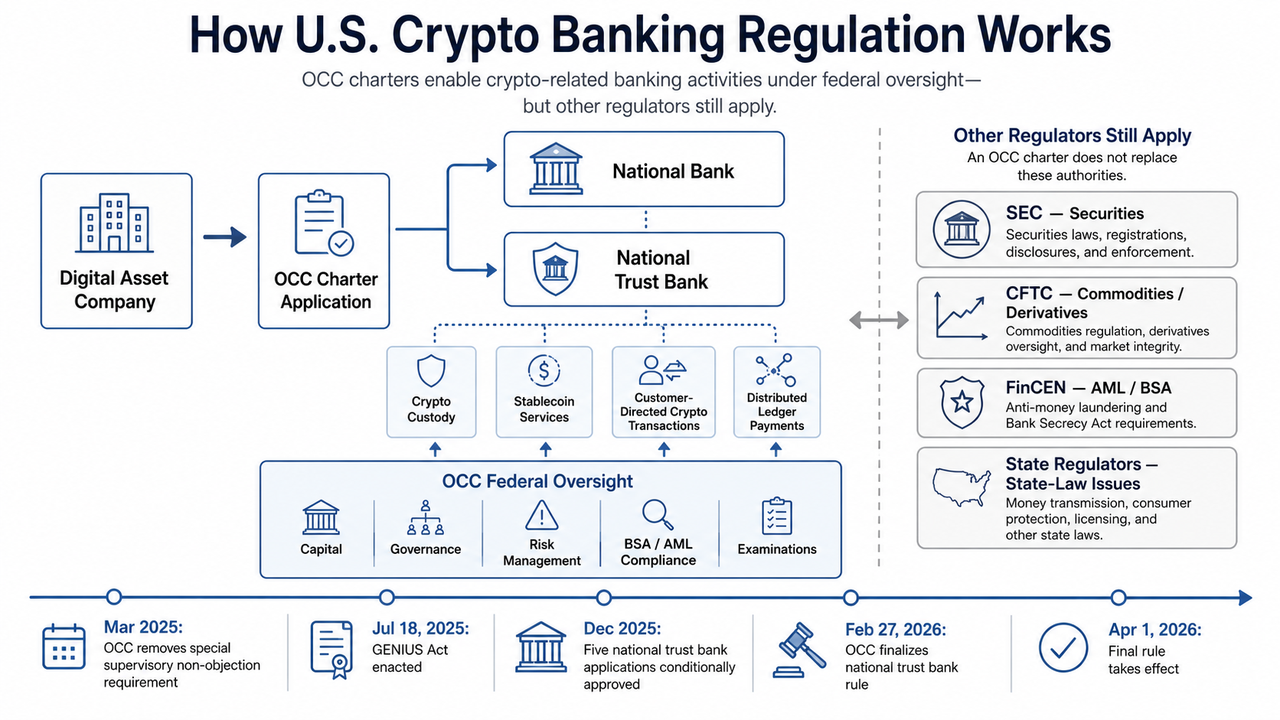
U.S. crypto banking regulation is the mix of federal banking law, OCC charters and ongoing supervision that determines whether a digital asset company can operate as a national bank or national trust bank, what crypto activities it may conduct, and which other regulators still have authority over securities, commodities, payments and state-law issues. The Office of the Comptroller of the Currency (OCC) sits at the center of this framework because it charters and supervises national banks and national trust banks, including institutions built around crypto custody, stablecoins and other digital asset services.
For crypto companies considering an OCC charter, banks assessing digital asset activities, investors trying to understand what a "crypto bank license" actually means and sophisticated users tracking the rules around crypto banking, the key point is that federal chartering doesn't create a regulatory shortcut. It places an institution inside a banking framework with capital, governance, Bank Secrecy Act compliance, risk management, examinations and activity-specific legal limits. Securities, commodities, payments and state-law questions can still bring the Securities and Exchange Commission, Commodity Futures Trading Commission, FinCEN and state regulators into the picture.
Recent changes have made that distinction more important. The OCC removed an earlier supervisory non-objection requirement for several crypto activities in March 2025, conditionally approved five digital asset-focused national trust bank applications in December 2025, and finalized a national trust bank chartering rule in February 2026 that became effective on April 1, 2026. Meanwhile, the GENIUS Act, enacted on July 18, 2025, created a specific federal framework for payment stablecoin issuers. Together, those developments make it essential to understand how OCC charters differ from other licenses, how national banks and national trust banks are treated, what the OCC's interpretive letters allow, and how federal oversight interacts with state digital asset regulation.
Key Takeaways
U.S. crypto banking regulation is activity-based as well as charter-based. An OCC charter brings a crypto-focused institution into federal banking supervision, but other federal and state laws may still apply to particular digital asset products.
National banks and national trust banks aren't the same thing. A full-service national bank can carry out traditional banking functions subject to its approvals, while a national trust bank can operate with a narrower business model centered on trust, custody, safekeeping and related activities.
OCC interpretive letters have progressively clarified crypto powers. They address crypto custody, stablecoin reserve services, distributed ledger payments, network fees and customer-directed crypto execution.
The regulatory direction changed in 2025. Interpretive Letter 1183 removed the special supervisory non-objection process created by Interpretive Letter 1179, although ordinary safety-and-soundness supervision remains.
The GENIUS Act added a distinct stablecoin layer. Certain OCC-supervised institutions may qualify as permitted payment stablecoin issuers, subject to reserve, disclosure, risk-management, BSA and other requirements.
What Is U.S. Crypto Banking Regulation?
U.S. crypto banking regulation is the combination of federal banking law, OCC chartering and supervision, anti-money laundering requirements and activity-specific rules that determine how banking institutions may deal with crypto assets.
It isn't one self-contained "crypto banking law."
A company may need to answer several different regulatory questions. Is it trying to become a national bank? Does it only want to provide custody and trust services? Will it issue a payment stablecoin? Is it facilitating trades in digital assets that could be securities? Does it receive customer money or transmit funds? Each answer can change the regulatory path.
The OCC administers the federal banking system and is the primary regulator for national banks and federal savings associations. Under the National Bank Act, it can approve charter applications and determine whether proposed activities fall within the permissible business of banking or operations of a trust company.
That makes OCC crypto regulation different from the SEC's role in securities markets or the CFTC's jurisdiction over commodity derivatives and other areas assigned by federal law. For broader questions about how digital assets are divided between securities and commodities, the emerging market-structure debate is better understood alongside the CLARITY Act and U.S. crypto market structure.
How OCC Charters Bring Crypto Companies Into the Federal Banking System
An OCC charter converts a regulatory question from "Can this crypto company provide a financial service?" into a more demanding one: "Can this institution conduct the proposed business safely and lawfully as a federally chartered bank?"
The charter application is only the beginning.
The OCC evaluates the proposed business plan, management, capital, governance, risk controls, financial resources, compliance systems and whether the institution has a reasonable expectation of operating safely. Conditional approval means those initial requirements have been satisfied sufficiently for the organizational process to continue. It does not mean the institution can immediately commence unrestricted banking business.
For example, the OCC's December 2025 conditional approvals expressly stated that final authorization remained dependent on completing pre-opening requirements.
This is why a crypto bank license should not be treated as a general permission slip for every digital asset activity. The approved charter, conditions imposed by the OCC and other applicable federal laws define what the institution may actually do. That makes OCC crypto regulation different from digital asset market oversight, where federal regulators divide authority differently across products and activities. SEC disclosure requirements and SEC staff positions may still affect certain digital assets even when the OCC is addressing banking status, and market participants should expect different entities and structures across the federal banking sector.
For a closer look at the mechanics of the approval process, OCC crypto bank charters involve several stages between submitting an application and receiving final authorization to commence business.
National Banks vs. National Trust Bank Charters
The distinction between a national bank and a national trust bank is one of the most important parts of digital asset bank regulation, because different institutions can enter the federal banking sector through an OCC charter as part of a diverse banking system.
A traditional national bank may engage in activities that form part of the business of banking, subject to applicable law and its charter. That can include taking deposits, lending, payments, custody and other financial services.
A national trust bank, by contrast, is organized around the operations of a trust company and related activities. Many crypto companies have focused on this structure because digital asset custody, safekeeping, fiduciary services and certain transaction-related activities can fit naturally within a trust business.
That doesn't make every national trust bank identical. The federal banking system includes both insured and uninsured national trust banks. The OCC noted in its 2026 chartering rule that the majority are uninsured, while a smaller number hold deposits and have Federal Deposit Insurance Corporation insurance.
Crypto-focused national trust charters have generally been structured more narrowly than conventional commercial banks. An uninsured national trust bank, for example, should not imply that customer assets automatically receive FDIC deposit insurance simply because "bank" appears in the institution's name, and it should not be confused with a state-licensed firm or any other entity outside the federal chartering framework.
The practical differences among a federal charter, state trust company authority and state money-transmitter licensing are substantial. The national bank charter versus state licensing framework shows why federal supervision can reduce some state-by-state licensing complexity without eliminating every state regulatory issue.
Why the OCC's 2026 Final Rule Matters for National Trust Banks
On February 27, 2026, the OCC finalized amendments to its national bank chartering regulation. The rule became effective April 1, 2026.
The change sounds technical but addresses a significant dispute, and these charter options can also contribute to a more diverse banking system.
The OCC amended 12 CFR 5.20 so the regulation more closely follows the National Bank Act's language concerning institutions limited to "the operations of a trust company and activities related thereto." The OCC explained that national trust banks can conduct non-fiduciary activities where those activities are legally permissible; the agency did not view the previous regulatory wording as restricting national trust banks exclusively to fiduciary business.
Crypto custody is a useful example. Safekeeping assets for a customer may be a core trust-bank service even when a particular custody relationship is not legally classified as fiduciary.
The Final Rule did not newly authorize every digital asset product, nor did it expand the OCC's underlying statutory chartering authority. It clarified how the regulation reflects authority the agency says it already possessed.
The proposal drew 19 public comments. Some supported the clarification, while other commenters questioned the scope of OCC authority, requested tighter standards or argued for limits on national trust chartering.
That debate also appeared in individual crypto charter applications. More than one banking trade group argued in some proceedings that crypto firms could gain bank-like benefits without taking on exactly the same business model or obligations as traditional banking institutions. The OCC stated that qualifying custody, trust and related activities could support national trust bank charters under federal law, and Jonathan Gould made the agency's view part of the broader push for regulatory clarity. Even so, the federal charter discussed here is not the same as a national trust bank charter and also differs from other entity forms created under state law.
Five Crypto-Focused National Trust Banks Received Conditional Approval
A major turning point came in December 2025, when the OCC conditionally approved five national trust bank charter applications.
The approvals included:
Institution
Application Type
First National Digital Currency Bank
De novo national trust bank
Ripple National Trust Bank
De novo national trust bank
BitGo Bank & Trust, N.A.
Conversion from state trust company
Fidelity Digital Assets, N.A.
Conversion from state trust company
Paxos Trust Company, N.A.
Conversion from state trust company
The five approvals didn't mean all five institutions immediately became fully operational national trust banks. Conditional approval precedes final authorization and can carry institution-specific requirements.
Still, the group matters because it shows how digital asset custody, stablecoin-related activity and other crypto services can be brought under direct federal banking supervision rather than remaining solely within state trust-company structures. In public comments, at least one banking trade group objected to the OCC's interpretation of national trust bank authority, arguing the approvals risked stretching charter standards for crypto-focused entities under federal regulators.
The OCC's chartering approach has also continued to attract new entrants. Digital asset-related applications remained visible in 2026, including applications from institutions proposing stablecoin, custody and trust-focused businesses, and the OCC stated that qualifying trust, custody, and related activities could support these charters under federal law, a view Jonathan Gould framed as consistent with the agency's reading of national bank authority.
How OCC Interpretive Letters Shaped Crypto Banking
OCC interpretive letters are central to understanding which digital asset activities national banks may conduct.
They don't create an entirely separate crypto banking code. Instead, the OCC examines whether a new activity is a modern form of an established banking function.
Interpretive Letter 1170: Crypto Custody
Interpretive Letter 1170, issued in July 2020, concluded that national banks may provide cryptocurrency custody services for customers. The OCC viewed safeguarding cryptographic keys and providing associated custody services as an extension of longstanding safekeeping functions.
Crypto custody is therefore more than storing a password. An institutional custody system may involve key management, transaction authorization, segregation of custody assets, recordkeeping, cybersecurity, operational resilience and controls against unauthorized transfers.
The wider compliance issues can be seen in crypto asset custody requirements, where segregation, security controls and regulatory status can matter as much as the underlying blockchain technology.
Interpretive Letters 1172 and 1174: Stablecoins and Distributed Ledger Technology
Interpretive Letter 1172 addressed banks holding deposits that serve as reserves backing certain stablecoins. Interpretive Letter 1174 then confirmed that national banks may participate in independent node verification networks and use stablecoins or distributed ledger technology to facilitate permissible payment activities.
Those decisions helped connect stable value digital assets with familiar banking activities such as payments, settlement and reserve management.
Interpretive Letter 1179: The Former Pre-Approval Layer
In November 2021, Interpretive Letter 1179 required institutions planning certain crypto, distributed ledger or stablecoin activities to notify their supervisory office and obtain written supervisory non-objection before proceeding.
The OCC said banks needed to demonstrate adequate controls for the relevant risks.
That requirement is historically important, but it is no longer the current rule.
Interpretive Letter 1183 Removed the Non-Objection Requirement
On March 7, 2025, the OCC issued Interpretive Letter 1183. It reaffirmed that the activities addressed by Interpretive Letters 1170, 1172 and 1174 were permissible while rescinding the special requirement for advance supervisory non-objection.
Banks still need sound risk management. Removing a special pre-approval process didn't remove examinations, governance requirements or safety-and-soundness obligations.
The distinction matters: OCC policy moved from permission plus special pre-clearance toward permission plus ordinary ongoing supervision.
More Recent OCC Interpretations Expanded the Practical Map
In May 2025, Interpretive Letter 1184 clarified that national banks may provide certain crypto custody and execution services, including outsourcing some execution or custody functions to third parties when properly managed.
Interpretive Letter 1186, issued in November 2025, confirmed that a national bank may hold certain crypto assets as principal when necessary to pay blockchain network fees associated with otherwise permissible services.
Then, on December 9, 2025, Interpretive Letter 1188 confirmed that national banks may conduct riskless principal crypto-asset transactions. In this structure, the bank enters into an offsetting transaction rather than accumulating a speculative crypto inventory.
Together, these interpretations illustrate the OCC's underlying approach: compare a digital asset activity with functions already recognized within the business of banking, then apply banking risk controls to the technological form.
Crypto Custody Is a Banking Activity, but Risk Controls Still Matter
Permission to provide crypto custody doesn't make custody risk disappear.
Banks handling private keys, wallet infrastructure or customer-directed blockchain transactions must consider operational risk, cyber risk, fraud, third-party dependence, sanctions exposure, liquidity and the possibility of irreversible transfers.
Federal banking agencies emphasized risk-management considerations for crypto-asset safekeeping again in July 2025.
A customer-directed transaction also creates a different risk profile from proprietary trading. OCC guidance allows banks to facilitate certain customer transactions, but banks still need controls around execution, authorization, conflicts, recordkeeping and applicable securities or commodities laws.
The GENIUS Act Added a Federal Stablecoin Framework
The GENIUS Act changed the regulatory picture because payment stablecoin issuance no longer depends only on earlier OCC interpretations.
The law was enacted on July 18, 2025 and establishes a statutory framework for permitted payment stablecoin issuers. It also treats those issuers as financial institutions for Bank Secrecy Act purposes and requires effective anti-money laundering controls.
For OCC-supervised institutions, that creates a direct link between federal banking regulation and stablecoin issuance.
Certain uninsured national banks can qualify within the GENIUS Act's definition of a federal qualified stablecoin issuer. OCC conditional approvals have consequently required proposed stablecoin activities to conform with the GENIUS Act and its implementing regulations.
This shouldn't be read as a blanket authorization for any national trust bank to issue any token. Qualification, reserve assets, redemption, disclosures, capital or liquidity requirements, risk management, sanctions compliance and implementing rules still matter.
The OCC was still developing parts of this implementation framework during 2026. It issued a proposed GENIUS Act rule in March and later proposed weekly and quarterly reporting forms for permitted payment stablecoin issuers.
For regulatory context, the GENIUS Act stablecoin framework places reserve requirements and issuer supervision alongside the wider U.S. stablecoin market.
There is also an important distinction between regulation of the issuer and secondary-market trading of the token. For example, a trader looking at the USDC/USDT market onGate.com is interacting with a secondary-market trading pair; the federal rules governing a payment stablecoin issuer concern a different part of the financial structure. The trading venue, issuer, custodian and customer's bank can each face different regulatory obligations.
Bank Secrecy Act Compliance Doesn't Disappear With a Federal Charter
A national charter brings federal supervision, but it also brings federal compliance duties.
Banks handling crypto assets remain subject to the Bank Secrecy Act and related anti-money laundering requirements. Depending on the activity, this can involve customer identification, transaction monitoring, suspicious activity reporting, sanctions screening and controls designed around the specific risks of digital asset transactions.
The GENIUS Act expressly extends BSA treatment to permitted payment stablecoin issuers.
Blockchain transparency can assist transaction monitoring because transfers are recorded on public ledgers, but it doesn't identify every person behind a wallet automatically. Banks still need procedures for customer due diligence, counterparties and risk escalation.
The same principle appears outside banking in regulated crypto payment systems. Web3 payment regulation shows how BSA and money-transmission obligations can apply even when a company does not hold an OCC bank charter.
OCC Authority Does Not Replace the SEC, CFTC or State Regulators
Obtaining an OCC charter answers one regulatory question: the institution is authorized to operate within the federal banking system under the terms of that charter.
It doesn't answer every question about every asset.
If a digital asset product falls within federal securities law, the Securities Act, Securities Exchange Act or Investment Company Act may become relevant. The Securities and Exchange Commission can still have jurisdiction over securities-related activity.
Commodity and derivatives activity can implicate the Commodity Futures Trading Commission. FinCEN administers major parts of the federal AML framework. State regulators may retain authority over areas not preempted by federal banking law, and nonbank affiliates can face separate licensing obligations.
OCC conditional approvals themselves recognize these boundaries. In reviewing crypto trust applications, the agency has noted that activities involving securities must comply with applicable Exchange Act requirements and related rules.
That is why U.S. crypto banking regulation should be viewed as a layer within the broader digital asset regulatory system, not a replacement for it.
Federal Charter vs. State Regulation: Why the Choice Matters
A crypto company has several possible regulatory structures.
It might remain a state-chartered trust company. It may operate through state money transmitter licenses. It could pursue an OCC national trust charter. A business intending to conduct conventional deposit-taking and lending may need a broader bank structure.
The federal path can create a single charter and direct OCC supervision, which may reduce dependence on a patchwork of state banking authorizations for activities covered by the federal charter.
The catch is that federal supervision is intensive.
Capital, management, governance, internal controls, business-plan execution, BSA compliance, cybersecurity and operational resilience become supervisory matters. Conditional approval may also impose institution-specific limits before final authorization.
State versus federal isn't therefore a simple question of "more regulation" or "less regulation." It is a question of which regulatory perimeter matches the business being built.
Why Banking Groups Have Challenged Crypto Trust Charters
The expansion of national trust charters has generated opposition within parts of the banking industry.
A recurring concern is regulatory arbitrage: critics argue that a narrow-purpose digital bank could receive some benefits associated with a national charter without taking deposits, extending conventional credit or operating under exactly the same economic model as a full-service insured bank.
The OCC has taken a different legal view. It argues that the National Bank Act permits national banks limited to trust-company operations and related activities and that those institutions don't need to mirror ordinary commercial banks. Its February 2026 Final Rule was designed partly to remove regulatory wording that could be read as restricting this authority.
Neither side's position makes the resulting institutions unregulated. The real dispute concerns the legal scope of the national trust charter and which activities Congress has authorized the OCC to place within it.
How the Federal Crypto Banking Framework Fits Together
The easiest way to understand the system is to separate four layers.
Layer
Main Question
Typical Authority
Charter
May the institution operate as a national bank or national trust bank?
OCC
Banking activity
Is custody, execution, stablecoin or DLT activity permissible?
OCC and federal banking law
Product/market regulation
Is an asset or transaction governed by securities or commodities law?
SEC, CFTC and applicable statutes
Financial crime compliance
How must customers and transactions be monitored?
BSA, FinCEN, banking regulators
A fifth layer can appear where state law remains applicable.
This layered structure explains why two crypto companies providing superficially similar services may face very different regulatory requirements. One may be an OCC-supervised national trust bank holding custody assets, while another may be a state-licensed money transmitter or securities intermediary.
Risks and Limitations of the OCC Charter Path
An OCC charter can provide access to the federal banking system, but it also raises the compliance threshold.
Conditional approval is not final approval. A charter applicant may need to raise capital, hire approved management, establish controls and satisfy other conditions before commencing business.
Permissible activities remain bounded. A trust charter does not automatically authorize conventional commercial banking or every digital asset product.
Crypto custody carries technical risk. Private-key compromise, flawed transaction controls, smart-contract exposure and third-party failures can create losses that ordinary custody systems were not designed to handle.
Federal law remains fragmented by activity. OCC supervision does not erase SEC, CFTC, FinCEN or applicable state authority.
Stablecoin rules are still being implemented. The GENIUS Act created the statutory framework in 2025, but implementing regulations and reporting requirements continued developing during 2026.
For firms evaluating the charter route, those constraints are as important as the ability to operate nationally.
Conclusion
U.S. crypto banking regulation is increasingly bringing digital asset services inside the existing federal banking framework rather than creating a separate category of lightly regulated "crypto banks."
The OCC can charter and supervise national banks and national trust banks engaged in permissible digital asset activities. Its interpretive letters have established pathways for crypto custody, stablecoin-related services, distributed ledger payments, network-fee holdings and customer-directed execution. The 2026 national trust bank rule also clarified that trust banks aren't confined only to fiduciary activity.
At the same time, an OCC charter doesn't eliminate the rest of U.S. financial regulation. Bank Secrecy Act requirements, securities laws, commodities rules, state authority and institution-specific charter conditions can continue to apply.
The GENIUS Act adds another layer by creating a specific statutory regime for payment stablecoin issuers. Combined with the OCC's recent national trust approvals, it shows how crypto companies are increasingly being integrated into traditional banking supervision rather than operating alongside it.
The useful question is therefore no longer simply, "Can a crypto company become a bank?" It is which charter fits the proposed activity, what that charter actually authorizes, and which regulatory obligations remain after the institution enters the federal banking system.
FAQ
Can a crypto company obtain a U.S. national bank charter?
Yes. A qualifying digital asset company can apply to the OCC for a national bank or national trust bank charter, depending on its proposed activities. Approval isn't automatic: the OCC reviews capital, management, business plans, risk controls, compliance systems and legal authority before granting conditional and ultimately final approval.
What is a national trust bank for crypto?
A crypto-focused national trust bank is an OCC-chartered institution whose business centers on trust-company operations and related activities such as custody and safekeeping. Many such institutions are uninsured and operate more narrowly than conventional commercial banks, although national trust banks aren't universally prohibited from every deposit-related activity.
Does an OCC charter allow a crypto bank to operate in every state?
A national charter can provide federal authority for activities covered by the charter and can reduce reliance on separate state banking licenses. It does not necessarily preempt every state law or eliminate licensing requirements for affiliates and activities outside the bank.
Can national banks hold cryptocurrency?
OCC guidance allows national banks to provide crypto custody and, in limited circumstances, hold crypto assets as principal when operationally necessary, such as holding enough crypto to pay blockchain network fees for permissible services. That authority should not be confused with unrestricted speculative crypto investment.
Can national banks execute crypto trades for customers?
Yes, within applicable legal and risk-management constraints. OCC Interpretive Letter 1184 addressed customer-directed crypto execution services, while Interpretive Letter 1188 later confirmed permissible riskless principal transactions where the bank simultaneously offsets its exposure rather than maintaining speculative inventory.
Can a national trust bank issue stablecoins?
Certain OCC-supervised institutions may qualify as permitted payment stablecoin issuers under the GENIUS Act. Issuance remains subject to the Act, implementing regulations, reserves, disclosure, risk-management, BSA and other applicable requirements; holding a national trust charter alone does not create unrestricted stablecoin issuance authority.
Disclaimer*: This article is for educational purposes only and does not constitute legal, regulatory, investment or financial advice. U.S. banking and digital asset requirements depend on an institution's charter, activities and applicable federal and state law.*
Author: Jared
Disclaimer
* The information is not intended to be and does not constitute financial advice or any other recommendation of any sort offered or endorsed by Gate.
* This article may not be reproduced, transmitted or copied without referencing Gate. Contravention is an infringement of Copyright Act and may be subject to legal action.
Yala is a modular Bitcoin DeFi infrastructure that connects BTC liquidity with multi-chain ecosystems through its YU stablecoin and MetaMint protocol. It enables Bitcoin holders to earn native DeFi yields across EVM and non-EVM networks securely and seamlessly.
The report shows that in Q1 2026, the crypto market will reach a stage of structural maturity, with Derivative trading making up more than 90% of total trading volume, exceeding $20 trillion. As Spot demand weakens, liquidity will become even more concentrated in top exchanges, reflecting a more cautious market sentiment and a shift toward leveraged and institutional trading.
Sui is a PoS L1 blockchain with a novel architecture whose object-centric model enables parallelization of transactions through verifier level scaling. In this research paper the unique features of the Sui blockchain will be introduced, the economic prospects of SUI tokens will be presented, and it will be explained how investors can learn about which dApps are driving the use of the chain through the Sui application campaign.
PAXG (Pax Gold) is a tokenized asset backed by physical gold, issued by the fintech company Paxos and traded on the Ethereum blockchain as an ERC-20 token. The core concept is to tokenize physical gold on-chain, with each PAXG token representing ownership of a certain amount of gold. This structure enables investors to hold and trade gold in the form of a digital asset.
Hyperliquid's vision is to develop an on-chain open financial system. At the core of this ecosystem is Hyperliquid L1, where every interaction, whether an order, cancellation, or settlement, is executed on-chain. Hyperliquid excels in product and marketing and has no external investors. With the launch of its second season points program, more and more people are becoming enthusiastic about on-chain trading. Hyperliquid has expanded from a trading product to building its own ecosystem.