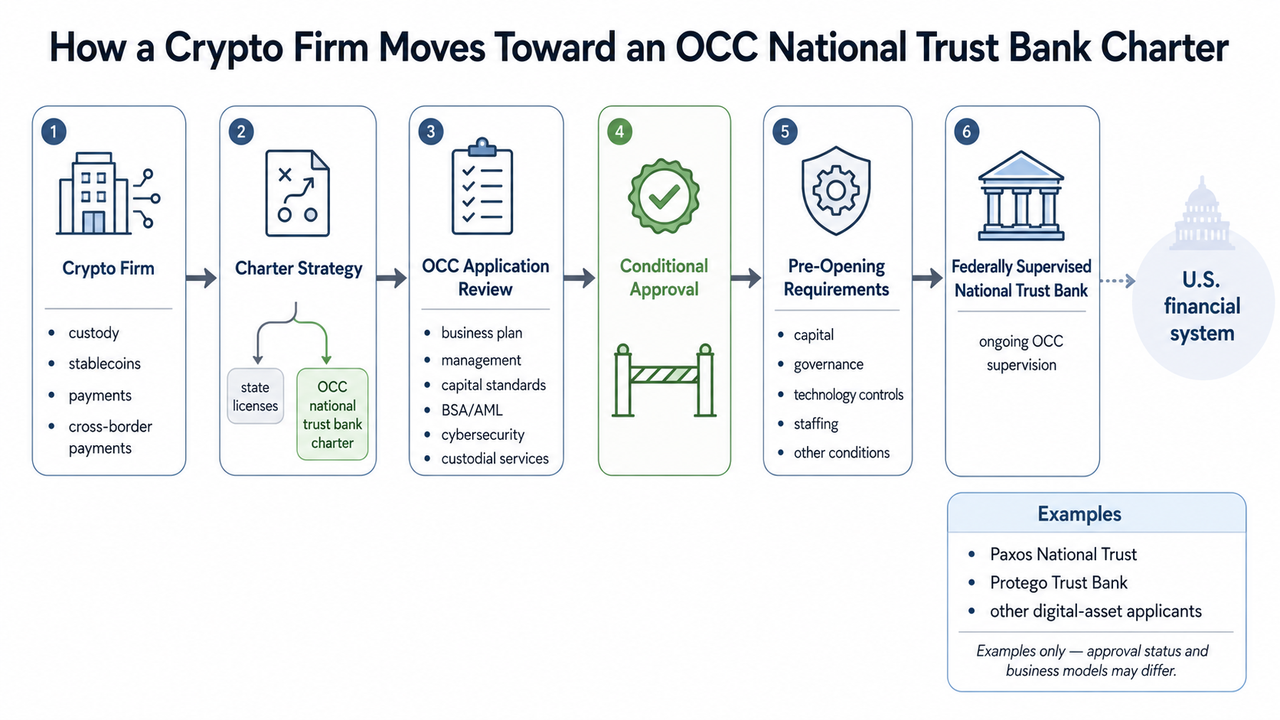
A crypto firm can obtain an OCC crypto bank charter by showing the Office of the Comptroller of the Currency that its proposed activities are legally permissible for a national bank or national trust bank and that the organization can operate them safely. In practice, that means far more than submitting a licensing form. Applicants need a detailed business plan, qualified management, sufficient capital and liquidity, Bank Secrecy Act and anti-money-laundering controls, cybersecurity systems, operational safeguards and a credible path through the OCC's pre-opening requirements.
For digital-asset companies weighing federal oversight against state licenses, an OCC charter changes the regulatory framework around the business rather than removing regulatory obligations. A national trust structure can place crypto firms alongside other federally supervised financial institutions within the broader U.S. financial system, while still requiring them to comply with applicable capital standards, governance, risk-management and supervisory requirements. That distinction has become more important as entities such as Protego Trust Bank, Paxos National Trust and other crypto-focused applicants have tested how custodial services, payments and related digital-asset activities can fit within rules traditionally applied to banks and trust companies.
For custodians, stablecoin businesses, payment companies and firms considering cross-border payments, the real question isn't simply whether they can obtain a banking license. They need to understand what activities the charter permits, what pre-conversion requirements or organizational conditions may apply, how the OCC evaluates capital and management, and whether the business could trigger additional considerations involving a bank holding company, foreign banks or other regulated entities. This section therefore explains how the charter process works in practice, including application review, permissible activities, conditional approval and ongoing supervision, while also showing how the policy environment evolved across the Trump administration and Biden administration. The goal is to clarify what a crypto company must establish before it can engage in federally supervised banking or trust activities, rather than treating an OCC charter as equivalent to the operating model of traditional banks.
Key Takeaways
An OCC charter application begins with the proposed business model: the applicant must establish that its activities fit within authority available under the National Bank Act and other applicable banking laws.
The OCC reviews the business plan, financial projections, management, ownership, capital, liquidity, compliance systems, cybersecurity and operational risks before a new institution can open.
Conditional approval is not permission to begin unrestricted operations. Applicants normally must complete organizational and pre-opening conditions before receiving final authorization.
A national trust bank is generally a limited-purpose national bank rather than a conventional deposit-taking commercial bank.
Once chartered, the firm becomes part of the federal banking system and remains subject to OCC supervision, examination and activity-specific restrictions.
What Is an OCC National Trust Bank Charter?
The Office of the Comptroller of the Currency charters and supervises national banks under federal law. Its authority includes national banks whose operations are limited to those of a trust company and activities related to those operations. The statutory foundation comes principally from the National Bank Act, including 12 USC 21–27, while fiduciary powers may involve separate authority under 12 USC 92a.
A national trust bank charter is particularly relevant to crypto businesses whose proposed services center on custody, safekeeping, fiduciary services, asset administration or closely related digital-asset activities rather than ordinary consumer banking.
That distinction matters. An uninsured national trust bank normally isn't operating like a traditional commercial bank that accepts ordinary insured deposits and makes consumer loans. Its activities are restricted by its charter, applicable banking law and the commitments made during the approval process. Because it does not necessarily take FDIC-insured deposits, FDIC insurance isn't automatically part of every national trust bank structure.
Federal status can nevertheless provide an important operational feature: a national trust bank may serve customers across the United States under a federal charter, subject to applicable federal and state laws concerning particular activities.
The OCC said in December 2025 that approximately 60 national trust banks were already under its supervision.
The difference between this model and a patchwork of state approvals is central to U.S. crypto banking regulation, especially for firms deciding whether federal supervision fits their long-term business model.
How Does the OCC Crypto Bank Charter Application Process Work?
There isn't one abbreviated "crypto banking license" application. Digital-asset businesses move through the OCC's established chartering framework, with additional scrutiny where their technology, custody model or crypto activities create specific risks.
1. Define the Proposed Digital Asset Activities
The applicant first needs to define exactly what the proposed bank will do.
That could include digital asset custody, fiduciary administration, stablecoin-related services, payment operations or other activities that the applicant believes fall within national bank authority. The OCC then evaluates whether those proposed activities are permissible under federal banking law.
This is why choosing between an OCC national bank charter and state licenses isn't merely a question of which regulator appears easier. The underlying business model has to fit the powers of the charter being requested.
The legal framework for permissible crypto activity has also developed through OCC interpretive letters. Interpretive Letter 1183, issued in March 2025, removed an earlier supervisory non-objection requirement associated with certain crypto activities. Interpretive Letter 1186 later confirmed that national banks may hold limited amounts of cryptoassets needed to pay blockchain network fees, while Interpretive Letter 1188 confirmed authority for certain riskless-principal crypto transactions.
2. Build the Business Plan and Financial Case
An OCC charter application requires far more detail than a description of the product.
The OCC's charter filing materials include a formal business plan, financial projections, organizational information and information about proposed directors and management.
For a crypto-native bank, the plan needs to connect the technology to the banking business. How will custody work? Who controls private-key infrastructure? How are customer funds and assets segregated? How does the company respond to a cyber incident? What happens if transaction volumes grow far faster than expected?
Capital is assessed in the context of those risks rather than through a universal dollar amount applicable to every crypto applicant. A custody-heavy national trust bank can have a very different balance sheet and risk profile from a full-service national bank, so applicants need to demonstrate capital adequacy and liquidity appropriate to their planned operations. OCC guidance for national trust banks also emphasizes forward-looking liquidity management and contingency funding arrangements.
3. Pass the Management, Compliance and Risk Review
Good technology alone won't carry a charter application.
The OCC looks at the people who will run the institution, and its licensing framework includes background investigations and biographical and financial information for relevant organizers, directors and executives.
For digital-asset applicants, compliance infrastructure is especially important. Recent crypto-related conditional approvals have required policies supporting a strong BSA/AML/OFAC program before the pre-opening examination.
That generally puts customer identification, customer due diligence, suspicious-activity monitoring, sanctions controls, governance, independent testing and escalation procedures near the center of the application. Cybersecurity, wallet controls, vendor dependencies, blockchain infrastructure and operational resilience also matter because the OCC evaluates whether risks can be managed in a safe and sound manner.
The broader OCC crypto bank regulatory requirements therefore continue after licensing. Becoming a national bank turns compliance into a continuing supervisory obligation rather than a one-time application exercise.
For context, institutional crypto services can also exist outside a national bank charter. A professional investor using Gate Institutional, for example, is accessing an exchange-side institutional trading environment rather than an OCC-chartered banking institution. The legal status, custody arrangements and supervisory framework shouldn't be treated as interchangeable simply because both serve institutional digital-asset customers.
4. Public Notice, OCC Review and Additional Information
Charter applications also have a public component. OCC filing materials include a public notice, and recent national trust bank applications show applicants publishing notice of their intention to organize a national bank. The OCC can receive and evaluate public comments before reaching its decision.
During substantive review, licensing staff can request additional information where the proposed operations, ownership, compliance program or risk controls aren't sufficiently clear.
There is no dependable rule that an OCC national trust bank approval will be "swift." Complexity, completeness of the application, public comments, legal issues and the applicant's response to regulatory questions can all affect the process.
5. Conditional Approval Is Only an Intermediate Stage
A successful review commonly leads first to conditional approval.
On December 12, 2025, the OCC conditionally approved five digital-asset-related national trust bank applications. First National Digital Currency Bank and Ripple National Trust Bank received conditional approval for new charters, while BitGo Bank & Trust, Fidelity Digital Assets and Paxos Trust Company received conditional approval for conversions to national trust banks.
That development showed how both new charter applications and conversion applications can be used. Anchorage Digital Bank had followed the conversion route earlier, moving from a South Dakota trust company to a national trust bank in 2021. Its federal banking role also illustrates why regulated custody matters to projects using institutional infrastructure, such as the relationship described around Anchorage Digital Bank and USDPT.
Conditional approval doesn't mean the applicant can immediately operate however it wishes. The approval can impose capital, staffing, policies, governance, technology and other developmental milestones that must be completed before opening. The OCC's recent decisions specifically direct applicants to complete organizing steps and pre-opening requirements before final authorization.
BitGo's path also shows how crypto custody companies can move between regulatory structures as their business develops; its custody model and institutional services are described in BitGo's digital asset custody structure.
What Changed for National Trust Banks in 2026?
A final OCC rule effective April 1, 2026 clarified that national banks limited to trust-company operations and related activities may conduct qualifying non-fiduciary activities as well as fiduciary activities. The OCC said the rule clarified existing charter authority rather than expanding or contracting it.
That point is important for digital banks. A national trust charter isn't automatically restricted to acting as a traditional trustee in every transaction. Custody, safekeeping and certain related asset-management or banking functions may fit within the permitted business, depending on their legal basis and the institution's approved operating plan.
The catch is that a charter doesn't make every digital-asset product permissible. Each proposed service still needs a legal basis, appropriate controls and consistency with the bank's approved activities.
What Happens After the Bank Charter Is Granted?
Final approval begins the supervisory relationship rather than ending the regulatory process.
The OCC examines the condition of national banks and their compliance with applicable laws and regulations. A crypto-focused national trust bank therefore has to maintain the governance, capital, liquidity, BSA/AML controls, cybersecurity and operational systems that supported its application.
Material changes to the business can also create additional regulatory questions. A company that was approved primarily for custody can't assume that a new lending, payments, staking or execution product automatically fits within the existing charter.
This is the central tradeoff of an OCC crypto bank charter: federal status can create a nationwide banking framework, but it also subjects the company to continuing federal oversight and examination.
Conclusion
A crypto firm obtains an OCC national bank or trust bank charter by proving that its business can operate lawfully and safely inside the federal banking system. The strongest applications connect permissible digital-asset activities to a detailed business plan, credible management, adequate capital and liquidity, enterprise-level operational controls and a functioning BSA/AML compliance program.
Conditional approval is a major milestone, but it isn't the finish line. The firm must satisfy the OCC's organizational and pre-opening conditions before commencing business and then remain subject to ongoing supervision.
For crypto companies, the charter decision therefore comes down to more than gaining federal recognition. The business model itself must be capable of operating as a regulated bank.
FAQ
Can a crypto company apply directly for a national trust bank charter?
Yes. A company may seek a de novo national trust bank charter if its planned activities qualify under federal banking law. Existing state trust companies may instead pursue conversion to a national charter, as Anchorage Digital and several of the December 2025 applicants did.
Does an OCC national trust bank need FDIC insurance?
Not necessarily. Many national trust banks are uninsured because they don't accept FDIC-insured deposits in the manner of conventional commercial banks. Whether deposit insurance is relevant depends on the institution's charter and activities.
How much capital does a crypto firm need for an OCC charter?
There isn't a single crypto-specific minimum that fits every applicant. The OCC evaluates capital in relation to the institution's business plan, projected financial condition and risk profile, so a crypto custodian's capital needs may differ materially from those of another banking model.
Can an OCC national trust bank operate nationwide?
A federal charter can support nationwide operations without requiring the institution to obtain a separate bank charter in every state, although particular activities can still be affected by federal and state law. Protego's conditional approval, for example, contemplated nationwide customer services under a national trust bank structure.
Is conditional OCC approval the same as receiving a final charter?
No. Conditional approval normally requires the organizing group to satisfy specified conditions and complete pre-opening steps. The OCC grants final authorization only after applicable requirements have been met.
Can a national trust bank provide crypto custody and execution services?
Crypto custody has been recognized by the OCC as a permissible national bank activity, and OCC interpretations have also addressed certain transaction and execution structures. The precise activity must still fall within the institution's authority and be conducted with appropriate controls.
Disclaimer
This content is for educational and informational purposes only and does not constitute legal, regulatory, financial or investment advice. Banking and digital-asset rules can change, and the regulatory treatment of a specific business depends on its activities and structure. Firms considering an OCC charter should obtain advice appropriate to their circumstances.
Author: Jared
Disclaimer
* The information is not intended to be and does not constitute financial advice or any other recommendation of any sort offered or endorsed by Gate.
* This article may not be reproduced, transmitted or copied without referencing Gate. Contravention is an infringement of Copyright Act and may be subject to legal action.
Yala is a modular Bitcoin DeFi infrastructure that connects BTC liquidity with multi-chain ecosystems through its YU stablecoin and MetaMint protocol. It enables Bitcoin holders to earn native DeFi yields across EVM and non-EVM networks securely and seamlessly.
The report shows that in Q1 2026, the crypto market will reach a stage of structural maturity, with Derivative trading making up more than 90% of total trading volume, exceeding $20 trillion. As Spot demand weakens, liquidity will become even more concentrated in top exchanges, reflecting a more cautious market sentiment and a shift toward leveraged and institutional trading.
Sui is a PoS L1 blockchain with a novel architecture whose object-centric model enables parallelization of transactions through verifier level scaling. In this research paper the unique features of the Sui blockchain will be introduced, the economic prospects of SUI tokens will be presented, and it will be explained how investors can learn about which dApps are driving the use of the chain through the Sui application campaign.
PAXG (Pax Gold) is a tokenized asset backed by physical gold, issued by the fintech company Paxos and traded on the Ethereum blockchain as an ERC-20 token. The core concept is to tokenize physical gold on-chain, with each PAXG token representing ownership of a certain amount of gold. This structure enables investors to hold and trade gold in the form of a digital asset.
Hyperliquid's vision is to develop an on-chain open financial system. At the core of this ecosystem is Hyperliquid L1, where every interaction, whether an order, cancellation, or settlement, is executed on-chain. Hyperliquid excels in product and marketing and has no external investors. With the launch of its second season points program, more and more people are becoming enthusiastic about on-chain trading. Hyperliquid has expanded from a trading product to building its own ecosystem.