Traditional securities markets have long depended on exchanges, brokerages, custodians, and central clearing systems to complete asset transfers. With the evolution of blockchain infrastructure, an increasing number of real-world assets are moving on-chain, with stocks emerging as one of the most closely watched asset classes. The rise of tokenized stocks bridges the gap between traditional finance and the digital asset ecosystem.
Within the digital asset space, tokenized stocks are considered a key component of the Real World Assets (RWA) sector. Their importance goes beyond improving asset circulation efficiency—they also provide new infrastructure support for decentralized finance (DeFi), automated investment strategies, and global asset allocation.
What Are Tokenized Stocks?
Traditional stock markets are inherently regional. Investors typically need securities accounts in specific countries or regions to trade, facing barriers like account opening requirements, mismatched trading hours, and restrictions on cross-border capital flows.
Blockchain technology has accelerated asset digitization. From stablecoins to bond tokenization, and from real estate to fund shares on-chain, more real-world assets are adopting on-chain issuance models.
As a digital asset issued and managed via blockchain, tokenized stocks generally mirror the value of specific publicly traded companies. By mapping traditional stocks onto blockchain networks, these assets can be traded, transferred, and combined on-chain.
How Do Tokenized Stocks Work?
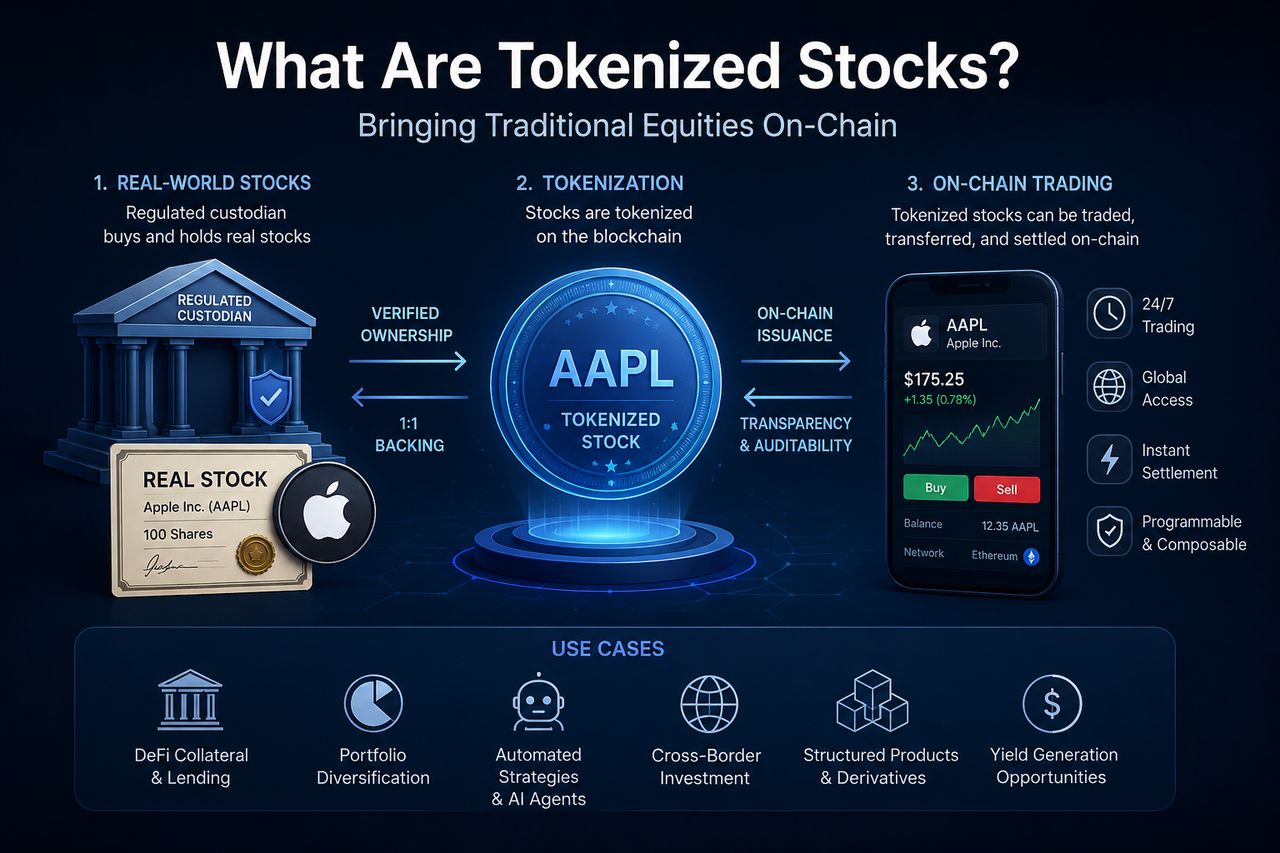
Tokenized stocks typically follow a model of "custody of actual stocks + on-chain token issuance." A custodian first buys and holds real stocks, then issues corresponding tokens on the blockchain based on the quantity held.
In most cases, each token represents a specific proportion of the underlying stock. For example, one token might represent one full share or a fraction of a share. Smart contracts are responsible for recording token issuance, circulation, and holdings.
When users trade tokenized stocks, the on-chain system updates ownership records instantly, bypassing traditional securities settlement systems. Some platforms also allow eligible participants to redeem assets, ensuring the value link between on-chain tokens and real stocks remains intact.
Stablecoins typically serve as the settlement medium for these trades. By pairing stablecoins with tokenized stocks, users can buy and sell directly on the blockchain, avoiding the multi-layered clearing processes of traditional banking.
Tokenized Stocks vs. Traditional Stocks: Key Differences
Both tokenized and traditional stocks reflect the market value of listed companies, but the underlying infrastructure differs significantly.
Traditional stocks are traded and settled through exchanges, brokerages, and central securities depositories, with ownership records stored in centralized databases.
Tokenized stocks, in contrast, use blockchain networks to record holdings and transactions. Settlement is nearly instantaneous, eliminating the T+1 or T+2 cycles common in traditional markets.
Trading hours also differ. Traditional markets operate on fixed schedules, while some tokenized stock platforms enable 24/7 on-chain trading, enhancing ease of participation for global users.
That said, traditional stocks benefit from well-established regulatory frameworks and investor protections, whereas tokenized stocks are still evolving, with legal and regulatory status varying across jurisdictions.
Core Technical Architecture of Tokenized Stocks
Smart contracts are central to tokenized stock systems, handling asset issuance, transfer records, access controls, and certain compliance rules.
The blockchain network provides underlying ledger support for tokenized stocks. Whether on a public chain or a Layer 2 scaling solution, its primary role is to ensure transparent, tamper-proof transaction data.
Price oracles synchronize data from traditional stock markets to the blockchain. Since stock prices originate from traditional exchanges, oracles are essential for delivering the latest market information on-chain.
To meet regulatory standards, many tokenized stock platforms incorporate identity verification, whitelist management, and trading restrictions. These features help issuers comply with local regulations across different regions.
Use Cases for Tokenized Stocks
The most straightforward application is on-chain stock trading. Users can gain exposure to the stock market without a traditional brokerage account, simply by using platforms that support these assets.
Within DeFi, tokenized stocks can also serve as collateral. Some protocols allow users to use tokenized stocks to participate in lending, liquidity management, or portfolio construction.
Asset managers are also exploring the automation potential of tokenized stocks. Smart contracts can rebalance portfolios, distribute returns, and manage assets more efficiently.
Risks and Limitations of Tokenized Stocks
Regulatory risk is a core challenge. Stocks are heavily regulated, and rules for on-chain securities vary widely across countries.
Custody risk is another concern. Most tokenized stocks rely on centralized custodians to hold the underlying shares. If the custodian faces issues, on-chain assets could be affected.
Liquidity can also be limited for some projects. Compared to mature stock exchanges, some on-chain markets have lower trading depth.
Technical risks include smart contract bugs, cross-chain bridge vulnerabilities, and oracle failures, all of which can impact pricing and trade stability.
Additionally, when stocks are suspended, delisted, or undergo major corporate events, robust mechanisms are needed to handle on-chain assets accordingly.
Tokenized Stocks vs. Other On-Chain Assets
Both tokenized stocks and stablecoins are real-world asset mappings, but they track different things. Stablecoins are pegged to fiat currencies, while tokenized stocks reflect corporate equity.
Compared to stock ETF tokens, which represent a basket of assets, tokenized stocks typically track a single company.
Unlike synthetic assets, which use collateral and derivative mechanisms for price tracking, tokenized stocks are usually backed by actual shares.
And compared to Contracts for Difference (CFDs), which are essentially price fluctuation contracts that do not involve actual asset holding, tokenized stocks emphasize asset mapping and on-chain ownership.
Summary
Tokenized stocks are bridging traditional securities markets with blockchain technology. By mapping real stocks onto on-chain networks, they offer faster settlement speed, higher circulation efficiency, and enhanced programmability.
As a key development in the Real World Assets (RWA) space, tokenized stocks not only expand the digital asset ecosystem but also provide a new blueprint for the digitization of global capital markets.
FAQs
Do tokenized stocks represent actual stock ownership?
It depends on the project. Some are backed by real stocks and grant holders corresponding rights, while others only offer price exposure. Always check the specific terms.
Can tokenized stocks be traded 24/7?
Yes, many platforms support round-the-clock on-chain trading, offering more flexibility than traditional markets with fixed hours.
What is the difference between tokenized stocks and stock ETFs?
Tokenized stocks track a single company, while ETF tokens represent a diversified portfolio. They differ in asset structure, risk profile, and tracking objectives.
Are tokenized stocks considered securities?
In many jurisdictions, yes—they may be classified as securities or securities-related products, requiring compliance with local financial regulations.
How do tokenized stocks maintain price alignment with real stocks?
Price oracles feed real-time data from traditional exchanges to the blockchain, ensuring on-chain prices stay in sync with the actual market.