As the tokenization of real world assets, or RWA, continues to develop, stocks have become one of the most closely watched categories of on-chain assets. Tokenized stocks connect traditional capital markets with blockchain infrastructure, allowing equity assets to enter digital asset markets and explore more efficient models for trading and settlement. For this reason, tokenized stocks are seen as an important part of the RWA sector and a key bridge between traditional finance and on-chain finance.
What Is the Tokenized Stock Trading Process?
The tokenized stock trading process refers to the full lifecycle of a real world stock, from asset custody and token issuance to investor trading and final settlement.
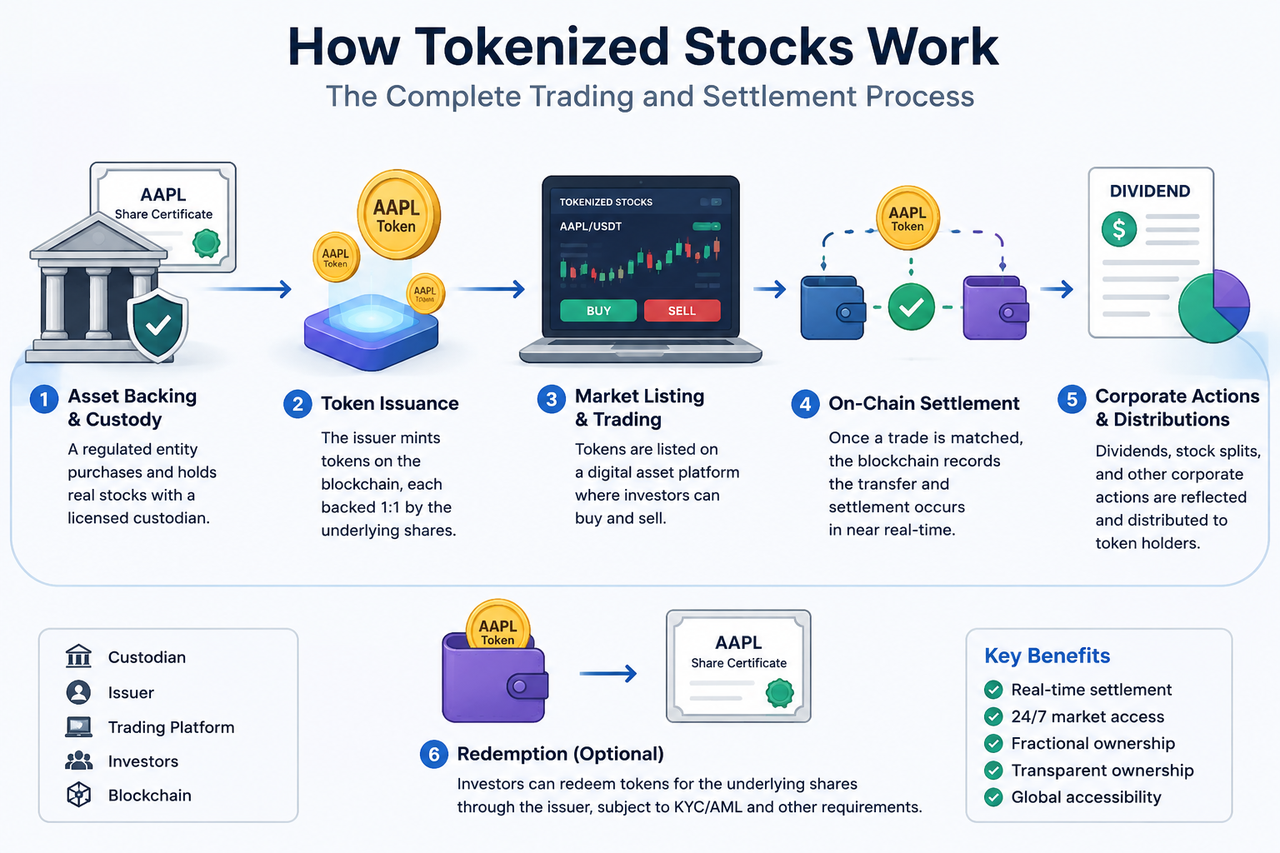
Compared with traditional stock trading, tokenized stocks add a blockchain issuance layer and a digital asset circulation layer. What users see is an on-chain token, while behind that token are actual shares or related rights and interests.
Viewed as a whole, tokenized stocks usually involve five types of participants:
-
Stock custodians
-
Token issuers
-
Blockchain networks
-
Trading platforms
-
Investors
Together, these participants form the operating foundation of the tokenized stock market.
How Real Stocks Are Mapped On-Chain
The first step in creating tokenized stocks is the custody of the underlying stock assets.
Issuers usually purchase actual shares through regulated securities accounts and place them with compliant custodians. The custodian is responsible for ensuring that the tokens issued on-chain are backed by corresponding assets.
For example:
This model is known as “1:1 asset backing.”
Once custody is complete, the issuer mints a corresponding number of tokens on the blockchain based on the number of shares held. At this point, a mapping relationship is established between the real world shares and the on-chain tokens.
This structure is similar to the issuance logic of stablecoins, except that the reserve asset changes from cash to stock assets.
How Tokens Enter the Market After Issuance
After tokens are created, they need to enter a tradable market.
The issuer deploys the tokens on a blockchain network that supports smart contracts and sets asset information, supply, and transfer rules.
The tokens may then enter the market in the following ways:
Primary Issuance
Investors purchase tokens directly from the issuer.
After funds enter the issuer’s account, the corresponding number of tokens is transferred to the investor’s wallet.
The issuer lists the tokens on a platform that supports tokenized stock trading.
Users can buy and sell through an order book or market maker mechanism.
This stage is similar to the initial issuance and listing process in traditional securities markets.
What Happens After Users Buy Tokenized Stocks?
When investors buy tokenized stocks, the ownership record on the blockchain changes.
For example:
User A sells 10 tokens representing Apple shares.
User B buys those 10 tokens.
After the transaction is completed:
-
User A’s wallet balance decreases
-
User B’s wallet balance increases
-
The on-chain record is updated
The entire process is automatically verified by smart contracts or the blockchain network.
Unlike in traditional securities markets, investors do not need to wait for multiple intermediaries to synchronize and update records. The on-chain ledger directly reflects the new asset ownership status.
As a result, tokenized stocks are often considered to offer greater transparency and verifiability.
How Tokenized Stocks Complete Settlement
Settlement is one of the most important parts of the tokenized stock system.
Traditional stock markets usually use a T+1 or T+2 settlement mechanism.
This means that after a trade is executed, clearing houses and central securities depositories still need to complete the final asset delivery.
In a blockchain environment, however, trading and settlement can often be completed at the same time.
Traditional Stock Settlement Process
After an investor places an order:
-
The broker confirms the trade
-
The exchange matches the order
-
The clearing house calculates the delivery result
-
The securities depository completes registration
The entire process may take several days.
Tokenized Stock Settlement Process
After an investor submits a transaction:
-
The network verifies the transaction
-
The smart contract executes the asset exchange
-
The on-chain ledger updates ownership
Settlement can be completed once the transaction is confirmed.
This model is usually called “Atomic Settlement.”
Assets and funds are delivered at the same time, which can reduce counterparty risk.
How Dividends, Stock Splits, and Corporate Actions Are Handled
Tokenized stocks do not simply copy stock prices.
When corporate actions occur in the underlying stock, the on-chain asset also needs to be adjusted accordingly.
Dividend Distribution
When the underlying stock pays a cash dividend:
The issuer receives the dividend income.
It then distributes the corresponding proceeds to investors based on their token holdings.
The specific method may include:
Stock Splits
If the underlying stock undergoes a 1 for 10 split:
The original 1 token may become 10 tokens.
The total value remains unchanged.
Mergers and Delistings
When a company undergoes a merger, delisting, or major restructuring, the issuer needs to adjust the token structure based on the actual situation.
Therefore, the operation and management behind tokenized stocks involve far more than simple on-chain trading.
How Investors Redeem the Underlying Stocks
Some tokenized stock products allow investors to redeem the physical underlying shares.
After meeting the required conditions, users can:
-
Burn the on-chain tokens
-
Submit identity verification documents
-
Complete securities account review
-
Receive the corresponding stock assets
However, not all tokenized stocks support this function.
Some products only provide price exposure and do not grant the right to directly obtain the underlying shares.
Therefore, understanding the difference between tokenized stocks and traditional stocks is essential when evaluating the structure of a specific product.
Comparison Between Tokenized Stocks and Traditional Stock Trading Processes
| Comparison Dimension |
Tokenized Stocks |
Traditional Stocks |
| Trading Hours |
May support round the clock trading |
Exchange opening hours |
| Asset Form |
Blockchain token |
Securities registration record |
| Settlement Method |
Real time or near real time on-chain settlement |
T+1 / T+2 |
| Ownership Record |
Distributed ledger |
Central depository |
| Entry Threshold |
Supports fractional ownership |
Usually traded in whole shares |
| Cross Border Circulation |
Relatively convenient |
Relies on cross border brokerage systems |
| Programmability |
Supports smart contracts |
Limited |
What Challenges Do Tokenized Stocks Face During Operation?
Tokenized stocks improve asset circulation efficiency, but they still face several real world challenges.
The first challenge is differences in regulatory frameworks. Different jurisdictions do not define digital securities and stock tokenization in the same way.
The second is asset custody risk. Investors need to trust that the issuer truly holds the corresponding stock assets.
The third is liquidity. Compared with mature securities markets, the tokenized stock market is still relatively small.
In addition, standards across different platforms have not yet been fully unified, which also affects asset interoperability and cross platform circulation.
Conclusion
Tokenized stocks bring traditional securities assets into the blockchain ecosystem through a model of “real stock custody plus on-chain token issuance.” The full process usually includes custody of the underlying shares, token minting, market circulation, on-chain settlement, corporate action synchronization, and asset redemption.
Compared with traditional stock markets, the biggest change brought by tokenized stocks lies in how trading records and settlement are handled. Blockchain can provide more transparent ownership records and more efficient asset delivery while preserving the value connection with real world stock markets.
FAQs
Do Tokenized Stocks Always Correspond to Real Stocks?
Not necessarily. Some tokenized stocks use a 1:1 real stock backed model, while others may only track the price performance of a stock. The specific structure depends on the issuer’s design and regulatory requirements.
Do Tokenized Stocks Come With Shareholder Rights?
It varies by product. Some tokenized stocks provide only economic rights and do not offer full shareholder rights such as voting rights. The exact scope of rights should be checked in the issuance documents.
Why Can Tokenized Stocks Settle Faster?
Tokenized stocks use blockchain to directly record asset transfers, without passing through the multiple layers of clearing and registration institutions used in traditional securities markets. This allows settlement time to be shortened.
Can Tokenized Stocks Be Traded 24 Hours a Day?
Technically, yes. Blockchain networks generally run around the clock, so tokenized stocks have the potential to support 24/7 trading. However, actual trading hours still depend on platform rules.
What Is the Difference Between Tokenized Stocks and Cryptocurrencies?
Cryptocurrencies usually do not have backing from real world assets, while tokenized stocks correspond to real stock assets or related rights and interests. Their sources of value and regulatory attributes are clearly different.
Are Tokenized Stocks Considered RWA Assets?
Yes. Tokenized stocks are an important category of real world asset, or RWA, tokenization. Their core feature is mapping traditional financial assets onto blockchain networks for circulation.