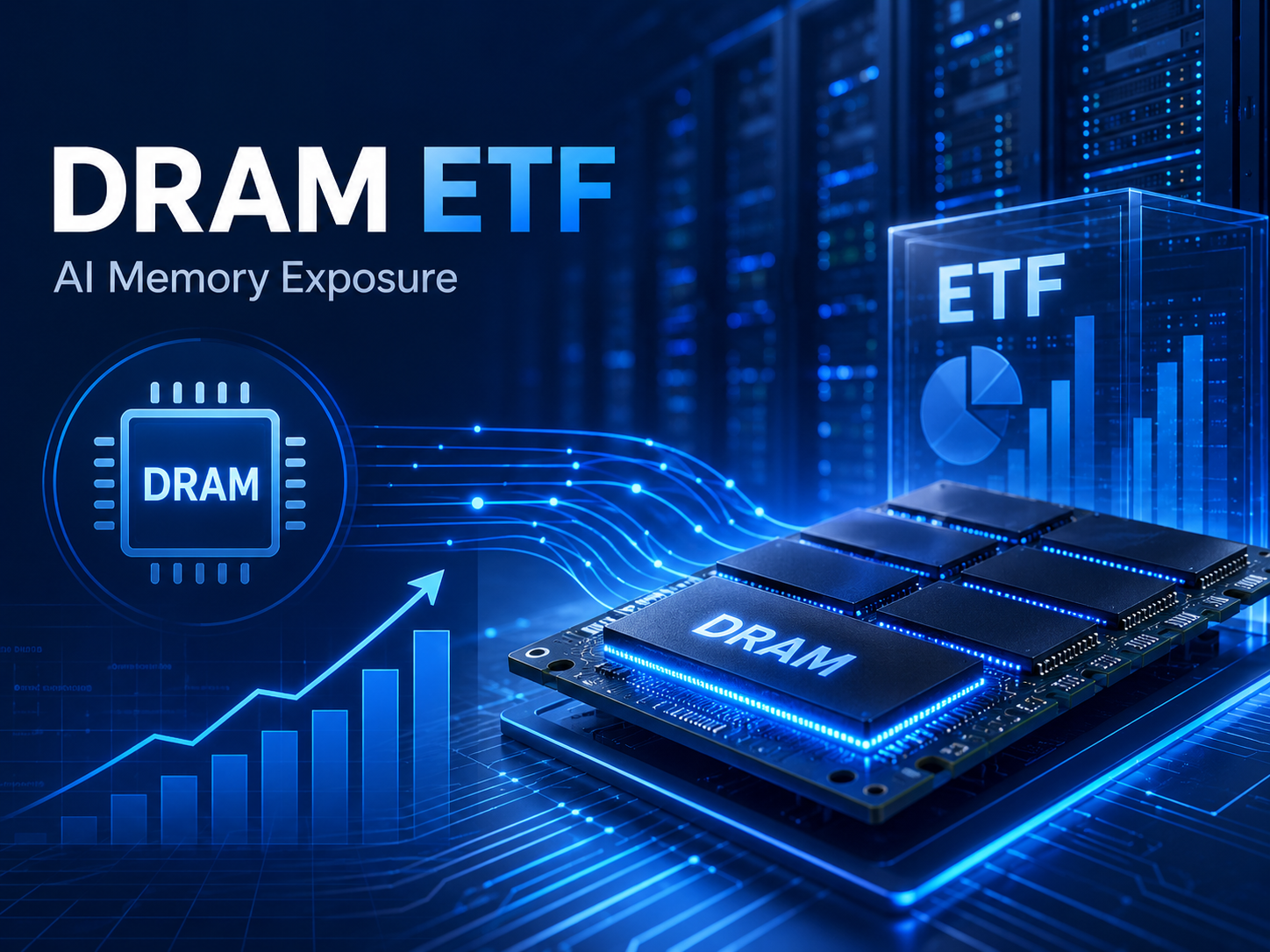
Unlike broad-based semiconductor ETFs that include chip design, wafer fabrication, equipment, and analog chips, the DRAM ETF narrows its investment focus to the storage industry. Roundhill positions this fund as a thematic portfolio targeting leading global storage manufacturers, highlighting the unified demand from AI workloads for high-speed memory, system memory, and long-term data storage.
To understand the DRAM ETF, it’s important to distinguish between the fund’s ticker symbol and the storage technology itself. “DRAM” serves as both the fund’s ticker and the abbreviation for dynamic random-access memory. However, the fund’s investments extend beyond traditional DRAM manufacturers to include companies involved with HBM, NAND, SSD, NOR, HDD, and specialized storage solutions.
What Is the Roundhill Memory ETF (DRAM)
The Roundhill Memory ETF seeks capital appreciation by investing in shares of storage companies rather than tracking a fixed public index. The fund is actively managed: the portfolio manager selects companies based on their storage revenue share, market position, market capitalization, and trading liquidity, with rebalancing at least quarterly.
According to the official prospectus, an eligible “storage company” generally derives at least 50% of its revenue or profit from HBM, DRAM, NAND, NAND-based SSDs, NOR, HDD, or from developing or manufacturing specialty and embedded storage. Under normal conditions, at least 80% of the fund’s net assets and investment borrowings are allocated to such companies or related exposure instruments.
| Fund Item |
Official Structure |
| Fund Name |
Roundhill Memory ETF |
| Ticker |
DRAM |
| Primary Listing |
Cboe BZX |
| Management Style |
Active |
| Investment Objective |
Capital Appreciation |
| Listing Date |
April 2, 2026 |
| Total Annual Expense Ratio |
0.65% |
| Portfolio Rebalancing |
At least quarterly |
| Main Investment Scope |
HBM, DRAM, NAND, SSD, NOR, HDD, and embedded storage companies |
The fund does not aim to replicate any index’s components or returns, so performance is shaped by the manager’s stock selection and weighting decisions. Active management allows for dynamic exposure adjustments as the industry evolves, but also means returns may diverge from standard storage or broad semiconductor indices.
Why the DRAM ETF Focuses on the Storage Chip Industry
The DRAM ETF centers on the storage chip sector because advances in computing power alone cannot resolve the data bottleneck in AI systems. Model training and inference require continuous data movement between accelerators, system memory, and long-term storage. Memory bandwidth, capacity, latency, and storage throughput all impact overall efficiency.
Roundhill identifies computer memory and storage as core to long-term AI infrastructure, viewing storage as a critical bottleneck for data-intensive applications. The fund, therefore, prioritizes companies directly producing and supplying storage products, rather than GPU, foundry, or semiconductor equipment firms.
This thematic approach addresses three primary demand layers:
- HBM and high-performance DRAM rapidly deliver data to AI accelerators and servers.
- Standard DRAM and embedded storage support system operations, caching, and edge computing.
- NAND, enterprise SSDs, and HDDs store models, training datasets, and inference results.
As a result, the DRAM ETF’s investment logic goes beyond simply “rising memory prices.” Fund performance is also shaped by product mix, advanced packaging capabilities, generational storage upgrades, data center demand, and the performance of each company’s non-storage businesses.
DRAM ETF Position Selection and Weighting Mechanism
To qualify for inclusion, companies must demonstrate high storage business purity. Official criteria typically require at least 50% of revenue or profit from designated storage products, a market capitalization of at least $10 billion, and an average daily trading volume of $5 million or more to minimize the impact of small or illiquid securities.
Weightings are primarily based on adjusted market capitalization, factoring in storage market share and the proportion of revenue from storage products. No single company’s target weight may exceed 25%. The fund rebalances at least quarterly, with limited trading between rebalancing periods.
| Selection or Management Stage |
Main Rule |
Impact on Fund Structure |
| Business Purity |
At least 50% of revenue or profit from designated storage business |
Reduces exposure to companies with limited storage focus |
| Market Cap Threshold |
Minimum $10 billion |
Emphasizes large-cap companies |
| Liquidity Threshold |
Minimum $5 million average daily trading volume |
Improves portfolio liquidity and rebalancing efficiency |
| Weighting Method |
Adjusted market cap, considering market share and storage revenue |
Not strictly proportional to market cap |
| Single Company Cap |
Maximum 25% |
Limits concentration risk |
| Adjustment Frequency |
At least quarterly |
Allows for adjustment as industry and company structures change |
The fund may also use total return swaps and forwards to gain exposure to certain companies. Roundhill notes that swaps help the fund meet diversification requirements for regulated investment companies; the weights disclosed on the official website combine direct holdings and swap exposures.
Roles of HBM, DRAM, NAND, and Enterprise Storage
HBM is designed for high-bandwidth data transfer near AI accelerators. Its stacked architecture and wide data interfaces enable GPUs and other accelerators to access model parameters and intermediate data more quickly, which is vital for large-scale training and high-throughput inference.
Traditional DRAM serves as system memory for servers and computing devices. Its capacity, speed, and energy efficiency affect data allocation between CPUs, GPUs, network equipment, and other components. Thus, even as HBM gains prominence, standard server DRAM remains fundamental in data centers.
NAND and enterprise SSDs are best suited for long-term data storage. Training datasets, model checkpoints, vector databases, and inference logs are typically retained on non-volatile devices. As AI infrastructure expands, demand rises for both high-speed memory and enterprise-grade SSD and flash storage capacity.
| Storage Type |
Core Function |
Typical Application |
Key Industry Variables |
| HBM |
Delivers ultra-high bandwidth for accelerators |
AI training, inference, GPU clusters |
Stacking technology, packaging, yield |
| DRAM |
Provides high-speed system memory |
Servers, PCs, mobile devices |
Capacity upgrades, supply/demand cycles, pricing |
| NAND |
Offers non-volatile flash memory |
SSDs, mobile storage, data centers |
Layer count, unit cost, inventory |
| Enterprise SSD |
High-performance long-term storage |
AI datasets, databases, cloud storage |
Endurance, throughput, capacity |
| HDD |
Large-capacity, low-cost storage |
Cold data, backup, cloud storage |
Per-drive capacity, cost, demand structure |
| Embedded Storage |
Integrated into devices or systems |
Automotive, industrial, edge devices |
Product lifecycle, end-user demand |
The DRAM ETF brings these categories together because AI systems require a complete storage hierarchy. HBM provides near-processor bandwidth, DRAM supports working memory, and SSDs and HDDs offer long-term storage. Demand and pricing cycles for each category are not fully synchronized.
Core Holdings: Micron, Samsung, and SK Hynix
Micron, Samsung Electronics, and SK Hynix are the DRAM ETF’s core holdings, as they comprise the bulk of global DRAM, HBM, and NAND production. As of June 30, 2026, Roundhill lists Micron, Samsung, SK Hynix, SanDisk, and Kioxia as major exposures, with actual weights subject to ongoing portfolio adjustments and swap exposures.
Micron provides US-listed exposure across DRAM, HBM, and NAND. Samsung Electronics, with its broad business scope, includes storage semiconductors as one segment; SK Hynix is a key player in DRAM and HBM. Each company’s sensitivity to AI storage demand and the impact of their non-storage businesses varies.
SanDisk and Kioxia mainly supplement the NAND and flash storage segments, ensuring the portfolio is not overly reliant on HBM and DRAM. This approach covers both high-speed and long-term storage, but the high concentration of the storage market means that performance and capacity decisions by a few large companies can significantly influence the fund.
Note that core exposure does not mean a fixed list or weight. The DRAM ETF is actively managed, allowing the manager to adjust holdings based on eligibility, market share, storage revenue, and rebalancing outcomes.
Impact of AI Data Center Demand on the DRAM ETF
AI data center demand influences the DRAM ETF primarily through HBM and server DRAM. Increases in accelerator deployments drive high-bandwidth memory demand, while larger models and inference tasks require greater system memory, altering product mix, average selling prices, and advanced product revenue shares for storage companies.
A secondary channel is NAND and enterprise storage. AI data centers must store training data, model versions, cache files, and inference results, so growth in server count and data scale boosts demand for enterprise SSDs, flash, and large-capacity storage.
However, AI demand does not guarantee synchronized growth for all storage companies. Key variables affecting performance include:
- Yields and customer qualification for HBM and advanced DRAM.
- Inventory and pricing dynamics for NAND, traditional DRAM, and enterprise SSDs.
- Speed of capacity expansion and capital expenditure discipline.
- Export controls, supply chain disruptions, and regional market shifts.
- Non-storage business performance at portfolio companies.
Therefore, while the DRAM ETF is closely linked to AI infrastructure, it is not an AI computing index. It reflects how AI and data growth reshape memory and storage demand, while retaining the cyclical nature of the traditional storage industry.
How the DRAM ETF Differs from Broad Semiconductor ETFs
The DRAM ETF’s main distinction from standard semiconductor ETFs is its narrower industry focus. DRAM actively selects companies whose business is primarily storage, while, for example, the VanEck Semiconductor ETF (SMH) tracks an index that includes semiconductor manufacturers and equipment firms—covering GPU, foundry, chip design, analog, and storage companies.
As of July 10, 2026, SMH’s top holdings include Nvidia, TSMC, Broadcom, AMD, Micron, Applied Materials, and ASML, reflecting the full semiconductor value chain. DRAM, by contrast, is concentrated in storage manufacturers such as Micron, Samsung, SK Hynix, SanDisk, and Kioxia.
| Comparison |
Roundhill Memory ETF (DRAM) |
Standard Semiconductor ETF (e.g., SMH) |
| Investment Theme |
Storage chips and data storage |
Comprehensive semiconductor value chain |
| Core Products |
HBM, DRAM, NAND, SSD, etc. |
GPU, CPU, foundry, equipment, analog, storage |
| Management Style |
Active |
Index tracking |
| Holdings Selection |
Emphasizes storage revenue/profit share |
Emphasizes semiconductor sector, scale, liquidity |
| Key Drivers |
Storage pricing, capacity demand, AI memory upgrades |
AI compute, wafer manufacturing, equipment investment, multi-device demand |
| Industry Concentration |
Higher, focused on storage |
More diversified, but still semiconductor-centric |
| Regional Structure |
Sensitive to Korea, Japan, and US storage firms |
Primarily US and US-listed global semiconductor companies |
| Expense Ratio |
0.65% |
0.35% (per SMH official site) |
| Main Use |
Pure storage industry exposure |
Broad semiconductor industry exposure |
The DRAM ETF offers higher thematic purity but less diversification. Standard semiconductor ETFs can offset storage cycle impacts with exposure to compute, foundry, and equipment companies, while DRAM more directly reflects storage supply, demand, and pricing.
How to Trade DRAM with USDT on Gate
To trade DRAM on Gate, eligible users can visit the Gate Stocks section, search for “DRAM” or “Roundhill Memory ETF,” and use their USDT balance to buy or sell the ETF. Before trading, users must confirm their region supports Gate Stocks and complete required identity verification and fund transfers.
On the trading page, verify the product name, ticker, and type to ensure you’re selecting the DRAM ETF—not a similarly named contract or derivative. Depending on platform support, choose a market or limit order, and confirm the order amount, ETF shares, estimated fees, and available USDT balance before submitting.
Once a buy order is filled, the DRAM ETF will appear in your stock holdings and order records; after a sell order, funds are typically settled in USDT per platform rules. Refer to Gate’s current page and applicable rules for trading hours, minimum order sizes, fees, corporate actions, and settlement methods.
DRAM ETF: Advantages, Limitations, and Key Risks
The DRAM ETF’s primary advantage is providing focused, global access to the storage industry. Investors can gain exposure to HBM, DRAM, NAND, and enterprise storage through a single fund, without managing multiple companies across the US, Korea, and Japan.
Active management lets the fund adjust weights based on market share, storage revenue, and industry trends. The 25% single-company cap limits dominance by any one firm, but the fund remains non-diversified and concentrated in information technology and storage sectors.
Key limitations and risks include:
- Pronounced supply-demand, inventory, and pricing cycles in the storage industry.
- Portfolio concentration among a few large producers and specific countries.
- HBM, DRAM, and NAND manufacturing involves yield, technology iteration, and high capital investment.
- Total return swaps introduce counterparty, valuation, and liquidity risks.
- ETF market price may diverge from NAV, with potential bid-ask spreads.
- Limited operating history—lacking long-term performance data.
Official documents also highlight risks such as technological obsolescence, supply chain disruptions, fierce competition, price volatility, export controls, and uncertain market acceptance. The fund’s significant allocation to Korean issuers adds exposure to Korean market and regional events.
Summary
The Roundhill Memory ETF (DRAM) is an actively managed, global storage-themed ETF investing in HBM, DRAM, NAND, SSD, HDD, and embedded storage companies through stocks, depositary receipts, and select derivatives. Its selection process emphasizes storage business purity, market cap, and liquidity, using adjusted market cap weighting and rebalancing at least quarterly.
The DRAM ETF’s connection to AI infrastructure is grounded in memory bandwidth, system capacity, and long-term data storage needs. Compared to broad semiconductor ETFs, it offers purer storage exposure, but is more sensitive to storage price cycles, a few key companies, regional markets, and technology iteration.
FAQ
What does the Roundhill Memory ETF (DRAM) mainly invest in?
DRAM primarily invests in major global companies whose revenue or profit relies heavily on HBM, DRAM, NAND, SSD, NOR, HDD, and embedded storage.
Is the DRAM ETF actively managed or an index fund?
DRAM ETF is actively managed. Roundhill selects holdings based on business purity, market share, market capitalization, and liquidity, with at least quarterly rebalancing.
What are the main holdings of the DRAM ETF?
As of June 30, 2026, the main exposures are Micron, Samsung Electronics, SK Hynix, SanDisk, and Kioxia, with weights subject to change.
AI training and inference require high-bandwidth memory, server DRAM, and enterprise storage. As AI data centers expand, demand for products from fund holdings increases.
How is the DRAM ETF different from standard semiconductor ETFs?
DRAM focuses on storage chip and device companies, while standard semiconductor ETFs also include GPU, foundry, chip design, and equipment firms.
What is the DRAM ETF’s expense ratio?
The Roundhill Memory ETF’s total annual expense ratio is 0.65%. Actual trading may also incur commissions, bid-ask spreads, and other intermediary costs.