Pi Network is a blockchain initiative designed to be an accessible experiment that focuses on enabling newcomers to enter the cryptocurrency space easily. Its primary goal is not to enhance computational efficiency but to allow non-technical users to engage with a cryptocurrency network at minimal technical cost through a mobile app. This app lets everyday individuals earn PI coins while contributing to the growth of a wider community ecosystem. Simply put, Pi Network and its cryptocurrency coin are structured as a social system that prioritizes building participation first and developing utility later, even as some question whether mobile mining is a scam.
In early blockchain networks, mining typically required high performance hardware, continuous power consumption, and specialized technical maintenance. While this model helped secure the network, it also led to a high concentration of participation rights among people who could afford specialized equipment. The background behind Pi Network reflects that shift: ordinary users found traditional mining hard to enter, blockchain projects needed faster community growth, and identity plus social relationships started to be treated as usable security signals in social cryptocurrency designs.
Within this framework, mobile mining does not perform computational competition. Instead, it functions as a participation mechanism based on user behavior and identity verification inside the Pi Network app, making cryptocurrency coins accessible to people who cannot run traditional miners. That makes Pi Network especially relevant to retail users exploring low-cost entry into crypto, as well as crypto enthusiasts evaluating whether community-driven, identity-based networks can offer a credible alternative to traditional mining. What makes Pi unique is the bet that a phone app can onboard a large community, help build an ecosystem of users, and still preserve enough identity checks to keep fake accounts lower than open airdrop farms. This article examines Pi Network’s origins, how its mobile mining system works, its pros and cons, the team and PI coin model behind it, what may determine PI’s value, how it compares with Bitcoin mining, where trading options such as Gate.com fit in, and the scam risks readers should watch for.
Advantages and Disadvantages of Pi Network
Pi Network is a highly controversial yet innovative cryptocurrency project. Its strengths are mainly reflected in its low entry threshold, low cost, and broad community base. For people asking whether Pi Network is a scam or legit—or “Is Pi a scam? Pi Network explained”—it is a real project with a real app and community, not an anonymous pump page, and still not a risk-free path to wealth. Are there free apps that pay users? Some advertise rewards, but Pi mining is a participation system that may allocate tokens/coins—not a guaranteed payday.
Extremely low barrier to entry : Pi’s mobile mining model removes dependence on high performance hardware and large scale electricity consumption seen in traditional cryptocurrencies such as Bitcoin. Users only need to tap once a day in the mobile app to “mine,” allowing people with no technical background to collect PI coins without ASICs.
Zero cost and low financial risk : Participating in Pi Network does not require users to purchase mining equipment or pay upfront fees. For users exploring crypto without risking principal, this is a relatively friendly starting point for making first contact with cryptocurrency coins through an app.
Large global community base : Pi Network has accumulated more than 45 million users. Such a broad community consensus base is critical to any crypto project and may help support future real world payment use cases and improve liquidity across the ecosystem.
At the same time, Pi Network has clear limitations, including limited transparency in its mining mechanism, risks related to user data, and potential compliance concerns. How Pi Network mining works in the app is easy to describe, but deeper cryptocurrency security claims still need careful review.
Prolonged development timeline : The mainnet launch was repeatedly delayed from the originally planned 2022 date until 2025. This prolonged uncertainty tested community patience and raised doubts about delivery of a production cryptocurrency ecosystem.
Lack of transparency in the mining mechanism : Although the project claims to use the SCP protocol, details around the “security circle” algorithm and reward distribution remain insufficient, leading to questions about decentralization for PI coins.
Privacy and KYC risks : Users must complete identity verification to transfer assets. Limited transparency around personal data handling inside the app creates misuse or leakage risks.
Limited ecosystem use cases : PI mainly circulates within the project’s internal ecosystem or among niche merchants, and has not entered mainstream consumer markets. Without real-economy support, PI coins are susceptible to speculation rather than app-native utility.
Controversial growth model : Because Pi Network relies on an invitation system to increase mining speed, some experts view it as having pyramid-scheme style characteristics, raising compliance concerns for people making community growth comparisons.
Pi Network mining risks and benefits therefore sit side by side: the app makes crypto mining easy for users worldwide, yet the same low-friction design can attract impersonation scams. How to avoid being scammed by someone impersonating Pi Network is straightforward—people should only use official project channels, never send coins or secrets to strangers claiming to unlock balances, and carefully check that any “support” app or website matches official domains. Treat unsolicited DMs that create fake urgency, demand seed phrases, or ask you to trade outside a regulated exchange as scam patterns. Official members of the project team do not need you to create secondary wallets for “unlock fees.”
Introduction to the Pi Network Team
Pi Network mining started in 2019 and the project was launched by Stanford University graduates, bringing academic and technical expertise to the project and shaping how the community talks about social cryptocurrency experiments. Core members of the Pi Network team include:
Dr. Nicolas Kokkalis: PhD in computer science from Stanford with experience in distributed systems; a key figure in Pi Network development and in making the app roadmap understandable to non-technical users.
Dr. Chengdiao Fan: Expert in social computing and human centered blockchain innovation, shaping Pi Network’s vision and community engagement strategy across the world.
Vincent McPhillip: A former co founder who made significant contributions to early community growth and strategic direction for the cryptocurrency project.
Together, these founders are widely viewed as the project's core team.
What the Pi Network team says matches the public thesis: build verified people first, then expand utility through apps. Team members emphasize KYC data checks and a staged mainnet launch checklist for nodes and users. The pi core team has also shaped development governance and early coin allocation discussions. Pi Network: mainnet launch date claims should be checked against official communications.
What Is PI Coin? How PI Issuance and the Economic Model Are Designed
PI is the native Pi cryptocurrency of the Pi Network project of the Pi Network, used to incentivize participation, support internal value exchange, and enable potential application scenarios for cryptocurrency coins inside the ecosystem. In terms of issuance, PI is not released all at once. Instead, it is gradually distributed as the network grows. Its main characteristics include:
Tokens are earned through user participation in the network via the mining app
As the total number of users increases, the mining rate and per user issuance rate of PI coins gradually decline
Additional incentives are provided for node operation and security related behaviors that help build network integrity
The core logic of this model is to use early incentives to build network scale and community density, then gradually reduce new issuance to control long term inflation, with a maximum supply capped at 100 billion, while people keep making daily app check-ins.
How to Understand the “Value” of PI: Where Does PI’s Value Come From?
The value of PI does not directly stem from computational costs or energy consumption. Instead, it depends more on network development and on whether the cryptocurrency project can convert app activity into durable demand. Its potential value foundation mainly includes:
User scale and network effects A large user base is a prerequisite for transaction demand and application ecosystem formation among people worldwide.
Real world use cases Whether PI based payments, services, or applications actually exist is critical to realizing value for coins earned in the app, with real world applications and real world utility serving as the practical test of value.
Network security and stability The consensus mechanism and governance structure determine long term sustainability of the cryptocurrency network.
Market and community consensus Ultimately, token value depends on participants’ recognition of its functionality across the community ecosystem.
Before a mature application ecosystem is established, PI’s value is largely speculative and mostly reflected in expectations about network development among crypto users around the world. Could Pi Networks' currency be valuable in the future? Only if markets create demand to trade PI tokens on an exchange. Pi's price has no official public market basis yet, so any quoted figure mainly reflects expectations rather than real value. Will Pi Network make you rich? No, but it can pay cents/hour of attention in the app—not guaranteed exchange profits. Unlock rules and ecosystem demand decide outcomes when users eventually trade coins or tokens.
How Does Pi Network Work?
The overall operating mechanism of Pi Network can be summarized as low barrier participation plus layered roles plus social verification, with the project operating in an enclosed network while planning a transition to an open network. How does Pi Network work in practice for people opening the app for the first time? Users create an account, confirm presence, and the system records participation while allocating cryptocurrency coins. How Pi Network works also depends on nodes that help maintain ledger work. The open network phase is meant to connect Pi to outside systems, and Pi Network planned that transition by 2024. Pi Network mining: everything you need to know still starts with that opening daily tap, then trust-circle and node roles. 1.
How Does PI Mobile Mining Work?
PI’s mobile mining does not perform complex calculations. After signup, users can start mining on a mobile phone through the Pi app, and its basic logic includes a step-by-step guide on how to mine Pi Network style participation rewards inside the official app:
Users confirm active status through the mobile application
The system records participation behavior and allocates tokens or coins
Allocation is independent of device performance, making cryptocurrency mining accessible on ordinary phones
From a mechanical standpoint, this is closer to a participation incentive system than traditional mining. Cryptocurrency mining explained for Bitcoin still means hash competition; Pi makes crypto mining easy via app check-ins, so the mining process is based on daily app check-ins rather than heavy computation and does not materially harm phone battery life. Step-by-step guide on how to mine Pi Network: open the official app, create a profile, and new users typically need an invitation code to register, complete the opening check-in after opening the mining screen, then optionally run nodes. ID verification/KYC is required later for migration or transfers; over 11 million users had completed KYC by May 2024, and the deadline was extended to November 30, 2024. The first digital currency many people try to mine on a phone is often PI, which is why the project’s app onboarding story spreads quickly around the world. 1.
Different Roles in the PI Network: Users, Nodes, and Trust Circles
Pi Network divides participants into multiple roles that together build the social cryptocurrency community:
Regular users : Participate in the network and receive basic token incentives through the app
Nodes : Run pi node software to help validate transactions and support network security
Trust circles : Better described as security circles, where people choose trusted members and sometimes add other users to form trust relationships that help with identity verification and limit fake accounts
The trust circle mechanism aims to reduce fake identity attacks through real world social relationships and is a key component of Pi Network’s security model within the broader pi ecosystem for users making identity-linked claims.
PI Mining vs Bitcoin Mining: Fundamental Differences Between Two Paths
PI mining and Bitcoin mining differ fundamentally in mechanism design, resource reliance, and security assumptions. Bitcoin uses a proof of work mechanism, making computing power and energy consumption the core foundation of network security. Pi Network, by contrast, weakens computing power and instead relies on user identity, participation behavior, and social relationships under the Stellar Consensus Protocol to build its consensus environment for a mobile cryptocurrency project.
Comparison Dimension
PI Mining
Bitcoin Mining
Security Foundation
Identity and social verification
Computational power competition
Participation Threshold
Smartphone app
Specialized mining hardware
Energy Consumption
Extremely low
High
Incentive Logic
Behavioral participation and coins via app
Hash computation
Decentralization Path
Driven by user scale and community
Driven by hash power distribution
These two models represent different technical tradeoffs. One emphasizes censorship resistance and security certainty; the other focuses on accessibility so everyday people worldwide can build crypto habits through an app instead of relying on specialized operators using expensive hardware. Differences appear in mining methods, decentralization paths, participation thresholds, and long term network structure for each cryptocurrency ecosystem.
How to View and Trade PI on Gate
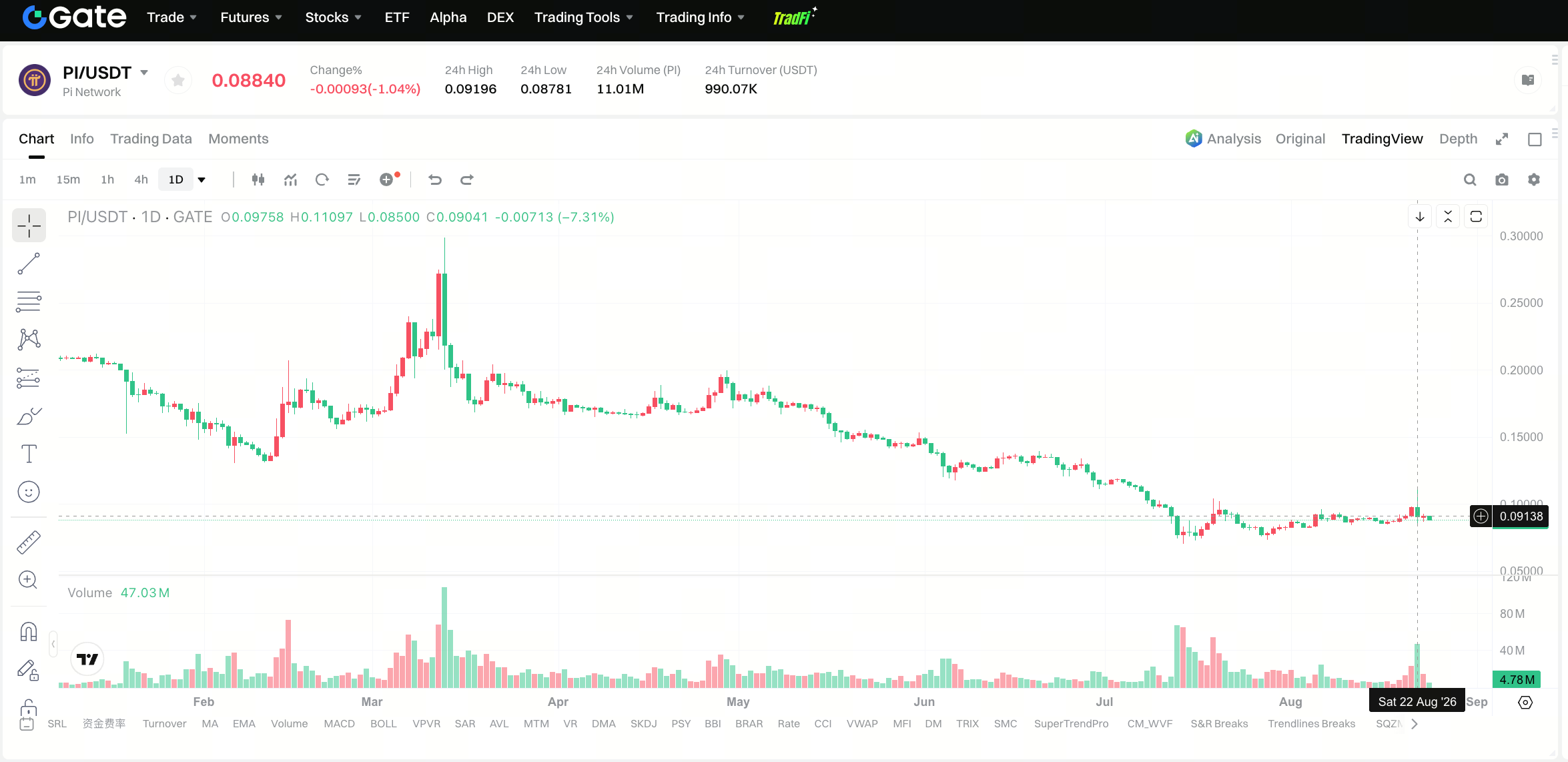
On the Gate platform, users can view basic information and market data related to PI through market or asset pages, including price trends, trading pairs, and volume. This information helps users understand PI’s circulation status and trading activity in secondary crypto markets for the cryptocurrency project without treating any display as investment advice for crypto users. When PI tokens are listed for trade, an exchange page is the place to review pairs and market data, not social scam links that create fake deposit addresses. Availability on crypto exchanges still depends on the network moving beyond its enclosed stage. Team members never ask users to open a side exchange chat to “unlock” balances.
For users with the appropriate permissions, Gate provides PI related trading markets that support buying and selling under defined rules, with actual exchange trading distinct from unofficial IOU-style pricing and only occurring when PI is available through supported markets. Specific trading methods, available pairs, and operational procedures are subject to the platform’s interface and guidelines. People making decisions should carefully check fees, unlock status, and wallet custody before moving coins.
Before engaging in any transactions, understanding trading mechanisms, fee structures, and asset risk management principles can help users participate more rationally in crypto markets. Gate also provides tutorials and rule explanations to help users better understand trading processes and important considerations around PI coins and the broader app-origin community.
Before opening any unofficial mirror site, remember that scam pages often imitate launch announcements, exchange deposit forms, and team member profiles. Legitimate trade flow happens on known exchange interfaces after users complete unlock work—not via private “priority listing” chats.
Conclusion
Through mobile participation, social trust, and layered role design, Pi Network explores a development path that differs from traditional computing power based mining. The value foundation of PI relies more on network scale, application ecosystems, and long term community consensus rather than on energy or hardware input, with the project aiming to broaden real world applications over time even as its outlook remains uncertain until utility expands. The project is a reference case for mass-adoption experiments—and for people asking what is Pi Network and cryptocurrency coin mechanics in one place: an app-led cryptocurrency experiment that tries to build a worldwide community of users earning coins through low-friction participation.
So what should you do? Treat the app as a window into the future of social cryptocurrency in Web3, but stay measured because some critics describe it as a social experiment or compare its referral-heavy growth to multi level marketing. Verify official materials, and size PI exposure carefully. Track use cases for Pi coins, the role of nodes in Pi Network, and mainnet launch readiness as system milestones—not scam-or-fortune binaries.
FAQ
Is Pi Network a blockchain network?
Pi Network adopts blockchain related ledger and consensus design concepts, but its security model and participation methods differ from traditional public blockchain networks and other blockchain designs centered on computational competition. It is a cryptocurrency project that uses ledger ideas while making participation app-first for people and community roles; for basic verification, use the official Pi Network website.
Is PI “mobile mining” equivalent to traditional mining?
No. PI mobile mining does not involve intensive computation. It is closer to an incentive mechanism based on user behavior, identity verification, and network participation inside the app, so mining Pi coins can continue through the app without ASICs or heavy processing.
What is the total supply of PI?
According to Pi Network’s publicly disclosed economic model, the designed maximum total supply of PI is approximately 100 billion tokens (coins under the project’s issuance plan).
What role does the trust circle play in Pi Network?
The trust circle introduces social relationships as a supplementary identity verification mechanism, aiming to reduce fake accounts and Sybil attacks while helping the community build higher-confidence users.
What factors mainly determine the value of PI?
PI’s value mainly depends on user scale, real world use cases, network security, and overall consensus among participants across the cryptocurrency ecosystem and app economy, with practical utility mattering more over time than referral growth alone.
Does Pi Network directly compete with traditional public blockchains such as Bitcoin?
The two differ significantly in design goals and technical paths—one oriented to hash-secured cryptocurrency settlement, the other to people making low-cost community participation through a mobile app.
Is Pi Network a scam or legit?
Pi Network is generally treated as a legitimate project with real team members, an app, and community members—not a proven get-rich scheme. Is Pi a scam? Pi Network explained carefully: the project itself is not automatically a scam, but scam actors create fake apps and fake exchange pages, and some observers still question its referral system and invitation structure. Verify official channels before moving coins, sharing identity data, or opening unfamiliar links.
What about the Pi Network mainnet launch date?
Official communications—not rumor posts—should define Pi Network: mainnet launch date expectations, KYC data deadlines, and which nodes or users can create transferable balances after launch work is complete.
Author: Carlton
Reviewer(s): Jayne
Disclaimer
* The information is not intended to be and does not constitute financial advice or any other recommendation of any sort offered or endorsed by Gate.
* This article may not be reproduced, transmitted or copied without referencing Gate. Contravention is an infringement of Copyright Act and may be subject to legal action.
Yala is a modular Bitcoin DeFi infrastructure that connects BTC liquidity with multi-chain ecosystems through its YU stablecoin and MetaMint protocol. It enables Bitcoin holders to earn native DeFi yields across EVM and non-EVM networks securely and seamlessly.
Solana faces both opportunities and challenges in its development. Recently, severe network congestion has led to a high transaction failure rate and increased fees. Consequently, some have suggested using Layer 2 and appchain technologies to address this issue. This article explores the feasibility of this strategy.
This article introduces the technical principles, framework, and applications of Zero-Knowledge (ZK) technology, covering aspects from privacy, identity (ID), decentralized exchanges (DEX), to oracles.
Sui is a PoS L1 blockchain with a novel architecture whose object-centric model enables parallelization of transactions through verifier level scaling. In this research paper the unique features of the Sui blockchain will be introduced, the economic prospects of SUI tokens will be presented, and it will be explained how investors can learn about which dApps are driving the use of the chain through the Sui application campaign.
TronScan is the primary blockchain explorer for the TRON network. It allows users to check TRX and TRC-20 transactions, inspect wallet balances, analyze smart contracts, monitor tokens, and view network activity without logging in. By connecting a compatible wallet such as TronLink, users can also transfer assets, stake TRX, vote for Super Representatives, and interact with TRON ecosystem applications.