Physical AI is artificial intelligence that helps autonomous systems—such as robots, autonomous vehicles, drones, and industrial machines—perceive real-world conditions, reason about space and physics, and perform or orchestrate complex actions in the physical world. Industry explainers from NVIDIA, BCG, and Georgetown’s CSET describe the same shift: move AI beyond screens into machines that must navigate three-dimensional environments safely.
Physical AI is often discussed alongside embodied AI (also called embodied intelligence). In practice the labels overlap. Embodied AI usually emphasizes an agent with a body that learns through physical interaction. Physical AI is the broader industry umbrella for systems that deal with sensors, motion, control, and real-world execution—even when the “body” is a forklift, a camera network, or a factory cell rather than a humanoid. For a side-by-side of labels, see Physical AI vs Generative AI vs Embodied AI.
Key Takeaways
- Physical AI connects perception, reasoning, and actuation so machines can act in the physical world under physics and safety constraints.
- Embodied AI / embodied intelligence is a closely related term; many sources use the phrases interchangeably.
- Generative AI mainly creates digital content; Physical AI must sense, decide, and move—often using generative models as helpers, not as the whole stack.
- Real deployments need sensors, models, simulation, edge compute, and reliable feedback loops; marketing claims alone are not enough.
- Crypto and DePIN discussions (sometimes called DePAI) focus on distributed data, machine identity, and incentives—not automatic investment merit.
What Is Physical AI (Embodied Intelligence)?
Physical AI equips machines to interpret sensory input and respond with physical actions. Typical forms include autonomous mobile robots (AMRs) in warehouses, robotic arms on production lines, humanoid research platforms, robotaxis, and smart spaces that monitor motion and trigger responses.
BCG frames Physical AI as systems that perceive, reason, and act in physical environments through robots, industrial machines, and similar hardware. That framing highlights why language-only chatbots are not Physical AI by themselves: they do not close an action loop on motors, wheels, or grippers.
Embodied intelligence research historically asked how cognition can be grounded in sensorimotor experience. Modern product language borrows that idea and pairs it with foundation models, multimodal perception, and large-scale simulation. Readers should treat “Physical AI,” “embodied AI,” and “generative physical AI” as a family of related labels rather than three unrelated markets.
How Does Physical AI Work?
Most Physical AI systems follow a closed loop:
- Perceive — Cameras, lidar, IMU units, force/torque sensors, microphones, and machine telemetry capture the environment and the machine’s own state.
- Understand — Models estimate where objects are, what is moving, which constraints apply, and which goals matter.
- Plan and control — Planners and controllers convert goals into trajectories, joint commands, or higher-level task graphs.
- Act and adapt — Actuators execute; sensors feed results back so the system can correct drift, slips, or unexpected obstacles.
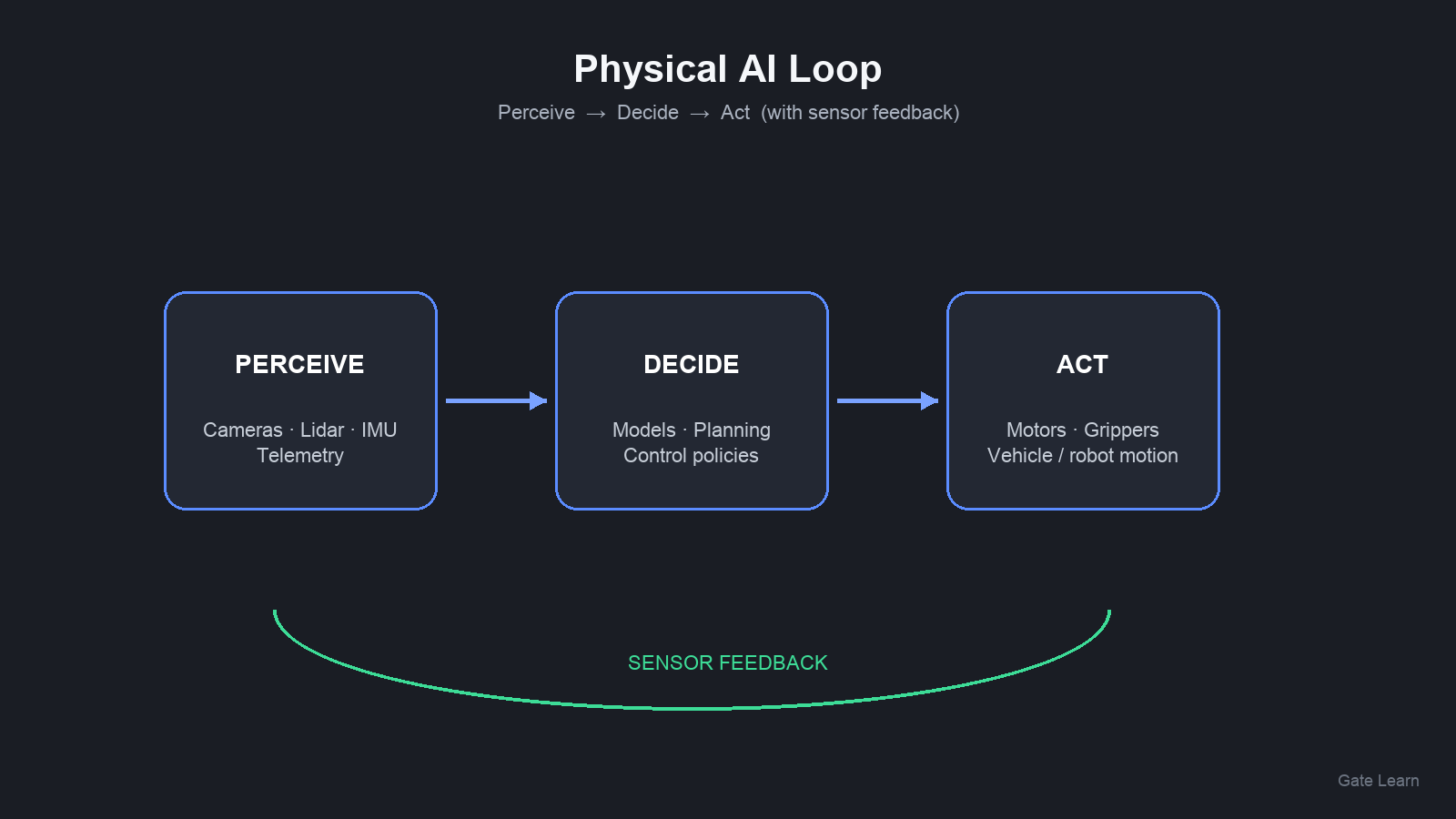 Figure 1. Physical AI closes a perception → decision → action loop with continuous sensor feedback.
Because real environments are noisy and incomplete, teams often train and validate in simulation before deploying on hardware. NVIDIA describes a pattern that combines model training, physically based simulation, and edge computers that run inference on the robot. Vendor tools vary; the train–simulate–deploy–monitor pattern is what matters for understanding.
Digital AI agents that only call APIs can use agent software layers such as those discussed in agent-to-agent commerce. Physical AI may still use those layers when software agents orchestrate robots, but it also needs hard real-time control and safety envelopes that digital agents usually ignore.
What Are Key Capabilities and Examples of Physical AI?
Useful capability buckets include:
| Capability |
What it enables |
Physical constraint example |
| Navigation |
Move through space without collisions |
Dynamic obstacles, localization error |
| Manipulation |
Grasp, place, assemble |
Friction, object pose uncertainty |
| Multimodal perception |
Fuse vision, depth, language, telemetry |
Lighting, occlusion, sensor lag |
| Task planning |
Break goals into sequenced actions |
Partial observability |
| Simulation-to-real transfer |
Train cheaply, deploy carefully |
Domain gap between sim and factory floor |
Examples commonly cited in industry explainers include warehouse AMRs that reroute around people, arms that adjust grasp force as parts shift on a conveyor, surgical robots learning fine motor tasks, and humanoid platforms that combine locomotion with manipulation. Amazon and other large operators publicly discuss robotics fleets measured in hundreds of thousands to millions of units—evidence that industrial Physical AI is already operational even while consumer humanoids remain early.
Spatial and vehicle data networks in crypto sit closer to the data and sensing layers than to a finished robot brain. Gate Learn coverage of Hivemapper and the broader automotive DePIN stack that includes DIMO shows how real-world data collection can be incentivized. That is not the same as proving a token equals a working humanoid.
How Is Physical AI Different From Generative AI and Traditional Automation?
Generative AI produces text, images, audio, code, and other digital artifacts. Physical AI uses AI to sense, decide, and act under physics. Generative models can still help Physical AI: they support language interfaces, synthetic data, multimodal understanding, and high-level task planning. They do not replace the control stack that must respect latency and safety.
Traditional industrial automation often relies on fixed scripts, fences, and highly structured environments. Physical AI aims for greater generalization—handling variation in object pose, lighting, or layout—while still needing engineering rigor. Many factories blend both: scripted cells for repeatable steps and learning-based modules for perception-heavy tasks.
A deeper comparison lives in Physical AI vs Generative AI vs Embodied AI.
Why Do Crypto and DePIN Communities Discuss Physical AI?
Decentralized Physical AI (DePAI) narratives argue that DePIN-style networks can supply sensing, connectivity, compute, or robot fleets with token incentives and shared ownership. Industry research often highlights data collection as the nearest-term DePAI opportunity: unique real-world datasets that help train agents that must operate outside screens.
Other crypto angles include machine identity, wallets for machines, proof-of-physical-work concepts, and agent payment rails. Those ideas are optional extensions of the core definition. A token ticker does not prove a closed perception–action loop exists. Evaluation should start from sensors, deployments, safety documentation, and verifiable usage—not from roadmap art alone.
What Risks and Limits Should Readers Know About Physical AI?
Physical AI faces structural limits that generative chat demos hide:
- 3D understanding is hard. Models that predict next tokens or pixels do not automatically understand stable 3D geometry, contact physics, or long-horizon manipulation.
- Sim-to-real gaps. Policies that work in simulation can fail when friction, lighting, or latency differ.
- Safety and liability. Autonomous action in shared spaces raises questions about fail-safes, human oversight, and who is responsible after an incident.
- Data quality and supply chains. Sensors, batteries, actuators, and GPUs create concentrated dependencies even when software is open.
- Narrative risk in crypto markets. Robotics and DePAI tokens can trade on story before hardware metrics exist. Educational reading is not investment advice.
On Gate Learn, start with the DePIN overview and the comparison article on Physical AI versus generative and embodied AI. If a related asset is listed for spot trading, use the official market page only after independent research. Gate product paths describe how to view markets and place orders; they do not recommend any Physical AI or robotics token.
Treat price charts, social campaigns, and “machine economy” slogans as secondary. Primary questions remain: what senses the system uses, what actions it can take, how it is tested, and what fails when the environment changes.
Summary
Physical AI (closely related to embodied AI / embodied intelligence) gives machines a closed loop of perception, reasoning, and physical action. It differs from generative AI’s content focus and from brittle scripted automation, while often combining ideas from both. Crypto and DePIN discussions add optional layers around data and incentives. Understanding the loop—and its safety and sim-to-real limits—matters more than memorizing brand names.
FAQ
What is Physical AI?
Physical AI is AI that enables autonomous machines to perceive, reason about, and act in the physical world—for example robots, vehicles, and industrial systems—under real-world constraints such as space, timing, and safety.
Is Physical AI the same as embodied AI?
They are closely related and often used interchangeably. Embodied AI usually stresses intelligence grounded in a body that interacts with the world; Physical AI is a broader industry label for AI systems that handle physics, sensors, and real-world execution.
How is Physical AI different from generative AI?
Generative AI mainly creates digital content. Physical AI senses and acts in the real world. Generative models can assist Physical AI with language, planning, or synthetic data, but they do not replace control and safety systems.
How does Physical AI work in simple terms?
Sensors gather data, models interpret the scene and goals, controllers send commands to actuators, and feedback updates the next cycle. Simulation is often used to train and test before hardware deployment.
What are examples of Physical AI?
Warehouse robots that navigate around people, arms that adapt grasps on a conveyor, autonomous mobile platforms, and research humanoids are common examples. Smart cameras and industrial monitoring systems that trigger physical responses can also sit under the umbrella.