Agent-to-Agent Commerce (A2A Commerce) is a business model in which artificial intelligence agents (AI Agents) act on behalf of users or businesses to automatically conduct product discovery, demand matching, price negotiation, transaction authorization, and payment settlement with other agents. The key shift is that AI no longer simply recommends products or assists with order completion. Within predefined permissions and rules, it can directly participate in multiple stages of commercial transactions.
As large language models, AI Agent frameworks, and digital payment infrastructure continue to develop, commercial activities are extending from human-centered web interactions to agent-driven automated workflows. For example, a corporate procurement Agent can query supplier Agents for inventory and quotes, a personal assistant Agent can compare subscription plans from different providers, and a software Agent can purchase API call credits based on task requirements. These use cases require different agents to identify one another, exchange structured information, and complete authorization and payment in verifiable ways.
In recent years, technologies such as A2A, Model Context Protocol (MCP), Agent Payments Protocol (AP2), and x402 have gradually matured, providing infrastructure at different layers for agent collaboration and machine payments. This article explains how Agent-to-Agent Commerce works, the relevant protocols, stablecoin payment use cases, and potential risks, while examining its relationship with Web3 and the future digital commerce ecosystem.
Key Takeaways
-
Agent-to-Agent Commerce (A2A Commerce) refers to commercial transactions completed by different AI Agents within the authorization scope of users or businesses through automated communication, negotiation, payment, and fulfillment mechanisms.
-
Unlike traditional e-commerce, Agent Commerce delegates product searches, price comparisons, order management, and certain payment decisions to AI Agents, shifting commercial activity from manual operations to machine collaboration.
-
Protocols such as A2A, MCP, UCP, AP2, and x402 address agent communication, tool connectivity, commercial workflows, payment authorization, and programmatic payments, respectively. Not all transactions need to use every protocol.
-
Stablecoins and on-chain payments can provide AI Agents with programmable fund transfer methods, particularly for cross-platform digital services, API calls, and small machine-to-machine payments.
-
Agent-to-Agent Commerce still faces challenges related to authorization boundaries, identity verification, transaction disputes, payment security, and compliance. Autonomous transactions do not mean AI can use user funds without restrictions.
What Is Agent-to-Agent Commerce? How Does It Differ From Traditional E-Commerce?
Agent-to-Agent Commerce is a model in which multiple AI Agents work together to complete commercial transactions. In this model, the buyer Agent is responsible for understanding user requirements, searching for products, comparing options, and managing budgets. The seller Agent represents the merchant by providing product information, quotes, inventory, delivery terms, and order processing capabilities. Both parties exchange information through standardized interfaces and proceed to payment and fulfillment once authorization requirements are met.
Traditional e-commerce is typically centered on active user operations. Consumers must visit websites, enter keywords, filter products, compare prices, and manually complete checkout. Even when platforms offer AI recommendations, purchase decisions and operational workflows are generally still controlled directly by users. Agent-to-Agent Commerce delegates certain tasks to agents, allowing users to express their needs through goals and constraints rather than operating each page step by step.
For example, a company may need to procure a new data analytics service. The traditional process may require employees to contact multiple suppliers, obtain quotes, and submit procurement requests. Under an Agent-to-Agent Commerce model, a corporate procurement Agent can automatically contact different supplier Agents based on budget, service level, and data security requirements, obtain structured quotes, and submit qualifying options for approval. If the user has already provided valid authorization, some low-risk transactions may also be executed directly.
This model does not mean that AI Agents can independently determine every transaction. Users still need to define budgets, merchant scope, payment terms, and required approval rules. An Agent’s autonomy should be based on clear authorization, rather than replacing the user’s control over funds and commercial responsibilities.
How Does Agent-to-Agent Commerce Complete a Transaction?
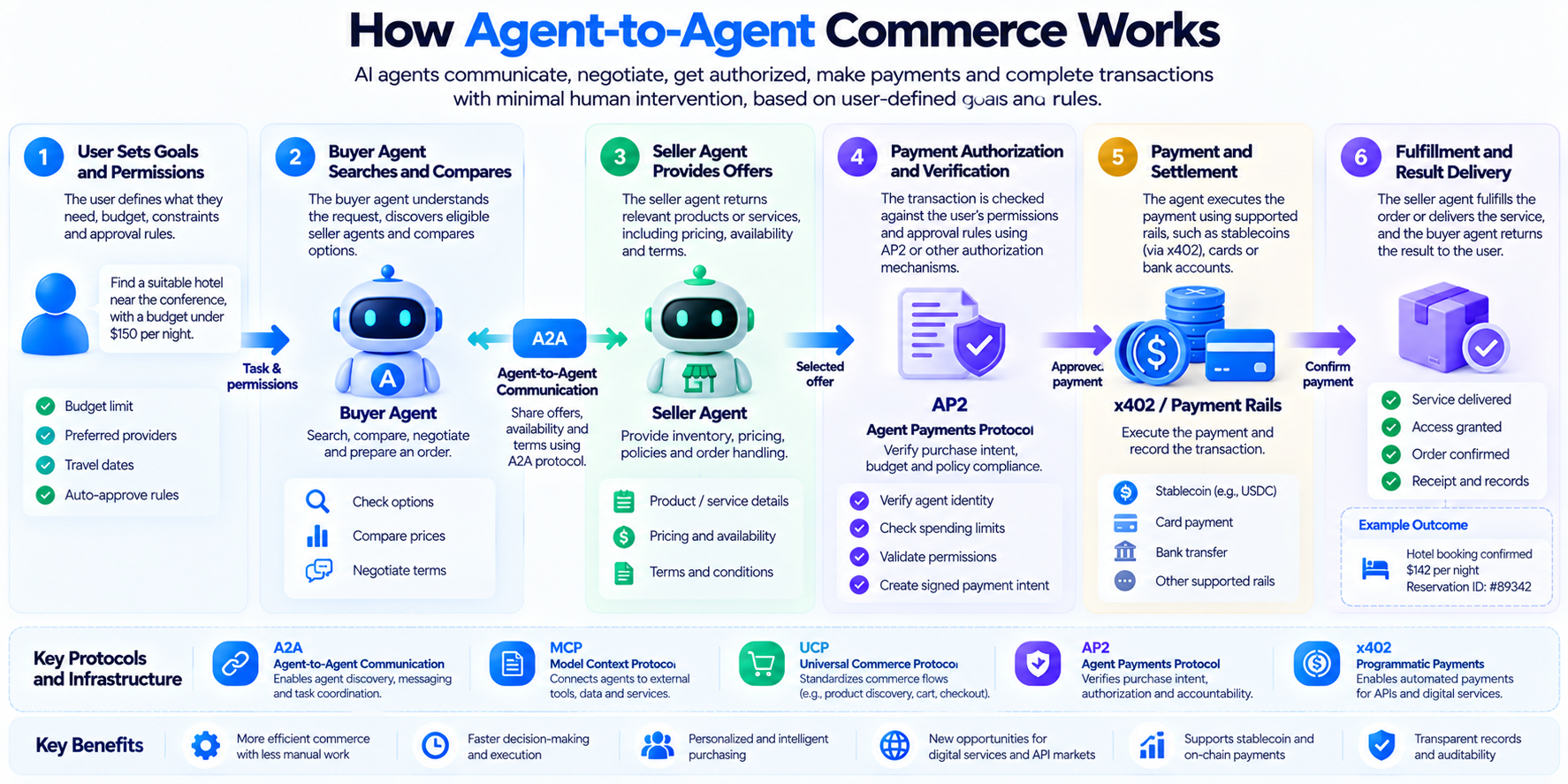
A typical Agent-to-Agent Commerce transaction can be divided into several stages: requirement understanding, agent discovery, quote negotiation, authorization verification, payment settlement, and fulfillment confirmation. Different applications may simplify or expand these steps, but the core requirement is to enable different systems to understand transaction intent and complete actions within authorized limits.
First, the user gives the Buyer Agent an objective, such as purchasing a digital service, and sets a price limit, service quality requirements, and delivery time. The Buyer Agent then searches for Seller Agents that can provide the relevant service and obtains product descriptions, quotes, available quantities, and transaction terms. The parties can further exchange information to determine whether the purchase requirements are met.
Once the transaction terms are clear, the system must verify that the payment has been authorized. For lower-value transactions that comply with predefined rules, preauthorized payment credentials may be used. For higher-value transactions or transactions involving special conditions, the user may need to confirm again. After payment is completed, the Seller Agent fulfills the order or provides the service and returns the transaction result and relevant credentials.
Using an AI data analytics service as an example, the process may work as follows: a research Agent needs access to paid market data, queries a data service Agent for pricing, confirms that the per-call fee is within budget, completes payment through a payment interface, then receives the data and continues its analysis task. For users, activities that previously required manual registration, account funding, and API calls can be combined into a continuous agent workflow.
However, Agent-to-Agent Commerce remains in a stage of ongoing standards and application development. Not all merchants provide independent Seller Agents, and not all payment systems support unattended transactions. As a result, actual deployments typically need to be designed around a merchant’s API capabilities, authorization methods, and payment terms.
How Do A2A, MCP, UCP, and AP2 Support Agent Commerce Transactions?
Agent-to-Agent Commerce involves multiple technical layers. Large language models alone are not sufficient to complete reliable commercial transactions. AI Agents need to connect to external data, communicate with other agents, understand order structures, and demonstrate that payment has been validly authorized. A2A, MCP, UCP, and AP2 each address these needs.
A2A (Agent2Agent) is primarily used for discovery, communication, and task collaboration between different AI Agents. Through A2A, a buyer Agent can identify the capabilities of a seller Agent and send it task requests. MCP (Model Context Protocol), on the other hand, is mainly used to connect AI Agents with external tools, databases, and services, enabling them to query inventory, read prices, or call business systems.
UCP (Universal Commerce Protocol) focuses further on commercial workflows themselves, including product discovery, shopping carts, checkout, and order management. It provides relatively standardized data structures and interaction methods for different merchants, reducing the need for AI Agents to develop separate checkout interfaces for every e-commerce platform.
AP2 (Agent Payments Protocol) addresses payment authorization and accountability verification. Through verifiable authorization credentials, it records which transactions a user allows an Agent to execute, which limits apply, and whether a specific payment meets the authorization conditions. In developer guidance released in 2026, Google described these protocols as different infrastructure layers that can be used together, rather than competing alternatives.
| Protocol |
Core Function |
Application in Transactions |
| A2A |
Agent discovery and communication |
Buyer Agent contacts Seller Agent |
| MCP |
Tool and data connectivity |
Query inventory, prices, and external systems |
| UCP |
Commercial workflow standardization |
Product discovery, shopping carts, and checkout |
| AP2 |
Payment authorization and auditing |
Verify budgets, purchase intent, and payment permissions |
| x402 |
Programmatic payments |
Pay for APIs or digital services |
These protocols are not a mandatory combination for every transaction. For example, a simple paid API call may only require a tool interface and x402 payment, while complex cross-platform procurement may require A2A, UCP, and AP2 together. Technical architecture should be selected based on actual business needs rather than by layering every protocol together.
How Does AP2 Address Payment Authorization for AI Agents?
Payment authorization is an important distinction between Agent-to-Agent Commerce and ordinary agent collaboration. Even if an AI Agent can find a product and create an order, it does not automatically gain the right to use a user’s funds. The system needs to verify whether the purchase complies with the user’s intent and whether the specific amount, merchant, and payment method are within permitted limits.
In September 2025, Google launched AP2 to establish a cross-platform authorization framework for agent-initiated payments. Its core approach is to connect a user’s purchase intent with actual payment activity through verifiable authorization records. Unlike relying only on chat records to demonstrate that a user agreed to a purchase, this mechanism emphasizes structured authorization, verifiability, and transaction auditing.
For example, a user can authorize a procurement Agent to purchase up to $100 in software services from approved suppliers within a specified period. After the Agent finds a qualifying product, the payment system must check the merchant, amount, and validity period. If the transaction exceeds the authorized scope, the user should be asked to confirm again rather than allowing the Agent to expand the budget on its own.
In 2026, Google donated AP2 to the FIDO Alliance and released updates supporting Human Not Present scenarios, enabling Agents to make payments under preauthorization conditions when users are not participating in real time.
However, AP2 is not a payment currency and does not directly handle all fund clearing. It primarily addresses payment intent and authorization verification. Actual fund transfers can still be completed through payment methods such as bank cards, bank accounts, or on-chain assets.
How Do x402 and Stablecoins Enable Automated AI Agent Payments?
x402 is a programmatic payment protocol built on the HTTP 402 Payment Required status code and advanced by Coinbase. It allows clients accessing paid APIs or digital services to complete payment according to the payment requirements returned by the server, then obtain the requested resource after payment verification is completed. For AI Agents, this provides a way to purchase services without relying on manual checkout every time.
For example, an AI Agent may need to call a paid data interface. The server can return payment requirements that specify the required amount, supported assets, and network. After checking whether the fee is within its authorized budget, the Agent submits payment credentials through a controlled wallet or signing service. Once the server verifies the payment and completes the corresponding settlement, it returns the requested data.
Stablecoins offer certain advantages in this process. Using USDC as an example, its price is generally pegged to the U.S. dollar, making it suitable for relatively stable pricing of digital services. When combined with blockchain networks that support low-cost transactions, stablecoins can be used for per-use charges, API calls, and cross-platform digital service payments. Coinbase developer documentation also provides examples of making paid x402 API requests through an Agentic Wallet and supports setting a maximum payment amount per transaction.
It is important to note that x402 does not mean all Agent Commerce must use cryptocurrency. Traditional bank cards and bank payments can also support agent transactions. The value of stablecoins is mainly reflected in use cases such as programmable transfers, settlement for digital-native services, and cross-platform payments. Actual use still requires consideration of network fees, wallet security, regulatory requirements, and merchant acceptance capabilities.
What Are the Practical Use Cases for Agent-to-Agent Commerce?
Agent-to-Agent Commerce is not limited to ordinary product shopping. As long as a service can provide quotes, authorization, payment, and delivery in a structured way, it may be possible to automate transactions through agent collaboration.
In corporate procurement, a Buyer Agent can automatically query supplier quotes based on inventory and budget, then confirm delivery time, purchase quantity, and contract terms with a Seller Agent. In its AI Agent protocol developer guidance, Google uses restaurant procurement as an example to demonstrate how MCP can be combined to query inventory, A2A can be used to contact suppliers, UCP can be used to place orders, and AP2 can be used to verify payment authorization.
For digital services, AI Agents can purchase data interfaces, computing resources, model inference services, or other software capabilities as needed. For example, an automated research Agent can select different data providers based on task requirements, complete paid calls within budget, and use the results for subsequent analysis. These transactions tend to involve smaller amounts, higher frequency, and digitally delivered results, making them suitable for programmatic payment mechanisms.
In consumer shopping, Agents can help users compare products, create shopping carts, and complete parts of the checkout process. Google has started applying UCP to certain shopping experiences in Search AI Mode and Gemini. However, related functionality is currently still limited by merchant eligibility, geographic availability, and product capabilities, so it should not be assumed that all online shopping already supports fully autonomous Agent-to-Agent transactions.
In the future, subscription management, travel bookings, cloud service procurement, and machine-to-machine service marketplaces may also adopt similar models. However, these scenarios involve different levels of consumer protection, refund responsibility, and identity verification requirements, so their actual degree of automation will not be identical.
What Is the Relationship Between Agent-to-Agent Commerce and Web3?
Web3 provides Agent-to-Agent Commerce with a type of programmable asset and open settlement infrastructure. Traditional commercial systems typically rely on platform accounts, bank cards, or banking networks for payments, while blockchains allow Agents that support on-chain payments to manage digital assets through wallets and transfer funds when authorization conditions are met.
This mechanism is particularly suitable for digital-native services. For example, two AI Agents from different platforms may not share a common payment account system, but if both support the same stablecoin and blockchain network, they can complete transactions through standardized payment interfaces. The extended designs of x402 and A2A have already begun exploring this model. The public A2A x402 Payments Extension specification defines processes such as service quotes, payment requirements, payment credential verification, and transaction receipts, connecting paid services between agents with on-chain payments.
In addition, smart contracts can be used to manage certain fund usage conditions, such as restricting the assets that can be used, payment amounts, or specific service addresses. However, smart contracts cannot independently determine every real-world commercial fact, nor can they automatically guarantee product quality, service fulfillment, or successful refunds. Therefore, on-chain settlement must still be combined with identity verification, authorization systems, merchant services, and dispute resolution mechanisms.
For the cryptocurrency industry, the significance of Agent-to-Agent Commerce lies in expanding potential use cases for stablecoins and on-chain payments, allowing digital assets to be used not only for transfers between people but also for service purchases between software systems. However, whether this direction can develop at scale will still depend on payment costs, user experience, merchant adoption, and regulatory frameworks—not blockchain technology alone.
What Security and Commercial Risks Does Agent-to-Agent Commerce Face?
Authorization and fund security risks. AI Agents may misunderstand user requirements, select the wrong products, or be influenced by malicious information. If payment permissions are too broad, incorrect decisions may result in real financial losses. Therefore, systems need to set budget limits, merchant allowlists, authorization validity periods, and approval mechanisms for high-risk transactions. They should also avoid allowing models to directly control unrestricted wallet private keys.
Agent identity and information reliability issues. A Buyer Agent needs to confirm whether a Seller Agent genuinely represents the relevant merchant, while merchants also need to identify whether a request comes from an authorized customer representative. Malicious Agents may provide false quotes, misrepresent service capabilities, or use prompt injection to influence transaction decisions. Standardized communication can improve interoperability, but it cannot automatically prove that a transaction counterparty is trustworthy.
Payment disputes and allocation of responsibility. When an Agent purchases goods while the user is not participating in real time, it is necessary to clarify whether the user, Agent service provider, merchant, or payment institution bears responsibility for duplicate charges, undelivered services, or incorrect orders. Protocols such as AP2 attempt to improve traceability through authorization records and payment credentials, but ultimate liability remains subject to specific contracts, payment rules, and legal requirements.
Privacy and compliance issues. During procurement and payment processes, Agents may handle user addresses, spending preferences, corporate contracts, and payment information. Transmitting this data across platforms requires compliance with applicable data protection requirements. Stablecoin payments may also involve anti-money laundering, sanctions screening, and digital asset regulatory rules across different jurisdictions.
Therefore, the development focus of Agent-to-Agent Commerce is not only to improve transaction automation, but also to establish verifiable authorization, reliable payments, and clear accountability mechanisms.
Summary
Agent-to-Agent Commerce is an important direction in the evolution of AI Agents from information assistants to commercial executors. It allows different agents to automatically complete demand matching, quote negotiation, order processing, and payment settlement within the authorization scope of users or businesses, reducing repetitive manual steps in traditional commercial processes.
A2A, MCP, UCP, AP2, and x402 provide technical support for agent communication, tool connectivity, commercial workflows, payment authorization, and programmatic settlement, respectively. Stablecoins and blockchains offer new options for digital-native services and cross-platform machine payments, but not all Agent Commerce scenarios need to rely on Web3.
Over the long term, the adoption of Agent-to-Agent Commerce will depend on whether Agents can reliably execute transactions with clear authorization and controlled risks. Only when identity verification, fund permissions, payment settlement, and dispute resolution form a complete mechanism can AI Agents potentially evolve from shopping assistance tools into trusted commercial participants.
FAQ
What Does Agent-to-Agent Commerce Mean?
Agent-to-Agent Commerce refers to a model in which different AI Agents represent users, businesses, or service providers and automatically complete commercial information exchanges, quotes, order processing, payments, and other activities within authorized limits.
What Is the Difference Between Agent-to-Agent Commerce and Agentic Commerce?
Agentic Commerce is a broader concept that covers various scenarios in which AI Agents participate in shopping and transactions. Agent-to-Agent Commerce places greater emphasis on direct collaboration between different agents, such as buyer and seller agents, and is one specific implementation of Agentic Commerce.
Can the A2A Protocol Complete Payments Directly?
A2A is primarily responsible for discovery, communication, and task collaboration between agents. Payments typically need to be completed in combination with AP2, x402, or other payment systems. A2A itself is not a payment network.
Can an AI Agent Make Payments Without User Confirmation?
If the user has provided valid authorization in advance and set limits such as the amount, merchant, and validity period, an Agent can automatically execute certain transactions. However, transactions that exceed the authorized scope should require reconfirmation. Actual capabilities also depend on the payment system and applicable rules.
Why Is x402 Suitable for AI Agent Payments?
x402 combines payment requirements with the HTTP request process, allowing AI Agents to pay for APIs and digital services as needed. It reduces the need for traditional account registration and manual checkout steps, making it suitable for programmatic and per-use billing scenarios.
Does Agent-to-Agent Commerce Require Stablecoins?
Not necessarily. Agent-to-Agent Commerce can use bank cards, bank payments, or stablecoins. Stablecoins are primarily suitable for scenarios requiring programmable transfers, on-chain settlement, and digital-native payments.
Is Agent-to-Agent Commerce Already Widely Adopted?
It has not yet been widely adopted. Relevant protocols and some commercial applications have emerged, but merchant integration, payment authorization, identity verification, regulatory compliance, and user trust mechanisms are still developing.