Physical AI is the industry umbrella for AI that perceives, reasons, and acts in the physical world. Embodied AI (embodied intelligence) usually means intelligence grounded in a body that senses and acts through physical interaction. Generative AI creates digital content such as text, images, audio, and code. Readers meet all three phrases in robotics and crypto research; mixing them up leads to wrong expectations about what a product can actually do.
The Physical AI explainer covers definitions, the perception–control loop, risks, and DePIN context. This page only compares what each of the three labels answers.
Key Takeaways
- Generative AI outputs digital artifacts; Physical AI outputs decisions that move or control machines in real space.
- Embodied AI overlaps heavily with Physical AI; academic writing prefers “embodied,” while industry decks often prefer “Physical AI.”
- Generative models can assist Physical AI (language, planning, synthetic data) without replacing actuators, controllers, or safety layers.
- Traditional automation is not generative AI and not always Physical AI; many plants still run fixed scripts in structured cells.
- Token or agent narratives do not erase the need for sensors, latency budgets, and sim-to-real testing.
What Does Each Term Mean?
| Term |
Core question it answers |
Typical outputs |
| Generative AI |
What content can the model produce? |
Text, images, audio, code, video |
| Embodied AI |
How is intelligence grounded in a body interacting with the world? |
Policies and behaviors learned via sensorimotor loops |
| Physical AI |
How can autonomous machines perceive, reason, and act under physics and safety constraints? |
Robot, vehicle, and industrial behaviors in real environments |
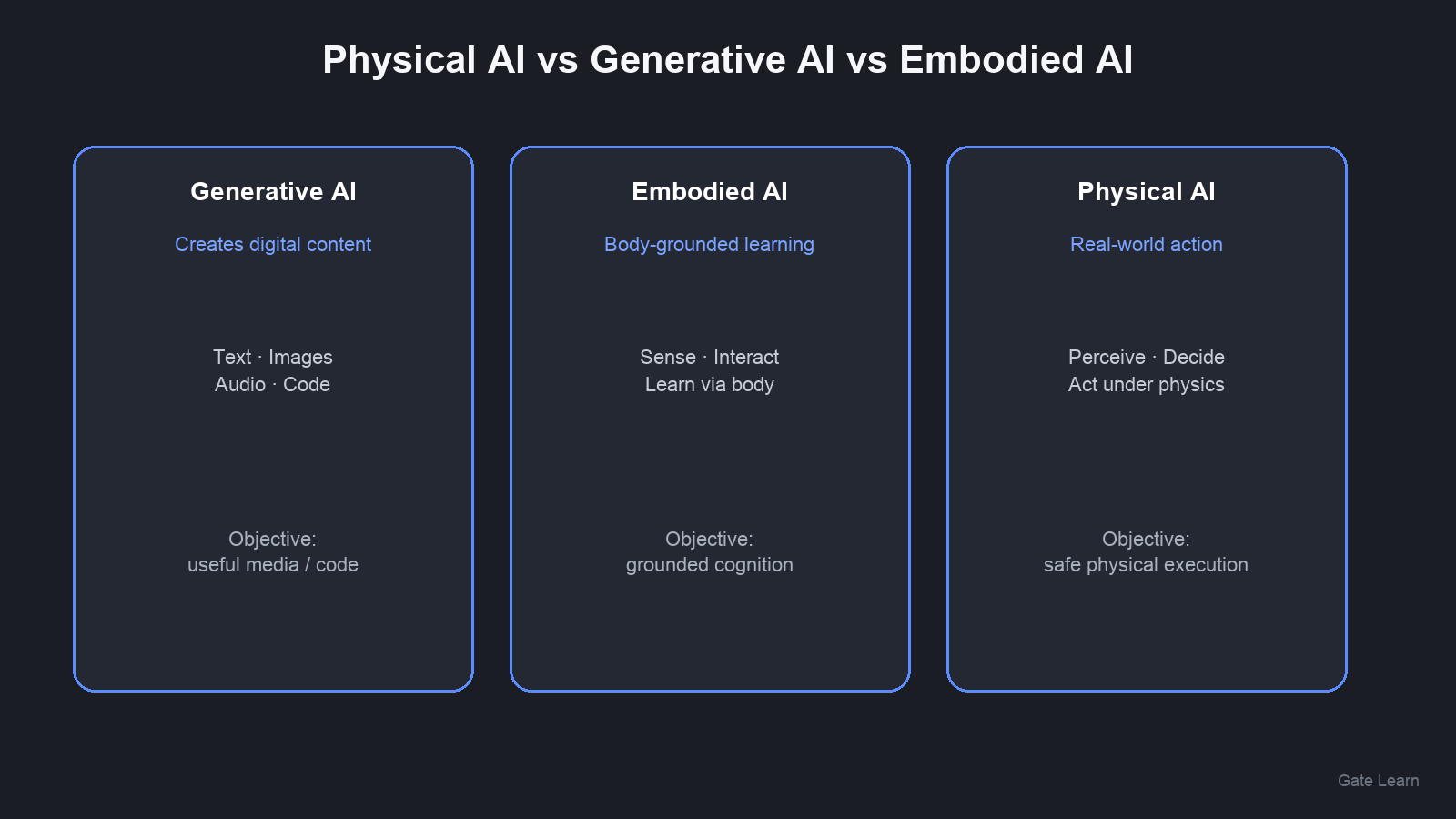
Figure 1. Three labels answer different questions: content generation, body-grounded learning, and real-world action under physics.
NVIDIA’s glossary-style definitions stress Physical AI for robots and robotaxis that must perform complex actions in the physical world. BCG emphasizes physics, motion, timing, safety, uncertainty, and feedback. CSET notes that “Physical AI,” “embodied AI,” and “generative physical AI” are competing labels for a still-forming field—so definitional precision matters more than brand loyalty.
In some research frameworks, embodied AI is framed more broadly because it can include simulated or virtual bodies trained before deployment on real machines, while Physical AI usually stresses deployment in real environments. Industry writing often treats the two as near-synonyms.
Physical AI vs Generative AI: Where Do They Diverge?
Objective. Generative AI optimizes for useful digital creation. Physical AI optimizes for reliable action under physical constraints.
Data. Generative systems train on documents, images, and code corpora. Physical AI needs spatial data, trajectories, contact events, failure cases, and often proprietary fleet logs. Synthetic data and digital twins can supplement costly real collection, but public web text alone is rarely enough.
Evaluation. Generative quality is judged with human preference, benchmarks, or task success in software. Physical AI is judged with collision rates, task completion under variation, recovery from slips, and safety envelope violations.
Failure modes. A generative model can hallucinate a wrong paragraph. A Physical AI failure can damage property or injure people; therefore fail-safes, monitoring, and human override are first-class requirements.
Helpful overlap. Multimodal generative models can label scenes, propose plans, or generate synthetic training environments. That support role explains phrases like “generative physical AI” without collapsing the two categories into one.
Physical AI vs Embodied AI: Are They Synonyms?
In many articles, yes—they point at the same robotics-and-AI convergence. Subtle emphasis still helps:
- Embodied AI comes from research traditions that study cognition through bodies, interaction, and grounding. It asks whether intelligence without a body is incomplete.
- Physical AI is the product and infrastructure framing: sensors, simulation, edge GPUs, factories, warehouses, and fleets.
If a humanoid research paper says “embodied,” and a chipmaker keynote says “Physical AI,” they may describe overlapping systems. For Gate Learn readers, treat them as near-synonyms unless a source explicitly narrows embodied AI to agents with a discrete robot body and excludes fixed industrial cells or smart-space orchestration.
Where Does Traditional Automation Fit?
Scripted PLCs, teach pendants, and fenced cells deliver high reliability in stable environments. They are not generative AI. They become part of a Physical AI story only when learning-based perception or adaptive control expands what the cell can handle. Many real deployments are hybrids: classical motion planning plus learned vision.
Digital AI agents that call tools—agent-to-agent commerce covers exchange and settlement—remain software agents until they are wired to robots with verified control paths. Calling a software tool is not the same as closing a motor control loop.
How Should Readers Choose the Right Label When Researching Projects?
Use this checklist:
- If the demo only generates text, images, or code → generative AI (or a generative feature), not Physical AI.
- If the system moves a robot, vehicle, or machine with sensor feedback → Physical AI / embodied AI territory.
- If the pitch is mostly token incentives for sensors or maps → likely DePIN data infrastructure that may support Physical AI later; verify actual deployments.
- If the article swaps all three terms without a table → demand a definition before treating it as research-grade.
This labeling hygiene prevents double-counting: a chatbot wrapped in robot marketing is still generative AI until actuation and feedback are real.
Summary
Generative AI creates digital content. Embodied AI stresses body-grounded intelligence. Physical AI names the systems that must perceive and act under real-world physics and safety constraints. The terms overlap in robotics stacks and should be compared by objective, data, evaluation, and failure modes—not by hype cycles.
FAQ
What is the difference between Physical AI and generative AI?
Generative AI produces digital content. Physical AI senses and acts in the physical world. Generative models can help Physical AI with language or synthetic data, but Physical AI still needs sensors, controllers, and safety systems.
What is the difference between Physical AI and embodied AI?
They are closely related. Embodied AI usually highlights intelligence in a body that interacts with the world; Physical AI is the broader industry term for AI that handles physics, sensors, and real-world execution. Many sources use them interchangeably.
Can generative AI power robots by itself?
Not by itself. Robots need perception, control, and safety layers. Generative models may supply planning or interfaces, but action still depends on real-time control and hardware.
Is a DePIN sensor network the same as Physical AI?
Not automatically. DePIN projects can supply data or connectivity that Physical AI systems consume. Physical AI still requires the closed loop that turns sensing into safe action.
Why do companies say “generative physical AI”?
The phrase usually means using generative or foundation models inside a Physical AI stack—for simulation data, multimodal understanding, or high-level planning—not that content generation alone equals robotics.