With the development of AI agents, smart wallets, and on-chain automation tools, the use of artificial intelligence in the crypto industry is expanding from information retrieval to trading assistance, risk management, and smart contract interaction. Traditional DeFi protocols can execute trading, lending, and asset management operations through predefined rules, but users generally need to understand market data, assess risks, and decide when to execute transactions themselves. AI tools can assist these on-chain operations by analyzing market information, identifying data patterns, and generating decision support.
NovaIn.ai seeks to connect these two areas of technology by incorporating AI analysis and blockchain execution mechanisms into the same ecosystem. However, the product design and roadmap described in the project white paper do not mean that all functions have already been deployed. This article reviews NovaIn.ai's disclosed technical architecture, token information, and development plans to explain its core positioning, primary use cases, NOVA tokenomics, and potential risks. It also distinguishes between existing on-chain infrastructure and product functions that still require verification.
Key Takeaways
- NovaIn.ai is an AI and blockchain integration project built on BNB Smart Chain. Its ecosystem token is NOVA, which uses the BEP-20 standard.
- The project plans to develop use cases around AI market analysis, smart contract automation, digital asset management, risk identification, and community governance.
- NovaIn.ai uses blockchain to process asset records and transaction execution and plans to use AI to analyze market data and user asset information.
- NovaIn Wallet, AI portfolio analysis, and automated financial tools are important parts of the project roadmap. Their launch status and specific functions still require verification.
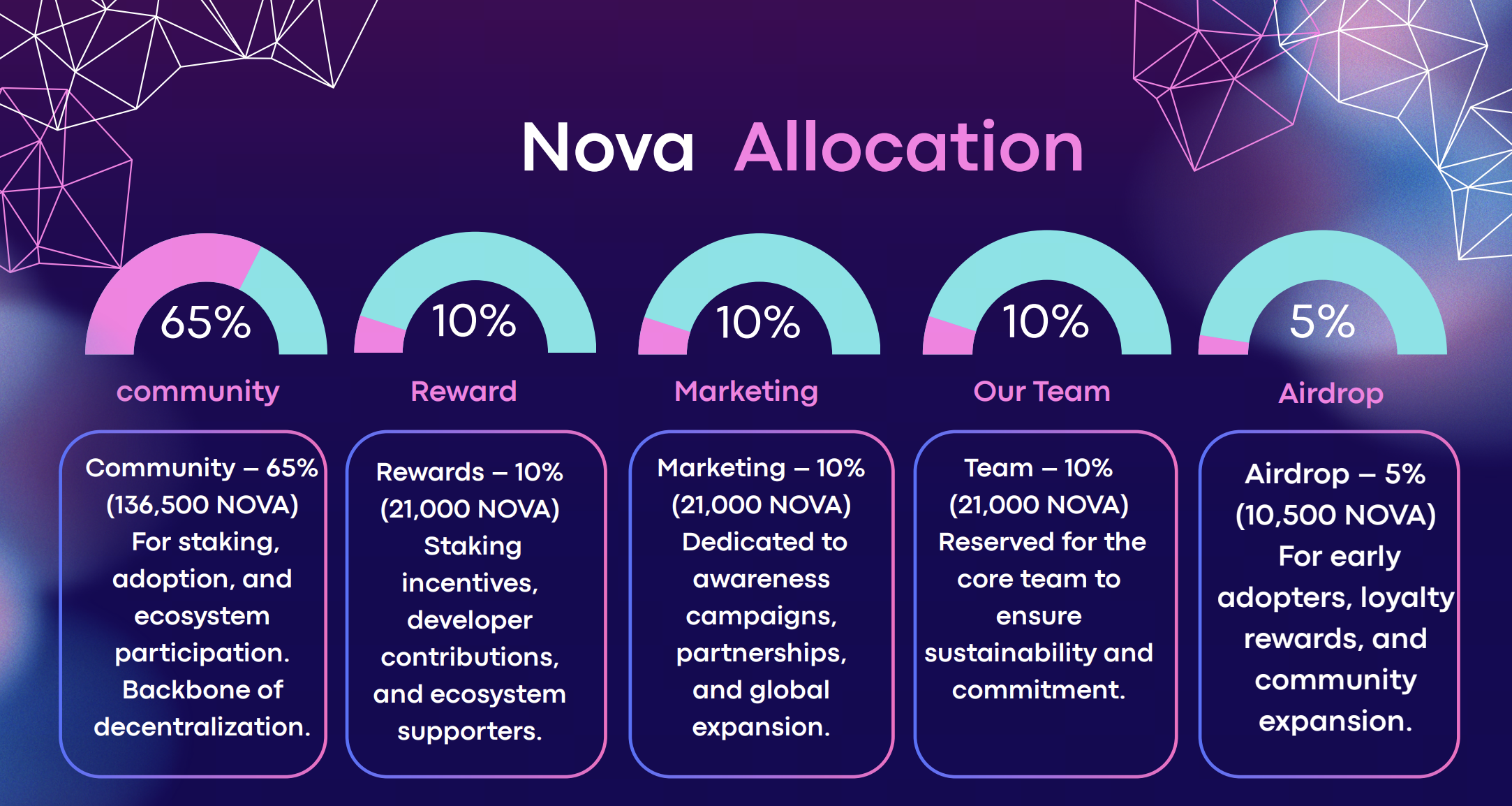
- NOVA has a total supply of 210,000 tokens. Community allocation accounts for 65%, while rewards, marketing, team allocation, and airdrops account for 10%, 10%, 10%, and 5%, respectively.
- AI analysis does not guarantee accurate predictions. Smart contracts also cannot automatically eliminate market volatility, data errors, or execution risks.
- Assessing NovaIn.ai's long-term development requires monitoring actual product delivery, the verifiability of its AI functions, demand for token utility, and on-chain liquidity.
What Is NovaIn.ai? What Problems Does the Project Aim to Solve?
NovaIn.ai is positioned as a project that combines artificial intelligence analysis with blockchain infrastructure to provide more automated tools for digital asset management and DeFi applications. The project uses BNB Smart Chain as its underlying network and issues the NOVA token through a BEP-20 smart contract. Its ecosystem plans cover more than token transfers and on-chain transactions. They also include AI-assisted market analysis, portfolio management, smart wallets, and automated financial services.
Traditional blockchain applications offer the advantage of executing clear rules through smart contracts and recording transactions on a public ledger. For example, decentralized exchange protocols can swap assets according to predefined mechanisms, while lending protocols can manage borrowing risks based on collateral ratios and liquidation conditions. However, smart contracts themselves cannot understand complex market conditions. For ordinary users, assessing market changes, identifying potential risks, and choosing the appropriate course of action still requires external information and analytical tools.
NovaIn.ai explores the use of AI to handle part of the information-processing work before on-chain operations. For example, an AI system can analyze historical prices, trading activity, and market changes to generate risk alerts or asset management recommendations. Users or automated programs can then decide whether to execute the relevant operations based on predefined conditions. This may reduce the amount of manual data processing required, but AI models can still make errors, and on-chain execution requires independent permission and security controls.
The project does not aim to build an independent Layer 1 blockchain. Instead, it seeks to explore the integration of AI and digital asset applications within the existing BNB Smart Chain ecosystem. Its actual value will depend on whether its AI tools can provide useful information and whether the related applications can generate sustained user demand.
Why Does NovaIn.ai Use BNB Smart Chain as Its Underlying Network?
NovaIn.ai uses BNB Smart Chain as the environment for token issuance and smart contract execution. BNB Smart Chain supports smart contracts compatible with the Ethereum Virtual Machine, allowing developers to use related tools to build digital asset applications and standardized token interfaces to facilitate interaction between wallets and DeFi protocols. For projects seeking to build an application ecosystem around AI analysis, wallets, and asset management, using existing blockchain infrastructure can reduce the complexity of developing an underlying consensus network from scratch.
BEP-20 is a common token standard on BNB Smart Chain. It defines basic interfaces such as token balance queries, transfers, and approvals. NOVA uses this standard, allowing it to interact at the technical level with wallets and applications that support the corresponding network and token standard. The contract address disclosed by the project is 0x2Fc1493bcc38DA9921Ac749899826289a146A1Fb. Users can view the relevant token records and transaction activity through a blockchain explorer.
However, technical compatibility does not mean that every DeFi protocol will automatically support NOVA, nor does it mean that the token has sufficient trading liquidity. The fact that a wallet can recognize a token only indicates that the token meets the relevant technical standard. Whether it can actually be traded, staked, or used in a specific application depends on protocol integrations, liquidity pools, contract permissions, and platform support.
From a system architecture perspective, BNB Smart Chain primarily handles asset records, transaction confirmation, and smart contract execution, while AI analysis is generally performed off-chain. Blockchain is suitable for verifying deterministic transaction rules, whereas complex model inference requires substantial computing resources and external data inputs. If NovaIn.ai is to connect AI with on-chain trading, it will need to establish reliable data transmission, permission management, and transaction execution mechanisms to ensure that model outputs do not directly result in unrestricted asset operations.
How Does NovaIn.ai Combine AI Analysis with DeFi Applications?
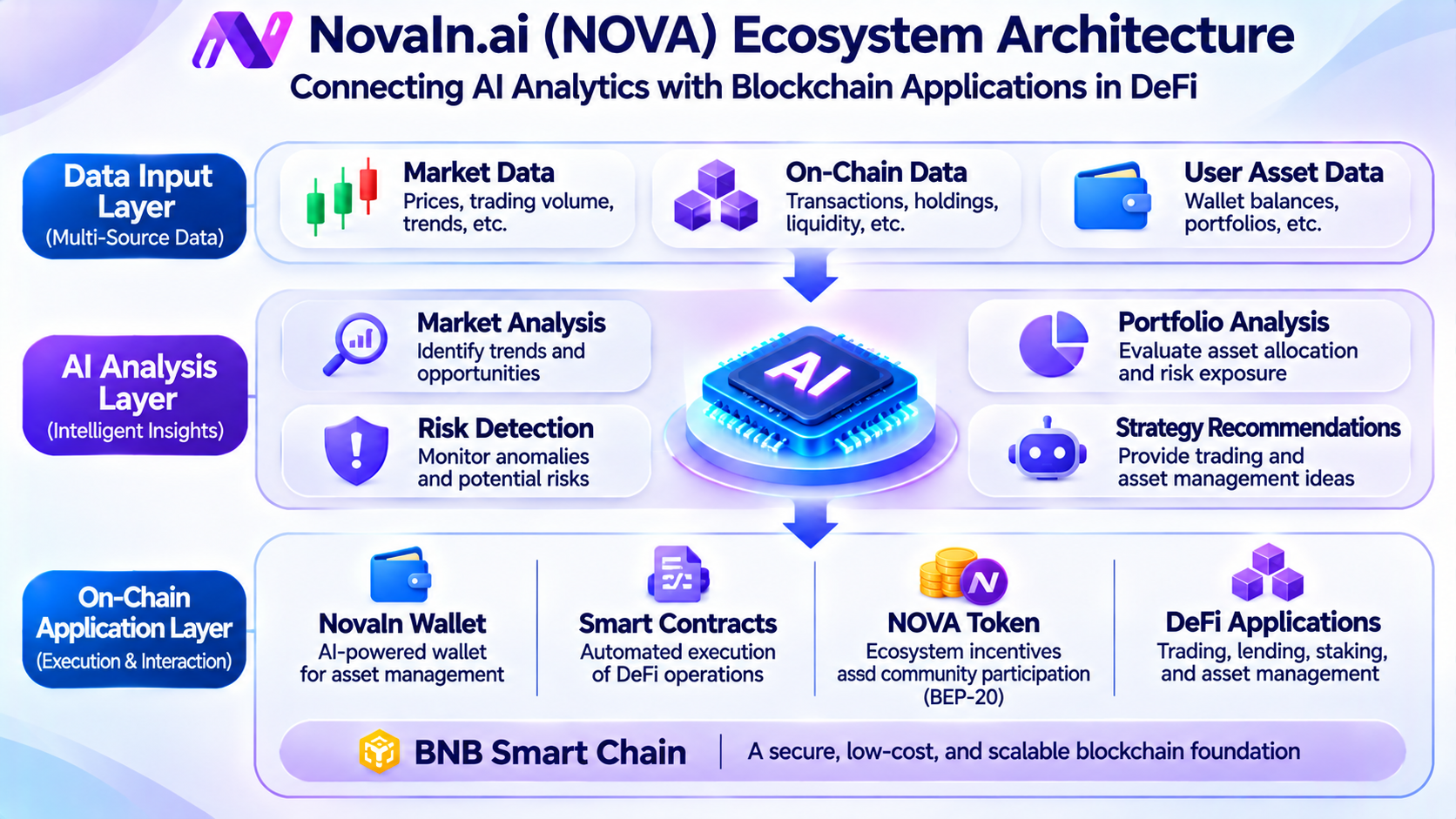
The integration of AI and DeFi primarily involves two areas: information analysis and automated execution. DeFi protocols can process assets according to smart contract rules, while AI systems can identify patterns in prices, trading volume, historical volatility, and other market data to help users understand market conditions. NovaIn.ai's technical plans include real-time market analysis, price change predictions, portfolio optimization, and risk assessment. The project aims to use AI tools to reduce the difficulty of processing complex financial information.
In market analysis scenarios, an AI system can collect price and trading data for different assets and identify short-term volatility, unusual transactions, or trend changes. For example, when a token's price volatility increases significantly, the analysis system can compare it with historical volatility levels and generate a risk alert. Users can use this information to reassess their positions instead of relying entirely on manual checks across multiple data platforms. However, correlations in historical data do not mean that future prices will necessarily move in the same direction. Model predictions may also be affected by data quality and changes in market structure.
In asset management scenarios, AI can assist in analyzing portfolio concentration, volatility, and correlations between assets. For example, when multiple tokens held by a user are highly dependent on the same market factor, the system can identify potential concentration risks and suggest adjustments. If the system is further connected to smart contracts, these recommendations could potentially be executed through automated rules authorized by the user. This would require clearly defined transaction limits, execution conditions, and emergency stop mechanisms.
NovaIn.ai's long-term plans also include AI-assisted governance, using algorithms to analyze community proposals, simulate potential outcomes, and provide decision support. These mechanisms may help participants process complex information, but AI should not be equated directly with community consensus. Governance outcomes must still be determined by the actual permission structure, voting mechanism, and smart contract rules. Model recommendations should also undergo independent review.
What Is NovaIn Wallet? What Functions Can an AI Wallet Provide?
NovaIn Wallet is a digital asset management tool included in the NovaIn.ai ecosystem plans. The project roadmap positions it as a wallet application for mobile and Web platforms and plans to add AI fraud detection, portfolio analysis, and personalized interaction features. Unlike traditional wallets, which primarily provide asset storage, transfers, and DApp connections, an AI wallet aims to add information analysis and risk alerts before transactions are executed, allowing users to understand changes in their wallet assets and potential risks more intuitively.
AI fraud detection is one potential application. Although on-chain transactions are publicly viewable, ordinary users often have difficulty directly understanding complex smart contract calls, approval permissions, and transaction paths. An AI system can combine contract behavior, address activity, and transaction patterns to identify anomalies, such as suspicious unlimited approvals, unusual asset transfers, or interactions with known high-risk addresses. However, this type of detection depends on rules, training data, and real-time information. It cannot guarantee the discovery of every malicious contract and may also incorrectly classify legitimate transactions as high-risk operations.
Portfolio analysis focuses on asset management. A wallet can aggregate users' asset balances, historical transactions, and price changes across supported networks and use analytical models to display asset distribution and concentration risks. For users holding multiple digital assets, this type of function can reduce the need to switch between different platforms. If automated asset adjustments are supported in the future, the system will also need to handle transaction approvals, slippage, Gas Fees, and failed execution.
It is important to note that NovaIn.ai's roadmap previously scheduled the launch of its wallet for January 2026, but a planned date does not prove that the product has officially launched. To assess the actual progress of NovaIn Wallet, users should look for an accessible product interface, a verifiable application version, a public security audit, and real on-chain interaction records. In the absence of such information, it is more appropriate to describe the wallet as an important product in the ecosystem plans rather than as a mature, operational AI wallet.
What Role Do Smart Contracts Play in the NovaIn.ai Ecosystem?
Smart contracts are an important technical foundation connecting digital assets with automated applications in the NovaIn.ai ecosystem. Some operations in traditional financial services are completed through centralized systems. Smart contracts, by contrast, can encode asset transfers, permission verification, and transaction execution conditions into software and run according to predefined rules when the conditions are met. In applications that combine AI and DeFi, smart contracts primarily execute clearly defined on-chain operations, while AI provides external analysis or operational recommendations.
For example, in an automated asset management scenario, an AI system can analyze market volatility and suggest adjustments. A smart contract can then execute the relevant operations according to the user's preconfigured permissions and trading conditions. The responsibilities of the two systems should remain distinct: AI processes complex information, while smart contracts verify and execute deterministic rules. If the model makes an incorrect judgment, a smart contract may still produce a transaction outcome that does not meet the user's expectations even when it executes the code correctly.
This mechanism involves connecting on-chain and off-chain systems. Most AI models need to run in off-chain computing environments, and market data may come from trading platforms, data providers, or other external sources. If a smart contract needs to use these results, it must receive the information through a reliable data interface or oracle mechanism. The accuracy of the data source, potential delays, and the possibility of result tampering can all affect the security of automated operations.
The NovaIn.ai white paper describes an AI workflow covering data collection, model design and training, evaluation and testing, deployment and integration, and ongoing monitoring. This provides a basic framework for understanding the project's technical direction. However, it does not fully disclose the specific model architecture, training data, on-chain calling interfaces, or complete execution permission design. Therefore, it can currently be confirmed that the project plans to combine AI analysis with smart contracts, but more technical information is needed to independently assess the effectiveness of the implementation.
What Is NOVA Used For? How Can Users Participate in the Ecosystem?
NOVA is the digital asset of the NovaIn.ai ecosystem and is issued using the BEP-20 standard on BNB Smart Chain. The project aims to use the token to support community participation, ecosystem incentives, and related digital asset applications. The white paper also proposes uses including staking rewards, developer contribution incentives, and community expansion. NOVA's role is primarily focused on participation and incentive mechanisms within the ecosystem rather than serving as the native Gas token of an independent blockchain.
For community incentives, the project plans to use token rewards to encourage users to participate in ecosystem activities, use related tools, or support community development. For early-stage Web3 projects, these mechanisms can help establish an initial user base. However, whether token rewards can generate sustained demand depends on whether the product itself provides lasting value. If users participate mainly to obtain rewards, user activity may decline when the rewards are reduced.
For staking and ecosystem participation, the white paper allocates a portion of the tokens to staking and ecosystem development. However, a token allocation plan and an operational staking protocol are two different concepts. Specific staking yields, lock-up periods, reward sources, and exit mechanisms must be determined based on the actually deployed contracts and product rules. The mere mention of staking in a white paper does not mean that holding NOVA will generate fixed returns.
For governance applications, NovaIn.ai has proposed AI-assisted community decision-making, but AI governance analysis must be distinguished from token voting rights. Whether tokens can be used for proposals, voting, or governance authorization depends on the actual governance contracts and rules. Existing information is insufficient to confirm that NOVA holders already have complete on-chain governance rights. Future governance functions should therefore not be described as established token rights.
How Is the NOVA Tokenomics Model Designed?
NOVA's tokenomics model focuses primarily on community allocation, ecosystem rewards, marketing, the team, and airdrops. According to the project white paper, NOVA has a total supply of 210,000 tokens. Of this amount, 65% is allocated to the community, while the remaining 35% is allocated to rewards, marketing, the team, and airdrops. The relatively high community allocation reflects the project's intention to expand its user base through ecosystem participation, but the allocation ratio itself does not prove that the token is sufficiently decentralized.
The token distribution structure needs to be analyzed together with actual circulation. A high community allocation does not mean that all community tokens have already been distributed to independent holders. If a large amount of tokens remains controlled by a small number of addresses, the market supply and actual holder structure may differ from the nominal allocation ratios. Investors also need to understand whether the tokens are subject to lockups, phased releases, staking reward distributions, or team unlock schedules.
The existing white paper lists the token amounts and planned uses for each category, but does not fully explain the detailed unlock schedules, on-chain distribution records, or long-term emission mechanisms for all categories. Therefore, current actual circulating supply cannot be calculated based solely on the total supply, and the entire community allocation should not be treated as tradable supply that has already entered the market.
In addition, a low total token supply does not mean that the token price will necessarily be high. Token value still depends on actual demand, liquidity, holder structure, and market expectations. For NOVA, users should pay particular attention to whether the ecosystem products create real use cases and whether the token serves an irreplaceable function in those products.
What Are the Important Development Stages in NovaIn.ai's Roadmap?
NovaIn.ai's roadmap expands from infrastructure development to AI wallets, financial analysis, smart governance, and automated payments. The plans for 2025 primarily focus on the official website, white paper, BEP-20 smart contract deployment, and token issuance. The plans for 2026 focus on NovaIn Wallet, AI analysis tools, ecosystem partnerships, and automated financial services, with further expansion of AI and smart contract integration planned for later stages.
From a technical development perspective, the roadmap can be divided into three stages. The first stage is establishing digital asset infrastructure so that NOVA can be issued, transferred, and queried on BNB Smart Chain. The second stage is developing user-facing AI tools, such as market analysis, risk identification, and wallet asset management. The third stage attempts to connect AI analysis with automated execution, expanding the ecosystem from information services to actual financial operations.
The project also proposes gradually integrating AI functions into smart contract-related applications in December 2026 and exploring automated payment systems compatible with the Internet of Things (IoT). Plans for 2027 include AI identity verification and expansion into Asian, European, and American markets. These areas involve more complex data security, identity management, and cross-system interaction issues. Actual implementation will require the necessary technical foundation and partnership resources.
However, the timing in a roadmap represents a project plan rather than proof of completed delivery. AI automated trading, financial analysis, and identity verification functions in particular often require model testing, security reviews, and validation in real-world scenarios. When evaluating NovaIn.ai's progress, users should focus on whether products are available for use, whether code and contracts can be verified, and whether actual functions correspond to previously disclosed objectives, rather than judging the project's maturity solely by roadmap dates.
How Does NovaIn.ai's Technical Approach Differ from That of General AI Crypto Projects?
The integration of AI and crypto assets can take multiple forms. Some projects focus on decentralized computing markets, using tokens to incentivize GPU providers and users of computing tasks. Others build AI agent infrastructure that provides autonomous agents with identity, payment, and on-chain interaction capabilities. Still others primarily provide market data analysis, trading assistance, or asset management tools. NovaIn.ai's plans are closer to the third category, while also seeking to extend these functions to smart wallets and DeFi automation.
This positioning means that the project's core competitiveness may not come from underlying blockchain performance. It may instead depend on the actual effectiveness of its AI analysis tools, user experience, and on-chain execution security. BNB Smart Chain already provides a basic transaction and smart contract environment. NovaIn.ai needs to demonstrate that its applications can solve specific problems on this foundation. For example, it needs to show whether its AI risk alerts are more effective than ordinary rule engines, whether portfolio analysis can provide valuable information, and whether automated operations have clear permission controls.
From a product structure perspective, NovaIn.ai can be understood as an ecosystem plan built around AI analysis, wallet interaction, and digital asset applications, rather than as an AI computing network with a complete independent infrastructure. Its white paper focuses on application objectives, AI workflows, and token allocation, while providing relatively limited information about model performance, data sources, system throughput, and actual user numbers. This means the project is currently more appropriately evaluated from the perspectives of product delivery and application validation than directly compared with mature AI infrastructure projects on performance.
In the long term, combining AI with DeFi requires more than determining whether a model can generate trading recommendations. It also requires addressing data reliability, user authorization, transaction costs, failed execution, and asset security. Only when AI analysis can consistently serve real needs and interact through verifiable on-chain mechanisms is the technical design more likely to generate sustained ecosystem value.
What Risks Should Users Consider When Participating in the NovaIn.ai Ecosystem?
NovaIn.ai involves crypto assets, smart contracts, and AI analysis. Its risks therefore come not only from token price volatility but also from uncertainty surrounding product development, technical security, and actual application demand. For projects that are still expanding their product functions, whether the roadmap can be completed as planned is an important factor in assessing long-term development prospects. Even if a token contract has already been deployed, this does not indicate that the project's AI products, wallet, or automated financial services have mature commercial capabilities.
AI analysis risk is a key concern. Financial markets are highly dynamic and uncertain. A model may perform well on historical data but fail to adapt to new market conditions. If users rely too heavily on model-generated price predictions or trading recommendations, they may underestimate the impact of liquidity changes, unexpected events, and extreme market conditions. For automated asset management tools, an incorrect model judgment may also be rapidly converted into an actual loss through on-chain transactions.
Smart contract and wallet security also require attention. On-chain contracts may contain code vulnerabilities, improper permission configurations, or external data dependencies. If an AI tool needs to read wallet information or call transaction permissions, it must clearly define which operations can be executed automatically, which require user confirmation, and whether transaction limits and emergency stop mechanisms are in place. The fact that blockchain transactions are publicly viewable does not mean that the application itself is free of security risks.
Token liquidity is another factor that should not be overlooked when evaluating NOVA. Low actual trading volume may result in wider bid-ask spreads, and some transactions may have a significant impact on the market price. A token's nominal supply, historical quotes, and number of holders cannot independently prove that the market has sufficient depth. Before conducting any on-chain interaction, users should verify the contract address, trading pool, and actual trading conditions to avoid confusing assets with similar names but different contracts.
For NovaIn.ai, more meaningful indicators for future evaluation include the actual delivery of its wallet and AI tools, active users, the number of on-chain interactions, publicly available code, security audits, and the real use of the ecosystem token. These data points can help distinguish development plans from established product capabilities and assess whether the combination of AI and DeFi is generating sustained demand.
Conclusion
NovaIn.ai (NOVA) is an AI and blockchain integration project built on BNB Smart Chain. It plans to develop an application ecosystem around smart contracts, AI market analysis, digital asset management, and community participation. The project uses the BEP-20 token standard and seeks to connect on-chain transaction execution with off-chain AI data analysis to provide users with more automated financial information and asset management tools.
In terms of technical architecture, NovaIn.ai uses an existing blockchain network to process asset records and smart contract interactions. It plans to expand its user applications through NovaIn Wallet, AI risk identification, and portfolio analysis. The NOVA token is intended to support ecosystem incentives and community participation. It has a total supply of 210,000 tokens, with 65% allocated to the community. The roadmap also covers AI-assisted governance, automated payments, and identity verification, but the actual delivery of these functions still requires ongoing verification.
For users seeking to understand NovaIn.ai, the most important point is to distinguish between existing token infrastructure and future AI products. The combination of AI and DeFi has multiple potential use cases, but its actual value depends on whether the products can operate reliably, whether the analysis results are useful, and whether on-chain operations have dependable security controls. NOVA's long-term ecosystem demand also needs to be assessed through actual user activity and product usage.
FAQ
What Is NovaIn.ai (NOVA)?
NovaIn.ai is an AI and blockchain integration project built on BNB Smart Chain. It plans to provide DeFi-related application services through AI market analysis, smart contracts, and digital asset management tools.
Which Blockchain Does the NOVA Token Run On?
NOVA uses the BEP-20 standard on BNB Smart Chain. The contract address disclosed by the project is 0x2Fc1493bcc38DA9921Ac749899826289a146A1Fb.
What Is the Total Supply of NOVA?
According to the project white paper, NOVA has a total supply of 210,000 tokens. The community receives 65%, while rewards, marketing, and the team each receive 10%, and airdrops receive 5%.
How Does NovaIn.ai Use Artificial Intelligence?
The project plans to use AI to analyze market data, identify risks, assist with portfolio management, and explore integration with automated smart contract execution mechanisms.
Has NovaIn Wallet Launched?
NovaIn Wallet is included in the project's 2026 roadmap. However, the available materials are insufficient to independently confirm its official launch status and complete functions. These details still need to be verified through an actual product interface and verifiable technical information.
Can NOVA Be Staked?
The white paper lists staking as one of the planned uses for the token. However, the specific staking product, reward mechanism, and contract status still require verification. Planned staking rewards should not be treated as guaranteed returns.
Is NovaIn.ai an Independent Layer 1 Blockchain?
No. The project's disclosed infrastructure is built on BNB Smart Chain, and NOVA is a BEP-20 token on that network.
Can AI Analysis Guarantee Profits from Digital Asset Trading?
No. AI models may be affected by data quality, market volatility, and prediction errors. Even when combined with automated smart contracts, they cannot eliminate trading losses or technical risks.