As DeFi applications expand into lending, liquidity management, and cross-chain asset allocation, users must process increasingly complex information. Asset prices, market depth, collateral ratios, smart contract permissions, and network fees can all affect the final outcome of an operation. Traditional smart contracts are effective at executing deterministic rules but struggle to independently understand constantly changing market conditions. AI models can extract patterns from large volumes of data, but their judgments may contain errors and cannot directly replace on-chain security mechanisms.
NovaIn.ai is positioned between these two areas: using AI to improve the efficiency of information processing and risk identification while relying on blockchain for asset recording and transaction execution. However, it is important to distinguish the features outlined in the project plans from products that have already been deployed. This article analyzes how NovaIn.ai plans to design the connection between AI and DeFi, examines the relationship between market analysis, risk identification, smart wallets, and automated asset management, and evaluates the technical and security challenges this model faces in practical applications.
Key Takeaways
-
NovaIn.ai plans to combine AI market analysis, portfolio management, risk identification, and DeFi smart contracts to build an application framework spanning information processing and on-chain interaction.
-
AI is primarily responsible for data analysis, pattern recognition, and decision support, while smart contracts handle permission verification, asset transfers, and the execution of transaction rules.
-
Market analysis requires multiple types of data, including prices, trading volume, and on-chain liquidity, but AI predictions cannot guarantee future returns.
-
NovaIn Wallet is an important planned interaction gateway. It is intended to integrate wallet-based asset management with AI-powered risk alerts.
-
The key to automated asset management is not to eliminate human involvement entirely, but to establish verifiable and restricted execution rules within the scope of user authorization.
-
The NOVA token is planned for ecosystem incentives and community participation. Its actual demand will depend on product implementation.
-
When evaluating AI DeFi projects, users should focus on data quality, model verifiability, smart contract security, and genuine user demand.
Why Does DeFi Need AI-Powered Analysis?
The core feature of DeFi is the provision of open financial services through smart contracts. Users can interact directly with protocols to swap assets, borrow, stake, or provide liquidity. Smart contracts can execute rules according to predefined conditions, but they generally do not actively analyze market conditions. For example, a lending protocol can determine whether a position has reached its liquidation threshold based on its collateral ratio, but it may not be able to explain in advance the combined risks associated with market volatility, declining liquidity, or changing asset correlations.
As the number of DeFi products continues to grow, users face increasingly complex decisions. An asset swap involves more than price and may also be affected by liquidity depth, slippage, Gas Fee, and the transaction route. When participating in lending, users need to consider collateral prices, borrowing rates, and liquidation thresholds. When managing liquidity, they also need to understand impermanent loss, trading fees, and market volatility. Relevant data is distributed across different protocols and blockchain networks, making it difficult for ordinary users to conduct a complete and continuous analysis.
AI can potentially convert this fragmented data into information that is easier to understand. For example, a model can continuously monitor asset prices and on-chain trading activity, identify abnormal volatility, analyze risk correlations between different assets, and generate alerts based on predefined conditions. For users managing multiple DeFi positions, automated analysis can reduce the need to repeatedly review data and gradually shift risk management from passive checking to continuous monitoring.
However, AI analysis cannot eliminate DeFi's inherent risks. Models may rely on outdated data or fail to identify new forms of market manipulation. Even when a risk alert is accurate, an on-chain transaction may still fail to execute as expected because of congestion, slippage, or insufficient liquidity. Therefore, AI is better suited to serve as an auxiliary analysis layer for DeFi rather than an independent decision-maker that replaces smart contract rules and user judgment.
How Does NovaIn.ai's AI and DeFi Architecture Work?
NovaIn.ai's ecosystem plans can be understood across three layers: data input, AI analysis, and on-chain applications. The data input layer collects market prices, trading activity, and user asset information. The AI analysis layer processes the data and generates market insights, risk alerts, and asset management recommendations. The on-chain application layer uses wallets and smart contracts to facilitate asset interactions. This layered design conceptually distinguishes information analysis from transaction execution and avoids treating complex AI models as equivalent to blockchain consensus mechanisms.
The data input layer may include market information such as asset prices, trading volume, and price volatility. On-chain data may include address transactions, token balances, liquidity changes, and contract interaction records. The update frequency, reliability, and completeness of different data sources vary. If an AI model relies on a single price source, it may be affected by abnormal quotes. If on-chain data is not updated promptly, it may fail to reflect the latest asset status. Data quality is therefore the foundation of the entire analysis process.
The AI analysis layer is primarily responsible for information processing and feature recognition. The project's white paper describes processes including data collection, model training, evaluation and testing, deployment and integration, and ongoing monitoring. However, it does not fully disclose the specific model architecture, training data, or actual performance metrics. At this stage, this should be understood as a technical framework the project plans to establish, rather than evidence that all analysis modules already have mature production capabilities.
The on-chain application layer is built on BNB Smart Chain and involves the NOVA token, smart contracts, and the planned NovaIn Wallet. AI analysis results may serve as a reference for user decisions and could potentially participate in automated operations through authorized interfaces in the future. However, blockchain does not automatically verify whether an AI judgment is correct. Smart contracts can only execute according to the data they receive and their predefined rules. Therefore, how model outputs are transmitted, how transaction permissions are restricted, and how abnormal situations are handled will determine whether this architecture can operate safely.
How Does NovaIn.ai Use AI to Identify Market Trends and Trading Risks?
Market analysis is one of the core applications planned for NovaIn.ai. The project aims to use AI to process prices, trading volume, and other financial data to provide users with market trend assessments and risk alerts. Unlike tools that merely display historical market data, an AI analysis system aims to identify potential changes by examining relationships between data points, such as unusual trading activity, increased price volatility, or risk correlations between different assets.
In practice, market analysis typically involves data collection, feature processing, and model output. Prices and trading volume can be used to measure market changes, while on-chain trading activity can provide information about fund flows and address behavior. If an asset experiences a short-term increase in trading volume, sharp price volatility, and declining liquidity, an analysis system can combine these changes into a risk signal and help users determine whether to review their positions. However, such a signal only indicates that market conditions have changed. It does not directly prove that the price is about to rise or fall.
NovaIn.ai's roadmap lists real-time market analysis and trend forecasting as important functions of its AI financial tools and plans to support personalized asset management in the future. This type of design may help users understand the market from multiple perspectives, but its effectiveness must be validated through actual products. Continuous testing is needed to determine whether the model can process new data promptly, whether it suffers from overfitting, and how its false-positive rate varies across different market conditions.
On-chain markets also face data manipulation risks. The price and trading volume of low-liquidity tokens may be influenced by a small number of traders, and activity from certain on-chain addresses may lack clear economic significance. If a model fails to identify these issues, it may mistake abnormal data for a valid trend. Therefore, the value of AI market analysis depends not only on model complexity but also on data sources, anomaly detection, and the ability to explain results.
How Can AI Help Users Manage DeFi Portfolios?
Portfolio management is another important area where AI and DeFi can intersect. Users may hold stablecoins, major crypto assets, and positions across different DeFi protocols at the same time. These assets have different levels of volatility, liquidity, and risk exposure. Traditional wallets generally focus on displaying balances and transaction records, while AI-powered asset management tools can further analyze asset allocation, risk concentration, and the potential impact of market changes on the overall portfolio.
For example, a user may hold several assets that are highly correlated with the price of ETH. The portfolio may appear diversified, but its actual risk may still be concentrated in the Ethereum ecosystem. An AI analysis system can identify this concentration through historical price relationships, on-chain positions, and asset types, then alert the user to potential correlation risk. If the user also participates in lending protocols, the system can incorporate collateral ratios, borrowing amounts, and market volatility into its analysis to help assess how price changes may affect the safety of the position.
NovaIn.ai plans to include predictive portfolio analysis in NovaIn Wallet and explore automated portfolio optimization through subsequent financial tools. The intended design is to enable users not only to view asset balances but also to receive more contextual information, such as which assets contribute most to portfolio volatility, which positions require continuous monitoring, and how different allocations may change the portfolio's risk profile.
However, there is no single portfolio optimization outcome that applies to every user. Investment horizons, risk tolerance, and liquidity needs vary, and model-generated adjustment recommendations may also involve trading costs, taxes, and market impact. If the system goes on to execute automated rebalancing, it must also account for slippage, network fees, and smart contract permissions. Automated tools can reduce some of the operational burden, but they cannot guarantee that a portfolio will always be in an optimal state.
How Does NovaIn Wallet Connect AI Analysis with On-Chain Asset Management?
NovaIn Wallet is a planned user interaction gateway for NovaIn.ai. The project plans to combine mobile and Web wallets with AI-powered fraud detection, portfolio analysis, and personalized features. Within this system, the wallet would do more than store asset information and initiate transactions. It could also serve as the interface connecting AI analysis results with actual on-chain operations.
In a typical wallet interaction, users must generally understand transaction requests themselves, including the recipient, contract address, approval amount, and network fee. For complex DeFi operations, the raw data displayed in the transaction interface may be difficult to understand directly. An AI-assisted wallet could attempt to categorize and explain this information, such as by identifying high-risk approvals, flagging unusual contract interactions, or helping users understand which asset balances a transaction may change.
If a user is preparing to interact with a DeFi protocol, the wallet could analyze the contracts, tokens, and permissions involved before signing and convert potential risks into easier-to-understand alerts. This type of assistance may be useful for transactions involving unlimited approvals or complex contract calls. However, a model cannot guarantee that it will identify every malicious transaction and may produce incorrect judgments because it lacks complete context.
NovaIn.ai's roadmap schedules the launch of NovaIn Wallet for January 2026. However, the public roadmap alone is not sufficient to independently prove that the product launched as planned or includes all of the described features. Assessing its actual progress requires further verification of whether the wallet has an accessible application interface, public version records, security audits, and real user interaction data. For functions involving private keys, seed phrases, and transaction signing in particular, the ownership and boundaries of asset control must be clearly defined. AI risk alerts alone cannot serve as a security guarantee.
How Are AI Analysis Results Converted into Smart Contract Operations?
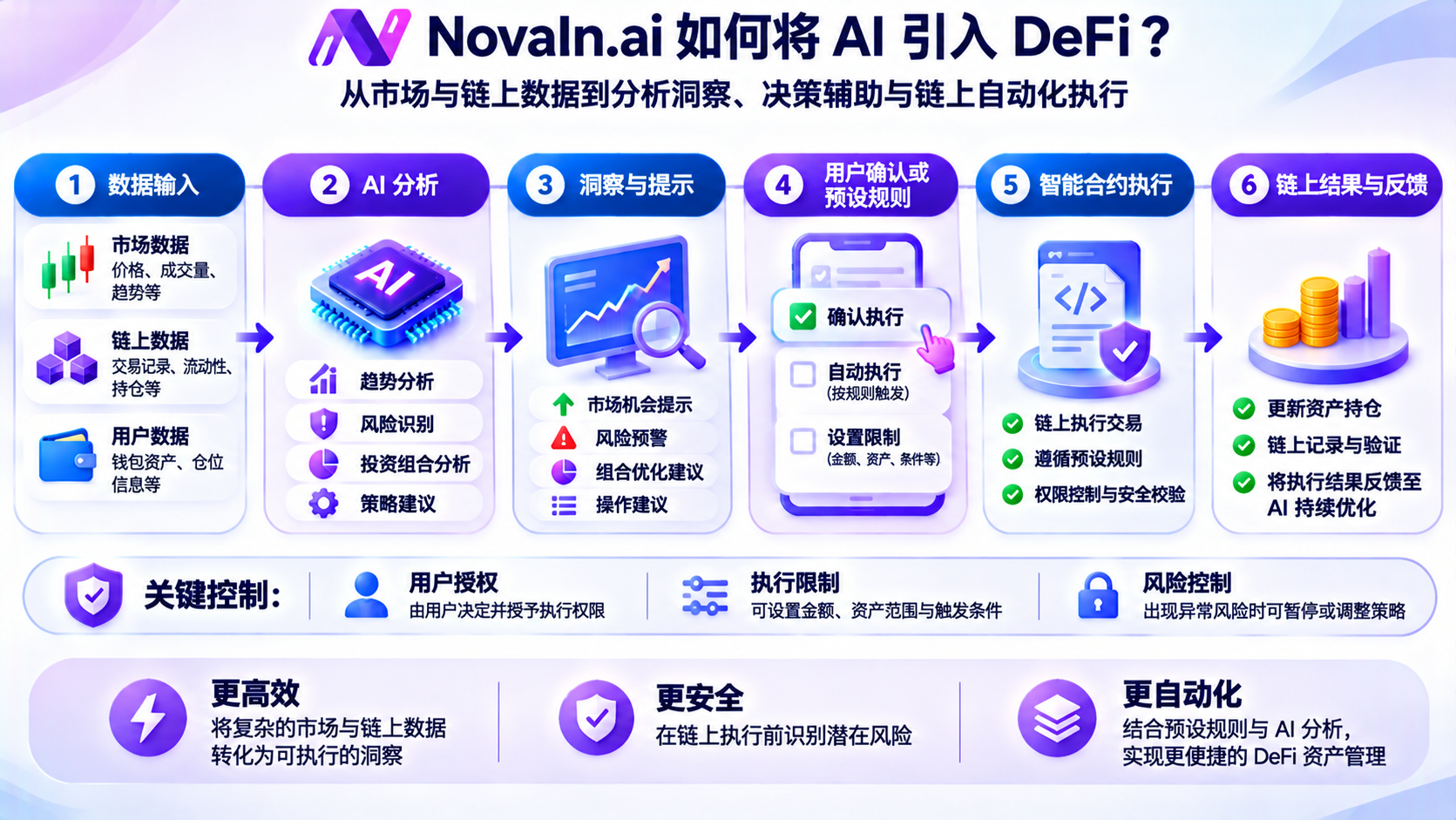
One of the key technical challenges of introducing AI into DeFi is converting off-chain analysis results into verifiable on-chain operations. AI models generally run in off-chain computing environments, where they can process large amounts of market data and generate judgments. Smart contracts run on blockchains and execute operations according to explicit code and transaction conditions. The two require data transmission and permission controls to establish a complete automated process.
One possible design is for the AI system to generate an analysis recommendation and then ask the user to confirm whether to execute it. For example, if the model identifies an increased risk level in a lending position, the wallet could send an alert. After reviewing it, the user could decide whether to add collateral or reduce the borrowing amount. This approach retains a manual confirmation step and can reduce the risk of an incorrect model judgment directly triggering an asset transaction.
Another design is for users to set automated conditions in advance, allowing the system to perform operations within limited parameters. For example, a user could authorize a contract to execute a predefined transaction when the collateral ratio reaches a specified threshold while also limiting the amount per transaction, the contracts that may be accessed, and the types of assets involved. AI can participate in risk analysis, but the actual transaction must still satisfy the restrictions defined in the smart contract. Without clear permission boundaries, model errors, abnormal data, or attacks on external interfaces could trigger unintended asset transfers.
NovaIn.ai plans to gradually integrate AI features into smart contract-related applications in December 2026. However, the available public information is not sufficient to confirm the specific model-calling interfaces, oracle design, or automated transaction permission structure. Accordingly, the process described above should be understood as a general technical implementation approach for integrating AI with DeFi, not as a verified operating process for a NovaIn.ai product.
Can AI Risk Identification Improve DeFi Transaction Security?
DeFi security risks do not come only from smart contract vulnerabilities. They also include malicious approvals, phishing websites, fraudulent tokens, price manipulation, and user errors. Because on-chain transactions are generally irreversible, users may find it difficult to recover their assets after signing a malicious transaction. The potential value of AI risk identification is to analyze more information before execution and convert complex risks into alerts that users can understand.
For example, a contract may request a token approval amount far greater than what the transaction actually requires. An AI system can combine the contract's historical activity, permission scope, and transaction context to flag the operation for additional confirmation. For addresses with unusual fund flows, a model can also use on-chain behavior patterns to help identify potential risks. However, a high approval amount does not necessarily mean that a contract is malicious, and frequent address activity does not necessarily indicate fraud. Risk identification must therefore account for the specific context.
AI risk detection also faces adversarial challenges. Malicious actors may deliberately construct transactions that bypass detection rules or exploit a model's reliance on certain data patterns to produce incorrect judgments. Historical training data may not include samples of newly emerging attacks. If a model relies too heavily on existing risk labels, it may fail to identify new exploit paths in time.
AI risk identification is therefore better suited as one component of a multilayer security system. Smart contract audits, transaction simulation, permission restrictions, hardware wallets, and user confirmation mechanisms remain important. If NovaIn.ai wants to develop AI fraud detection into a mature product, it must demonstrate that the system can identify risks consistently in real on-chain environments while controlling false positives and false negatives. Simply claiming to use AI is not enough to prove that a wallet or DeFi operation provides stronger security.
How Does the NOVA Token Participate in the AI and DeFi Ecosystem?
NOVA is a BEP-20 token issued by NovaIn.ai on BNB Smart Chain. The project plans to use it for ecosystem incentives, community participation, and related application scenarios. Through its token mechanism, the project aims to encourage users to use its products, participate in community activities, and support ecosystem development. Within an AI and DeFi framework, the token may serve an incentivizing and coordinating function, but its actual demand must be supported by specific product features.
For example, the project could use token rewards to encourage developers to build tools or support users participating in community activities. For projects that need to expand their application ecosystems, such incentive mechanisms may reduce the initial barrier to user participation. However, token rewards alone do not mean that a product has established stable demand. If users participate primarily to receive rewards, activity may decline when rewards are reduced.
NovaIn.ai also plans to explore staking rewards and AI-assisted community governance. Whether a staking mechanism can generate sustainable returns depends on the source of rewards, token issuance, and actual protocol rules. Whether community governance has binding authority depends on proposal permissions, voting methods, and contract execution mechanisms. AI can help analyze governance proposals, but it cannot automatically grant token holders decision-making authority.
From a long-term value perspective, NOVA must demonstrate that it has a clear use within the ecosystem. If AI analysis, wallet, and automated asset management features can continue to attract users, the project may further explore token-related services and incentive mechanisms. However, in the absence of actual rules, it should not be assumed that all product revenue will flow back to NOVA or that token holders will necessarily share in the project's commercial returns. The tokenomics model must be evaluated together with genuine product demand.
What Technical Challenges Does NovaIn.ai's AI DeFi Application Still Face?
The integration of AI and DeFi involves multiple independent systems. A problem at any point in the process could affect the final user experience.
-
Data quality. AI analysis depends on accurate, timely, and representative information. Crypto market data comes from complex sources, some assets have low trading volume, and on-chain trading activity may be affected by bots and market manipulation. If the input data is biased, the model may generate judgments that appear reasonable but lack a sound basis.
-
Model verifiability. Smart contract execution results on a blockchain can be reviewed through transaction records, but the reasoning process of an off-chain AI model is generally difficult to verify directly. Users may see a risk score or investment recommendation generated by a model without being able to assess its training data, parameter settings, or actual predictive capabilities. For applications involving asset management, projects need to consider how to disclose model performance, record analysis results, and establish error-handling procedures and responsibility boundaries.
-
Automated execution security. There is a clear distinction between an AI-generated recommendation and actual control over a user's assets. If the system can automatically call smart contracts, it must restrict the authorization scope, transaction amounts, execution frequency, and contract addresses it can access. It must also establish suspension or manual takeover mechanisms for abnormal market conditions, data interruptions, and incorrect model outputs. The higher the degree of automation, the greater the usual requirements for permission management and security controls.
-
Product demand and commercial sustainability. The market already offers various market analysis, wallet security, and DeFi management tools. AI features are more likely to generate sustained demand only when they improve analysis efficiency, enhance risk identification, or reduce actual operating costs. NovaIn.ai's long-term development cannot rely solely on the conceptual combination of AI and DeFi. It must also demonstrate its value through product delivery, user feedback, and actual usage data.
How Can You Determine Whether NovaIn.ai's AI DeFi Ecosystem Has Truly Been Implemented?
Evaluating NovaIn.ai's actual progress requires distinguishing between three stages: technical planning, product launch, and real usage. Technical planning describes the functions the project hopes to implement. Product launch means that users can access the relevant tools. Real usage requires further observation of user numbers, on-chain activity, and sustained demand. These stages differ significantly, and a mature AI DeFi ecosystem cannot be inferred solely from a white paper or roadmap.
-
Pay attention to the availability of NovaIn Wallet and AI analysis tools. Whether users can access the products through public interfaces, and whether clear feature descriptions, version updates, and security information are available, are basic indicators of delivery. If the project claims to support AI risk identification or portfolio analysis, users should also examine whether these features can process real on-chain data and provide interpretable analysis results.
-
On-chain applications and token usage. NOVA transaction records, holder distribution, and related smart contract interactions can provide some verifiable information. However, active token transfers do not mean that an AI product is widely used. More meaningful indicators include the number of active application contracts, user interaction frequency, feature calls, and long-term retention. For automated financial tools, users should also examine whether execution rules and security audits are publicly available.
-
Ongoing disclosure of technical progress. NovaIn.ai's roadmap covers multiple areas, including an AI wallet, financial analysis, smart governance, and automated payments. Its development scope is broad. Continued public disclosure of product updates, code changes, security testing, and real-world application cases can help external users determine which functions have been completed and which remain under development.
For AI DeFi projects, true competitiveness does not come from adding more AI features to a product description. It comes from connecting data analysis, risk controls, and on-chain execution into a stable, transparent service that addresses genuine demand. Whether NovaIn.ai can achieve this goal will require continued validation through subsequent products and on-chain activity.
Conclusion
NovaIn.ai's exploration of AI and DeFi integration primarily focuses on market data analysis, risk identification, portfolio management, and smart contract automation. Its basic technical logic is to use AI to process complex market and on-chain information, then connect the analysis results to digital asset applications through wallets and smart contracts. AI is responsible for decision support, while blockchain handles asset recording and rule execution. The two have different technical roles.
Under the project plans, NovaIn Wallet is an important gateway connecting users with AI analysis tools, while the NOVA token is designed for ecosystem incentives and community participation. As automated financial tools develop, AI may help users identify risks and manage assets more efficiently. However, model errors, data quality, contract vulnerabilities, and transaction permissions still require independent controls.
For NovaIn.ai, the most important question is not how many functions AI and DeFi can theoretically provide, but whether the project can turn its planned wallet, market analysis, and automation tools into verifiable products. Only when these applications consistently solve user problems and generate genuine on-chain demand is the combination of AI and DeFi more likely to create long-term ecosystem value.