infiniFi is an on-chain fractional-reserve yield protocol that accepts stablecoins such as USDC, issues iUSD receipts, and allocates reserves across DeFi and real-world asset credit strategies. Its senior/junior capital structure gives liquid depositors different access and return terms from users who lock capital for longer durations. The comparison with Aave and Morpho separates this model from direct lending protocols, while the Gate spot trading guide covers INFI order placement and market checks.
Key Takeaways
-
infiniFi applies fractional-reserve and duration-matching logic to on-chain stablecoin yield rather than treating all deposits as one undifferentiated liquidity pool.
-
iUSD is the receipt token for USDC deposits; siUSD is the staked, liquid return token; liUSD represents locked positions with differentiated return terms.
-
Official dashboard data reports $9.75M in cumulative yield, a 6.63% seven-day average APY for siUSD, and 10.29% over 13 weeks for liUSD.
-
DefiLlama lists infiniFi with $73.9M TVL, ranking seventh in the Yield category, with $429K in 30-day fees and $22.7K in 30-day revenue.
-
INFI launched on November 17, 2026 on Ethereum Mainnet and Base, with 600,000 tokens allocated for eligible token lockers in the first year.
What Is infiniFi?
infiniFi is a decentralized finance protocol for stablecoin yield. Instead of routing every deposit into a single lending pool, it applies fractional-reserve banking concepts to on-chain capital management: a portion of funds remains available for redemptions, while longer-duration reserves support higher-yield DeFi and RWA credit strategies.

The protocol’s public materials describe a senior/junior structure. Senior or liquid capital prioritizes access and smoother returns, while junior or locked capital accepts duration and first-loss exposure in exchange for differentiated returns. This separation lets infiniFi seek a wider opportunity set than a single fixed lending pool while preserving a clearer liquidity hierarchy.
infiniFi raised more than $6M, including a $3.1M seed round led by Electric Capital. Fasanara, New Form, and Generative Ventures also participated. The protocol has also introduced infiniFi Prime to serve institutions, funds, and fintech platforms that need scalable access to on-chain yield infrastructure.
How Does infiniFi’s Fractional-Reserve Architecture Work?
infiniFi’s architecture starts with a USDC gateway. A user deposits USDC and receives iUSD, a receipt token representing a claim on underlying strategy exposure. The deposit does not sit idle: capital is routed to registered farms and strategy modules selected through the protocol’s allocation process.
The reserve layer keeps a liquid buffer so that current withdrawals can be served quickly. Other reserves are allocated to longer-duration strategies that pay higher expected returns. That is the duration-matching component: liquid demand and locked demand are matched with different maturities and liquidity terms.
The senior/junior layer further organizes risk. Liquid siUSD holders receive lower, steadier return exposure, while locked liUSD holders receive access to returns associated with less-liquid strategies and can participate in governance actions. When strategy losses occur, loss-cascading mechanics define how those losses are absorbed within the capital structure.
What Are iUSD, siUSD, and liUSD?
iUSD is the receipt token. Depositing USDC through the gateway mints iUSD, and redeeming iUSD through the supported redemption path is intended to return USDC when the buffer and redemption process allow. iUSD itself does not automatically earn interest; its yield exposure is activated through staking or locking. infiniFi employs a points system that rewards users for minting and staking the iUSD token.
siUSD is the staked token for liquid users. Staking iUSD into siUSD gives exposure to liquid returns, and siUSD can be converted back into iUSD. This makes siUSD useful for users who want ongoing exposure without accepting a fixed lock period.
liUSD represents locked iUSD positions. Locked tranches provide access to illiquid or longer-duration return streams and may carry governance-related functions. Because capital is committed for a predefined unwind bucket or duration, liUSD terms differ from siUSD’s liquid design.
How Does infiniFi Generate Higher Yields Across DeFi and RWA?
infiniFi uses deposited stablecoins across registered farms and strategies to generate yield from multiple rate sources. Its documentation references integration opportunities with platforms such as Pendle, Ethena, and Aave, while public materials also discuss diversifying across DeFi protocols, credit, and real-world assets. Allocation weights can be shaped by protocol logic and community processes where available.
DeFi strategies may include lending markets, fixed-yield markets, delta-neutral exposures, or liquidity-related campaigns. RWA and credit strategies may involve combining liquid and illiquid assets to support higher returns from duration-bearing strategies for depositors. Duration matching matters here because locking capital can support strategies that a fully liquid reserve cannot efficiently hold, while also addressing some traditional banking duration gaps on-chain through transparent fractional reserves.
The protocol smooths reported yield through its return-sharing mechanisms, reducing sharp jumps in displayed APY. People who deposit stablecoins should review the underlying farm mix, lock terms, withdrawal behavior, and strategy fees before committing funds, and investors should also review broader market trends alongside changing demand for DeFi protocols.
What Performance, Market Cap, and TVL Does infiniFi Have?
As of November 18, 2026, infiniFi's official dashboard reports $9.75M in cumulative yield generated, alongside reported Total Value Locked that reflects protocol economic activity. The dashboard also reports a seven-day average APY of about 6.63% for siUSD and about 10.29% over 13 weeks for liUSD.
DefiLlama reports infiniFi's TVL at $73.9M and ranks it seventh in the Yield category. The same source lists $429K in 30-day fees and $22.7K in 30-day revenue. TVL, fees, and revenue help users judge scale and fee capture, but they should be read alongside strategy quality, reserve ratios, and withdrawal capacity.
How Does INFI Work?
INFI is infiniFi’s native token. The token generation event occurred on November 17, 2026, and INFI launched on Ethereum Mainnet and Base alongside planned centralized exchange listings. Gate announced INFI spot availability, making the token tradable through Gate’s spot market.
INFI’s announced utilities include token locking incentives, future governance, emissions allocation, and broader ecosystem participation. The launch allocated 600,000 INFI for distribution to eligible token lockers over the first year, rewarding long-term participation. infiniFi’s whitepaper also outlines how utility-token mechanisms can support protocol proposal, verification, and governance roles over time.
INFI should be separated from iUSD, siUSD, and liUSD. INFI is the protocol’s governance and incentive token; iUSD is the deposit receipt; siUSD and liUSD represent different return and liquidity tranches. iUSD is traded on decentralized exchanges such as Curve, separate from trading INFI on Gate. Trading INFI on Gate is therefore distinct from depositing stablecoins into the yield protocol.
How Is infiniFi Different From Aave and Morpho?
infiniFi is a structured stablecoin yield protocol. Aave is a direct lending and borrowing liquidity market where lenders earn rates set primarily by utilization. Morpho is a lending protocol that matches borrowers and lenders directly, with pool-based fallback and market or vault structures that can optimize lending terms.
The difference is user role and risk structure. In Aave or Morpho, users generally choose a lending market, supply collateral, and manage liquidity or borrowing exposure directly. In infiniFi, the project lets users deposit USDC into an aggregated system and choose liquid or locked exposure, while the protocol handles allocation across multiple farms and strategies.
The full comparison examines deposit models, return sources, liquidity terms, and risk layers in more detail. For readers who prefer direct market control, lending protocols may be easier to reason about; for readers evaluating an aggregated fractional-reserve model, infiniFi positions itself against competitors through transparency in its capital-management structure.
How Do Users Trade INFI and What Is Its Daily Trading Volume on Gate?
Gate lists INFI in its spot trading area. Users who already have a funded Gate account can search for the INFI spot pair, review order book depth, choose a market or limit order, and confirm the order details before execution. Deposit, withdrawal, and availability rules can vary by region and account status.
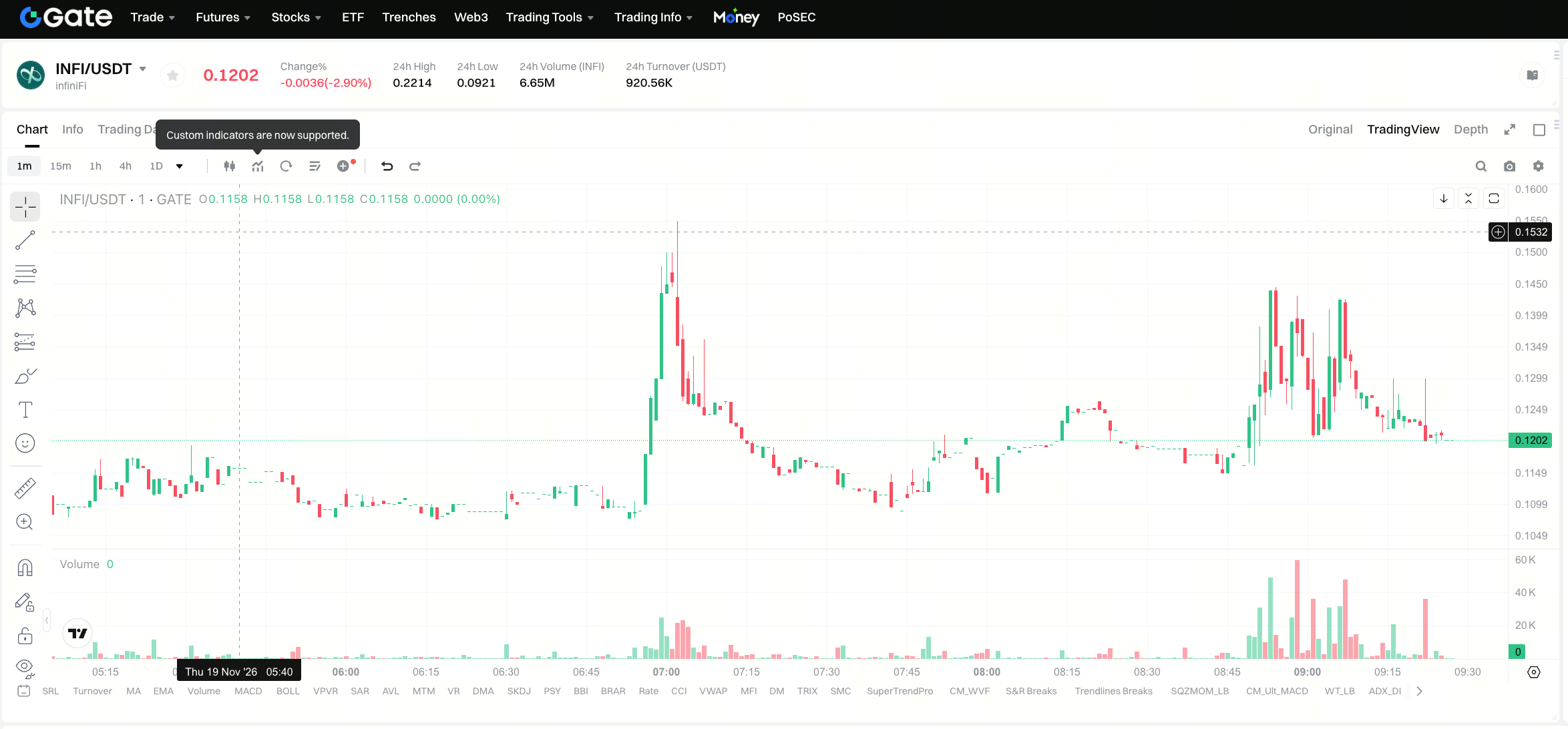
Because INFI is a newly launched token, liquidity and spreads may evolve after listing. Traders should check the selected pair, recent trade volume, depth, and fee tier before placing a large order. The step-by-step Gate guide explains pair selection, order types, common errors, and risk checks.
What Are the Main Risks?
infiniFi carries smart-contract risk across its gateway, receipt tokens, strategy modules, and governance systems. The protocol’s smart contracts are verified and readable. InfiniFi also reports comprehensive test coverage, including unit tests. Ownership of the protocol’s smart contracts has been renounced. Strategy risk comes from lending-market volatility, credit counterparties, duration-bearing RWA exposure, liquidity contraction, and changes in protocol allocations.
Fractional reserve adds liquidity design risk: if liquid demand exceeds available buffers, redemptions may queue or otherwise be constrained. Stablecoin deposits also expose users to the regulatory health of those stablecoins. Locked liUSD positions may also require waiting until their unwind term completes.
For INFI traders, additional considerations include token unlock schedules, emissions, governance decisions, market volatility, exchange liquidity, and the separation between protocol TVL and token market demand. Newly listed tokens often have wider spreads during their early liquidity formation phase.
Summary
infiniFi is an on-chain fractional-reserve stablecoin yield protocol recreating modern banking infrastructure through decentralized finance, merging liquid and illiquid assets in a capital structure designed to deliver higher yields. It turns USDC deposits into iUSD and splits return exposure between liquid siUSD and locked liUSD tranches. Its architecture matches liquid and locked demand with different DeFi and RWA credit strategies while INFI supports locking incentives, future governance, emissions allocation, and ecosystem participation. With $73.9M TVL, $9.75M cumulative yield, and spot availability on Gate, infiniFi combines yield infrastructure with a newly tradable protocol token.
FAQ
What is infiniFi?
infiniFi is a fractional-reserve stablecoin yield protocol. It accepts USDC, issues iUSD, and allocates reserves across DeFi and RWA credit strategies through liquid and locked capital tranches.
What is INFI used for?
INFI supports token locking incentives, future governance, emissions allocation, and ecosystem participation. It is distinct from iUSD, siUSD, and liUSD.
What is the difference between iUSD, siUSD, and liUSD?
iUSD is the receipt token for deposited USDC. siUSD is the staked, liquid return token. liUSD represents locked iUSD positions with differentiated return and liquidity terms.
How much yield has infiniFi generated?
As of November 18, 2026, the official dashboard reports $9.75M in cumulative yield. It also reports approximately 6.63% seven-day APY for siUSD and 10.29% over 13 weeks for liUSD.
Where can users trade INFI?
Gate announced INFI spot availability. Users can trade INFI through the Gate spot market after completing the platform’s required account and regional eligibility checks. InfiniFi Labs said the project’s February 11, 2025, $3M pre-seed round included New Form Capital, Axiom, Kraynos Capital, Alan Keegan, Defi Dad, Justin Reyes, and Sam Kazemian; combined with its other financing, infiniFi raised more than $6M.
Educational content only. Yield protocols and spot trading involve smart-contract, liquidity, market, and loss risk.