What Is Hyperliquid (HYPE)? A Practical Guide for Traders and Builders

Intermediate
CryptoBlockchain
Last Updated 2026-08-23 16:53:01
Reading Time: 15m
Hyperliquid (HYPE) is a high-performance decentralized trading platform built on a proprietary Layer-1 blockchain, delivering a transparent and user-driven trading experience. Leveraging the HyperBFT consensus mechanism, the platform supports perpetual contracts and an on-chain order book model, with the capacity to process up to 100,000 orders per second. The HYPE token is central to the ecosystem, functioning as transaction fuel, enabling staking rewards, and facilitating governance voting. Hyperliquid stands out from competitors by providing higher leverage, lower fees, and faster transaction speeds, while maintaining robust network security through validator and staking mechanisms.

Hyperliquid has quickly become a leading force in decentralized finance, blending the speed of centralized exchanges with the transparency of on-chain execution. This guide breaks down how Hyperliquid works, what the HYPE token does, and whether the platform fits your trading or building needs.

  • Hyperliquid is a fast Layer 1 blockchain and DEX with a fully on-chain order book and sub-second finality.

  • It offers centralized-exchange speed and liquidity with decentralized self-custody and up to 50x leverage.

  • The HYPE token supports governance, staking, gas fees, and trading discounts, with a strong community launch.

  • Its architecture uses HyperBFT consensus and splits state into HyperCore (gasless trading) and HyperEVM (EVM compatibility).

What Is Hyperliquid?

Hyperliquid is a high-performance layer 1 blockchain and decentralized exchange designed for perpetual futures trading and spot trading across crypto and other asset classes. It runs a fully on-chain central limit order book with sub-second finality, aiming to deliver centralized-exchange-level speed while allowing users to retain complete self-custody of their funds during trading. The Hyperliquid blockchain is powered by the HYPE token, which supports staking, governance, and gas fees on HyperEVM smart contracts.

Here is what you need to know at a glance:

  • Type: Purpose-built L1 blockchain and flagship DEX trading platform

  • Core product: Perpetual futures (up to 50x leverage) and spot markets

  • Order execution: Fully on-chain central limit order book - no off-chain matching

  • Speed: Processes up to 200,000 orders per second with sub-second finality

  • Custody: Non-custodial - you hold your own keys

  • Native token: HYPE - used for governance, staking, and gas fees

Hyperliquid is a decentralized exchange built on its own layer 1 blockchain, not deployed on top of Ethereum or another general purpose chain. That distinction matters because the entire chain is optimized around electronic trading rather than general-purpose computation.

How Hyperliquid Works: Blockchain and Architecture

Unlike general-purpose L1s that must balance the unique demands of gaming, NFTs, DeFi, and social apps on one network, Hyperliquid is a purpose-built app-chain optimized for high-frequency trading. Its custom consensus algorithm, called HyperBFT, is a variant of HotStuff running under delegated proof of stake.

Key architecture details:

  • Block time: Approximately 0.07 seconds, with one block finality and median end-to-end latency around 0.2 seconds. HyperBFT achieves sub-second finality for transactions, making it competitive with the latency of centralized exchanges.

  • Throughput: The consensus mechanism can confirm 200,000 transactions per second, constrained primarily by execution logic rather than networking.

  • State split into two components: HyperCore handles the trading engine - perpetual futures, spot order books, matching, margining, funding payments, and liquidations. HyperEVM is an Ethereum-compatible layer for general smart contract execution. Both share the same underlying consensus mechanism and validator set.

  • Fully on-chain matching: All order placement, cancellation, and matching happen directly on-chain. This contrasts sharply with off-chain matching engines used by some other decentralized exchanges, where only settlement touches the blockchain.

The Hyperliquid blockchain is optimized for high-frequency trading, and its architecture allows gasless trading for users on HyperCore - you only pay trading fees, not gas fees for order operations.

The Hyperliquid Exchange: Perpetual Futures and Spot Trading

Hyperliquid's flagship product is its derivatives DEX. Perpetual futures contracts allow traders to speculate on the price of an asset without owning it and carry no expiration date. Funding payments (typically hourly) keep contract prices tethered to the underlying spot price.

What the exchange offers:

  • Leverage: Hyperliquid supports perpetual futures with up to 50x leverage on major pairs like BTC and ETH, with smaller-cap assets capped at lower multiples based on volatility.

  • Spot trading: Added to Hyperliquid in April 2024, spot trading runs on the same hyper performant chain with a visible on-chain order book - unlike AMM-based DEXs where you trade against a liquidity pool rather than a live book of bids and asks.

  • Beyond crypto: Under HIP-3, builders can deploy synthetic perpetual markets for equities, commodities, FX, and indices. Markets for TSLA, NVDA, Gold, and Crude Oil already trade 24/7 with no expiry, expanding Hyperliquid's reach toward real world assets.

  • Order types: Limit, market, stop-loss, take profit, TWAP, and scale orders are all stored directly in on-chain state.

Hyperliquid allows gasless trading for all order types on HyperCore. Near-instant confirmations make the platform suitable for active intraday strategies, and the trading experience closely mirrors what you would find on major exchanges.

Hyperliquid captures a significant share of the decentralized perpetual futures market, offering over 300,000 users a daily trading volume exceeding $4 billion. That scale positions it alongside mid-tier centralized exchanges in raw throughput.

Onchain Order Book and Market Making

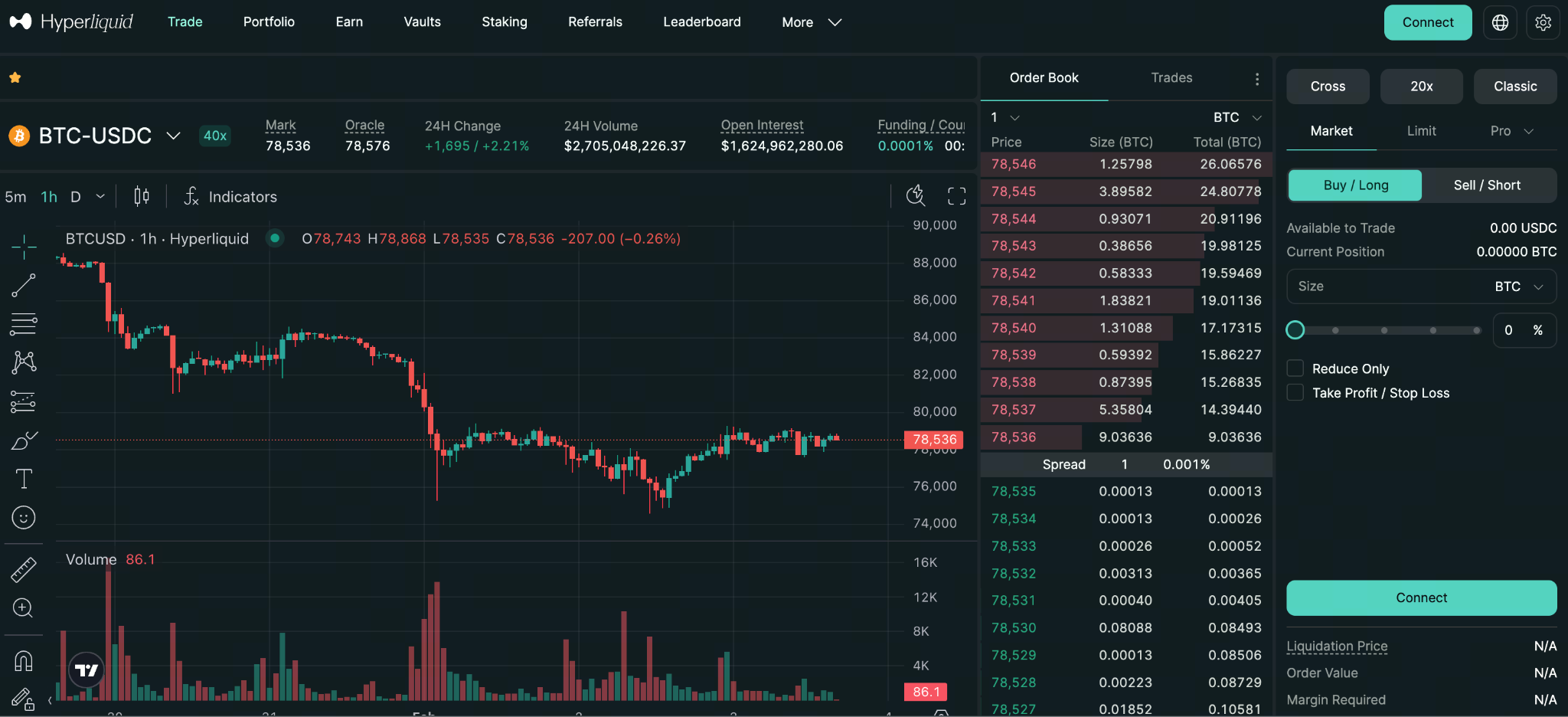
Most decentralized exchanges typically use automated market makers instead of central limit order books. Hyperliquid breaks from that pattern. Its fully on-chain CLOB stores every order - limit, market, stop-loss, take profit, TWAP, and scale - directly in blockchain state. Hyperliquid's order book is fully on-chain, ensuring transaction transparency for every participant.

How market making works on Hyperliquid:

  • Professional firms: Independent market makers, including teams with backgrounds at firms like Hudson River Trading, provide liquidity by quoting both sides of the book across dozens of markets.

  • Hyperliquidity Provider (HLP): A protocol-managed vault that quotes bid-ask spreads, absorbs liquidations, and improves depth. This mechanism helps maintain tight spreads and low slippage, especially on high-volume pairs.

  • Transparency: All fills, liquidations, and funding payments are verifiable on-chain. External analytics tools can reconstruct historical order book snapshots because every state transition lives on the Hyperliquid blockchain.

For traders, the practical result is greater transparency, tighter spreads, and a trading environment where you can verify every fill against the public ledger rather than trusting an opaque matching engine.

HYPE Token: Utility, Market Cap, and Tokenomics

HYPE is the native token of the Hyperliquid ecosystem. The HYPE token launched via an airdrop in late November 2024 to nearly 100,000 users, with a fixed maximum supply of 1 billion HYPE.

Core utilities of HYPE:

  • Gas fees: Pays transaction costs on HyperEVM smart contract interactions.

  • Staking: Secures the HyperBFT network through delegated proof of stake.

  • Governance: Token holders vote on protocol parameters, upgrades, and asset listings under HIP proposals.

  • Trading fee discounts: Stakers and validators access tiered fee reductions.

  • Asset deployment: Required for builders who want to launch tokens or deploy new perpetual markets under HIP-3.

The broad functionality underscores why HYPE sits at the center of the protocol. Notably, 75% of HYPE tokens were distributed to community members, making it one of the most community-heavy allocations in recent DeFi history. Core contributors hold multi-year lockups extending through 2027–2028.

HYPE achieved a market cap exceeding $9 billion within three months of launch. As of mid-2026, the circulating supply sits around 222–255 million HYPE, with a total supply near 950–960 million after buybacks and burns. The fully diluted valuation ranges around $50–55 billion.

Hyperliquid directs approximately 99% of exchange revenues toward buying back and burning HYPE through its Assistance Fund. This has resulted in a negative year-over-year inflation rate of roughly -30%, meaning the circulating supply is actively shrinking.

HYPE Staking and Network Security

HYPE staking secures the Hyperliquid blockchain through delegated proof of stake. HYPE holders delegate tokens to validators, who participate in consensus and earn staking rewards drawn from a future emissions reserve.

Key staking mechanics:

  • Validator requirements: A minimum self-delegation of 10,000 HYPE, locked for one year. Validators face jailing for poor latency or uptime and slashing for provable malicious behavior like double-signing.

  • Delegator flow: A 1-day warm-up period before staking becomes active, and a 7-day unstaking period before tokens can be withdrawn.

  • Rewards: Auto-compounding daily. At 400 million HYPE staked, the estimated annual reward rate is approximately 2.37% APR, scaling inversely with the square root of total stake.

  • Governance + fee benefits: Staking HYPE is tied to governance influence and sometimes to tiered trading fee discounts, giving stakers both yield and in-platform advantages.

Network security is a critical consideration. Hyperliquid has 16 validators for blockchain security - significantly fewer than Ethereum's hundreds of thousands of validators. While the validator set has maintained strong uptime since launch, the network has not been battle-tested against cyberattacks at the scale that larger chains have endured. The trade off between performance optimization and decentralization is real: fewer validators enable faster consensus but introduce concentration risk.

If you are evaluating HYPE staking, weigh the yield against lockup periods and the relative newness of the validator set. Consider diversifying staking exposure across multiple protocols. For a comparison of staking approaches across DeFi, regulated platforms often provide additional safeguards.

Hyperliquid Ecosystem and HyperEVM

The HyperEVM provides Ethereum compatibility, enabling the development of decentralized applications that leverage Hyperliquid's liquidity. Because HyperCore and the HyperEVM share the same underlying consensus mechanism, developers can build apps - lending protocols, structured products, yield vaults, NFT markets, automation tools - that tap into live perpetual futures and spot data from the trading engine without a separate validator set or cross-chain bridge.

What the ecosystem supports today:

  • Vaults and structured yield: Protocol-managed and community-built vaults offering exposure to market making strategies, delta-neutral yield, and more. The ecosystem supports borrowing, lending, and other financial primitives atop the trading layer.

  • Analytics and tooling: Because all state is on-chain, third-party dashboards can reconstruct full order book history, funding rate trends, and liquidation cascades.

  • Stablecoin-centric design: USDC serves as primary collateral for perpetual futures and most DeFi apps. Cross-chain bridges and intent-based routers connect Hyperliquid with Ethereum and L2 networks like Arbitrum.

  • Wallet integrations: MetaMask and other EVM wallets enable users to send assets, trade, and interact with HyperEVM contracts directly. This integration lets traders fund perp accounts from any EVM token.

The Hyperliquid ecosystem is still early compared to Ethereum's, but its tight coupling between a trading engine and a general-purpose EVM layer is a massive technical upgrade over architectures that bolt DeFi onto chains never designed for high-speed order matching.

How to Start Using Hyperliquid (Step-by-Step)

Getting started with Hyperliquid today follows a straightforward flow:

  1. Choose a wallet: MetaMask or any browser-based EVM wallet works for HyperEVM interactions. The Hyperliquid web app also supports its own session-key wallet for streamlined trading.

  2. Bridge funds: Transfer USDC from Ethereum or Arbitrum to Hyperliquid via the native bridge. Expect confirmation within a few minutes and minimal bridging fees.

  3. Connect and deposit: Link your wallet to the Hyperliquid interface, then deposit USDC into your trading margin account.

  4. Place your first trade: Select a perpetual futures or spot market. Set leverage (start low - 2x or 3x). Place a small limit order to test execution. Monitor P&L in real time.

  5. Activate risk controls: Set stop-loss and take profit orders immediately. Avoid maximum leverage until you understand how Hyperliquid works under volatility. Use position size limits to manage risk management effectively.

If you prefer centralized exchanges and traditional interfaces, you can access HYPE trading pairs and similar perpetual futures exposure via platforms like Gate.com, which offers spot and perpetual futures markets under a fully custodial, regulated environment with fiat on-ramps.

Is Hyperliquid Safe? Risks and Considerations

Hyperliquid has a strong performance and security record to date, but it remains a relatively new L1 with specific risks that traders should evaluate honestly. Decentralized finance platforms can struggle with producing the speed and liquidity of centralized exchanges, and while Hyperliquid has largely solved the speed problem, other concerns remain.

Technical risks:

  • A validator set of only 16 nodes is far smaller than major L1s, raising concentration and censorship concerns.

  • Smart contract vulnerabilities on HyperEVM are possible despite audits.

  • The network has not been battle-tested against sophisticated cyberattacks at scale.

Trading and liquidity risks:

  • Leveraged trading up to 50x creates rapid liquidation risk during volatile moves.

  • Less liquid pairs may see wider spreads and slippage.

  • Oracle-derived prices rely on external venues - a failure or manipulation at those sources could cascade.

Regulatory and access risks:

  • Hyperliquid is not available to users in the U.S. or Ontario. Attempting access via VPN may violate terms.

  • Synthetic equity and commodity perpetual exchanges face evolving regulatory scrutiny in multiple jurisdictions.

  • Hyperliquid experienced $256 million in withdrawals due to security concerns following a widely discussed incident, highlighting that confidence can shift quickly in DeFi.

Consider diversifying platform exposure. Some traders prefer accessing Hyperliquid indirectly via centralized exchanges that list HYPE, such as Gate.com, which can offer additional protections like insurance funds, compliance oversight, and regulated custody.

Hyperliquid vs Other Decentralized Exchanges and CEXs

Understanding where Hyperliquid fits requires comparing it against both decentralized exchanges and centralized alternatives.

Feature Hyperliquid AMM-Based DEXs (e.g., Uniswap) CEXs (e.g., Gate.com)
Order type On-chain CLOB AMM pools Off-chain CLOB
Derivatives Full perp suite Limited or none Full perp + options
Custody Self-custody Self-custody Custodial
Speed Sub-second finality Block-time dependent Milliseconds
Fiat on-ramp No No Yes
Regulation Minimal Minimal Licensed / compliant
Advanced orders Stop, TP, TWAP, scale Swap only Full suite

Hyperliquid aims to combine transparency, self-custody, and the performance of centralized exchanges. Its on-chain order book delivers superior execution quality for derivatives compared to AMM-based DEXs, which are better suited for simple spot swaps. Against other perpetual-focused DEXs, Hyperliquid's advantage is matching inside consensus rather than relying on off-chain sequencers.

However, centralized exchanges like Gate.com still offer regulated access, broad spot listings, fiat on-ramps, copy trading, structured yield products, and compliance-friendly payment rails that many retail users prefer. The choice is not binary - sophisticated traders often use both.

Key Metrics: Volume, Users, and Growth

A numeric snapshot illustrates Hyperliquid's scale:

Metric Value (Mid-2026)
Daily trading volume (perps) ~$2.2–4+ billion
Cumulative trading volume $3.9–4.3 trillion since inception
Open interest ~$6.7 billion
Perpetual markets listed ~232+
Registered users ~1.1–1.2 million
Monthly fee revenue ~$80 million
HYPE circulating supply ~222–255 million
HYPE market cap ~$10–14 billion
HYPE FDV ~$50–55 billion

Hyperliquid launched as a testnet in 2023 and reached mainnet in 2024. Since then, cumulative fees have exceeded $1.1 billion. The trading volume regularly rivals mid-tier centralized exchanges, and the protocol's self-funded model - Hyperliquid Labs raised no external capital through traditional VC rounds - has been a point of technical and product excellence that the community highlights frequently.

Core development has remain committed to shipping without outside investor pressure, and the deflationary supply dynamics driven by revenue buybacks have made HYPE one of the stronger-performing DeFi tokens over the past year.

Who Hyperliquid Is For and When to Consider Alternatives

Hyperliquid is primarily designed for active derivatives traders, sophisticated market makers, and DeFi builders comfortable with self-custody and L1-level risk.

Ideal user profiles:

  • High-frequency perp traders who need CEX-grade latency on a decentralized finance ecosystem

  • Quant teams wanting transparent on-chain data, API access, and the ability to build apps on HyperEVM

  • Developers looking to deploy structured products, vaults, or novel DeFi platform functionality on the Hyperliquid ecosystem

When to consider alternatives:

  • Casual users who mainly want simple spot trading, fiat on-ramps, or diversified passive income products will find a centralized platform like Gate.com more practical - it offers spot, margin, perpetual futures, staking, savings, and compliance-friendly payment rails.

  • Leveraged perpetual futures and protocol-level market making strategies like the HLP vault are inherently risky. They suit informed, risk-tolerant participants, not beginners looking for passive exposure.

  • Both the algorithm-driven nature of on-chain liquidations and the low fees of Hyperliquid's trading engine are attractive, but they do not eliminate the fundamental risks of leveraged trading.

Hyperliquid enables users to access a decentralized, high-performance trading stack that was previously only available through centralized venues. But most investors will combine it with centralized exchanges and other DeFi protocols rather than rely on it as their only trading venue. The existing financial system and the global financial system are increasingly connected to on-chain infrastructure - Hyperliquid is one of the clearest examples of that convergence, and understanding where it fits in your toolkit is the first step toward using it well.

FAQ

Is Hyperliquid a DEX?

Yes, Hyperliquid is a decentralized exchange (DEX) built on its own high-performance Layer-1 blockchain. It features a fully on-chain central limit order book and offers perpetual futures and spot trading with decentralized self-custody, combining the speed and liquidity of centralized exchanges with the transparency and security of blockchain technology.

Is Hyperliquid coin a good investment?

The Hyperliquid native token, HYPE, has a fixed maximum supply of 1 billion tokens and supports governance, staking, gas fees, and trading fee discounts. It launched via an airdrop to nearly 100,000 users with 75% of tokens allocated to the community. HYPE achieved a market cap exceeding $9 billion within three months and benefits from a deflationary buyback-and-burn mechanism. While it has strong utility and community backing, like all crypto investments, it carries risks related to market volatility and the platform's relative newness.

Is Hyperliquid safe to use?

Hyperliquid prioritizes security with a delegated proof-of-stake consensus mechanism secured by 16 validators and a robust on-chain architecture. Users retain full self-custody of their funds during trading. However, the network is relatively new and has not been battle-tested against large-scale cyberattacks. There are also risks related to validator concentration, smart contract vulnerabilities on HyperEVM, and leveraged trading. Additionally, Hyperliquid is not available to users in the U.S. or Ontario due to regulatory restrictions.

Author: Matheus
Translator: Sonia
Reviewer(s): Pow、KOWEI、Joyce、Rei
Translation Reviewer(s): Ashley
Disclaimer

* The information is not intended to be and does not constitute financial advice or any other recommendation of any sort offered or endorsed by Gate.

* This article may not be reproduced, transmitted or copied without referencing Gate. Contravention is an infringement of Copyright Act and may be subject to legal action.

Related Articles

The Future of Cross-Chain Bridges: Full-Chain Interoperability Becomes Inevitable, Liquidity Bridges Will Decline
Beginner

The Future of Cross-Chain Bridges: Full-Chain Interoperability Becomes Inevitable, Liquidity Bridges Will Decline

This article explores the development trends, applications, and prospects of cross-chain bridges.
2026-04-08 17:11:27
Solana Need L2s And Appchains?
Advanced

Solana Need L2s And Appchains?

Solana faces both opportunities and challenges in its development. Recently, severe network congestion has led to a high transaction failure rate and increased fees. Consequently, some have suggested using Layer 2 and appchain technologies to address this issue. This article explores the feasibility of this strategy.
2026-04-06 23:31:03
Sui: How are users leveraging its speed, security, & scalability?
Intermediate

Sui: How are users leveraging its speed, security, & scalability?

Sui is a PoS L1 blockchain with a novel architecture whose object-centric model enables parallelization of transactions through verifier level scaling. In this research paper the unique features of the Sui blockchain will be introduced, the economic prospects of SUI tokens will be presented, and it will be explained how investors can learn about which dApps are driving the use of the chain through the Sui application campaign.
2026-04-07 01:11:45
Navigating the Zero Knowledge Landscape
Advanced

Navigating the Zero Knowledge Landscape

This article introduces the technical principles, framework, and applications of Zero-Knowledge (ZK) technology, covering aspects from privacy, identity (ID), decentralized exchanges (DEX), to oracles.
2026-04-08 15:08:18
What is Tronscan and How Can You Use it in 2025?
Beginner

What is Tronscan and How Can You Use it in 2025?

Tronscan (tronscan.org) is a TRON explorer and asset toolkit. Around 2025 it expanded security, analytics, cross-chain, and mobile UX—always confirm the live UI on the official site.
2026-08-05 05:44:25
What Is a Yield Aggregator? DeFi Auto-Compounding Explained
Beginner

What Is a Yield Aggregator? DeFi Auto-Compounding Explained

Yield Aggregators are protocols that automate the process of yield farming which allows crypto investors to earn passive income via smart contracts.
2026-08-19 03:14:40