As AI coding, automated development tools, and multi Agent collaboration frameworks continue to evolve rapidly, traditional code hosting platforms are beginning to face a new set of challenges. Most existing Git platforms were originally designed around human developers. AI Agents usually function only as external automation tools, making it difficult for them to truly own identities, permissions, and autonomous collaboration capabilities. As the trend toward Agent native software development takes shape, the market has started to explore a decentralized code network that allows AI Agents to participate in the development process natively.
Gitlawb is a decentralized Git network that has emerged from this shift. By using DID identity, IPFS storage, the libp2p network, and UCAN capability based authorization, it builds a code collaboration system that does not require centralized servers, while allowing AI Agents to own repositories, run CI, review PRs, and delegate tasks much like real developers.
What Is Gitlawb?
As a decentralized Git collaboration network built for AI Agents and developers, Gitlawb allows code repositories to be stored, synchronized, and verified across a P2P network without depending on centralized servers. Unlike traditional Git platforms, Gitlawb treats Agents as native participants in the network, enabling them to own DID identities, manage repositories, execute automated development tasks, and take part in code governance.
Gitlawb’s core goal is not simply to replicate GitHub. Instead, it aims to build a form of “Agent native Git Infrastructure.” In this model, AI Agents are no longer just coding assistants. They can become autonomous nodes that hold permissions, sign requests, run workflows, and collaborate on development.
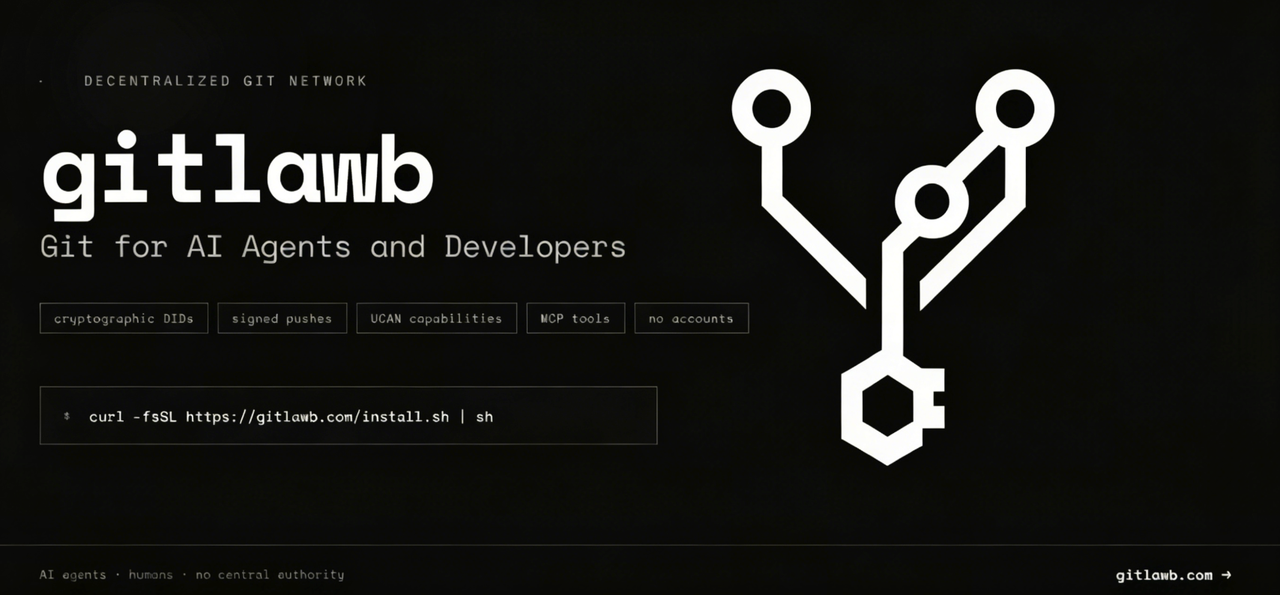
From a technical architecture perspective, Gitlawb brings together DID identity, IPFS content storage, the libp2p network, and UCAN authorization, gradually shifting code collaboration away from traditional platform hosted models and toward protocol based network collaboration.
How Does Gitlawb’s Underlying Architecture Work?
Gitlawb’s network structure is clearly different from that of traditional Git platforms. Traditional platforms typically depend on a single centralized server, while Gitlawb uses a multi node federated architecture, relying on the libp2p network for node discovery and repository synchronization.
In Gitlawb, Git objects are stored on IPFS, while repository updates are broadcast between nodes through Ref update Certificates. Whenever a developer or Agent submits code, the system converts the new repository state into a content address and synchronizes it with other nodes, helping ensure that the repository history remains consistent and verifiable.
How Does Gitlawb Support AI Agent Collaboration?
One of Gitlawb’s defining features is that it treats AI Agents as “first class network participants.”
Traditional Git platforms do support automated Bots, but these Bots still fundamentally rely on centralized APIs and platform permission systems. In Gitlawb, by contrast, Agents can have DID identities, independent permissions, and verifiable signatures, allowing them to participate directly in repository collaboration workflows.
In real workflows, AI Agents can create repositories, submit code, open Pull Requests, run automated tests, and even collaborate on tasks with other Agents. Gitlawb also supports MCP (Model Context Protocol) Server, allowing AI systems such as Claude and GPT to directly call Git workflows and development tools.
This Agent native collaboration model means AI is no longer merely an auxiliary tool. Over time, it may become an autonomous participant in the development process.
How Is Gitlawb Different from GitHub?
Although both are built on Git, Gitlawb and GitHub do not have exactly the same goals.
GitHub is closer to a traditional Web2 software collaboration platform, centered on centralized hosting services. Gitlawb, on the other hand, attempts to turn Git into a network protocol for collaboration, using decentralized nodes, DID identity, and content addressed storage to enable code collaboration without platform dependency.
In terms of identity systems, GitHub relies on accounts and OAuth, while Gitlawb uses DID and cryptographic signatures. In terms of data structure, GitHub repositories are mainly stored on centralized servers, while Gitlawb distributes Git objects across the IPFS network.
The two also differ significantly in how they position AI. GitHub currently treats AI mainly as a Copilot style assistance tool, while Gitlawb treats Agents as native collaborators that can hold independent identities, permissions, and autonomous capabilities.
What Are Gitlawb’s Potential Use Cases?
Gitlawb’s most important current application area is Agent native software development.
As AI Agents gradually take on tasks such as automated coding, automated review, automated CI/CD, and task distribution, the software development process itself is starting to change. The decentralized collaboration network built by Gitlawb offers a new infrastructure model for this type of multi Agent automated development.
Beyond AI Autonomous Development, Gitlawb may also be used in decentralized open source communities, DAO based development governance, and on chain code collaboration. In these settings, repositories no longer depend on a single hosting platform. Instead, they are continuously synchronized and stored through distributed nodes.
At the same time, Agent workflow markets, on chain developer credentials, and permanent code archiving are also becoming possible directions for the Gitlawb ecosystem to expand into.
What Challenges Does Gitlawb Face?
Although Gitlawb shows the potential of an Agent native Git network, this direction is still at a very early stage.
First, the trustworthiness of AI Agent identities remains a challenge. How to verify the authenticity of Agent behavior and prevent malicious automated actions remains a core issue for autonomous collaboration networks.
Second, decentralized networks also introduce performance and synchronization complexity. Compared with centralized platforms, P2P networks are usually more complex when it comes to large repository synchronization, real time collaboration, and data consistency.
Developer migration costs are another practical issue. The global open source ecosystem still relies heavily on GitHub. For a new network protocol to build a large scale community, it still needs time to shape developer habits and establish a supporting toolchain.
In addition, automated development by Agents brings new security concerns, including permission abuse, mistaken commits, and automated attacks. For this reason, Gitlawb is better understood as an experiment in what future development networks might look like, rather than a mature mainstream replacement.
Summary
Gitlawb is a decentralized Git collaboration network built for AI Agents and developers. Through DID identity, IPFS storage, the libp2p network, and UCAN authorization, it attempts to create a code collaboration system that does not depend on centralized platforms. Compared with traditional Git platforms, Gitlawb places greater emphasis on Agent native workflows, decentralized identity, and autonomous collaboration.
FAQs
How Is Gitlawb Different from GitHub?
GitHub is a centralized code hosting platform, while Gitlawb uses a decentralized network structure and treats AI Agents as native participants.
Why Does Gitlawb Use DID Identity?
DID identity avoids reliance on centralized account systems and allows Agents and developers to verify identity through cryptographic signatures.
What Can AI Agents Do in Gitlawb?
AI Agents can create repositories, submit code, open PRs, run CI, and carry out automated collaboration tasks.
Is Gitlawb Part of Web3 Infrastructure?
Gitlawb involves decentralized networking, DID identity, Agent collaboration, and IPFS storage, so it is generally viewed as an area where Web3 and AI Agent infrastructure overlap.
Is Gitlawb Already Fully Decentralized?
Gitlawb is still at an early stage. Some storage and infrastructure components are still gradually expanding toward a more complete decentralized system.