Gate Pay is Gate's integrated Web3 payment suite for global businesses and users. It covers crypto collection, payout, multi-account fund management, checkout, and digital-asset operations, helping teams launch faster and scale cross-border payment flows.
Cryptocurrencies are gaining increasing popularity globally with the development of blockchain technology and decentralized finance. More and more people begin to use cryptocurrencies as a means of payment, store of value, and investment. In recent years, several large events in cryptocurrency happened: In 2020, the DeFi summer spearheaded the decentralized finance (DeFi) explosion; in 2021, many famous enterprises, including Tesla, Mastercard, and Goldman Sachs, started their crypto businesses one after another; further, El Salvador introduced legislation to adopt Bitcoin as a legal tender, becoming the first sovereign country in the world to do so. The popularization of cryptocurrency is irresistible.
According to the latest industry report Digital 2022: Global Overview Report by DataReportal, the crypto penetration rate worldwide is constantly rising, and the proportion of the global population holding cryptocurrencies has reached 10%, an increase of more than 30% compared with a year ago. And in countries like Thailand, the Philippines, South Africa, and Turkey, the penetration rate of cryptocurrencies is even as high as 20%, signaling that holding cryptocurrencies has become a commonality.
With the explosive growth of the percentage of users owning cryptocurrencies in recent years, cryptocurrency holders have developed increasingly diversified needs for the use of cryptocurrencies. In addition to the core financial trading services, crypto holders are also looking for products to transfer or pay with cryptocurrencies in daily life or business scenarios. Gate Pay was created in such a context.
What is Gate Pay? An Integrated Web3 Payment Suite
Gate Pay is Gate's integrated Web3 payment suite, combining core capabilities for collection, payout, account operations, and fund management. After registering a Gate account, users can access Gate Pay in supported scenarios, while merchants can integrate it into their existing systems with lower implementation friction. Backed by Gate's trading and asset infrastructure, Gate Pay is designed to improve operational efficiency for crypto-related payment workflows.
Gate Pay supports QR-code and address payments, and can process 300+ mainstream cryptocurrencies including Bitcoin and USDT. For merchants, the product focuses on faster settlement, lower operating costs, and scalable global expansion. For users, Gate accounts provide a practical path to compliant digital-asset payments in everyday scenarios.
For individual users, Gate Pay can be used to pay with cryptocurrencies while shopping, making cross-border transfers, or receiving e-commerce services in an easier way. For enterprise users, Gate Pay is cost-efficient and fast to integrate, providing a one-stop cryptocurrency payment solution, which overcomes the obstacles of traditional finance. Through Gate Pay, merchants can directly receive thousands of cryptocurrencies from global cryptocurrency users anytime. In the future, Gate Pay will support real-time settlement as a local legal tender, bringing a wider user group to the financial system. This way, Gate Pay is committed to bringing the Web 3.0 lifestyle to the public and better serving individual users and business partners, hence contributing to the large-scale popularization and mass adoption of crypto assets globally.
In practical terms, many teams position Gate Pay as an all-in-one Web3 payment suite: merchants can accept crypto, settle quickly, and connect with Web3 users worldwide from one integration flow. This positioning emphasizes solutions for every business size, from small online shops to larger cross-border operators, while keeping checkout simple for end users.
Disadvantages of Traditional Electronic Payments
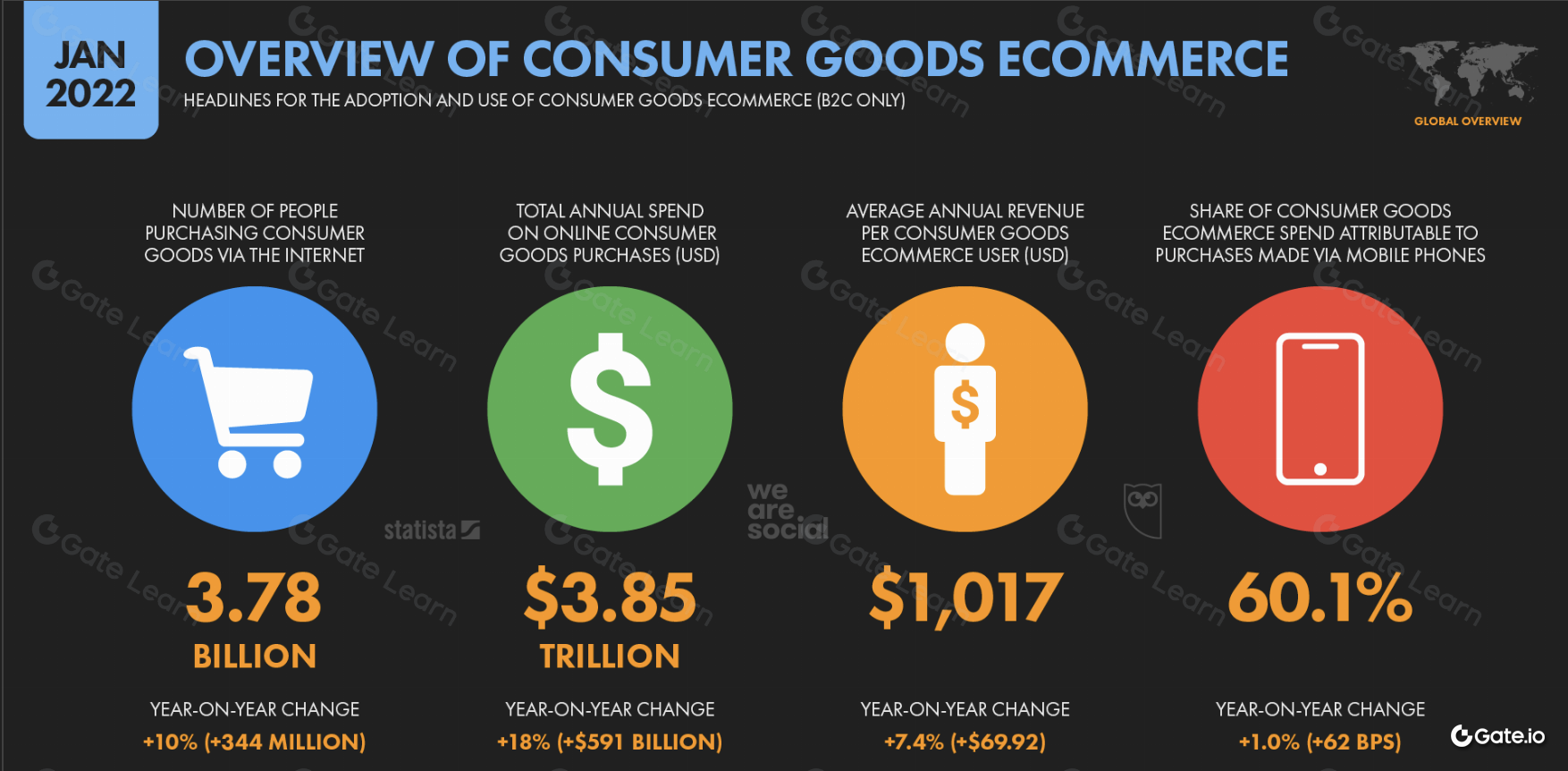
Traditional electronic payment is very expensive, as it involves many intermediaries and commercial cash flow that the general public does not actually know. Whether you are paying with a debit card or a credit card or simply by scanning the QR code, you will inevitably be raided by the bank or the clearing institution. Let’s also take Digital 2022: Global Overview Report as an example. In 2022, global revenues related to online purchases of consumer goods reached 3.85trillion,withover3.78billionpeopleshoppingonline.Withoutconsideringtheexchangerateofcross−borderpayments,traditionalelectronicpaymentaccountsforabout2100 billion.
Hence, when you purchase goods or services through traditional electronic payment methods, your money reduces the moment you pay. Then where did all the money go? What is it used for? Let’s explain this using the cash flow of credit card payments. Your consumption records will be processed by the bank that provides the acquiring service first, then transferred to the clearing center for data aggregation, and then to the card-issuing bank for settlement and issuing the bill. For the final step, you pay according to the bill, as shown below.
In the entire process of paying with a credit card, the acquiring bank, the clearing center, and the card-issuing bank will all take a commission. The merchants will not get all the money paid by the consumer: the intermediaries collect 2% ~ 4% of the total amount paid by the consumer as the commission fee, and the rest goes to the merchant. For example, if you spend 100onshoppingwithacreditcardtoday,themerchantonlygets98 at most. If it involves cross-border payment and the exchange rate, the commission will be higher. Merchants with brick-and-mortar stores have to spend extra money to install POS machines, which reduces their profits as the cost of installing and maintaining the machine is high.
Then how are the profits divided by the intermediaries? If the commission fee of a credit card transaction is 2%, the clearing institution gets at least 0.05%, while the acquiring bank gets 0.45%, and the card-issuing bank, the biggest vested interest therein, will get 1.5%. If the card-issuing bank is exactly the acquiring bank, it almost takes all the profits. Card-issuing banks spend not a penny on marketing, they therefore would like to issue reward points or gifts to encourage people to apply for cards. Actually, users employ part of the total amount they spend to buy these so-called reward points or gifts. This is indeed a profitable deal for intermediaries.
How does Gate Pay work?
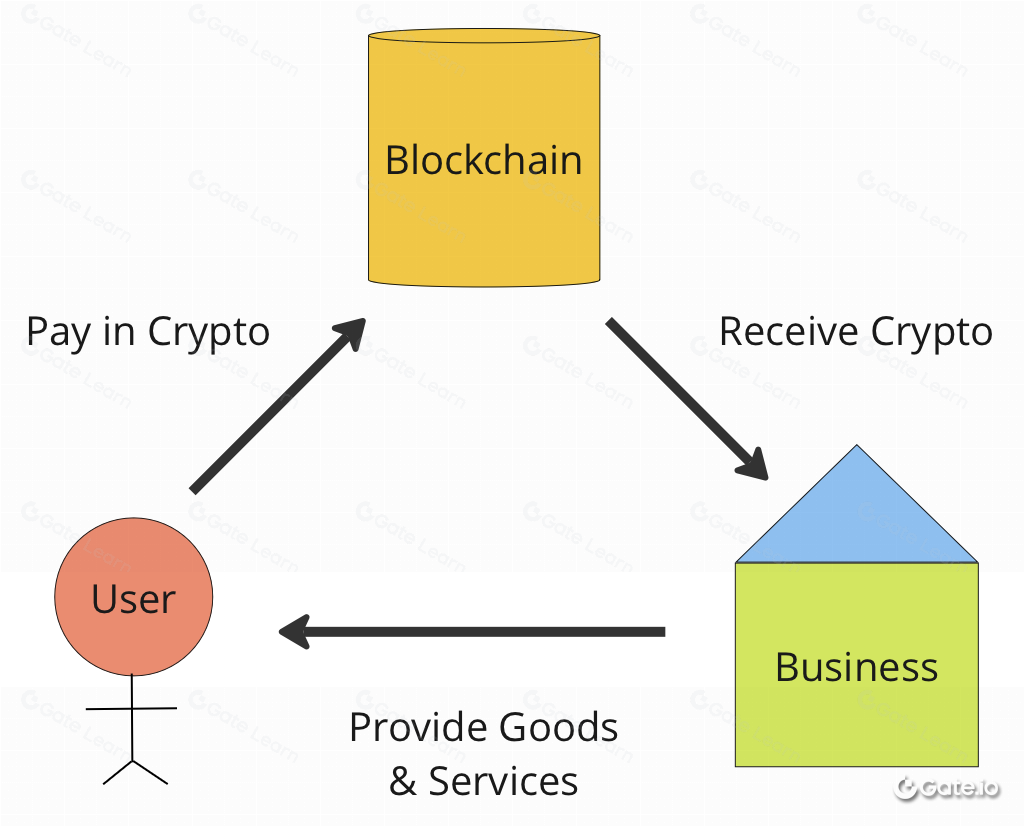
Gate Pay is a cryptocurrency payment product based on blockchain technology. It does not serve as a payment intermediary but provides the infrastructure necessary for business partners to integrate into the blockchain network, enabling miners or validator nodes on the blockchain to handle the cash flow and liquidation, which distinguishes it from traditional electronic payment. Gate Pay focuses on competitive fee efficiency and faster settlement compared with many traditional payment rails. Notably, many high-performance blockchain networks such as Solana, Polygon, Apt, and Sui are also launching new payment services.
You can use Gate Pay simply by scanning the QR code provided by the payee using the Gate App. Gate Pay will generate different QR codes for each product after the user places an order. After the user completes the payment, the merchant will be notified of the payment status. Throughout the process, users do not need to be concerned about the withdrawal, deposit, the time when the deposit is credited, and the integration of the blockchain network and the merchants’ platform. Gate Pay can be regarded as a necessary tool in the future Web 3.0 economy. For the latest operation and setup details, please refer to the official Gate Pay page.
For merchant operations, this model can support multi-account fund management and send-funds workflows to any address supported by the selected chain and asset. That flexibility is especially useful for businesses that need to handle supplier payouts, treasury movement, and customer-facing checkout in one payment stack.
How to use Gate Pay?
Gate Pay is now available to all registered users. As long as you have completed KYC verification and have sufficient crypto assets in your account, you can use Gate Pay to purchase goods and services from third-party merchants who have integrated into the Gate App. We will take the Web 3.0 online shopping platform Uquid as an example to illustrate how to use Gate Pay on both the web page and the built-in MiniApp on the Gate App.
On Web
Navigate to the Uquid website, register, and log into your account at the top right. You may choose to log in directly using your Apple, Facebook, Google, or WalletConnect account.
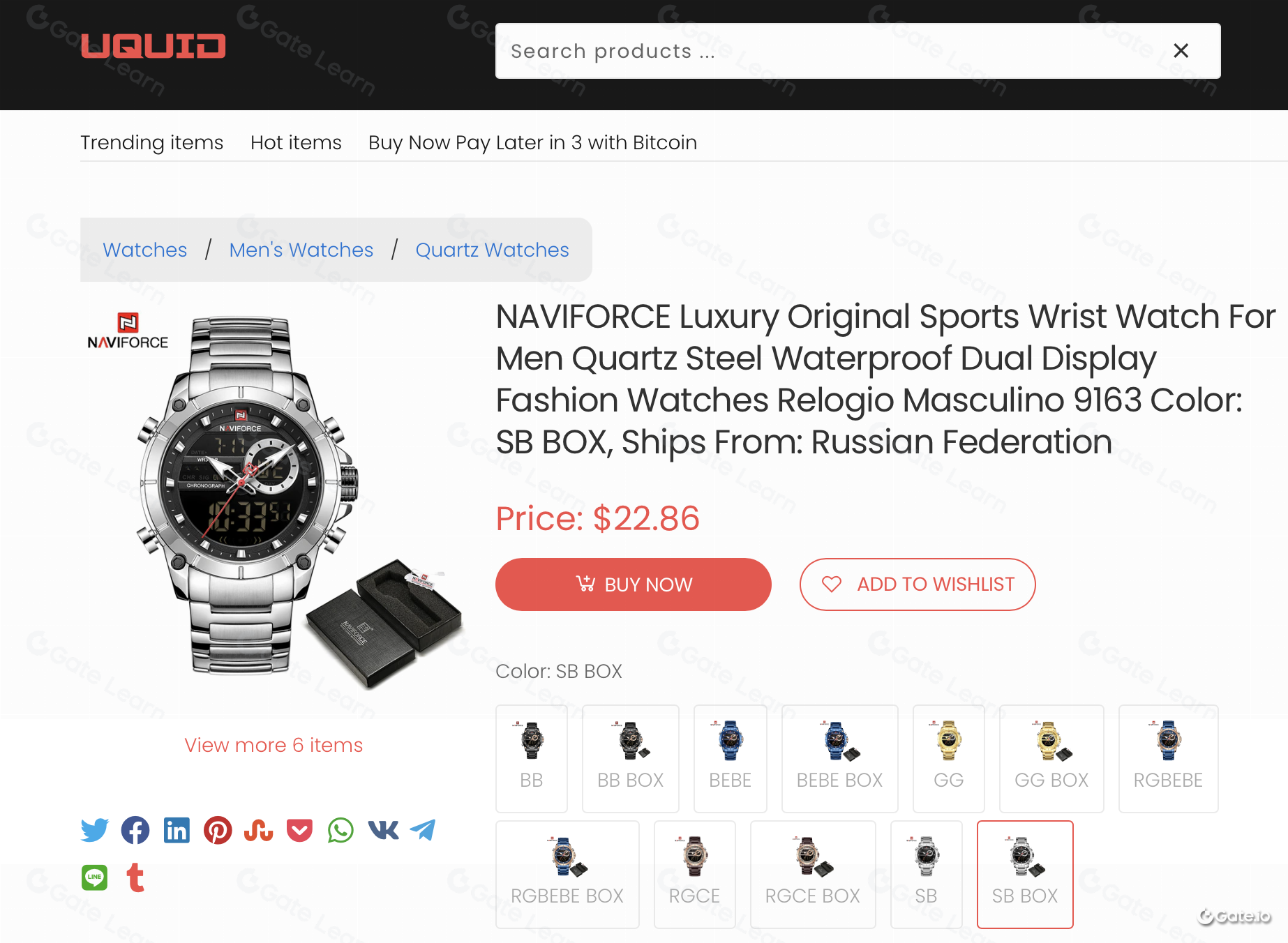
Find the product you want to buy and click “Buy Now”.
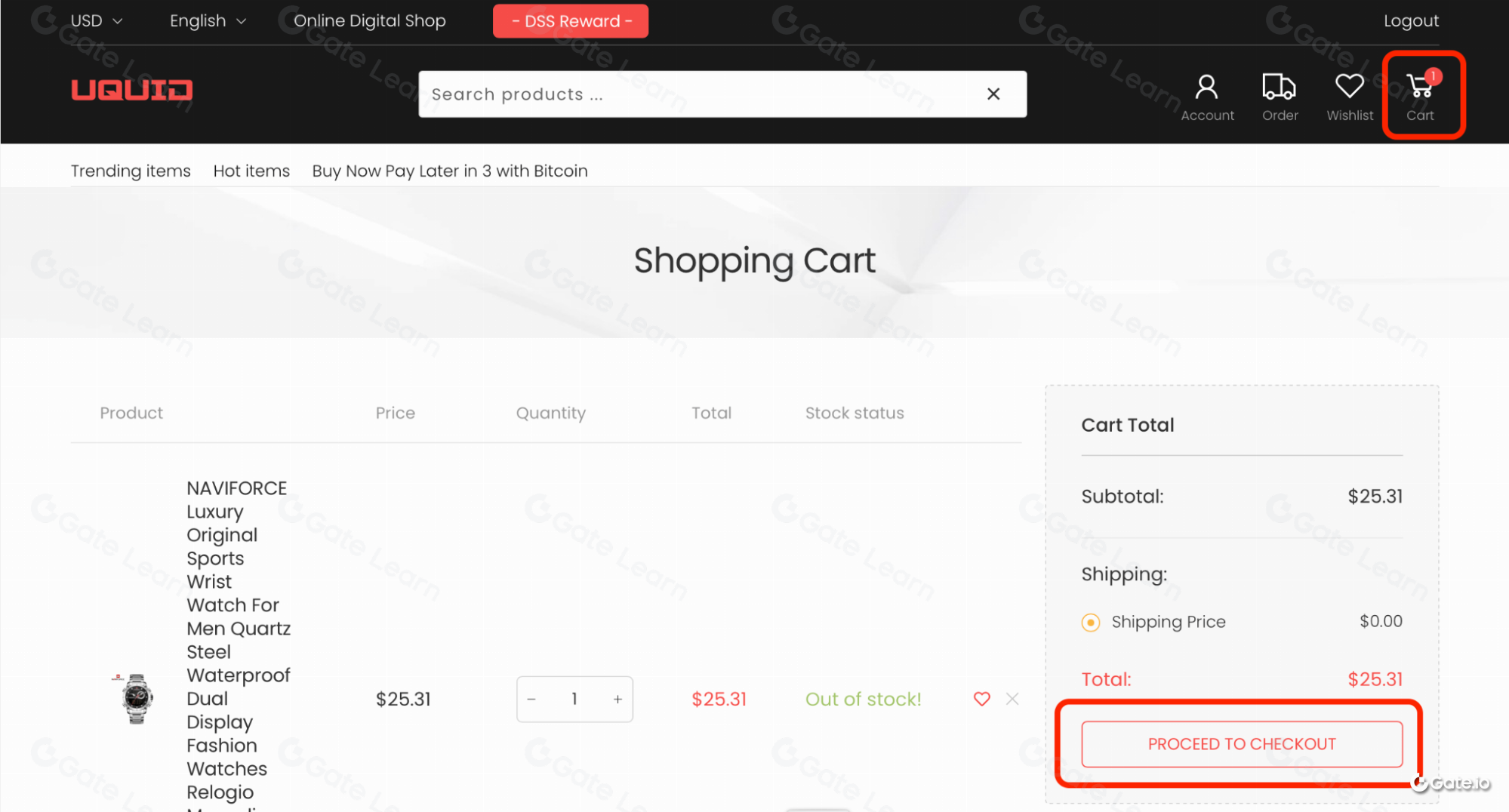
Click the shopping cart icon at the top right, and then “Proceed to Checkout”.
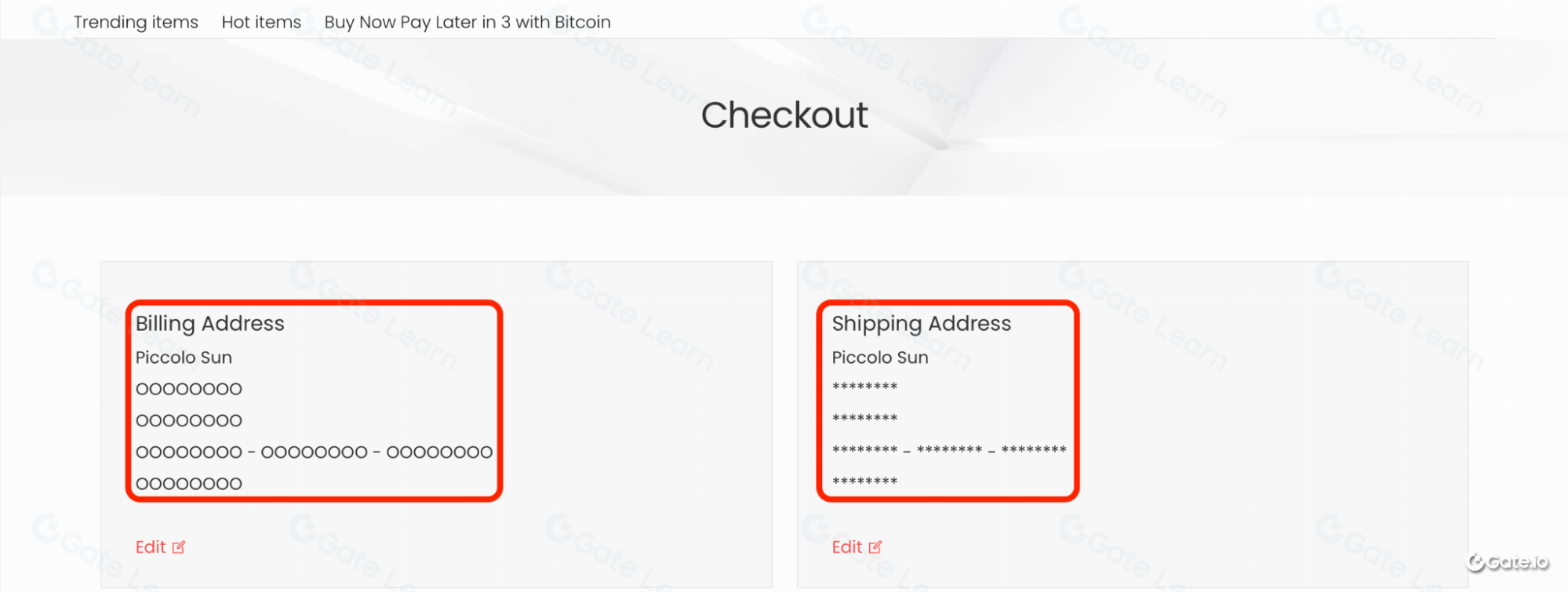
Fill in the shopping address and billing address.
Move to the bottom of the checkout page, and tick “Crypto payment, Pay as you go!”
You will see several different cryptocurrency payment channels on this page. Choose Gate Pay and click the “Checkout” button.
The order information, together with the payment QR code, will be displayed.
Open your Gate App. Use the scanner on the upper right to scan the QR code. Then you will be prompted to confirm the payment.
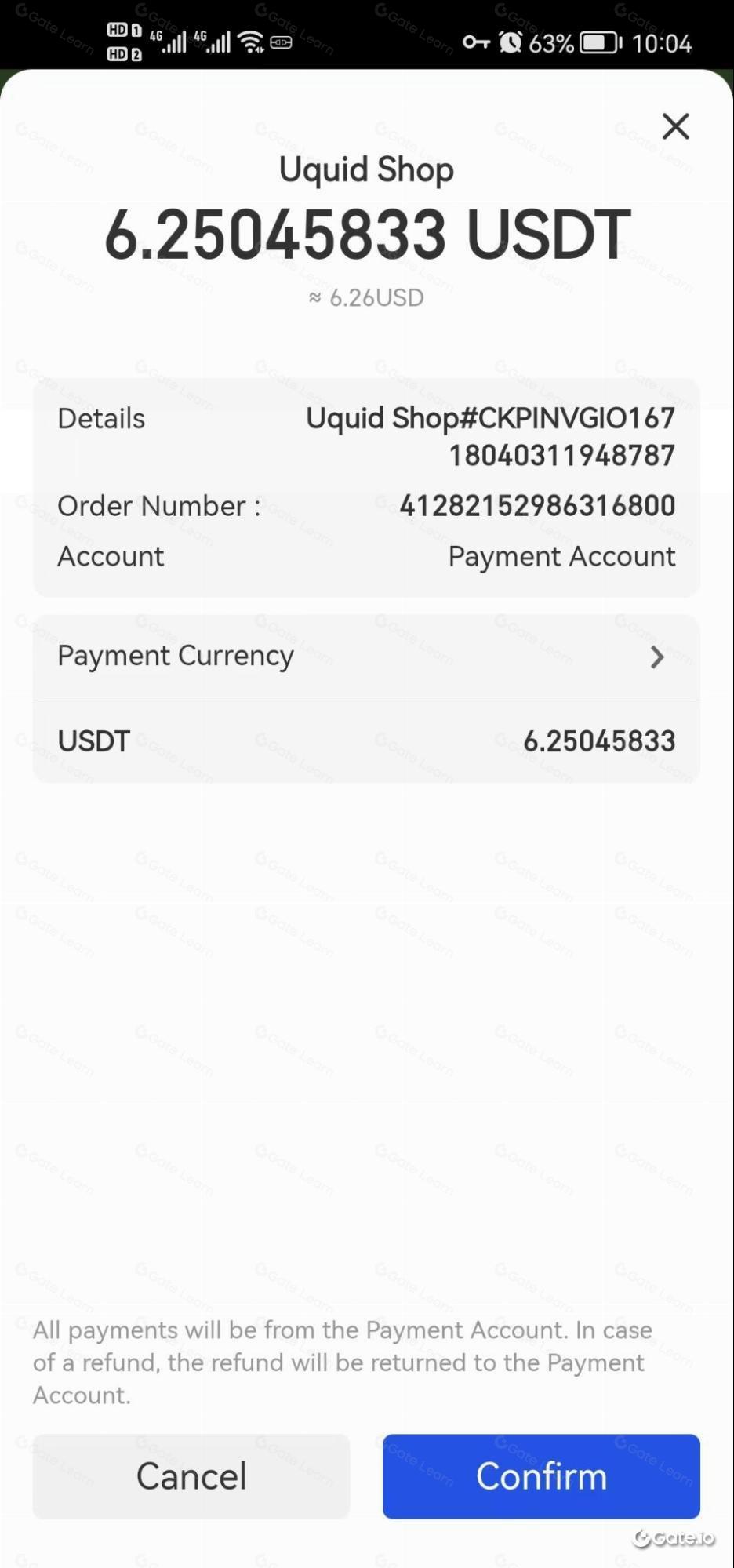
Double-check the order information and click “Confirm” to complete the payment. If there is an insufficient balance in your payment account, you need to transfer funds from other accounts (spot account, margin account, futures account, etc.) to the payment account before proceeding with the purchase.
On App
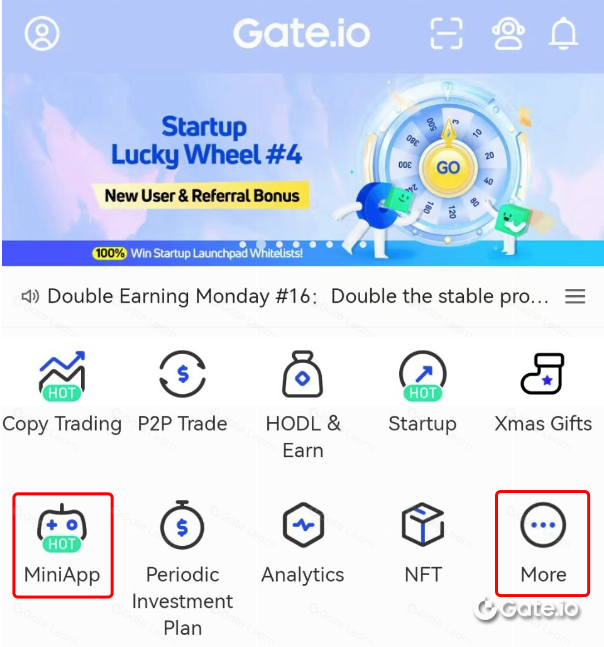
Click MiniApp in the navigation section of the Gate App. If you cannot find the MiniApp, click “More” to access it.
MiniApp provides various services and products, including gaming, gift cards, transportation, travel, online shopping, etc. Here, we are also taking the Uquid shop as an example. Click “Uquid Shop” to enter it. The merchants and services on the MiniApp are all provided by third-party business partners and can be accessed with prior user authorization.
Choose the product you want to buy and click “Buy Now”.
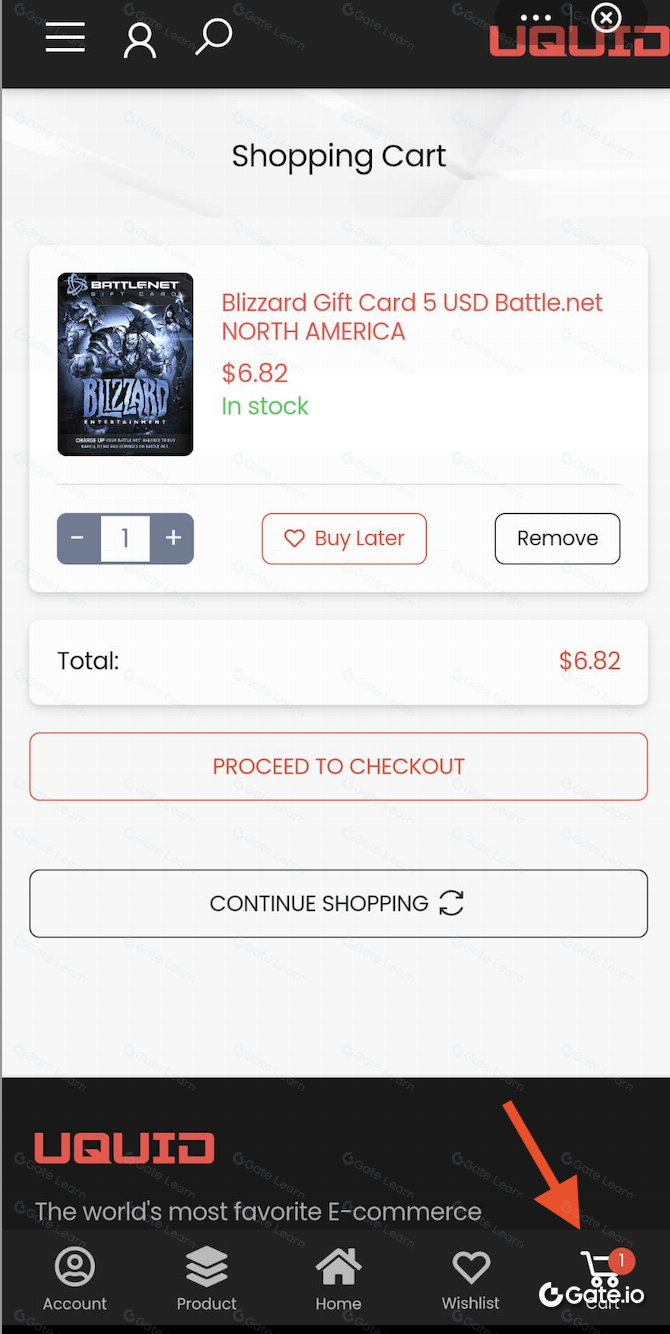
Click the cart icon at the bottom right. Double-check the information and click “Proceed to Checkout”.
Products on the MiniApp will be paid directly with Gate Pay, eliminating the extra step of selecting the payment channel on the Web. Click “Checkout” to proceed.
If all the information is correct, click “Confirm” to complete the payment. If there is an insufficient balance in your payment account, you need to transfer funds from other accounts (spot account, margin account, futures account, etc.) to the payment account before proceeding with the purchase.
Advantages of Gate Pay
1. Pay with cryptocurrencies
Gate Pay allows users to purchase the services and goods they want with cryptocurrencies without needing to convert to fiat currencies first. Merchants who deploy Gate Pay can integrate it directly into their backends, allowing customers to pay with dozens of cryptocurrencies on their mobile phones anytime, anywhere.
2. Low cost
Gate Pay is a cryptocurrency payment solution based on blockchain technology. The transaction settlement is completed by miners and nodes on the chain with no intermediaries. It is designed for lower fees and efficient settlement, and also reduces deployment friction compared with traditional payment setups that require dedicated hardware and complex integration paths. Users only need to download the Gate App on their mobile devices to use the service.
3. Expand the commercial market
Gate accommodates millions of crypto users. Merchants who have enabled Gate Pay can deploy their own applications on MiniApp to increase exposure and develop new sales channels. Enterprises could reach more target audiences if they accept cryptocurrency payments.
4. Manage your crypto assets with only one wallet
Gate Pay provides an all-in-one solution for users to access, send, spend and manage crypto earnings. Cryptocurrencies could be distributed as salaries or payments to suppliers in batches, or simply for trading, investment, risk hedging, and converting to fiat currencies on the Gate App.
5. Technical support
Gate Pay can assist you in building payment products catering to your business needs. If you don’t have developers on your team, you may choose the non-code solution, or create a built-in app on the MiniApp to get better exposure. The service charges no maintenance fee, unlike traditional electronic payment systems. If you are a merchant and want to deploy Gate Pay’s payment service, please fill in the merchant registration form and email us at gatepay@gate.com.
From an implementation perspective, Gate Pay highlights fast onboarding and code-light integration for merchant systems, which can reduce launch time compared with many legacy payment rails. Combined with account-level controls inside the Gate ecosystem, this approach aims to give businesses full cash control while keeping user-facing payment steps intuitive.
Hold the key to financial freedom
Gate was established in April 2013 with the goal of achieving a higher level of financial freedom. What is meant by “financial freedom” here does not refer to holding the amount of money enough to spend in a lifetime. It means the “freedom exempted from being deprived of assets”, so everyone can pursue their ideal lives based on their own will. When assessing the contemporary financial system meticulously, we may find many limitations in this world.
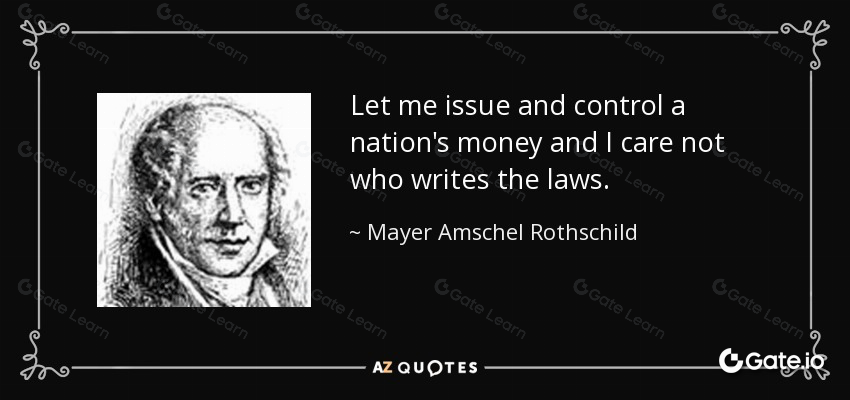
As the banker, Mayer Amschel Rothschild said: “Let me issue and control a nation’s money and I care not who writes the laws.” Money is the blood of all economic activities, while governments and banks are like the heart of the human body. When you intend to open an offshore account overseas but are rejected, you find that traditional finance doesn’t welcome people to explore new possibilities; when your domestic bank account is frozen for no reason, you realize that your bank deposits do not actually belong to you; when people in any country face skyrocketing prices, they find their wealth being raided.
Currencies issued, not by governments but by a decentralized financial system, are the only approaches to protecting private property and guaranteeing freedom of life. To break away from the shackles of the traditional financial system, one must first have his/her own wallet and use cryptocurrencies as a daily payment method. Gate Pay is created as a gateway for cryptocurrency holders and ordinary people who have not yet used cryptocurrency to smoothly enter the Web3 economy.
As Dr. Lin Han, the founder of Gate, said in Blockchain Week in Busan, “Gate Pay is our next major commitment to further crypto adoption. It will bridge the gap between Web3 and daily life, reducing the barriers for users and merchants to utilize cryptocurrency fully.” Gate believes that cryptocurrencies contribute a lot to the goal of decentralization by not only promoting the development of decentralized financial services such as DeFi, but by giving the key to unlocking personal wealth to every user. As long as you control the wealth yourself, you control your own life.
FAQ
What is Gate Pay?
Gate Pay is Gate's crypto payment solution that supports QR-code and address payments. It allows users and merchants to send or receive digital assets directly for real-world and online payment scenarios.
What are Gate Pay's fee characteristics?
Gate Pay is positioned as a low-fee, efficiency-focused payment solution. Actual costs can vary by business setup, asset, and on-chain network conditions, so users and merchants should confirm the latest fee details before each transaction flow.
Do I need KYC to use Gate Pay?
For most account-level payment scenarios in this article, users are expected to complete registration and KYC on Gate before using Gate Pay functions in production flows.
Can merchants integrate Gate Pay without a large engineering team?
Yes. The product positioning includes low-code and integration-friendly workflows, so businesses can start from simpler deployment paths and expand into deeper integration as needed.
Where can I find the latest Gate Pay access information?
The most reliable starting point is the official Gate Pay page: https://www.gate.com/pay. Merchants can also contact the team via gatepay@gate.com for onboarding support.
Author: Piccolo
Translator: binyu
Reviewer(s): Hugo、Edward、Jayne
Disclaimer
* The information is not intended to be and does not constitute financial advice or any other recommendation of any sort offered or endorsed by Gate.
* This article may not be reproduced, transmitted or copied without referencing Gate. Contravention is an infringement of Copyright Act and may be subject to legal action.
Yala is a modular Bitcoin DeFi infrastructure that connects BTC liquidity with multi-chain ecosystems through its YU stablecoin and MetaMint protocol. It enables Bitcoin holders to earn native DeFi yields across EVM and non-EVM networks securely and seamlessly.
In the Web3 ecosystem of 2026, Non-Fungible Tokens (NFTs) have evolved far beyond basic digital art into multi-chain dynamic assets, tokenized Real-World Assets (RWAs), cross-chain gaming items, and Bitcoin Ordinals. Navigating today’s hyper-connected market requires real-time data precision, algorithmic anti-wash trading filtering, and sophisticated cross-chain intelligence.
Solana faces both opportunities and challenges in its development. Recently, severe network congestion has led to a high transaction failure rate and increased fees. Consequently, some have suggested using Layer 2 and appchain technologies to address this issue. This article explores the feasibility of this strategy.
This article introduces the technical principles, framework, and applications of Zero-Knowledge (ZK) technology, covering aspects from privacy, identity (ID), decentralized exchanges (DEX), to oracles.