As the global ETF market has grown rapidly, ETF CFD trading has gradually become an important part of online derivatives trading. Compared with traditional long term ETF investing, ETF CFD trading focuses more on market price movements themselves, which is why it is widely used in short term trading, index trend trading, and risk hedging.
Against the backdrop of continued growth in global index investing, ETF CFDs have also become one of the key tools connecting the traditional ETF market with the leveraged derivatives market.
What Assets Can Be Traded with ETF CFDs?
The underlying assets of ETF CFDs are usually ETFs, or exchange traded funds.
Common ETF CFD products include S&P 500 ETF CFDs, Nasdaq 100 ETF CFDs, gold ETF CFDs, crude oil ETF CFDs, technology sector ETF CFDs, and semiconductor ETF CFDs.
For example, traders can use CFD products that track ETFs such as SPY, QQQ, or GLD to participate in price movements in the US stock market, the technology sector, or the gold market.
Compared with single stock CFDs, ETF CFDs place greater emphasis on the overall performance of a basket of assets, so their prices are usually more closely aligned with broader macro market trends.
How Do ETF CFDs Work?
The core logic of ETF CFDs is still “settlement by price difference”.
For example, if a trader believes that a Nasdaq ETF will rise, they may open a long position in the corresponding ETF CFD product. If the ETF price rises and the trader closes the position, the profit is calculated based on the price difference.
Throughout this process, the trader does not actually hold any ETF fund shares. They are only participating in the ETF’s price movement.
If the trader believes the market will fall, they can also open a short position directly and seek to profit from the price difference during a decline.
Because ETF CFDs support two-way trading, both rising and falling markets may create trading opportunities.
How Are ETF CFDs Different from Traditional ETF Investing?
The biggest difference between ETF CFDs and traditional ETF investing is whether the investor actually holds the ETF asset.
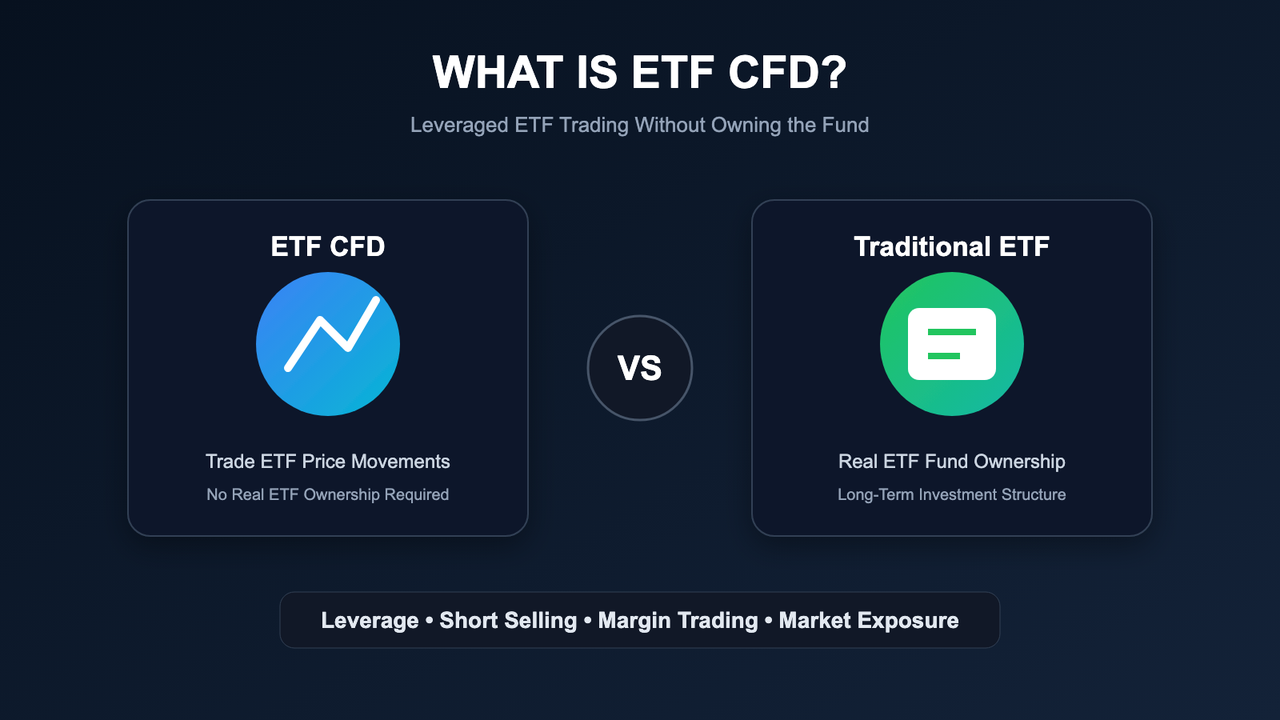
In traditional ETF investing, users buy fund shares and usually have ownership rights in the corresponding asset, as well as potential dividend rights.
ETF CFDs, by contrast, are derivatives. Traders only participate in price movements and do not actually hold the ETF.
The core differences include:
| Comparison Dimension |
ETF CFD |
Traditional ETF Investing |
| Holds the actual ETF |
No |
Yes |
| Supports leverage |
Usually yes |
Partially supported |
| Supports short selling |
Yes |
Restricted in some markets |
| Has fund rights |
Usually no |
Yes |
| Core logic |
Settlement by price difference |
Holding fund shares |
Compared with long term index investing, ETF CFDs are more focused on short term trading and participation in market volatility.
Why Are ETF CFDs Suitable for Index Trading?
Because ETFs themselves usually track indexes or industry sectors, ETF CFDs are often used for macro market trend trading.
For example, an S&P 500 ETF CFD can be used to participate in the overall trend of the US stock market; a Nasdaq ETF CFD is more closely tied to the technology stock market; and a gold ETF CFD tends to reflect the movement of safe haven assets.
Compared with single stock CFDs, ETF CFDs usually have more diversified volatility, so some traders use them to express broader market views.
ETF CFDs are also commonly used in sector rotation and thematic investing strategies.
What Is the Leverage Mechanism in ETF CFDs?
ETF CFDs usually use a margin trading model.
For example, with 5x leverage, traders only need to pay part of the required margin to open a larger ETF market position.
The leverage calculation logic can usually be expressed as:
Leverage can improve capital efficiency, but it also amplifies both potential gains and the risk of losses caused by market fluctuations.
Although ETF volatility is usually lower than that of individual high growth stocks, ETF CFDs can still experience significant price changes during periods of intense macro market volatility.
What Fees Do ETF CFDs Incur?
The main costs of ETF CFDs usually include spreads, trading fees, and overnight financing fees.
The spread is the difference between the buying price and the selling price, while overnight financing fees are related to how long a leveraged position is held.
For users who hold positions for a long time, financing fees may gradually accumulate and affect overall returns.
As a result, ETF CFDs are more commonly used for medium and short term trading rather than long term asset allocation.
What Are the Main Risks of ETF CFDs?
ETF CFDs are high risk leveraged derivatives. Their main risks come from leverage risk, forced liquidation risk, market volatility risk, liquidity risk, and financing cost risk.
Although ETFs themselves usually have a diversified structure, ETF CFDs are often used with leverage, which means market volatility can still be further amplified.
For example, during periods of sharp global market volatility, index ETF CFD prices may change rapidly and cause a noticeable decline in account equity.
What Is the Difference Between ETF CFDs and Index CFDs?
ETF CFDs and index CFDs can both reflect overall market movements, so they are often compared with each other.
However, their underlying structures are different:
For example:
ETF CFDs may also be affected by ETF management fees, fund structure, and tracking error.
The Role of ETF CFDs in Global Markets
ETF CFDs give users a way to participate in global index markets without holding actual fund shares.
For some traders, ETF CFDs can be used for index trend trading, sector rotation, leveraged market exposure, risk hedging, and macro market trading.
As the global ETF market continues to grow, ETF CFDs are gradually becoming an important part of the modern online derivatives market.
Conclusion
An ETF CFD is a financial derivative settled based on changes in ETF prices, allowing traders to participate in market volatility without holding the actual ETF.
Compared with traditional ETF investing, ETF CFDs place greater emphasis on leverage, two way trading, and short-term market participation. At the same time, they involve higher risks, including forced liquidation, financing fees, and market volatility risk.
With the development of index investing and the global online trading market, ETF CFDs have become an important tool connecting the ETF market with the derivatives market.
FAQs
Do ETF CFDs Require Traders to Actually Hold ETFs?
No. ETF CFDs are derivatives settled by price difference and do not involve holding actual fund shares.
What Markets Can Be Traded with ETF CFDs?
They usually include stock index ETFs, sector ETFs, gold ETFs, commodity ETFs, and similar products.
Why Do ETF CFDs Support Short Selling?
Because CFDs are essentially based on price movements, users can participate in both rising and falling markets.
What Is the Difference Between ETF CFDs and Traditional ETF Investing?
Traditional ETF investing involves holding actual fund shares, while ETF CFDs are settled only based on price differences.
Why Are ETF CFDs Higher Risk?
Because ETF CFDs are usually used with leverage, market fluctuations may amplify changes in account profits and losses.
Are ETF CFDs Suitable for Long Term Holding?
Because long term positions usually generate overnight financing fees, ETF CFDs are more commonly used for medium and short term trading.