Contract margin is the performance guarantee fund submitted by traders to the exchange in crypto contract trading, divided into initial margin and maintenance margin. It is a core mechanism to control leverage risks.
Contract margin is the performance guarantee fund submitted by traders to the exchange in crypto contract trading, divided into initial margin (the minimum guarantee fund required when opening a position) and maintenance margin (the minimum amount required to maintain a position). It is a core mechanism to control leverage risks.
In contract trading, margin not only determines the leverage multiple that can be used, but also directly relates to the trigger conditions for forced liquidation. This article will explain in detail the concept, classification, calculation methods of contract margin, as well as how to manage margin risks, helping traders better control position risks.
Key Takeaways
Contract margin is divided into initial margin (minimum guarantee fund required when opening a position) and maintenance margin (minimum amount required to maintain a position), which is the core risk control mechanism for leveraged trading.
Different contract modes (full/isolated) and currency types (USDT-margined/coin-margined) have different margin calculation methods, which need to be calculated according to specific rules.
When the account margin is lower than the maintenance margin ratio, the exchange will trigger forced liquidation. Traders need to add margin or reduce positions in time to avoid losses.
Reasonable management of margin, control of leverage multiple, and setting stop-loss and take-profit orders are the keys to long-term profitability in contract trading.
The concept and classification of contract margin
Margin, simply put, is a certain amount of funds or assets that the trading parties submit to the exchange or the counterparty as a guarantee to ensure the smooth performance of the contract during contract trading. Its essence is a contractual guarantee mechanism, just like when you rent a car, you need to pay a deposit, which is the ‘margin’ that ensures that you can return the car on time and without damaging the vehicle. In the financial market, when you buy or sell a contract, market fluctuations may expose you to huge losses or even make you unwilling to perform the contract. The existence of margin increases the cost of default and constrains you to act according to the rules, ensuring fair and orderly transactions.
In the cryptocurrency futures market, contract margin is mainly divided into initial margin and maintenance margin. The main differences between the two are as follows: Initial margin is the minimum margin amount required to be transferred when opening a position; maintenance margin is the minimum margin amount that needs to be maintained during the holding period.
The importance of initial margin
The initial margin plays an important role in contract trading, mainly for the following reasons:
Risk Management: Initial Margin ensures that users have sufficient funds to cover potential losses when conducting contract transactions, thereby reducing the risk for the exchange and other users.
Credit guarantee: The initial margin serves as a form of credit guarantee, ensuring that users have the ability to maintain their positions during market fluctuations.
Trading leverage: The initial margin allows users to control a larger position with less capital, thereby amplifying potential returns and risks.
Calculation method for initial margin
Cross margin mode
All available funds in the user's account are considered as available margin.
The user uses 50x leverage to open a long position worth 200 USDT, with a fee rate of 0.075%. The initial margin for the position is:
(200 ÷ 50) + (200 × 0.075%) = 4.15 USDT
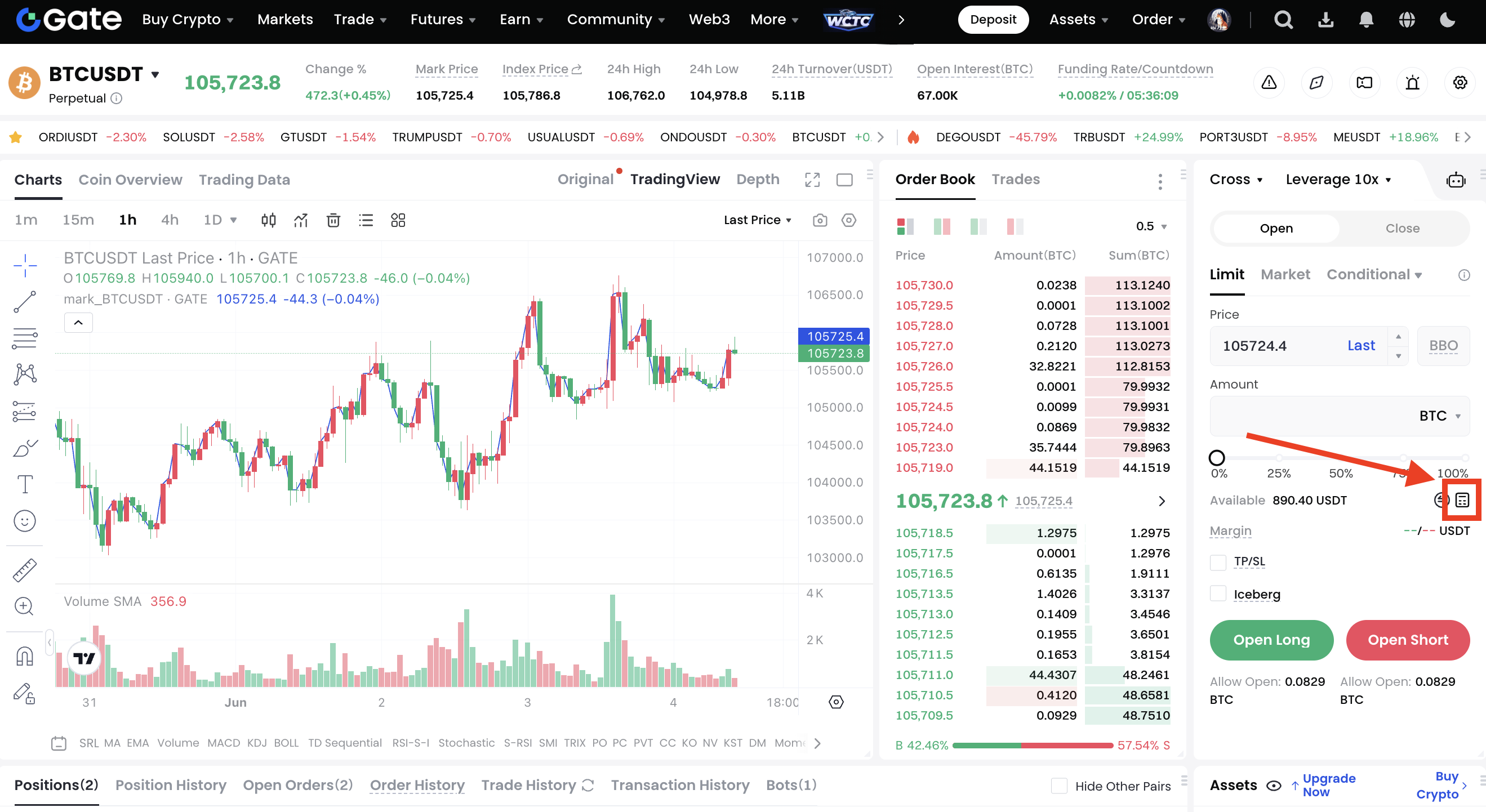
The specific margin can also be calculated on the order page using the Contract Calculator, which is more convenient and fast.
How to view and manage initial margin?
Account Information Page: Log in to the exchange account and go to the account information page to view current positions and required initial margin.
Trading page: When placing an order, the system will automatically calculate and display the required initial margin.
Contract Calculator: Some exchanges provide contract calculators, where users can input the position value and margin ratio to automatically calculate the required initial margin.
Transfer in extra funds: In order to ensure that the position is not forcibly liquidated, users can deposit additional funds at any time to increase the margin balance.
The Importance of Maintaining Margin
The setting of margin maintenance is designed to protect the exchange and other traders from potential losses. When the market price is unfavorable to the holder, if the account margin is insufficient to maintain the position (i.e., the current maintenance margin ratio ≤ 100%), the forced liquidation mechanism will be triggered to close part or all of the positions to avoid greater losses.
Calculation of Maintenance Margin
The amount of maintenance margin is related to the position value and maintenance margin ratio, and the maintenance margin ratio is related to the risk limit.
The specific formula is as follows:
Mode
Formula
Isolated Margin Mode
Single position maintenance margin = Position value × Maintenance margin ratio + Closing fee
Margin Rate = Total Margin Balance ÷ Maintenance Margin
Example calculation:
Assuming a user opens a long position for ETH_USDT worth 100 USDT with 100x leverage, a maintenance margin ratio of 0.5%, and a liquidation fee of 0.075%. The calculation for the maintenance margin of the user’s position is as follows:
The initial margin for this position is: (100 ÷ 100) + 100 × 0.075% = 1.075 USDT
At this time, the margin ratio of this position = (1.075 + 0) ÷ 0.575 × 100% ≈ 187%
Forced Liquidation Mechanism
When the account margin falls below the maintenance margin (i.e. maintenance margin rate ≤ 100%), the exchange will activate the forced liquidation mechanism to reduce potential losses.
How to manage maintenance margin
To avoid forced liquidation, users should regularly monitor their account margin and take the following measures:
Additional Margin: Deposit more funds in a timely manner when the account margin is insufficient.
Reducing Position: Reducing the position to lower the maintenance margin requirement.
Using stop-loss orders: set a stop-loss price to automatically sell and limit potential losses.
Lower leverage: Reduce leverage ratio and increase error tolerance.
Confirm Risk Tolerance
Before trading a contract, it is important to understand the proportion of the single loss amount to the total account funds. For example, if trading once a day, the single loss amount should be controlled within 10% of the total assets, so that only 10 consecutive losing trades will result in a complete loss of all the money in the account. This is unacceptable for contract traders.
But if we control the proportion of single loss to the total account to 5%, 3% or even 1%, the probability of losing all the capital will be greatly reduced.
Strictly implement the contract trading plan
A complete trading plan typically includes the following key points and can be adjusted according to the cryptocurrency market conditions. The overall logical framework is applicable. Start with the macro cycle to determine the current stage of the market, then focus on technical analysis to find opportunities, and finally, have a detailed operational plan for specific trading targets.
Position management
After confirming the risk tolerance, good position management can be achieved by adopting rectangular position management, funnel position management or pyramid position management.
Dynamic take profit, static stop loss, maintain a good mindset, avoid FOMO emotions
The market is volatile and unpredictable, with a probability of less than 5% of being correct for five consecutive times.
Investment itself has no risk, but uncontrolled investment is the biggest risk;
Strictly setting “stop loss and take profit” in contract trading is the discipline of excellent traders. Every position opening should have a logical reason, and a stop-loss should be set for every position opening. Using dynamic take profit and static stop loss methods to limit the risk exposure and allow profits to run. Being able to strictly execute the trading plan within one’s own risk tolerance, allocate position funds reasonably, and set stop loss and take profit for each transaction, the holding mentality will naturally be relaxed, and it can also better cope with various unexpected market conditions.
Summary
Margin in futures trading is like the ‘ballast’ in the ocean of financial transactions, playing a crucial role in different markets with various types and calculation methods. Poor management of margin risks can turn leverage into a ‘deadly scythe,’ but using it wisely can lead to ‘small bets for big wins.’ Investors must fully understand the rules, carefully set leverage, use stop-loss and take-profit orders skillfully, allocate funds scientifically, always respect the market, in order to harness the power of margin in the ever-changing market conditions, sail towards the shore of wealth appreciation, and achieve investment ideals.
FAQ
What are initial margin and maintenance margin?
Initial margin is the minimum margin amount required to open a position, while maintenance margin is the minimum margin amount that needs to be maintained during the holding period. Together, they form the risk control system for contract trading.
What is the difference between margin calculation for full and isolated margin modes?
In full margin mode, all available funds in the user's account can be used as margin, while in isolated margin mode, each position is calculated separately, with profits and losses not affecting each other, and the calculation methods are also different.
How to avoid forced liquidation in contract trading?
Traders can avoid forced liquidation by ensuring their account margin is higher than the maintenance margin requirements through methods such as adding margin, reducing positions, setting stop-loss orders or lowering leverage multiples.
How are fees calculated for contract margin?
Contract margin fees are usually included in the opening/closing costs. The specific fee rate depends on the exchange rules and trading variety, and can be viewed through the contract calculator or trading page.
What impact does leverage have on margin?
Higher leverage requires lower initial margin, but at the same time, it will amplify potential profits and risks. Traders need to choose the appropriate leverage multiple based on their own risk tolerance.
Author: Frank
Reviewer(s): Wayne, Jayne
Disclaimer
* The information is not intended to be and does not constitute financial advice or any other recommendation of any sort offered or endorsed by Gate.
* This article may not be reproduced, transmitted or copied without referencing Gate. Contravention is an infringement of Copyright Act and may be subject to legal action.
DEX aggregators integrate order data, price information, and liquidity pools from multiple decentralized exchanges, helping users find the optimal trading path in the shortest time. This article delves into 8 commonly used DEX aggregators, highlighting their unique features and routing algorithms.
The report shows that in Q1 2026, the crypto market will reach a stage of structural maturity, with Derivative trading making up more than 90% of total trading volume, exceeding $20 trillion. As Spot demand weakens, liquidity will become even more concentrated in top exchanges, reflecting a more cautious market sentiment and a shift toward leveraged and institutional trading.