In everyday talk, each launch is often called a clank—new clanks appear as fixed-supply ERC-20 markets with locked liquidity. If you first want a clean split between the launchpad and the ecosystem token, the rest of the guide is easier to follow. Cast, wizard, and Preclank parameters are in how to launch a token with Clanker; launchpad contrasts come later. Per Clanker’s ecosystem page today, tokens launched are about 1.5M+, all-pool volume about $30.8B, Clanker pool volume about $6.8B, and fees about $82.9M—scale markers, not a quality signal for any single clank. Check Clanker docs and analytics when those aggregates refresh.
Key Takeaways
- Clanker is a multi-chain EVM token launcher (Base-first); CLANKER (often listed as tokenbot) is a related ecosystem token, not Farcaster’s official coin. Each clank is a separate market with its own demand path.
- A typical Clanker path: fixed-supply ERC-20 → optional vault → default WETH pool → permanently locked LP → swap fees to creators and the platform.
- Older Clanker builds mostly split pool fees; v4 adds an ~20% platform fee on top via a Uniswap v4 Clanker hook.
- CLANKER’s capped units are about 1,000,000; protocol revenue can fund buyback-and-hold, but holding does not automatically grant governance or revenue rights, staking rewards, or selling privileges.
- LP lock reduces liquidity-pull risk, yet does not remove contract, impersonation, thin-liquidity, or demand risk for traders and other market participants.
What Is Clanker, and Is It the Same as tokenbot (CLANKER)?
Clanker and tokenbot (CLANKER) are related but sit on different layers: the first is a launch product; the second is an ERC-20 on Base.
Who founded Clanker? Clanker was built primarily by Jack Dishman (@proxystudio.eth) with a simple goal: let users launch a token from a Farcaster cast or a web form. Older bot handles moved to @clanker_world (some legacy pages still say “USED FOR TESTING NOW”); for live launches, tag the current @clanker in the docs—not expired accounts.
Clanker is an AI-powered token launcher, Base-first, with coverage across BNB Chain, Ethereum, Monad, and other EVM networks. After a cast or form request, the protocol mints the token, opens a pool, and locks liquidity into a locker with no withdraw path. On Base, lower transfer fees help the default pool become tradable without a separate liquidity-bootstrap step.
tokenbot (CLANKER) is an ecosystem reference coin and one of the early Clanker launches; CoinMarketCap, Gate, and similar sites often show the name tokenbot with ticker CLANKER. It is a Base ERC-20 linked to platform-fee buybacks—not a separate exchange product and not a staking certificate. Holding CLANKER does not automatically grant governance votes, revenue share, redemption, or platform service access—Gate’s price page says the same. People sometimes blur Clanker the launcher with CLANKER the coin; treat them as two layers.
What Actually Happens When You Launch with Clanker—from Cast to Trading Clanker in a Tradable Pool?
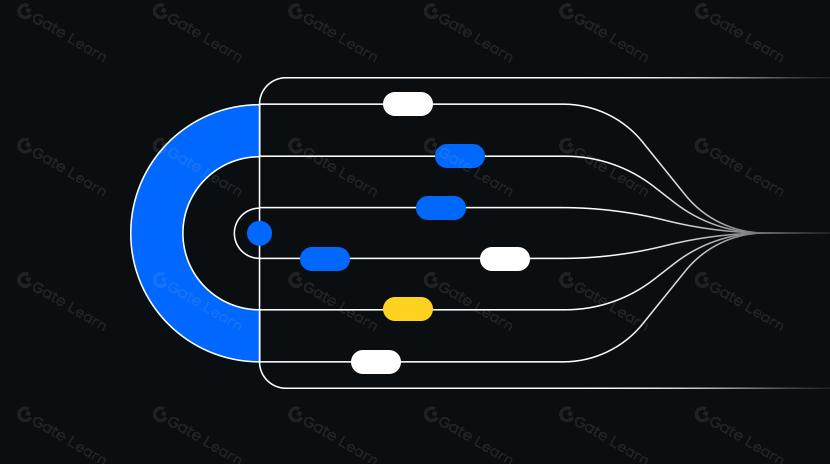
A standard Farcaster bot path turns an idea into a tradable market, not an empty contract. How Clanker Works in practice is a short pipeline: request → mint → optional vault → pool → permanent LP lock, with fee sinks updating after trading begins. Creating tokens this way keeps the smart contract path consistent across Clanker entrances.
Following Farcaster Bot Deployments:
- Request — Tag @clanker with name and ticker; optional vault (common max/default 30%, minimum about 31 days). Tagging needs a clear cast so the agent can parse the clank name without follow-up prompts.
- Mint ERC-20 — Non-mintable; docs commonly use a fixed 100 billion units for each clank.
- Fund vault (if enabled) — Move the chosen share to the creator vault; the rest stays pool-side.
- Open pool — Default WETH quote (Uniswap v4 on newer versions); remaining units as single-sided liquidity, with a documented starting market-cap example of 10 WETH.
- Lock LP forever — LP NFTs enter the Clanker LP Locker with no withdraw function. Clanker launches then settle on Base’s proof-of-stake consensus mechanism.
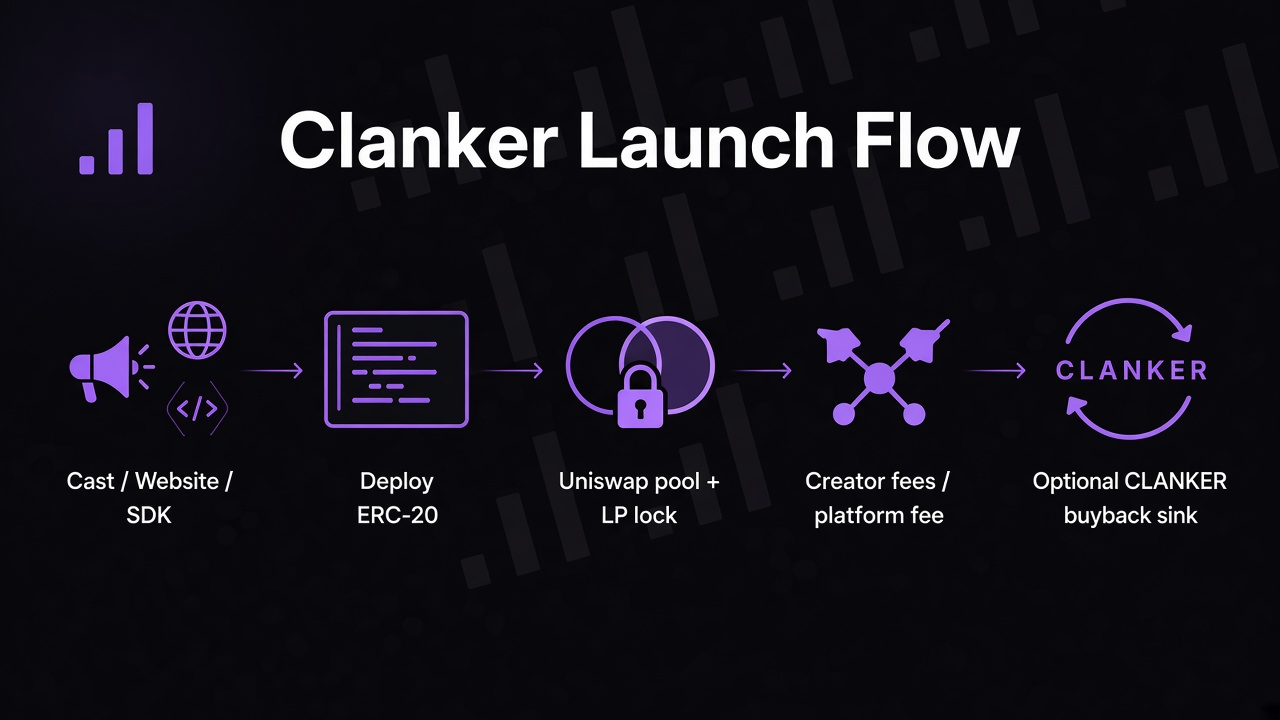
Figure 1. Educational flow from Cast / Website / SDK path through pool creation, LP lock, creator fees, and an optional CLANKER buyback sink.
LP lock constrains liquidity withdrawal only—it does not guarantee fundamentals, external bids, or bug-free contracts and front ends, so broader security claims still do not remove contract or market risk. Deploy your token via the Clanker website wizard when you prefer forms over casting; the same pool and locker goals still apply. Over time, docs may update defaults, so re-read fee notes each time you use Clanker.
Which Entrances Can You Use—Farcaster, Website, and Preclank?
Parallel Clanker entrances differ in UX and configuration depth, not in a wholly different tokenomic model. Readers who find the social path noisy can still create a clank through the wizard or SDK.
Farcaster @clanker. Name and ticker in a cast (optional image) use recommended fee and liquidity defaults; the same cast can name a non-WETH quote. Success returns a token-page link; unclear requests get clarifying prompts; blocked requests get a reason. Clank launches on this path still use the same day-one LP lock.
Website wizard. Connect a wallet to configure vaults, airdrops, or creator buy options visually, then publish, which is helpful for users who want a more guided configuration flow than casting. The UI can list vault percentages and fee defaults before you confirm.
SDK / contract integration. Embed Clanker launch capability inside apps or agents with seamless integration, making automated clank launches possible without a manual cast each time.
Preclank. Save a config and trigger phrase, then cast that phrase while tagging @clanker. Requires Farcaster sign-in; phrases are case-sensitive; creator buy is documented as not yet supported. Update the saved config when tickers or vault shares change before the next trigger day.
How Do Creator Rewards and Protocol Fees Split—and How Do v3 and v4 Differ?
Creator rewards come from pool swap fees, but the platform cut depends on contract version—so a single 40%/60% rule cannot describe Clanker. Fee math is one of the forces driving how creators compare older clanks with v4 Clanker launches.
Clanker Analytics Methodology frames the chain as: traders pay a pool fee (often ~1%) → shares go to creators / launch apps / other recipients and the platform by version → platform revenue is booked separately from later cash flow (withdrawals, sweeps, buybacks).
| Version |
Pool type |
How the platform is paid (summary) |
| v0 |
Uniswap V3 |
Share of pool fees: platform ~50%–75% (most ~60%), remainder to creator |
| v1–v3 |
Uniswap V3 |
Common 60% team share / 40% creator; on v2/v3 overrides, partners may take part of the team share |
| v3.1 |
Uniswap V3 |
Platform ~20%; remainder split between creator and launch app |
| v4.0 / v4.1 |
Uniswap v4 + hook |
Pool fees to up to 7 reward slots; hook adds ~20% platform fee on top |
Methodology example: on a $1,000 trade with a 1% pool fee, about $10 goes to fee recipients and about $2 is the platform fee. Farcaster bot docs also note ~80% of LP fees as creator rewards on that path (still subject to version and slots). Separate Trading fees from Platform revenue when reading Clanker dashboards; total platform take can differ by version even when pool fee looks the same.
What Is CLANKER Used For, and How Do Buybacks Tie to Platform Revenue?
CLANKER acts as a reference asset and income sink—not an equity certificate that controls Clanker. What Is the CLANKER Token Used For? In practice it is mainly a Base ERC-20 people transfer, observe on price pages, and sometimes see as the destination of protocol buybacks funded by platform fees—not a key that unlocks deployer privileges for a new clank, and not a buy tokenbot shortcut that replaces reading Clanker docs.
CLANKER supply and tokenomics stay simple on paper: total units / max units are capped near 1,000,000 with no further minting; burns can leave circulating units lower, which also changes how trackers compute market cap and fully diluted figures for token holders. The commonly cited Base canonical address is 0x1bc0c42215582d5A085795f4baDbaC3ff36d1Bcb (verify before interacting). Ecosystem stats surface bought back, treasury, burned figures, and on-chain holder activity when you update dashboard views over time. Third-party charts may also list ALL TIME HIGH, all time low, Clanker price history, or 24 hours trading volume in real time—useful context, not a substitute for reading Clanker fee rules. Headline pieces such as “CLANKER Jumps 350% After Farcaster Acquires the AI Token Launchpad” describe short-term market moves around acquisition news; they are not a fee-version guide and are neutral on whether any holder should buy or keep selling.
Buybacks tie to platform revenue: a fee sink pulls platform fee shares and spends them on CLANKER purchases and USDC conversions—post-earning cash flow. Holding supports transfers in Base-capable wallets and observation on venues such as Gate’s tokenbot (CLANKER) price page, without changing the “holding ≠ platform rights” boundary. Free education pages should emphasize mechanism first; exchange listings and trading venues are secondary observation layers.
Where Does Clanker Stand vs Other Launchpads—and What Are the Limits and Risks?
Differentiation usually sits in agent-led / social entrances plus permanent LP lock and multi-entrance configuration—not guaranteed token quality. Clanker tooling here is the interface layer, not a promise about any single clank’s fundamentals. Attention cycles and meme day volume are often driving which clanks trend briefly, independent of fee design. Social virality can keep driving short-time spikes even when the Clanker stack stays unchanged.
Versus pump.fun’s bonding-curve path or Virtuals Protocol’s agent-economy stack, Clanker sits closer to Base / Farcaster instant ERC-20 + Uniswap rails; Clanker vs other launchpads breaks apart chain, entrance, and liquidity models. Strengths include no-code speed, default LP lock, ongoing creator rewards, Preclank / SDK, and multi-EVM reach for users who want to create tokens quickly.
Limits: social launchpads are noisy; fee rules bind for a token’s life; some historical chains remain analytics-only; Preclank still lacks creator buy. Risks: LP lock ≠ unmanipulable or zero-proof; contracts, spoofs, thin pools, and fading attention each move outcomes separately. Anyone trading a clank still needs an independent smart-contract and liquidity check beyond the Clanker brand; place research ahead of social FOMO and set risk tolerance before interacting. Security reviews, community diligence, and neutral comparisons beat hype about investments.
What Are the Common Misconceptions?
Myth 1: CLANKER is the official Farcaster token. Entrance overlap is not official Farcaster protocol or client issuance.
Myth 2: Clanker and CLANKER are interchangeable. The former names the launcher; the latter names the token—app features are not holder equity.
Myth 3: Locked LP equals rug-proof. It reduces liquidity-pull exits, not bugs, phishing sites, thin-pool noise, or other harmful behavior.
Myth 4: Every Clanker launch forever splits fees 40%/60%. Rules evolved across v0–v4.1; v4 adds a pool fee + ~20% platform fee structure.
Myth 5: Ecosystem-scale volume pays CLANKER holders automatically. Volume / Fees are aggregates; creator and holder cash flows differ. A long list of clanks with high total volume does not mean every holder of CLANKER receives a share, staking yield, or selling rebate.
Summary
Clanker compresses cast or form parameters into a tradable ERC-20 market on Base and other EVM chains: fixed units, default WETH pairing, permanently locked LP, and versioned fee splits. tokenbot (CLANKER) can receive protocol-driven buybacks tied to platform revenue, yet holding does not automatically confer governance or revenue rights. Treat each clank as its own market with its own demand path. Clanker remains a launcher first; CLANKER remains a reference coin second.
Separate Clanker mechanics, fee versions, and asset disclosure before any hands-on launch or secondary-market observation. Take time to match the contract version of each clank with the analytics methodology before drawing fee conclusions about trading Clanker markets.
FAQ
Frequently asked questions about Clanker, clank launches, and tokenbot (CLANKER) are summarized below.
What is Clanker crypto?
Clanker is a token launcher on Base and other EVM chains. Users create ERC-20s—commonly called clanks—through the Farcaster bot, website wizard, SDK, or Preclank; Clanker opens a pool, locks liquidity permanently, and lets creators share trading-related fees under version-specific rules.
What is tokenbot (CLANKER), and what is its supply cap?
tokenbot (CLANKER) is the Base ERC-20 tied to the Clanker ecosystem; venues often display the name tokenbot. The capped units are about 1,000,000, with burns able to leave less in circulation. It is a reference asset and buyback sink—not an equity claim on Clanker. CLANKER supply and tokenomics do not grant automatic rights over individual clank launches.
How do I launch a token with Clanker?
Tag @clanker on Farcaster with a name and ticker, or use the clanker.world wizard; Preclank can store a config for a later trigger phrase. Defaults create a fixed-unit token, a WETH pool, and permanently locked LP. Deploy your token only after confirming vault share, quote asset, and fee version for that day. Optional creator buy settings depend on the entrance.
Is CLANKER the Farcaster token?
No. CLANKER can be reached through Farcaster entrances tied to the Clanker bot, but it is not the official network token of the Farcaster protocol or clients.
How do Clanker creator rewards and platform fees work?
Traders first pay a pool fee (often ~1%). On older versions (v0–v3.1) the platform mainly takes a share of that pool fee (about 20% on v3.1). On v4, the hook adds ~20% platform fee on top, while the pool fee splits across up to seven recipients including the creator. Match the Clanker launch version to analytics methodology when making fee comparisons across clanks.