A short description of each job is enough for a PumpFun vs Clanker quick comparison before fees enter the frame. Choose by aligning chain, entrance, and liquidity model before comparing fees or creator incentives. The launcher-versus-tokenbot (CLANKER) split is already covered in the Clanker product vs token boundary; this page only contrasts mechanisms side by side and does not repeat the full product overview. Token creation volumes across launchpads still bounce between Base and Solana from month to month, so the landscape description stays mechanism-first rather than brand-rank first.
It suits intermediate readers running a commercial investigation across AI / social launchpads after they already understand basic token-launch vocabulary. Later sections cover positioning, chain and social layer, liquidity and fees, scenario fit, and shared risks with compact tables—useful when @clanker sits beside pump.fun and other venues in the same SERP set.
Key Takeaways
- Clanker: Base and other EVMs plus Farcaster / web / SDK, with an instant pool and permanent LP lock by default.
- pump.fun: Solana plus app / social clients, with bonding-curve discovery before PumpSwap graduation.
- Virtuals: Base agent launches paired with VIRTUAL, then Uniswap V2 migration with a long LP lock.
- Fees bind to version, curve stage, or modules—one percentage cannot describe all three.
- Fit the scenario, not the slogan; locked LP does not erase contract, spoof, or demand risk.
What Problem Does Each Launchpad Solve? (One-Line Positioning)
Clanker vs pump.fun is not a close substitute choice: Clanker launches ERC-20 tokens on Base and other EVM chains with an instant Uniswap pool and permanently locked liquidity, while pump.fun launches on Solana through a bonding curve that later graduates to PumpSwap. They target different chains, liquidity models, and user audiences, so the real decision is less “which is better in general?” and more “do you want the Base/EVM social-token path or the Solana memecoin curve path?”
| Platform |
One-line position |
Typical reader question |
| Clanker |
AI / social token launcher on Base / EVM |
Can a cast or wizard open a pool immediately? |
| pump.fun |
Solana memecoin bonding-curve launcher |
When does the curve graduate, and where does it trade next? |
| Virtuals Protocol |
AI-agent tokens plus VIRTUAL capital-formation layer |
How does an agent launch reach durable liquidity? |
If you are a crypto builder, creator, or active user deciding where to launch, trade, or evaluate a social token, that split matters immediately: the chain, launch flow, liquidity engine, creator economics, and social environment all change your odds of traction, the depth and timing of liquidity, the fees you can earn or pay, and the risks you take on. This comparison focuses on the decision points that actually separate Clanker and pump.fun—chain support, launchpad entry methods, instant-pool versus bonding-curve liquidity, creator incentives and fee structures, social layers, and the main risk factors—so you can choose the better fit between Base/EVM and Solana launch ecosystems. Neighbor names on the same map—Zora on Base, LetsBonk / BONK-linked Solana venues, Bags as a social-first dark horse, or WOW and Ape.store style alternatives—still fall under the same chain-first filter rather than a single “best Solana launchpad” slogan. In clear terms: Bonk-driven Solana flows, Bags-driven social mint experiments, and Base Coinbase L2 content feeds are different categories of distribution, not interchangeable blockchain services.
Independent research on launchpad content should treat fee terms, pool terms, and graduation terms as separate information layers. The result shown in any dashboard is only as useful as the contract set behind it; making venue choice on brand heat alone is a weak result when the same research shows lower or higher volumes week to week. Over a longer time horizon, community-driven Bonk narratives and Bags-style social launches can manage attention for a short period, then leave thin liquidity—important barriers that no small UX improvement fully removes.
How Do Chain, Entrance, and Social Layer Differ? (Base/Farcaster vs Solana/Clients vs AI-Agent Launchpad Economy)
Chain and entrance decide audience and tooling before brand names do. A launch that looks similar in a screenshot can still settle on different rails, quote assets, and social surfaces. Base vs Solana launchpad traffic in recent months often rearranges day by day without changing those rails, and Base expansion versus Solana memecoin narrative cycles can raise or cool token creation volumes in the same period. Coinbase’s Base chain processes high on-chain transactions at peak times; that infrastructure context matters when highlighting why Clanker and Virtuals sit in the Base category while pump.fun stays Solana-native for the retail trader.
Clanker. Base-first across multiple EVMs; entrances include Farcaster @clanker, the website wizard, SDK, and Preclank. The social layer sits inside Farcaster casts, so launch requests can live in the feed rather than only on a standalone mint page—providing day-one Uniswap routing visibility when the cast path succeeds.
pump.fun. Solana is the home chain; the entrance is the platform app, widely embedded in social clients and trading bots. The social layer skews toward memecoin discovery, timeline virality, and high-velocity distribution across third-party interfaces, providing bonding-curve discovery before graduation depth appears.
Virtuals Protocol. The main path is Base with VIRTUAL-paired launches; the entrance is agent creation plus toggleable modules on the Virtuals platform. The narrative layer centers on agent products and capital formation—not ticker memes alone—so module choices matter as much as the ticker string, providing VIRTUAL-paired curve depth before Uniswap V2 migration. That AI-agent narrative is why Clanker and Virtuals Protocol often appear together when readers ask what drives Base’s growth.
All three can be labeled a social token launcher or AI token launchpad in search queries, but “social” means different surfaces in practice: a Farcaster bot inside a protocol feed, Solana client and bot traffic, and agent launch pages are not substitutes for one another. Ask first where users live and which entrance shows the mint request—then compare fee percentages. Neighbor venues on Base or Solana (including other social-first launchers) still share this entrance filter even when monthly volumes rotate across each ecosystem. Main launchpads on Base for social and memecoin paths still compete on entrance UX more than on a shared price engine.
How Do Liquidity, Fees, and Creator Incentives Compare?
Liquidity models decide when depth appears and who can move the pool; fee models decide which trade segment funds creators. Read both together: a generous creator cut on a thin curve stage is not the same product as a locked Uniswap pool with versioned reward slots. How do the fees compare in practice? Business-model simplicity (curve then graduate) versus innovation (instant pool hooks, agent modules) functions as the useful split—not a single headline percentage. For trading volume, public-dashboard magnitude snapshots evolve quickly: Pump.fun daily volume is often cited around the hundreds-of-millions-USD order (e.g., about $400 million on some days), while Clanker’s daily volume is often cited in a lower tens-to-low-hundreds-of-millions band (e.g., about $30–$100 million)—treat these as magnitude hints that change, not a permanent ranking or trade advice. Confirm fee math against Clanker Analytics Methodology, pump.fun docs, and the Virtuals whitepaper rather than a frozen slogan. The liquidity description below is the chart of record for this comparison—not a live price chart.
| Dimension |
Clanker |
pump.fun |
Virtuals Protocol |
| Liquidity start |
Default Uniswap pool at deploy (newer builds often use v4) |
Bonding-curve trading |
VIRTUAL-paired bonding curve |
| Graduation / migration |
Usually no curve-graduation gate; tradable at launch |
Atomic move to PumpSwap after the threshold |
Migration to Uniswap V2 after ~42,000 VIRTUAL liquidity |
| LP constraints |
Permanent LP lock (no withdraw path) |
Canonical post-graduation pool held via protocol path |
Long LP lock after graduation (docs state ~10 years) |
| Fee structure |
Pool fee often ~1%; platform cut varies across v0–v4.1; v4 hook can add ~20% platform fee atop the pool fee |
Curve total fee ~1.25% (~0.30% creator + ~0.95% protocol); PumpSwap creator share tiers by market-cap band |
Trading tax commonly 1%: ~70% creator / ~30% Treasury |
| Creator incentive |
Ongoing pool-fee / reward-slot share by version |
Curve and PumpSwap creator fees accrue and must be claimed |
Creator share accrues; Fee Delegation can assign the recipient |
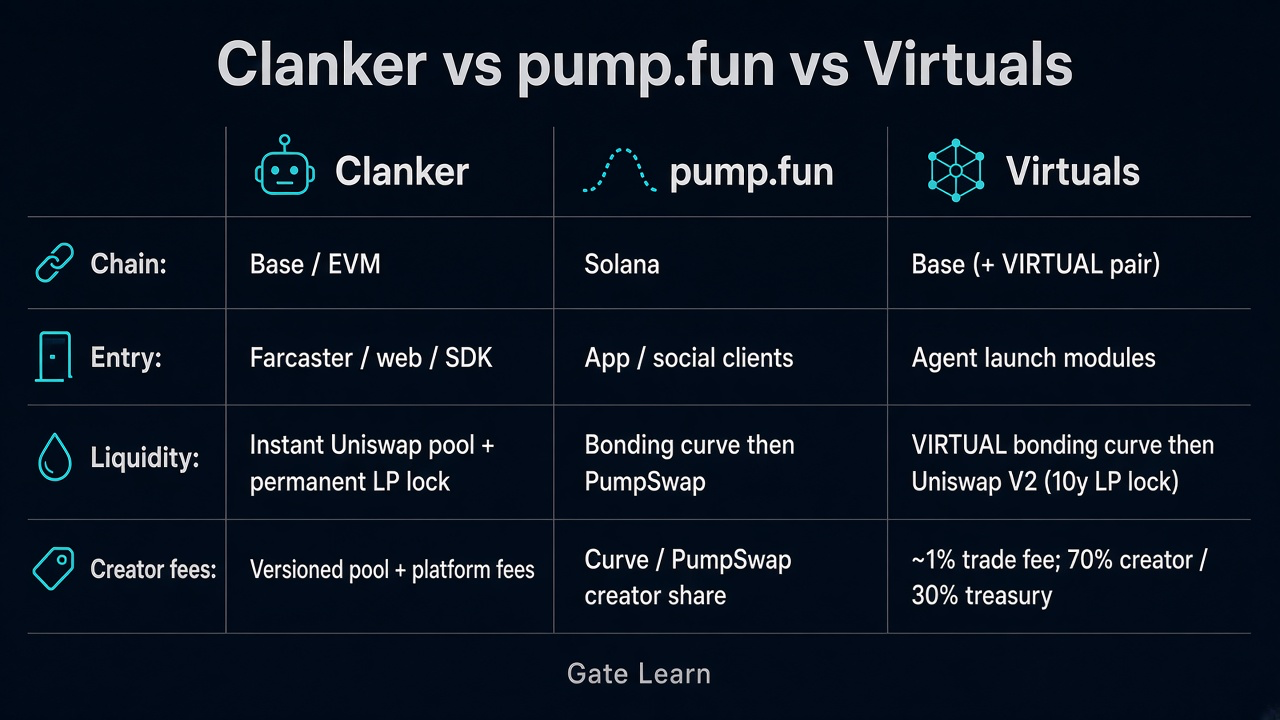
Figure 1. Side-by-side comparison chart of Clanker, pump.fun, and Virtuals across chain, entry, liquidity model, and creator fees.
Clanker emphasizes an instant pool, permanent LP lock, and versioned fees—useful when Base DEX routing visibility and reduced liquidity-pull exits matter most. Active pool depth on day one still depends on the deploy parameters, not on a later graduation phase. Fee rules bind for that launch version; separate Trading fees from Platform revenue when reading Clanker analytics methodology rather than treating every dashboard number as creator cash flow. Day-one pool depth is set at deploy, so early chart readings reflect Uniswap routing rather than a pre-graduation curve price path.
pump.fun emphasizes curve discovery → automatic graduation: early price discovery follows curve reserves during the bonding phase, where trading begins before migration into a liquidity pool, and the bonding curve is also designed to help mitigate insider sell pressure before graduation, then depth and creator-fee tiers switch to PumpSwap rules. Creator fees accrue per platform docs and require an explicit claim. Graduated liquidity acts as a structural moat—Pump.fun’s comeback story is often told as liquidity-as-a-moat once volumes concentrate on PumpSwap, and its token volume has reached about $7.5 billion; curve volumes and post-graduation volumes still need separate reading. Virtuals emphasizes agent + VIRTUAL curve + long LP lock period; optional anti-sniper tax windows and Fee Delegation can change early tax rates and which identity receives the creator share. Across months of module revisions, that fee description should be re-checked against current docs rather than a frozen slogan.
Who Is Each Best For—and How Should You Choose by Scenario?
Pick tools by scenario fit, not by which brand is loudest on timelines. The same team can use different venues for different audiences without implying that one launcher “beats” the others in every metric. Scenario description beats a ranked “top AI agent launchpad coins by market cap” list when the brief is about settlement path, not ticker heat—highlighting rails over leaderboard expansion.
Choose Clanker if: the audience lives on Base / Farcaster; you need cast, web, or SDK deployment of an ERC-20; you want Uniswap tradability at launch with default LP lock; you can map fee expectations to the specific launch version; and a one-token-per-day creation limit is acceptable. Cast, wizard, and Preclank checks follow how to launch a token with Clanker. Set expectations for permanent LP lock and versioned pool fees before mint day.
Choose pump.fun if: users and liquidity habits sit on Solana; you accept bonding-curve discovery before graduation; distribution rides clients / bots; creators will claim curve and PumpSwap fees under platform rules and understand that create fees and trading fees are separate line items. Set the graduation threshold check as a first-day workflow item, not an afterthought. Its scale also includes 41,716 token launches, which fits teams that do not want to limit themselves to low-throughput meme flows.
Choose Virtuals if: the story centers on an AI agent rather than a pure meme ticker; you need VIRTUAL pairing and modular capital formation; you accept the graduation threshold and long LP lock; Fee Delegation may route incentives to the real builder instead of the wallet that clicked create. Set module toggles carefully so the agent launch description matches the capital-formation path you intend.
If the brief requires both “Farcaster cast mint” and “Solana curve graduation,” no single venue wins both—split the decision by chain instead of forcing one launch to cover two audience habits and two liquidity-migration rulebooks. Navigating launchpad rivalry still means matching chain first, then reading volumes and chart liquidity as secondary checks.
What Shared Risks and Selection Mistakes Should You Avoid?
Shared risks come before brand differences: smart-contract and front-end risk, spoof sites and fake tokens, thin-liquidity slippage, fading social attention, and reading ecosystem-wide volumes or fee totals as if they were personal cash flow for creators or CLANKER holders; community engagement can disappear quickly after launch, raising liquidity and visibility risk. Risk description belongs next to fee description—not after a promotional chart, and readers should apply due diligence instead of leaning on launchpad popularity or ecosystem-wide numbers alone. Navigating the launchpad wars still means testing whether you can interact with the documented front end and contract set before trusting any trader-facing dashboard.
Mistake one: treating CLANKER as the official Farcaster token, or merging the Clanker launcher with the tokenbot (CLANKER) asset. Holding CLANKER does not automatically equal governance, revenue share, redemption, or platform service rights.
Mistake two: equating “locked LP” with “rug-proof.” Permanent or decade-long locks constrain liquidity withdrawal only—they do not remove bugs, hostile parameters, phishing sites, thin-pool distortion, or trade manipulation.
Mistake three: comparing all three with one stale fee slogan. Clanker spans v0–v4.1; pump.fun differs between curve and PumpSwap tiers; Virtuals adds modules and anti-sniper windows. When unsure, state mechanism differences—do not invent precise market share or a forever 40/60 split that no longer matches every contract generation. Fee parameters can shift across months without a loud headline on the same trading day.
Mistake four: optimizing only creator-fee percentages while ignoring quote asset (WETH / SOL / VIRTUAL), graduation conditions, traffic source, and token issuance mechanics is a weak selection strategy—those variables often move outcomes more than a few tenths of a percent in headline fees. For example, Pump.fun facilitated 21,505 new tokens in a single day, but that kind of volume can still mislead investors if they skip contract and domain verification. A secondary chart of creation volumes does not replace verifying the contract set and front-end domain for the launch you actually open.
Summary
Clanker, pump.fun, and Virtuals Protocol share the launchpad category but optimize different jobs: Base social instant pools, Solana curve graduation, and AI-agent + VIRTUAL capital formation inside Base’s ecosystem. Compare chain and entrance first, then liquidity migration and creator incentives, and only then fee decimals; that is the right frame now, and in the future the likely winners in the next phase of on-chain launches will depend more on chain fit and core infrastructure than short-term hype.
A compact choice frame: Farcaster / Base instant pools → Clanker; Solana meme curves → pump.fun; agent capital formation → Virtuals. None of these frames is buy, sell, or participation advice—verify contracts, front ends, quote assets, and current documented fee parameters independently before any launch or secondary-market observation. Re-read the mechanism description on a quiet day as carefully as on a high-volume day, and weigh Clanker through Base’s broader infrastructure, network effects, and key metrics rather than only short-term launchpad heat. Potential upside narratives run longer than operational readiness: improve the checklist first—domains, fee terms, and who can manage LP—then read any chart information shown afterward.
FAQ
Clanker vs pump.fun — what’s the difference for meme coins?
Clanker mainly deploys ERC-20s on Base and other EVMs via Farcaster / web / SDK, opening a Uniswap pool by default with permanently locked LP. pump.fun prices and trades on a Solana bonding curve first, then migrates to PumpSwap after graduation, so the launch and trading process differs from an instant pool launch. Chain, liquidity path, and fee rules all differ—they are not drop-in replacements. Venue choice should follow where the user community already is on-chain and socially, not brand heat alone. A one-paragraph description of rails beats chasing day volumes on either venue.
What is Clanker used for in token creation?
Clanker is an AI / social-driven token launchpad used for token creation and to create tokens with lightweight setup: it turns names and parameters into a tradable ERC-20 market and splits trading-related fees to creators and the platform under versioned rules. In one 30-day stretch, Clanker generated approximately $9.7M in protocol revenue. It also facilitated the creation of about 8,000 meme coins in its first month, which shows the scale of token creation it enables and the early adoption that can come from a built-in user base around Base/Farcaster-style launch flows. It solves launch and pool setup—not demand, distribution quality, or secondary-market performance. Providing an instant pool does not equal providing lasting attention.
Is Clanker safe?
No launchpad is absolutely safe. Clanker’s permanent LP lock can reduce liquidity-pull exits, yet smart-contract, spoof-front-end, thin-liquidity, and demand risks remain. Check official domains, contract addresses, and the launch version’s fee rules, and evaluate project fundamentals separately before you interact with any mint surface. Thin chart depth in the first months after a quiet mint is still a liquidity risk.
How does Clanker work on Farcaster?
Users can tag @clanker in a cast with a name and ticker (optional image or other parameters), using a token creator flow on Farcaster rather than a Twitter-style posting workflow while still launching by tagging the bot directly in the post. The bot follows documented paths to deploy the token, set default liquidity, and reply with a token-page link and launch data; this is designed to keep token creation lightweight from within the social feed, while unclear requests get follow-ups and blocked requests get a reason. Farcaster is one entrance—it does not make CLANKER the official Farcaster token. The cast path sits inside a broader social launchpad ecosystem of clients and bots.
What is tokenbot (CLANKER)?
tokenbot (CLANKER) is the Base ERC-20 tied to the Clanker ecosystem; venues often display the name tokenbot with ticker CLANKER. In that context, the broader ecosystem has included breakout tokens such as $GOAT, for instance, which reached a market capitalization of $1.3 billion, but that example reflects ecosystem success rather than any holder right attached to CLANKER itself. It can act as a reference asset and participate in platform-fee buyback flows, but holding does not automatically grant governance or revenue rights, and it is not Farcaster’s official network token. Asset description and launcher description must stay separate when reading any chart or volume panel, since CLANKER reflects that ecosystem reference role rather than a claim on its future.