Casper Network is a proof-of-stake (PoS) Layer-1 public blockchain built for regulated real-world assets (RWA) and machine commerce, with CSPR as its native token. Mainnet launched around March 2021. Public materials position Casper Network as infrastructure where institutions can bring assets onchain under enforceable rules, and where autonomous systems can operate through accounts as economic actors—not only as a venue for crypto-native speculation.
Compared with probabilistic finality models that treat “more confirmations” as higher confidence, Casper Network—from Casper 2.0 onward—uses Zug consensus to pursue deterministic finality once a block reaches quorum. The contract layer highlights upgradable contracts, protocol-level access control, and a Rust/WASM path with mainstream-language SDKs. The sections below cover definition, consensus, contracts, token utility, use cases, differences versus Ethereum, and common risks or misconceptions.
What Is Casper Network, and How Does It Relate to CSPR?
Casper Network is the chain layer that produces blocks, finalizes state, executes contracts, and expresses permissions. CSPR is the native utility token used for network fees and for staking into validator security economics. Separating “the chain” from “the coin” helps avoid treating protocol capabilities as a price narrative.
Public materials describe Casper Network as Layer-1 infrastructure for regulated RWA and machine commerce: institutions can enforce onchain rules, while autonomous systems can participate in financial activity through accounts. Third-party pages such as CoinMarketCap commonly tag Casper under AI & Big Data, Layer 1, and ISO 20022—those tags are informational classifications, not regulatory endorsements or compliance conclusions.
| Concept |
Role |
Beginner takeaway |
| Casper Network |
PoS Layer-1 chain |
Consensus, execution, permissions, and finality live here |
| CSPR |
Native utility token |
Fees, staking, and validator economics |
| Zug Consensus |
Consensus protocol |
Deterministic finality reduces “wait for more confirmations” ambiguity |
The table frames three layers: what the chain does, what the token does, and how consensus settles state. Circulating supply, total supply, and whether a hard cap exists should be checked on explorers and CoinMarketCap-style sources, because snapshots change over time.
How Does Casper Network Work? What Are Zug Consensus and Deterministic Finality?
Casper Network organizes a validator set under proof of stake to agree on transaction ordering and state transitions. Casper 2.0 introduced Zug consensus as a leaner successor to the earlier Highway design. In each round, a designated leader may propose a block; validators echo the proposal hash; when a quorum is reached, the block can become deterministically final—treated as irreversible rather than “safer after N more blocks.”
Deterministic finality is especially intuitive for payments, security-like asset transfers, and multi-party corporate approvals: applications can react to state changes immediately without long reorganization buffers. Public notes also describe skippable rounds when consensus cannot form (for example during partitions), preserving liveness. Casper 2.1 further describes faster block/finalization cadence (public materials cite an about-8-second block-time target) and protocol-level fee burning; exact parameters follow mainnet configuration and docs.
A four-step reading path:
- Submit a transaction — a user or app sends a transaction.
- Leader proposes a block — the round leader packages and proposes.
- Quorum echo — validators form a quorum on the proposal.
- Deterministic finality — finalized state is treated as irreversible.
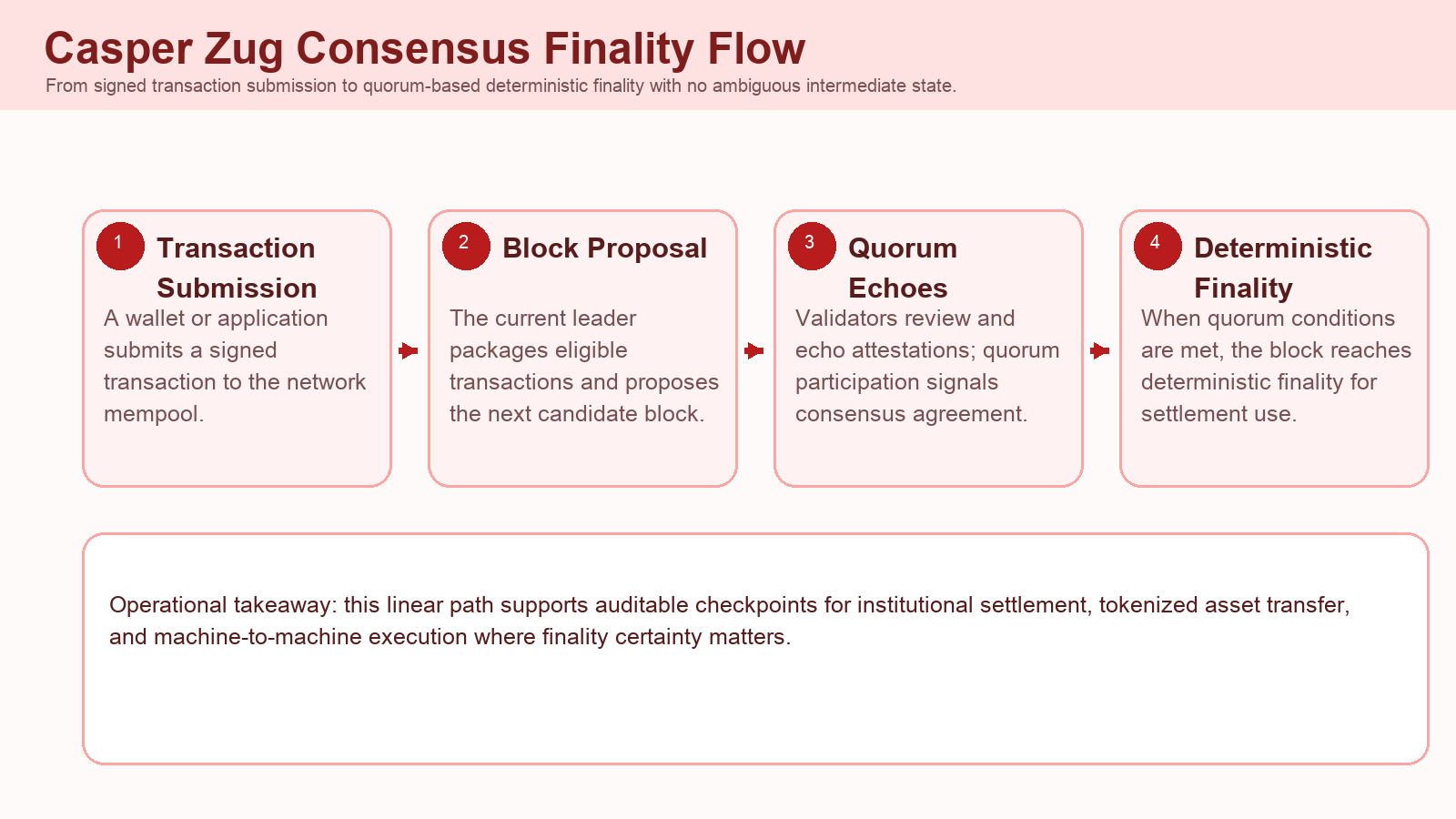
Figure 1. Casper Zug consensus path: submit → propose → quorum echo → deterministic finality.
What Makes Casper Smart Contracts Distinct? How Do Upgradable Contracts and Access Control Work?
Casper Network treats “business logic changes over time” and “different parties need different permissions” as first-class capabilities rather than afterthought scripts. Upgradable smart contracts allow logic to evolve under defined governance and permission frameworks, reducing friction from “deploy once, freeze forever” assumptions. Protocol-level access control lets issuers, investors, transfer agents, auditors, and similar roles hold different visibility and action boundaries onchain.
On the execution side, Casper Network emphasizes Rust and WebAssembly (WASM), with SDKs in JavaScript, Python, Go, and other mainstream languages. Multi-VM execution is described as a foundation for running different execution needs natively on one Layer-1. Items such as EVM compatibility, smart accounts, and gasless UX appear more often in Manifest and roadmap language—readers should separate what is live on mainnet from what is still planned.
For institutional workflows, access control plus upgradeability can map compliance rules, transfer restrictions, and role permissions closer to an asset’s lifecycle. Upgrade authority is also an attack surface: key custody and governance mistakes can change contract behavior.
What Is CSPR Used For? How Should Supply and Staking Be Read?
CSPR primarily acts as network fuel and security incentive on Casper Network: it pays for transaction and execution costs, and it is staked through validator or delegation paths that fund PoS security. Protocol-level fee burning (highlighted in Casper 2.1 materials) is a supply-side mechanism for understanding how fees leave circulation—not a price forecast.
Supply is best read as circulating supply / total supply / hard-cap status across public data sources. As of July 2026, CoinMarketCap listed Casper (CSPR) with roughly 16.6 billion circulating, about 19.7 billion total supply, and max supply shown as unlimited (∞). Those figures change with issuance and unlocks; verify against the live page and on-chain explorers. CSPR tokenomics and staking expands utility, supply reading, and validator participation for readers who already have the fee-and-stake frame.
| Dimension |
Beginner reading |
Caution |
| Fees |
CSPR pays for network operations |
Fee and burn rules follow mainnet config |
| Staking |
Lock CSPR to validate or delegate |
Slashing, liquidity, and operator risk apply |
| Supply |
Circulating ≠ total; check hard-cap claims separately |
Do not treat a third-party snapshot as permanent |
The table is a reading frame: token mechanics explain how the network runs, not where price goes. Staking rewards, unlocks, and validator performance are variable parameters governed by protocol rules and operator disclosures.
What Use Cases Fit Casper? How Do RWA, Institutions, and AI/Machine Commerce Map?
Casper Network’s public narrative rests on three premises: frictionless for users, trusted by institutions, and native for machines. On RWA, materials emphasize embedding identity, compliance rules, and transfer restrictions into the asset itself (including a native ERC-3643-oriented path and related network integrations), so issuers, investors, and transfer agents can collaborate under different permissions. Institutional workflows lean on deterministic finality, more predictable execution costs, and role-based access control for settlement and audit-friendly processes.
For machine commerce, x402 micropayments and agent-oriented accounts and tooling (such as MCP and Agent Skills) are described as infrastructure so autonomous systems can pay, react to onchain events, and execute contracts. The developer stack connects Rust/WASM, multi-VM, indexer and middleware APIs, and frameworks such as Odra. Some of these capabilities arrived with Casper 2.0/2.1 at the protocol layer; others remain Manifest roadmap items—use a live-versus-planned split when reading claims.
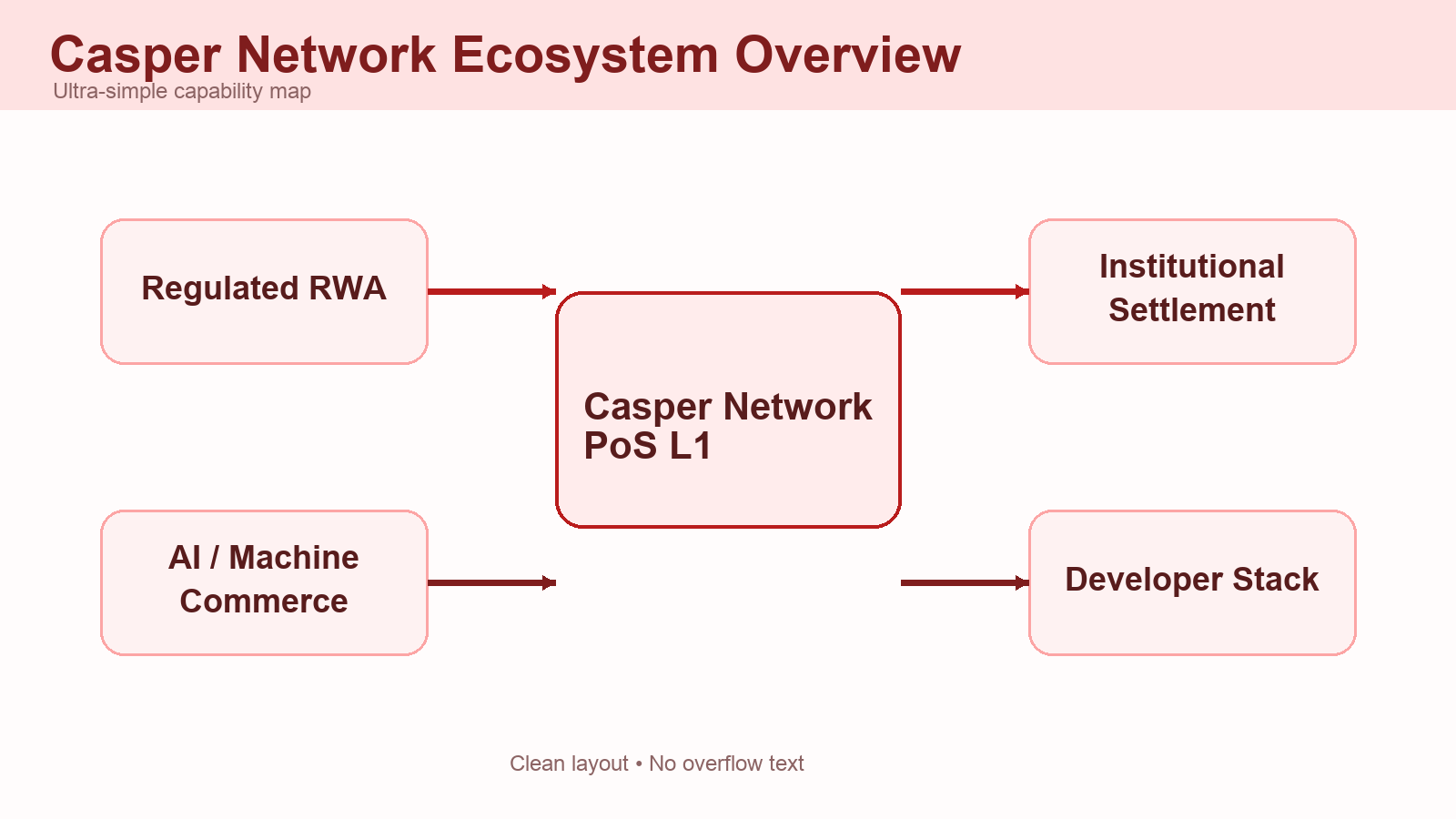
Figure 2. Casper Network overview: regulated RWA, institutional permissions, AI/machine commerce, and developer stack.
How Does Casper Network Differ from Ethereum for Institutional Settlement?
Casper Network and Ethereum are both smart-contract public chains, but design emphasis differs. Ethereum is among the largest general-purpose settlement layers for DeFi and developer tooling, where finality is often understood through probabilistic confirmations and ecosystem practice. Casper Network pushes deterministic finality, protocol-level permissions, and upgradable contracts earlier in its product narrative, and it explicitly targets regulated RWA and machine-account workflows.
For institutional settlement comparisons, start with finality semantics (whether long confirmation windows are assumed), permission models (whether roles are native onchain), contract evolution (how upgrades are expressed), and developer stacks (WASM/Rust versus EVM tooling). Casper vs Ethereum compares RWA and finality assumptions so “both are Layer-1” is not mistaken for identical settlement premises.
A common naming confusion: Ethereum’s early proof-of-stake research also used the name “Casper” (for example Casper FFG). That research line is not the same entity as today’s Casper Network public chain. Cross-check casper.network and the CSPR ticker when verifying sources.
What Risks and Misconceptions Apply to Casper / CSPR?
Strengths and risks should be stated separately. Deterministic finality, upgradable contracts, and access control can help express institutional workflows. At the same time, PoS still depends on validator honesty and stake distribution; upgrade keys and governance mistakes can alter contract logic; multi-VM and roadmap breadth can increase implementation complexity and expectation gaps.
Common misconceptions include treating CoinMarketCap tags as compliance certification; reading Manifest items such as x402, EVM compatibility, or quantum-safe cryptography as fully live; equating Ethereum’s old “Casper” research with Casper Network; and treating CSPR staking as risk-free yield. Smart contracts, bridges, fake tokens, and phishing sites remain generic threats—verify domains, contract addresses, and explorer listings. CSPR is a tradable crypto asset: volatility, liquidity, and regulatory change can affect holding and usage. None of the above is investment advice or a return promise.
Summary
Casper Network is a PoS Layer-1 with CSPR as its native token, mainnet around March 2021, positioned for regulated RWA and machine-economy infrastructure. Zug consensus targets deterministic finality; the contract layer emphasizes upgradeability and protocol-level access control, with Rust/WASM and multi-language SDKs. Casper 2.0/2.1 strengthen Zug, multi-VM foundations, faster blocks, and protocol-level fee burning; Manifest capabilities still require a live-versus-roadmap split. Versus Ethereum, differences concentrate on finality semantics, institutional permission expression, and settlement assumptions. Learning and using the network should include validator and contract risk checks, plus care around naming and third-party tags.
FAQ
What is Casper Network?
Casper Network is a proof-of-stake (PoS) public Layer-1 blockchain whose mainnet launched around March 2021, with CSPR as its native token. Public positioning focuses on regulated real-world assets (RWA) and machine/AI commerce infrastructure, emphasizing deterministic finality, upgradable contracts, and protocol-level access control.
What is CSPR used for?
CSPR is Casper Network’s native utility token. It is used to pay network fees and to stake—either as a validator or via delegation—to help secure the PoS network. Circulating and total supply figures should be checked on explorers and CoinMarketCap-style sources; mechanism descriptions are not price judgments.
How does Casper Network work?
Validators under PoS rules package transactions and agree on state. From Casper 2.0, Zug consensus drives deterministic finality: after a proposal reaches quorum via echoes, the block is treated as irreversible. Rounds that cannot reach agreement can be skipped to preserve liveness.
What is Zug consensus?
Zug is the consensus protocol introduced with Casper 2.0. Its goal is deterministic finality: once a block reaches quorum, it is considered finally confirmed, rather than relying on a probabilistic “more confirmations are safer” model. Public materials link this property to settlement and RWA transfer workflows that need clear finality semantics.
How does Casper Network differ from Ethereum?
Both are smart-contract chains, but Casper Network emphasizes deterministic finality, protocol-level access control, and upgradable contracts for regulated RWA and machine accounts, while Ethereum is known for a large general-purpose ecosystem and tooling. Institutional settlement comparisons should examine finality, permissions, and contract-evolution assumptions—not only “both are Layer-1.” Also distinguish Ethereum’s early Casper PoS research from today’s Casper Network project.
What are the risks of Casper / CSPR?
Key risks include PoS validator and staking risks, governance and key risks around upgradable contracts, smart-contract and impersonation risks, and mistaking roadmap features for fully live capabilities. Tags and third-party classifications are not compliance endorsements. CSPR price volatility and liquidity changes can also affect usage experience. This is not investment advice.