Casper Network fits workflows that need deterministic finality and protocol-native role permissions for regulated real-world assets (RWA), institutional settlement, and machine-account activity. Ethereum fits applications that rely on deep EVM tooling, broad DeFi liquidity, and established ERC-style standards. Both are PoS Layer-1 smart-contract chains; the material differences are finality semantics, where compliance permissions are expressed, and which developer stack teams enter. This comparison builds on how Casper Network describes Zug, upgradable contracts, and institutional positioning.
In one line: Casper Network is a proof-of-stake Layer-1 public chain, and CSPR is its native token for network fees and staking—not a price narrative. As of July 2026, public docs and explorer views remain the practical place to verify chain parameters, validator participation, and fee-related notes before comparing settlement design with Ethereum.
How Do Casper Network and Ethereum Differ in Positioning?
Casper Network’s public positioning targets regulated RWA, institutional settlement, and machine/AI commerce infrastructure, with enforceable onchain rules and deterministic finality in the foreground. Ethereum positions as a general-purpose smart-contract settlement layer hosting a leading DeFi, NFT, and developer-tool ecosystem; many institutional and RWA use cases also ship on Ethereum or its L2s as applications and standards.
Both support smart contracts and PoS validator security. The difference is narrative priority: Casper Network pushes protocol-level permissions and finality semantics forward; Ethereum pushes general programmability and ecosystem network effects forward. Searchers should also separate Ethereum’s early PoS research line named Casper (for example Casper FFG) from today’s Casper Network public chain; they are not the same entity. CSPR is Casper Network’s native utility token for fees and staking, while ETH fills the analogous fee-and-staking role on Ethereum—utility comparison is about how each token powers consensus and execution, not a ranking of market labels.
Institutional product teams usually map positioning to operational constraints first: how finality is defined, who may hold privileged transfer roles, and whether permissions live closer to the protocol or to application contracts. Teams that need protocol-native role boundaries often evaluate Casper Network’s published access-control story; teams that prioritize the widest EVM composition path often evaluate Ethereum’s standards and liquidity surface first.
| Dimension |
Casper Network |
Ethereum |
| Chain type |
PoS Layer-1 |
PoS Layer-1 |
| Finality model |
Zug: deterministic finality after quorum |
Economic / probabilistic finality + confirmation windows |
| Contract upgrades |
Protocol-friendly upgradable-contract narrative |
Common app-layer proxy / upgrade patterns |
| Access control |
Protocol-level roles and permissions |
Mostly contract standards and application logic |
| RWA placement |
Rules closer to protocol / the asset itself |
Mostly app-layer + ERC-style standards |
| Execution stack |
Rust/WASM, multi-VM path |
EVM-centric, very large tooling ecosystem |
| Native token |
CSPR (fees and staking utility) |
ETH (fees and staking utility) |
The table frames a like-for-like checklist: compare when state becomes irreversible, which layer encodes permissions, and which toolchain developers join.
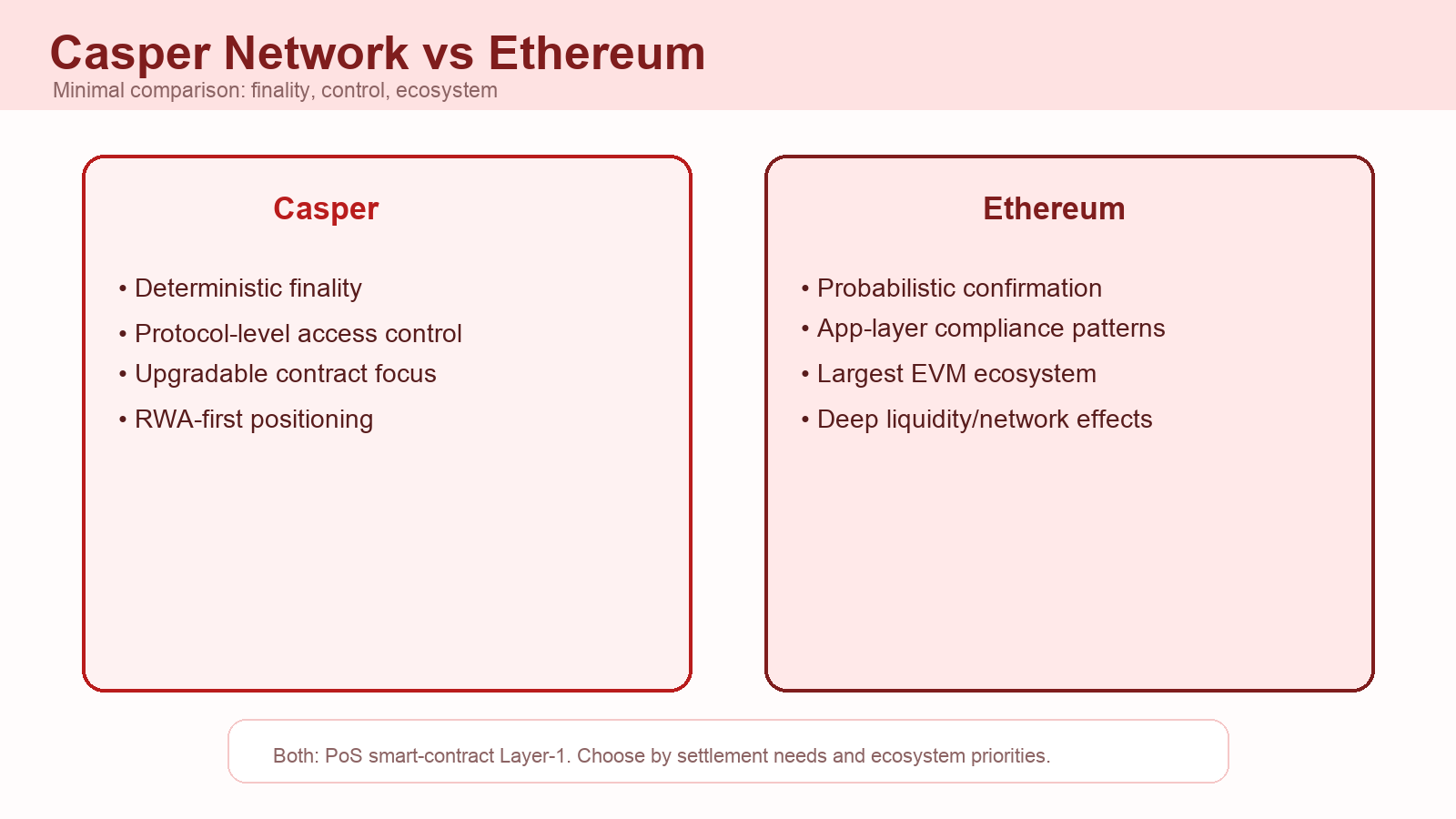
Figure 1. Casper Network vs Ethereum on finality, RWA permissions, and developer stacks.
How Does Zug Deterministic Finality Differ From Ethereum’s Economic or Probabilistic Finality?
From Casper 2.0 onward, Casper Network uses Zug consensus to pursue deterministic finality: after validators echo a proposal to quorum, block state is treated as irreversible, so applications can react under a clear “final” semantic. Validator attestations and proposal echoes record agreement before a block is treated as final. After The Merge, Ethereum runs PoS with economic finality and confirmation-window language—as checkpoints and later confirmations accumulate, reversal cost rises and reorganization risk falls, while many products still buffer as “wait for N confirmations.”
For payments, asset transfers, and multi-party approvals, deterministic finality reduces ambiguity about whether more blocks are still required. Product logic can treat “final” as a protocol event rather than a sliding confirmation count. Ethereum’s economic or probabilistic model is tightly coupled to its large ecosystem and mature confirmation practices, where teams often wait through additional blocks until residual reorganization risk is acceptable. Both semantics can support serious financial flows; the difference is how products encode “when is it safe to continue.” Casper 2.1 materials also describe faster block times (about eight seconds in public notes) and protocol-level fee burning; as of July 2026, live parameters should be checked against mainnet docs and the Casper Blockchain Explorer (cspr.live).
In PoS designs on both networks, proven validator faults can reduce bonded stake. Treat that penalty path as consensus security context—not as a returns promise—when comparing finality models.
How Do Fees and Execution Predictability Compare?
Fee behavior and execution predictability matter for institutional scheduling and machine micropayments. Casper Network pays fees in CSPR, and Casper 2.1 describes protocol-level fee burning; public materials pair predictable execution with deterministic finality. Ethereum pays Gas in ETH, and fees move with block demand; EIP-1559 improved fee-structure transparency, yet peak congestion can still swing cost and wait times, so many applications rely on L2s or dedicated Gas strategies.
CSPR’s primary onchain utility is paying fees and bonding stake; ETH’s primary L1 utility is likewise Gas payment and staking. Fee-token choice follows which execution environment a team plans to build on—not a standalone “which coin is better” framing. Time-sensitive machine payments and scheduled institutional transfers often care more about fee variance than about a single snapshot fee number.
| Dimension |
Casper Network |
Ethereum |
| Fee token |
CSPR (fee + staking utility) |
ETH (fee + staking utility) |
| Mechanism notes |
Includes protocol-level burn narrative (2.1) |
EIP-1559 and related designs; demand-driven swings common |
| Execution context |
Predictable execution + deterministic finality |
L1 congestion can vary cost/latency; L2s absorb load |
| Reading tip |
Verify mainnet fee schedules and explorers (e.g. cspr.live) |
Separate L1 Gas from the L2 fee surface in use |
Compare how fees form and behave under congestion rather than seeking a single “cheaper chain” answer. Supply and staking paths for CSPR are covered in CSPR tokenomics. As of July 2026, explorer and docs checks remain the durable way to confirm fee schedules and validator-set notes without treating any live quote as the article’s main narrative.
RWA and Compliance Permissions: Protocol-Native vs Application-Layer Approaches
Casper Network treats protocol-level access control and upgradable contracts as first-class capabilities: issuers, institutional investors, transfer agents, and auditors can hold different visibility and action boundaries, and RWA identity or transfer restrictions tend to sit closer to the asset and protocol expression (public materials also discuss paths oriented toward standards such as ERC-3643). On Ethereum, much RWA work lands through application-layer contracts and ERC-family standards—allowlists, freezes, and disclosure logic live in issuer contracts and compliance vendors, then compose with DeFi or custody flows.
A protocol-native model makes “who can transfer / who can see” easier to encode as onchain constraints by default. Role holders authorize actions under those boundaries through wallet and contract checks that prove who is acting. An application-layer model reuses existing standards, audit templates, and liquidity entry points. Both can support compliant assets; the difference is whether capability defaults to protocol or application, and how upgrade or key-governance attack surfaces are distributed.
Expressing transfer restrictions closer to the asset matters when regulated RWA workflows must prove who may move, freeze, or view positions. That does not remove legal or operational review—it means the chain’s permission model can mirror more of the control surface that institutional investors and transfer agents already expect offchain.
How Do Developer Stacks and Ecosystem Paths Compare Objectively?
Casper Network’s execution path emphasizes Rust and WebAssembly (WASM), with SDKs for languages such as JavaScript, Python, and Go; multi-VM designs are described as a foundation for parallel execution needs on one Layer-1. Items such as EVM compatibility and smart accounts appear more often in Manifest roadmap materials—separate what is live on mainnet from what is still planned. Ethereum centers on the EVM and Solidity/Vyper toolchains, with wallets, auditors, indexers, bridges, and L2s at larger scale; most general DeFi composition happens first on that stack.
When teams need the largest ready liquidity and interoperability surface, Ethereum’s network effects are stronger; when teams need a WASM/Rust path, protocol-level permissions, and deterministic-finality semantics, Casper Network’s stack aligns with its public product focus. Builders choose stacks by the contracts and tooling they must ship, and by whether privilege models sit in protocol-facing roles or in application contracts. Ecosystem size is not the same metric as settlement-finality semantics.
What Risks and Fit Boundaries Matter When Comparing?
On Casper Network, watch PoS validator and staking distribution risk, governance or key risk around upgradable contracts, multi-VM and roadmap expectation gaps, plus scam tokens and phishing sites. Validator faults can reduce bonded stake under PoS rules—that is security context, not a returns promise. On Ethereum, watch L1 fee volatility, smart-contract and bridge risk, inconsistent application-layer compliance implementations, and L2 or cross-chain complexity. Shared risks include treating third-party tags as compliance certifications and confusing Ethereum’s historical “Casper” research name with Casper Network.
When protocol-native roles and deterministic finality are the binding constraints, read Casper Network’s published capabilities carefully; when the widest EVM composition and liquidity matter most, read Ethereum’s ecosystem constraints carefully. The Casper Blockchain Explorer at cspr.live is a read-only reference for checking blocks, accounts, and network activity alongside official docs. This is mechanism and architecture context only—not investment advice.
Summary
Casper Network and Ethereum are both PoS Layer-1 smart-contract chains. Casper Network leans on Zug deterministic finality, upgradable contracts, and protocol-level access control for regulated RWA and institutional or machine settlement narratives. Ethereum leans on EVM ecosystem breadth and application-layer or ERC-style paths for general DeFi and much RWA delivery. Fee predictability, permission placement, and developer stack form the main comparison axes. Selection should match required finality semantics and compliance expression, while validating validator sets, upgrade authority, and impersonation risks—then verify parameters on explorers and docs rather than treating any single scorecard as complete.
FAQ
What is the difference between Casper Network and Ethereum?
Both are PoS Layer-1 smart-contract blockchains. Casper Network emphasizes Zug deterministic finality, protocol-level access control, and upgradable contracts, with an explicit focus on regulated RWA and machine accounts. Ethereum is known for a vast EVM ecosystem and application-layer standard composition. The difference is finality semantics and where permissions live—not a simple quality ranking. Do not confuse today’s Casper Network (and its native token CSPR) with Ethereum’s historical Casper research line.
What is Zug consensus?
Zug is the consensus protocol introduced with Casper 2.0 on Casper Network. It targets deterministic finality: once a block reaches validator quorum, it is treated as finally confirmed, rather than relying on a probabilistic model where waiting for more confirmations is assumed to be safer. Public materials link that semantic to settlement and RWA transfer flows that need an explicit finality definition.
How does Casper support RWA?
Casper Network uses protocol-level access control, upgradable contracts, and deterministic finality so identity, transfer restrictions, and role permissions sit closer to onchain assets and protocol expression; public materials also discuss compliance-token paths oriented toward standards such as ERC-3643. By contrast, most Ethereum RWA work lands in application-layer contracts and ERC-style standards. The educational point is where controls live, not trading guidance.
Is Casper a Layer 1 blockchain?
Yes. Casper Network operates as a proof-of-stake (PoS) public Layer-1 responsible for block production, finality, contract execution, and permission expression, with CSPR as its native token. Mainnet launched around March 2021; Casper 2.0 and 2.1 strengthen Zug, multi-VM foundations, and fee-related mechanisms. Builders can deploy WASM/Rust-oriented contracts, and validators stake CSPR under PoS security rules that can reduce bonded stake for proven faults.
What are the risks of Casper / CSPR?
Key risks include PoS validator and staking-related risk (including bonded-stake penalties for misbehavior), governance and key risk around upgradable contracts, smart-contract and counterfeit-asset risk, and treating Manifest roadmap items as already fully live. CSPR as a tradable asset can face volatility and liquidity changes. This is mechanism context only and is not investment advice.
How should Ethereum finality be understood versus Casper’s deterministic finality?
Under Zug on Casper Network, state after quorum is treated as irreversibly final. On Ethereum, practice commonly uses economic or probabilistic finality plus confirmation windows: more confirmations raise reorganization cost and lower residual risk. Both models can support financial flows; they encode “when downstream actions may proceed” differently. Map confirmation and settlement assumptions to each chain’s finality semantic before treating the two as interchangeable.