For blockchain developers, crypto enthusiasts, and users evaluating AI-powered blockchain infrastructure or considering trading and investing in CNPY on Gate.com, understanding Canopy helps clarify how its architecture can support more specialized blockchain applications and where its investment potential and risks may lie. This article explains Canopy’s AI integration, Nested Chains model, the role of CNPY in the ecosystem, use cases across DeFi, AI, consumer, and community apps, the platform’s main benefits and trade-offs, and how to trade the token on Gate.com.
Key Takeaways
- Canopy is an AI-native blockchain platform focused on application-specific networks.
- Its core concept, Nested Chains, allows applications to have their own logic, rules, and economic models.
- Canopy aims to make blockchain development more accessible through AI-assisted infrastructure.
- CNPY is the native token of the Canopy ecosystem.
- Canopy combines AI, blockchain infrastructure, and application-specific networks into a single development framework.
Sources:Canopy Website
What Is the Canopy Network?
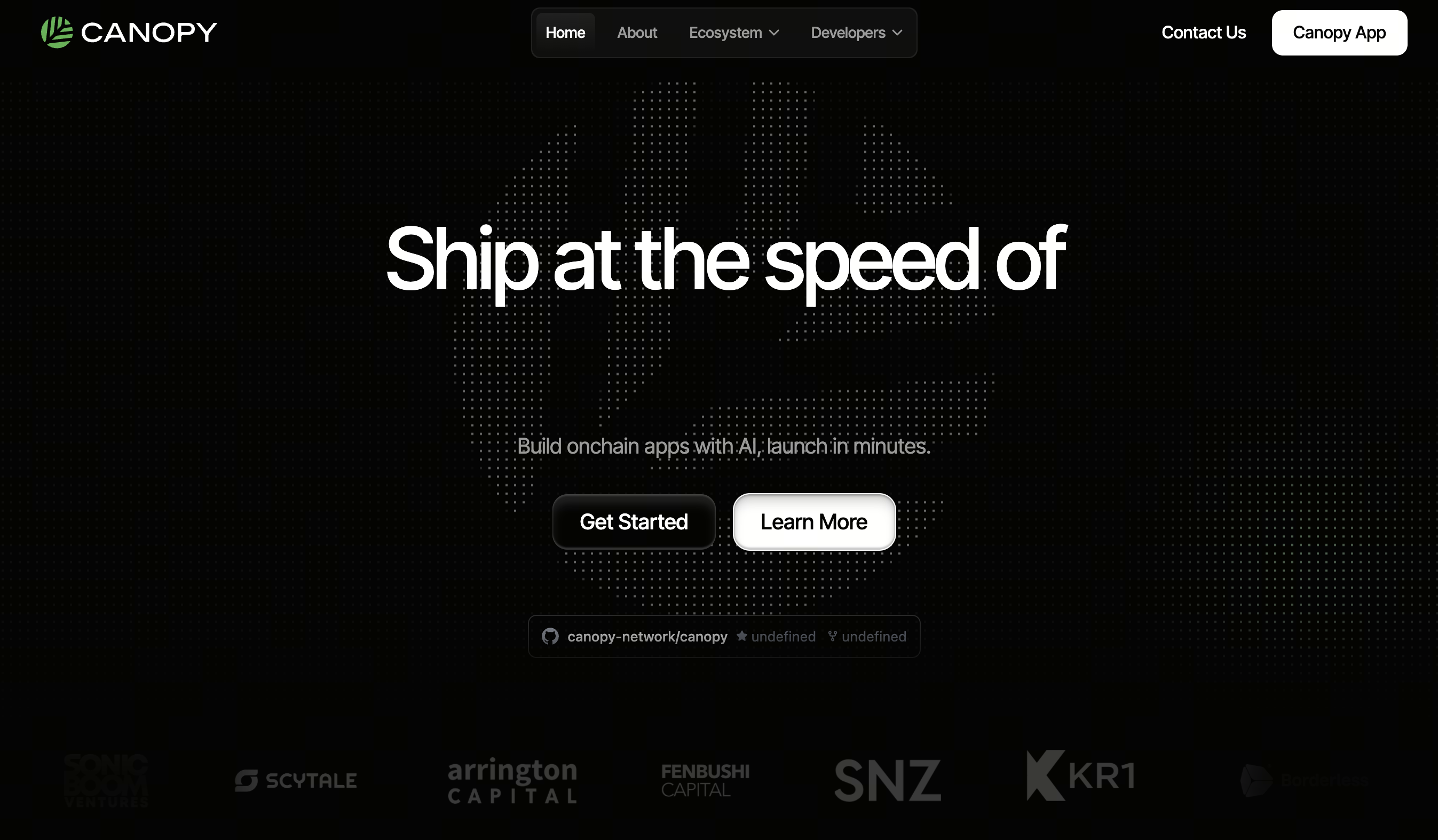
Canopy is an AI-native platform designed to help developers create specialized on-chain applications through Nested Chains.
Traditional blockchain applications generally operate within the rules and execution environment of an existing network. While this approach provides access to established infrastructure, developers may have limited control over application-specific logic, economics, or execution requirements.
Canopy takes a different approach by allowing applications to operate through their own Nested Chains. These networks can define their own rules and economic models while remaining connected to the broader Canopy ecosystem.
The result is an architecture intended to give developers more flexibility without requiring them to build every component of a standalone blockchain independently.
What Are Nested Chains?
Nested Chains are the central concept behind Canopy.
A Nested Chain can be understood as an application-specific on-chain environment with its own logic, rules, and economic model. Instead of treating a blockchain application as a contract operating entirely within another network, Canopy allows the application to have a more specialized execution environment.
For developers, this can provide greater control over how an application operates. Different applications may require different transaction rules, incentive mechanisms, or economic structures, and a single general-purpose blockchain may not always be optimized for every use case.
Nested Chains are designed to address this challenge by giving individual applications a more customizable environment.
How Do Nested Chains Work?
The basic idea behind a Nested Chain is to move some of an application's infrastructure and economic logic into a dedicated environment.
A developer can create an application with specific requirements, define its rules and economic model, and deploy it as a Nested Chain within the Canopy ecosystem.
This creates a relationship between the broader Canopy infrastructure and the individual application:
Canopy → Nested Chain → Application
Each Nested Chain can therefore be optimized for a particular application or use case rather than relying entirely on a common execution environment.
This architecture can potentially support applications that require specialized logic, custom incentives, or different economic parameters from those offered by a conventional smart-contract platform.
How Does AI Fit Into Canopy?
Artificial intelligence is a core component of Canopy's approach to blockchain development.
Building blockchain applications can require expertise across smart contracts, network architecture, token economics, security, and infrastructure. Canopy aims to use AI to simplify parts of this development process.
Instead of treating AI as a separate application layered on top of a blockchain, Canopy positions AI as part of the development environment itself.
The goal is to make it easier for developers to describe what they want to build and translate those requirements into functional on-chain infrastructure.
This approach reflects a broader trend in blockchain development in which AI tools are being used to automate coding, infrastructure configuration, testing, and application deployment.
Why Build Application-Specific Networks?
General-purpose blockchains are designed to support many different types of applications. This creates a shared environment where applications compete for blockspace and operate according to common network rules.
For many applications, this model works well. However, some applications may benefit from greater control over execution or economics.
For example, an application could require:
- Customized transaction rules
- A specialized fee structure
- Application-specific incentives
- Dedicated execution logic
- Custom token economics
- Greater control over network parameters
An application-specific network can provide these capabilities without requiring the application to conform entirely to the design choices of a general-purpose blockchain.
Canopy's Nested Chains are designed around this concept.
Canopy vs. Traditional Smart Contracts
A traditional decentralized application typically runs through smart contracts deployed on an existing blockchain.
This model provides developers with access to established security and infrastructure, but applications must operate within the constraints of the underlying network.
Canopy's Nested Chain architecture provides another option. Instead of relying solely on smart contracts within a shared execution environment, developers can create an application-specific network with customized rules and economics.
This does not necessarily mean that Nested Chains replace smart contracts. Rather, they represent a different architectural approach for applications that require greater control over their underlying execution environment.
What Is CNPY?
CNPY is the native token associated with the Canopy ecosystem.
As the ecosystem develops, the token can serve as an economic component of the broader Canopy network. Its role is connected to the platform's infrastructure and the applications built within its ecosystem.
However, the specific utility of a native token depends on the protocol's implementation and development roadmap. Users should refer to Canopy's official documentation for the latest information about CNPY's functionality, token economics, and ecosystem participation.
What Is the Role of CNPY in the Ecosystem?
A native token can play several potential roles within an application-specific blockchain ecosystem.
Depending on Canopy's implementation, CNPY may be used to support economic activity across the network and provide a common asset for interactions within the ecosystem.
The broader concept is that CNPY represents the economic layer of Canopy, while Nested Chains provide the application infrastructure.
This distinction is useful because CNPY and individual applications built through Canopy do not necessarily have the same function. CNPY is associated with the platform as a whole, while each Nested Chain can have its own application logic and economic model.
What Can Developers Build With Canopy?
Canopy's application-specific architecture can potentially support a wide range of blockchain applications.
DeFi Applications
Financial applications can benefit from customized transaction logic, fee structures, and incentive systems. A dedicated environment may allow developers to optimize the network around a particular financial use case.
AI Applications
Because Canopy is designed as an AI-native platform, applications that combine artificial intelligence with blockchain infrastructure represent another potential use case.
AI-powered agents, decentralized AI services, and autonomous applications could potentially use specialized on-chain environments for their economic and execution requirements.
Consumer Applications
Consumer-facing blockchain applications may require different economic models from financial protocols. A Nested Chain could allow developers to customize incentives and application rules around a specific user experience.
Creator and Community Applications
Applications built around communities, digital assets, or creator economies could also benefit from customized token and incentive structures.
The underlying idea is that developers do not need to force every application into the same blockchain architecture.
What Problems Is Canopy Trying to Solve?
Canopy addresses several challenges associated with blockchain application development.
Development Complexity
Building blockchain infrastructure can require specialized technical knowledge. AI-assisted development aims to reduce some of this complexity.
Limited Customization
Applications operating on general-purpose chains share the same basic execution environment. Nested Chains provide a way to customize application-specific logic and economics.
Infrastructure Requirements
Launching a dedicated blockchain traditionally requires substantial infrastructure and technical resources. Canopy aims to make application-specific networks more accessible through its platform.
AI and Blockchain Integration
Although AI and blockchain are often discussed together, combining the two at the infrastructure level remains technically challenging. Canopy's AI-native approach attempts to integrate AI into the development and operation of blockchain applications.
What Makes Canopy Different?
Canopy combines two ideas that are often developed separately: AI-assisted blockchain development and application-specific networks.
AI can help reduce the technical complexity of building blockchain applications, while Nested Chains provide developers with greater control over application logic and economics.
Together, these concepts create a development model in which AI helps build specialized on-chain environments rather than simply operating as an application that interacts with an existing blockchain.
This positioning differentiates Canopy from platforms that focus exclusively on smart-contract deployment or AI applications.
What Are the Benefits of Nested Chains?
Application-Level Customization
Developers can design network rules around the specific requirements of their application.
Flexible Economic Models
Each application can potentially use a customized economic model instead of relying entirely on the economics of a shared blockchain.
Specialized Infrastructure
Applications with unique execution requirements can use a more specialized environment.
AI-Assisted Development
Canopy's AI-native approach aims to lower the technical barrier associated with creating blockchain infrastructure.
What Are the Risks of Canopy?
Like other emerging blockchain platforms, Canopy involves several risks that users and developers should consider.
Technology Risk
Canopy combines AI and blockchain infrastructure, both of which involve technically complex systems. Bugs, implementation problems, or unexpected behavior could affect applications built on the platform.
Ecosystem Adoption
The long-term value of an application-specific platform depends heavily on whether developers actually build and users actually adopt applications within the ecosystem.
AI Reliability
AI-assisted development can improve productivity but does not eliminate the need for human oversight. AI-generated code or configurations can contain errors or security vulnerabilities.
Economic Risk
Applications with their own economic models may experience problems related to incentives, token distribution, liquidity, or market dynamics.
CNPY Market Risk
CNPY is a crypto asset and can experience significant price volatility. Its market performance may be influenced by broader crypto-market conditions as well as developments within the Canopy ecosystem.
Canopy and the Future of AI-Powered Blockchain Development
Canopy represents an approach in which AI becomes part of the infrastructure used to create blockchain applications.
The concept of Nested Chains extends this idea by giving individual applications their own execution logic and economic models. Instead of requiring every application to operate under identical blockchain rules, developers can create environments tailored to specific requirements.
If AI-assisted development continues to improve, this model could make application-specific blockchain infrastructure more accessible to smaller development teams and individual builders.
At the same time, the long-term success of the approach depends on practical adoption. Developers must be able to create useful applications efficiently, while users must find enough value in those applications to sustain their ecosystems.
How to Trade CNPY on Gate
CNPY is available for spot trading on Gate through the CNPY/USDT market.
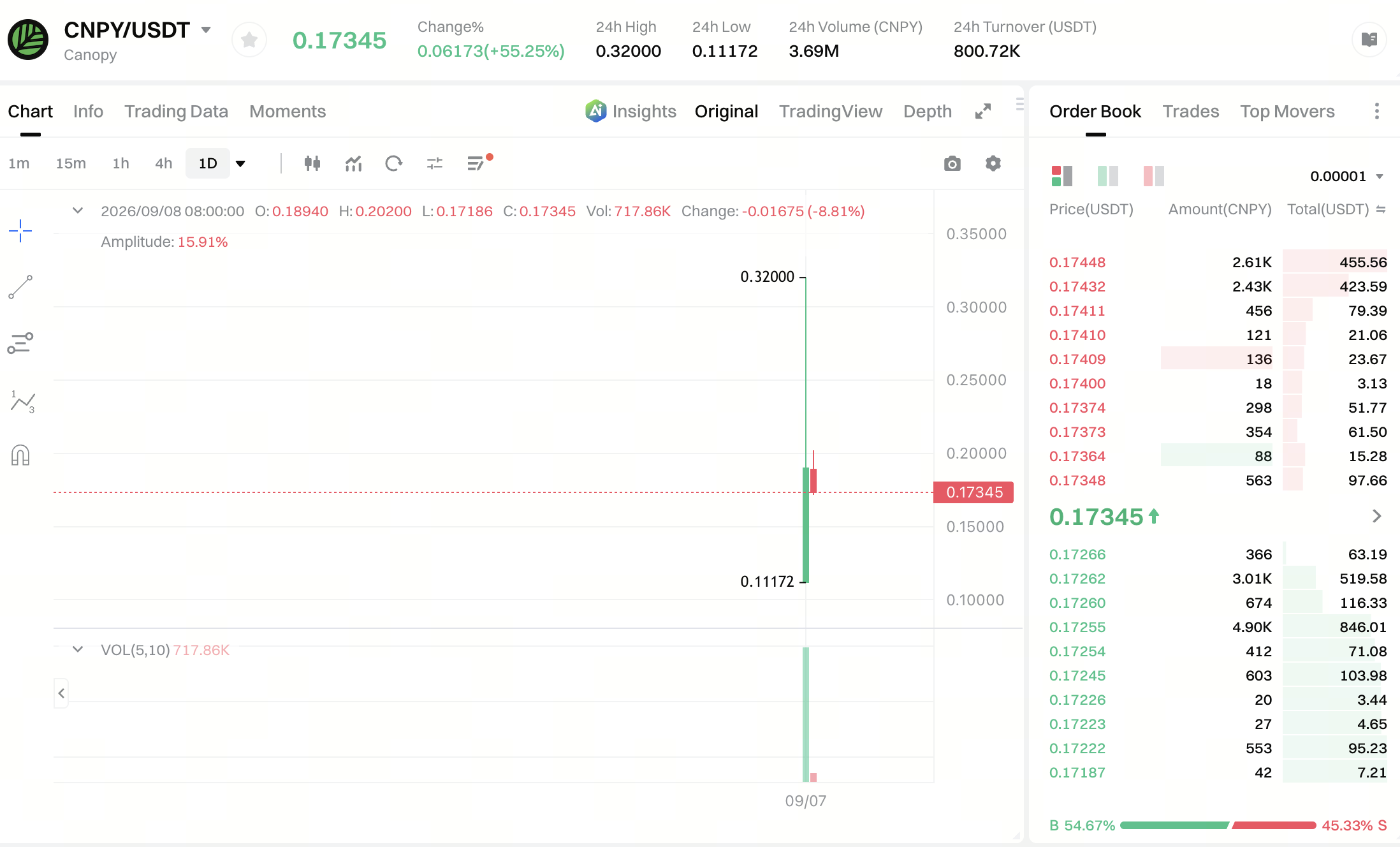
Users can visit the CNPY/USDT trading page to access the available market and trading interface.
Gate also provides a dedicated Canopy price page, where users can view market information related to CNPY.
Before trading CNPY, users should consider the token's market volatility, liquidity, project development, and broader crypto-market conditions. The availability of a trading market does not imply that the asset is suitable for every user.
Conclusion
Canopy is an AI-native blockchain platform focused on helping developers create application-specific networks known as Nested Chains. These networks are designed to give individual applications their own logic, rules, and economic models.
By combining AI-assisted development with customizable on-chain infrastructure, Canopy aims to make specialized blockchain applications easier to create while providing developers with greater control than a conventional shared execution environment may offer.
CNPY is the native token associated with the Canopy ecosystem. As the platform develops, its broader role will depend on the implementation of Canopy's network and the applications built through its infrastructure.
For users interested in CNPY, Gate provides access to the CNPY/USDT spot market. As with other emerging crypto assets, users should conduct their own research and consider market, technology, liquidity, and ecosystem risks before trading.
FAQs
What is Canopy?
Canopy is an AI-native blockchain platform designed to help developers create application-specific networks called Nested Chains.
What are Nested Chains?
Nested Chains are application-specific on-chain networks that can have their own logic, rules, and economic models.
What is CNPY?
CNPY is the native token associated with the Canopy ecosystem.
What blockchain is Canopy built on?
Canopy's architecture focuses on creating specialized application networks rather than simply operating as a conventional application on a general-purpose blockchain. Users should refer to the project's official documentation for the latest technical details.
How does AI work in Canopy?
Canopy integrates AI into its blockchain development approach, with the goal of helping developers create and manage specialized on-chain applications more efficiently.
What can Nested Chains be used for?
Nested Chains can potentially support DeFi, AI applications, consumer applications, creator economies, and other use cases that may benefit from customized logic and economic models.
What is the difference between a Nested Chain and a smart contract?
A smart contract typically runs within the execution environment of an existing blockchain. A Nested Chain provides a more application-specific environment with its own rules, logic, and economic model.
Where can I trade CNPY?
CNPY is available for spot trading on Gate through the CNPY/USDT market.
Is CNPY a good investment?
CNPY is a cryptocurrency and its price can be highly volatile. Whether it is appropriate for an individual depends on their own objectives, risk tolerance, and research. This article does not provide investment advice.