Treating a scaling network as an independent blockchain is the most common misunderstanding among people new to Layer 2. A scaling network does not establish final security on its own; it hands transaction data and dispute resolution back to the underlying settlement chain. Unlike a sidechain that leans on its own validator set, this design anchors asset security to Ethereum.
The operating side is now documented in measurable terms. According to the first-half 2026 progress report published by the Arbitrum Foundation on September 2, 2026, ArbitrumDAO recorded $6.19 million in total revenue for the first half of 2026, at a protocol revenue gross margin above 97%.
Key Takeaways
- Arbitrum is an Ethereum optimistic rollup developed by Offchain Labs and governed by ArbitrumDAO.
- ARB is a governance token with a 10 billion total supply; gas on Arbitrum is denominated in ETH, and the two roles are not interchangeable.
- Arbitrum One, Arbitrum Nova, and Arbitrum Orbit map to general settlement, low-cost high-frequency activity, and third-party chains respectively.
- Optimistic rollups rely on a challenge window and fraud proofs, native withdrawals take about seven days, and data availability depends on the Ethereum blob market.
What Is Arbitrum and How Does It Relate to Ethereum?
Arbitrum operates as the execution layer of an optimistic rollup for Ethereum: computation and ordering happen on Arbitrum, while state and batch data return to Ethereum for settlement. Offchain Labs advances the technology stack, ArbitrumDAO decides network parameters and treasury spending, and the Arbitrum Foundation handles operational disclosure.
The most frequent confusion is treating ARB as a gas token. ARB exists for governance voting, whereas the asset paying transaction fees on Arbitrum One and Arbitrum Nova is ETH. Because the design is EVM-equivalent, most Ethereum contracts and developer tooling port across with minimal rewriting, and Ethereum supplies the final venue for data availability and dispute resolution.
How Does Arbitrum Work? Nitro, Optimistic Rollups, and Fraud Proofs
Arbitrum is a Layer 2 scaling solution for Ethereum, and arbitrum assumes transactions are valid unless challenged, helping optimistic rollups handle thousands of transactions per second. Arbitrum's operation breaks into four stages: execution, sequencing, data posting, and dispute resolution.
- A user submits a transaction, and the Sequencer receives it, fixes its order, and returns a fast local confirmation on a roughly 1–2 second cadence.
- The transaction executes in the Nitro stack, where ArbOS handles gas metering and cross-layer messaging, and Arbitrum Nitro helps process transactions faster while supporting high transaction throughput.
- Many off chain transactions are compressed into a batch and posted to Ethereum mainnet as a blob, serving as the data availability source.
- The corresponding state root goes to the rollup contracts on Ethereum, which opens the challenge window.
- Validators can submit a fraud proof against an invalid state during that window; if a dispute arises, the protocol re-executes only the disputed part onchain; absent a challenge, the state becomes final.
Nitro combines Geth's execution logic with a custom state transition function that compiles to WASM for step-by-step onchain arbitration. It also lets contracts from existing ethereum deployments run without modification. ArbOS runs inside it, managing cross-layer messaging and the allocation of Layer 1 data costs, with full parameter details published in the Arbitrum documentation. Calldata compression is central to reducing costs, cutting gas costs and supporting lower fees. The challenge window also sets the withdrawal rhythm: moving assets back to Ethereum takes roughly seven days, while deposits in the other direction confirm far faster.
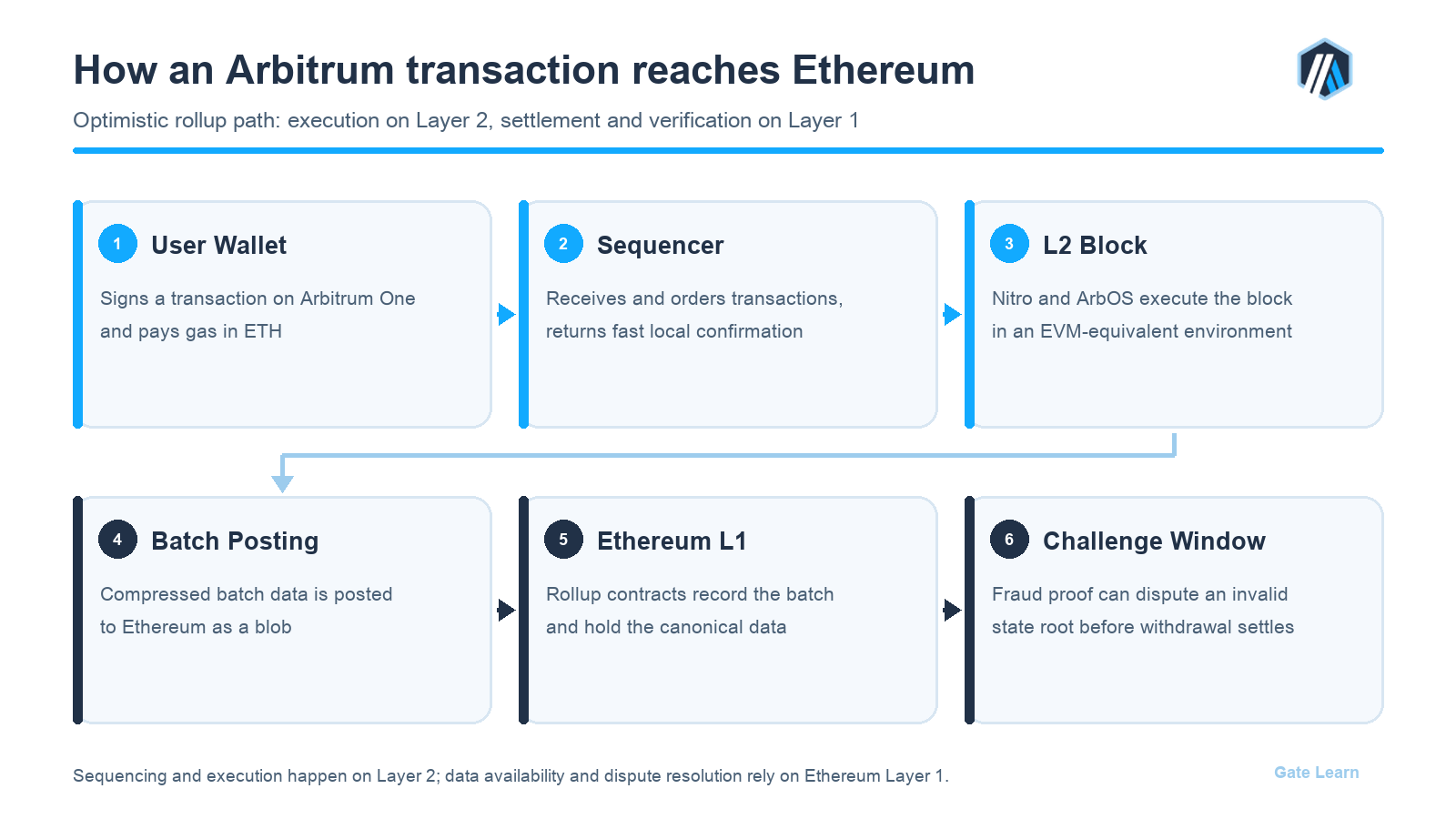
Figure 1. The path of an Arbitrum transaction, from the user wallet through Sequencer ordering and batch posting to dispute resolution inside the Ethereum challenge window.
Which Arbitrum Chains Exist? One, Nova, and Orbit Compared
Arbitrum spans three tiers: Arbitrum One is the general-purpose settlement network, Arbitrum Nova is an anytrust chain for low-cost high-frequency activity, and Arbitrum Orbit is the stack third parties use to launch their own Layer 2 or Layer 3 networks. What separates them is the data availability approach and who operates the chain.
| Chain / Stack |
Data availability approach |
Typical use |
| Arbitrum One |
Batch data posted to Ethereum as blobs |
General DeFi and major ecosystem apps |
| Arbitrum Nova |
AnyTrust data availability committee |
Social and gaming activity with high cost sensitivity |
| Arbitrum Orbit |
Rollup or AnyTrust, chosen by the deploying team |
Purpose-built third-party Layer 2 and Layer 3 networks |
The distinction that matters is where the data lives. Arbitrum One writes complete batch data back to Ethereum, keeping its security assumptions closest to mainnet, while Arbitrum Nova uses AnyTrust and delegates data custody to a committee in exchange for lower costs. Arbitrum Orbit is not a specific chain; teams use it to launch an arbitrum chain with different governance models and settlement choices, and Arbitrum One and Robinhood Chain represent its two ends: a general-purpose settlement network versus a purpose-built chain run by a single operator.
How Do Arbitrum Orbit and the Expansion Program Work?
The Arbitrum Expansion Program (AEP) sets the revenue rule for the Orbit ecosystem: depending on configuration, some Orbit chains can settle directly to Ethereum while others settle through Arbitrum layers, and chains that settle outside Arbitrum One and Arbitrum Nova must route 10% of net protocol revenue back to the Arbitrum ecosystem.
Robinhood Chain is the most clearly identified Orbit deployment, and developers gain access to configurable economics such as a custom gas token when launching these networks. Per the Robinhood Chain documentation and L2Beat records, the chain is built on Arbitrum Orbit, with Arbitrum technology underpinning customizable Layer 2 and Layer 3 deployments through Orbit; it launched a public testnet on February 10, 2026, and brought mainnet live on July 1, 2026, with chain ID 4663, ETH as the gas token, and no native token issued.
July 2026 was the first full month after mainnet launch, and AEP licence fees that month reached $360,000, or 35% of ArbitrumDAO revenue for the month (source: Arbitrum Foundation first-half 2026 progress report). That makes how Robinhood Chain revenue flows back the first complete sample for observing the mechanism in practice.
What Is ARB Used For? Governance Rights, Treasury, and DAO Revenue
The core function of ARB is governance: holders vote on protocol upgrades, treasury allocations, ecosystem incentives, and rules connected to the expansion program, rather than using the token to pay network fees. The governing body is ArbitrumDAO, a decentralized autonomous organization. ARB holders also elect a security council for emergency governance. Gas on the Arbitrum network remains denominated in ETH.
Total ARB supply is 10 billion tokens. As of August 17, 2026, roughly 92.3% (about 9.23 billion ARB) had unlocked or was held by the ArbitrumDAO treasury, while the remaining 7.7% (about 0.77 billion ARB) stayed inside the original vesting schedule, with the final tranche set for March 2027 (source: Arbitrum Foundation first-half 2026 progress report). The treasury itself holds approximately 2.66 billion ARB.
| Revenue line |
What generates it |
| Arbitrum One transaction fees |
Fees from sequencing and executing network activity |
| Timeboost |
Proceeds from auctioning priority ordering rights |
| Expansion Program (AEP) licence fees |
The 10% of net protocol revenue routed back by qualifying Orbit chains |
| Treasury income |
Yield generated on assets held by ArbitrumDAO |
Together these four lines produced $6.19 million in combined revenue for the first half of 2026, at a protocol revenue gross margin above 97%, up from above 90% across full-year 2025. These figures describe ecosystem-level revenue and treasury scale rather than cash flow distributed to ARB holders, since how that revenue gets used is decided through ArbitrumDAO governance.
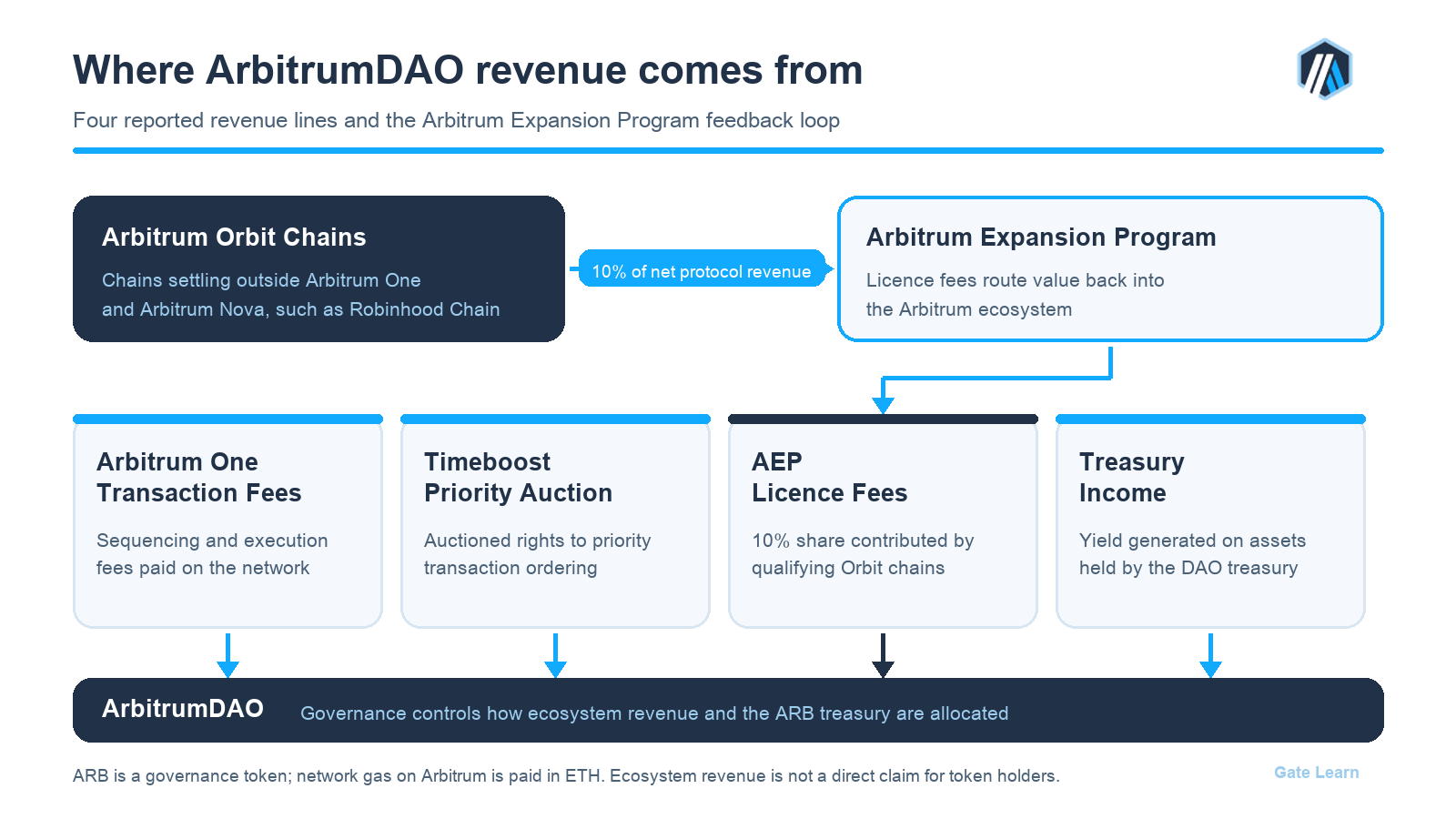
Figure 2. The four ArbitrumDAO revenue lines, alongside the path by which Orbit chains route 10% of net protocol revenue back through the expansion program.
What Problems Do Stylus and Timeboost Solve?
Stylus widens the set of smart contracts available beyond Solidity: developers can write smart contracts in multiple programming languages within Nitro’s tech stack, including languages like Rust, C, and C++, compile to WebAssembly (WASM) for onchain execution, and have those contracts coexist with existing EVM contracts on the same chain. It adds a second virtual machine alongside the EVM. Computation-heavy logic therefore is not confined to Solidity, nor does it require launching a separate chain, while enabling seamless interaction between WASM-based and EVM smart contracts.
Timeboost changes how ordering rights are allocated, auctioning priority transaction ordering so that a position previously won through network latency advantages becomes biddable, measurable revenue. Timeboost contributed roughly $7 million in revenue during 2025, a year in which Arbitrum gross profit reached $23.49 million (source: Arbitrum Foundation blog).
What Are the Advantages and Risks of Using Arbitrum?
The advantages concentrate in cost, compatibility, and ecosystem depth: as a scaling solution for Ethereum, Arbitrum makes transactions faster, lowers fees, and improves cost efficiency; batch compression and blob posting cut per-transaction settlement costs while preserving Ethereum's security and core security guarantees at settlement, EVM equivalence lets Ethereum contracts migrate with minimal rewriting, Arbitrum One hosts a comparatively large DeFi application cluster with strong decentralized exchange activity, and Arbitrum Orbit offers a path to running a custom network.
The risks and limitations are equally structural. Sequencing runs through a single Sequencer, creating concentration around transaction censorship and ordering fairness and limiting the decentralized network ideal in practice. Native withdrawals require a challenge window of roughly seven days. Concentration in ARB governance weight shapes proposal outcomes. Bridge contracts form an attack surface sitting outside the rollup protocol itself.
Dependence on the Ethereum blob market for data availability is another concrete constraint. On September 4, 2026, Robinhood Chain saw a batch data posting delay of roughly 14 minutes, during which the chain kept producing blocks, and Arbitrum attributed the cause to Ethereum Layer 1 blob market conditions rather than chain downtime (source: Arbitrum, L2Beat). The pace of Layer 2 data posting is shaped by Layer 1 blockspace supply and demand.
How Can You Trade or Use ARB on Gate?
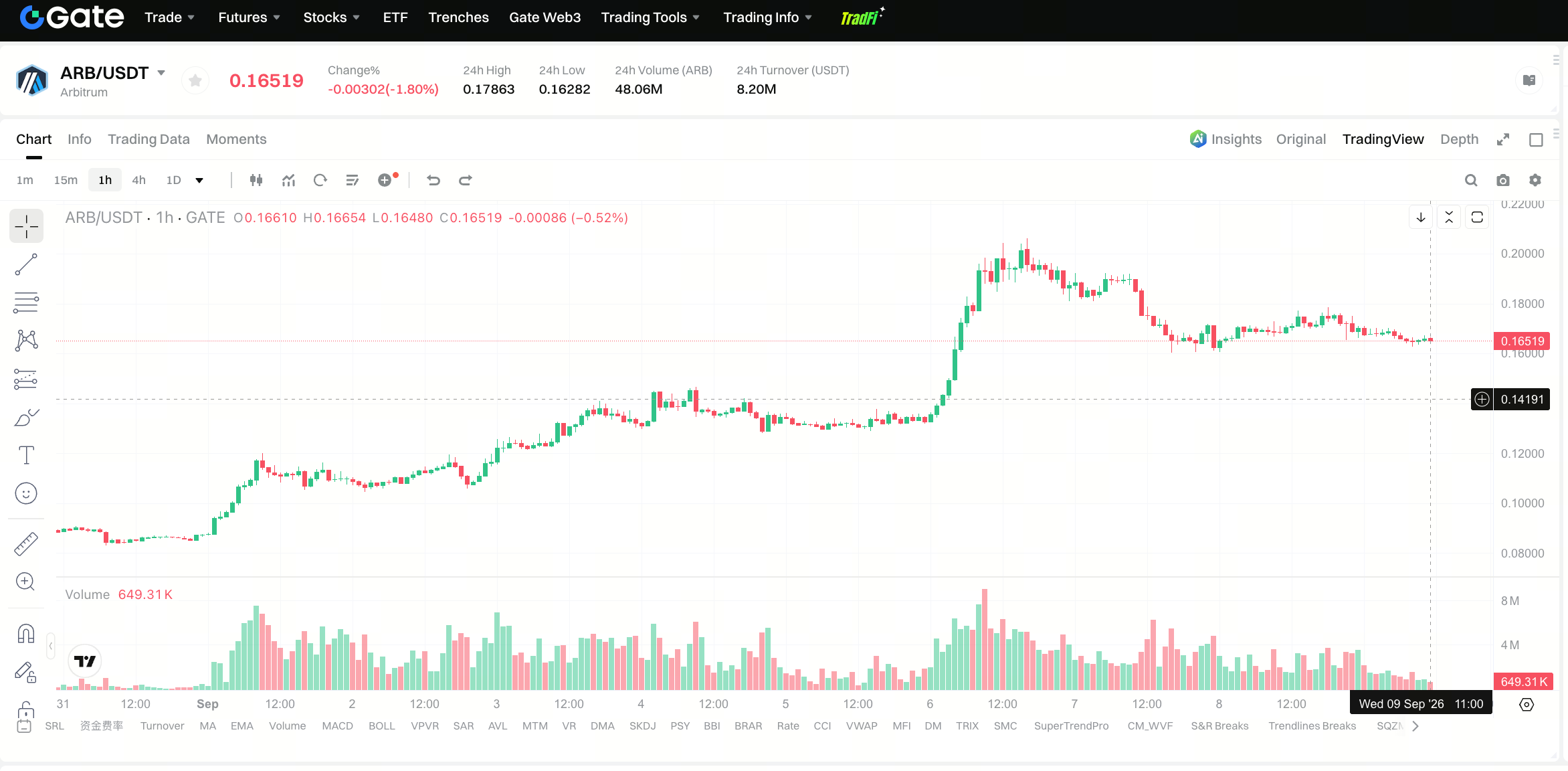
Two main paths exist for interacting with ARB on Gate: spot trading and onchain deposits or withdrawals. ARB can also be purchased on Binance, Coinbase, and KuCoin. Spot trading happens within ARB trading pairs through limit or market orders, settling inside the platform ledger rather than on a blockchain, so no network gas is consumed.
Onchain transfers let users bridge ETH and ERC-20 tokens between Ethereum and Arbitrum, but they require confirming the network first. ARB is an ERC-20 token deployed on both Ethereum mainnet and Arbitrum One, so the deposit address, withdrawal network, and related transaction data must match exactly what the counterparty wallet or exchange uses, and selecting the wrong network can leave assets uncredited. Transfer fees on Arbitrum One are paid in ETH, while available networks, limits, and fee rates follow the live rules displayed on Gate platform pages.
Summary
Arbitrum operates as an optimistic rollup scaling network for Ethereum, executing transactions on Layer 2 through Nitro, posting batch data back to Ethereum as blobs, and relying on a challenge window with fraud proofs to guarantee state validity. Arbitrum One, Arbitrum Nova, and Arbitrum Orbit map general settlement, low-cost high-frequency activity, and third-party chains onto different data availability approaches.
On the token and economic side, ARB carries a governance function rather than a gas function, and ArbitrumDAO revenue comes from transaction fees, Timeboost, expansion program licence fees, and treasury income. The convenience of low fees and EVM compatibility, alongside the structural constraints of a single Sequencer, a roughly seven-day challenge window, and blob market dependence, belong in the same picture.
FAQ
What is the ARB token used for?
ARB is the governance token of the Arbitrum ecosystem, used to vote on protocol upgrades, treasury allocations, ecosystem incentive programs, and rules tied to the expansion program. ARB does not pay network fees, since gas on Arbitrum One and Arbitrum Nova is denominated in ETH. Holding ARB grants governance participation rights, not a direct claim on network revenue.
How is Arbitrum different from Optimism and Base?
All three belong to the Ethereum optimistic rollup family, and the differences sit in the technology stack and governance structure. Arbitrum runs its own Nitro and ArbOS stack and supports WASM contracts written in Rust, C, and C++ through Stylus, while Optimism and Base build on the OP Stack, with Base operated by Coinbase and no native governance token issued.
Is Robinhood Chain built on Arbitrum?
Yes. Robinhood Chain is an Ethereum Layer 2 built on the Arbitrum Orbit stack, with mainnet live since July 1, 2026, chain ID 4663, ETH as the gas token, and no native token issued (source: Robinhood Chain documentation, L2Beat). Because it settles outside Arbitrum One and Arbitrum Nova, the 10% net protocol revenue share rule applies to it.
Is Arbitrum safe, and is the Sequencer centralized?
Asset security on Arbitrum ultimately anchors to Ethereum: batch data goes to mainnet, and an invalid state can be overturned by a fraud proof during the challenge window. Sequencing, however, runs through a single Sequencer, a centralized component affecting censorship resistance and ordering fairness. A native withdrawal window of roughly seven days and bridge contract exposure also belong in any assessment.
What is the total supply of ARB, and how much remains locked?
Total ARB supply is 10 billion tokens. As of August 17, 2026, roughly 92.3% (about 9.23 billion ARB) had unlocked or was held by the ArbitrumDAO treasury, while the remaining 7.7% (about 0.77 billion ARB) stayed within the original vesting schedule, with the final tranche scheduled for March 2027 (source: Arbitrum Foundation first-half 2026 progress report, published September 2, 2026).