Choosing between the two chains matters to readers who already grasp the basic rollup structure and need to confirm which layer their assets and applications sit on. Both share one technical lineage: the Nitro stack behind Arbitrum (ARB), developed by Offchain Labs and governed by ArbitrumDAO. Arbitrum One is the general-purpose settlement network of that system, whereas Robinhood Chain runs on Arbitrum Orbit and is operated independently by Robinhood.
Launch timing explains much of the maturity gap. Robinhood Chain opened a public testnet on February 10, 2026 and mainnet on July 1, 2026, with chain ID 4663, ETH as the gas token, and no native token issued (source: Robinhood Chain documentation, L2Beat). Arbitrum One, by contrast, has accumulated a far larger DeFi application cluster and surrounding tooling layer.
Key Takeaways
- Arbitrum One is the general-purpose settlement network of the Arbitrum ecosystem, while Robinhood Chain is a purpose-built chain running on Arbitrum Orbit and operated by Robinhood; both are Ethereum Layer 2 networks.
- Gas on both chains is paid in ETH; ARB is the Arbitrum governance token with a total supply of 10 billion, and Robinhood Chain has issued no native token at all.
- Sequencing structures differ: Arbitrum One allocates priority ordering rights through the Timeboost auction, while Robinhood Chain orders transactions through a single Sequencer operated by Robinhood, targeting a block interval of roughly 100 milliseconds.
- Revenue routing differs: under the Arbitrum Expansion Program (AEP), Arbitrum chains settling outside Arbitrum One and Arbitrum Nova must route 10% of net protocol revenue back into the Arbitrum ecosystem.
What Is Arbitrum One?
Arbitrum One serves as the general-purpose settlement network of the Arbitrum ecosystem and follows an optimistic rollup design: transactions execute and get ordered on Layer 2, then batch data is compressed and posted back to Ethereum for settlement. The technology stack is Nitro, inside which ArbOS handles gas metering and cross-layer messaging, with full parameter details published in the Arbitrum documentation.
Responsibilities split across three parties. Offchain Labs advances the technology stack, and ArbitrumDAO governs network parameters and treasury spending. Gas is denominated in ETH, so ARB carries a governance role only. Stylus lets developers write contracts in Rust, C, and C++, compile them to WASM for execution, and have them coexist with existing EVM contracts on Arbitrum One, while Robinhood Chain is fully EVM-compatible for smart contracts. Native withdrawals of assets still pass through a challenge window of roughly seven days.
What Is Robinhood's Own Chain?
Robinhood Chain operates as an Ethereum layer 2 blockchain built on the Arbitrum Orbit stack, run by Robinhood and positioned as infrastructure for tokenized real-world assets, 24/7 financial services. The mainnet chain ID is 4663 and the testnet chain ID is 46630, with ETH serving as the gas token in both environments, exactly as on Arbitrum One.
The most direct structural differences from Arbitrum One sit in the token and the sequencer. Robinhood Chain has issued no native token, so no corresponding governance token or token-weighted vote exists on the chain. Sequencing runs through a single Sequencer operated by Robinhood, targeting a block interval of roughly 100 milliseconds. Block exploration goes through Blockscout, and the official bridge is the Arbitrum bridge rather than a bespoke one.
What Are the Core Differences Between the Two Chains?
Six dimensions cover the main divergences between the two chains: purpose and target assets, gas and native token, block speed and sequencing, settlement and data availability, ecosystem applications, and where protocol revenue lands.
| Dimension |
Arbitrum One |
Robinhood Chain |
| Purpose and target assets |
General-purpose Layer 2 with a mature DeFi ecosystem and no restriction on asset or application type |
Built for tokenized equities, tokenized ETFs, and 24/7 financial services |
| Gas and native token |
Gas paid in ETH; ARB is the governance token, 10 billion total supply |
Gas paid in ETH; no native token issued |
| Block speed and sequencing |
Timeboost allocates priority ordering rights by auction |
Single Sequencer operated by Robinhood, targeting roughly 100 ms block intervals |
| Settlement and data availability |
Optimistic rollup; batch data posted to Ethereum as blobs |
Orbit chain settling to Ethereum; data availability likewise relies on Ethereum blobs |
| Ecosystem applications |
Broad choice of applications, bridges, and explorers |
Young ecosystem; Blockscout explorer, Arbitrum bridge |
| Protocol revenue |
Transaction fees and Timeboost proceeds accrue to ArbitrumDAO |
10% of net protocol revenue routed back to the Arbitrum ecosystem under the expansion program |
The first four dimensions describe technical structure. Both chains combine high throughput and low costs with Ethereum's security, handing batch data and dispute resolution back to Ethereum, so the distinction lies not in security assumptions but in how ordering rights get allocated. Arbitrum One turns priority ordering into a biddable market, where Timeboost contributed roughly $7 million in revenue during 2025 (source: Arbitrum Foundation blog). Robinhood Chain instead accepts a fixed single operator in exchange for its roughly 100 millisecond target block interval.
The final two dimensions determine ecosystem depth and economic ownership. Fees and Timeboost proceeds on Arbitrum One flow to ArbitrumDAO. Because Robinhood Chain settles outside Arbitrum One and Arbitrum Nova, the Arbitrum Expansion Program (AEP) requires it to route 10% of net protocol revenue back into the Arbitrum ecosystem, which makes Robinhood Chain revenue share the first clearly identified case of that rule in practice.
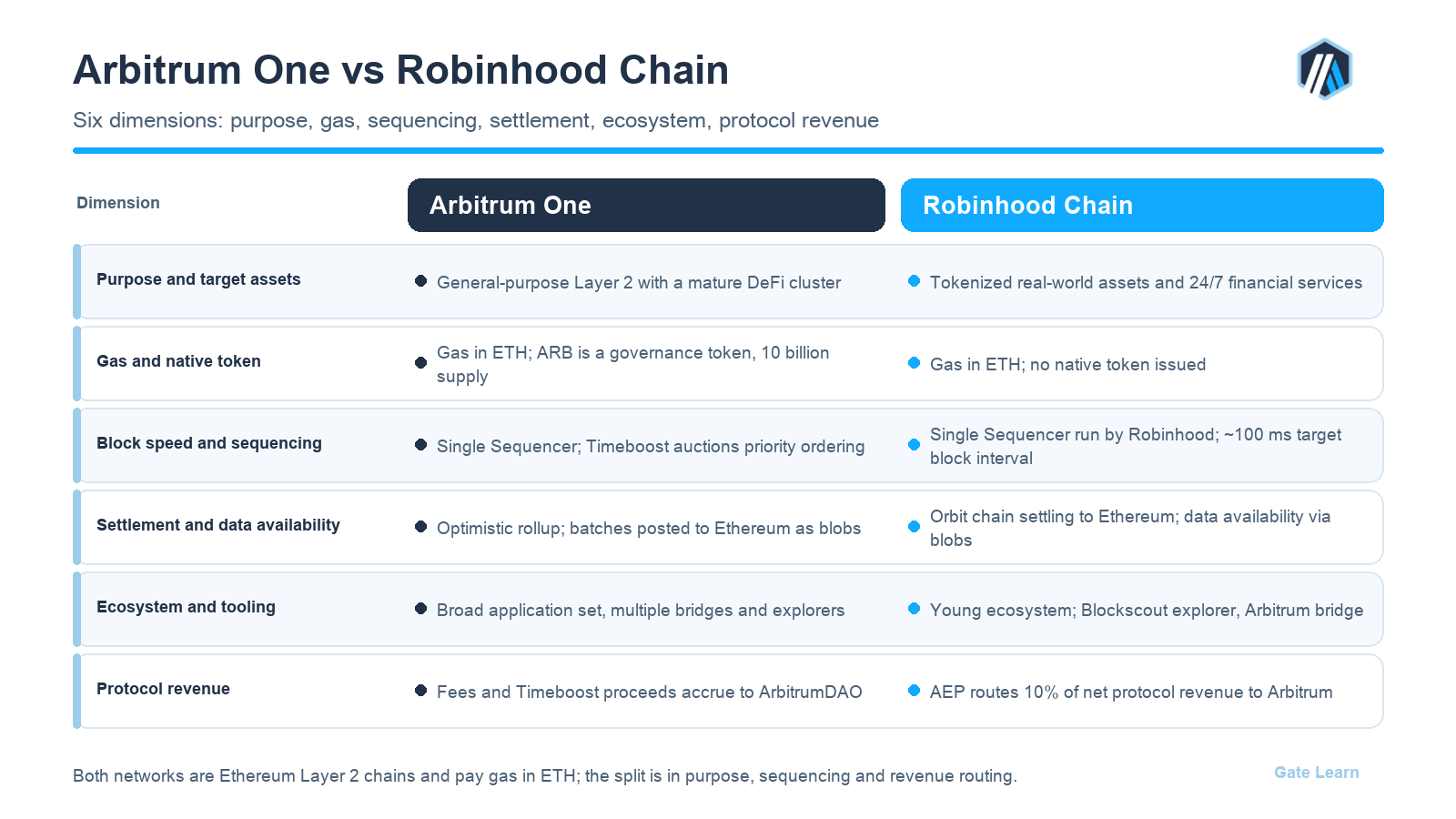
Figure 1. Arbitrum One and Robinhood Chain set side by side across six dimensions: purpose, gas and token, sequencing, settlement and data availability, ecosystem applications, and protocol revenue.
How Does Day-to-Day Use and Smart Contracts Differ?
Wallet setup differs only in network parameters. Both chains charge gas in ETH, so for users adding a network mainly means entering the right chain ID. Arbitrum One and Robinhood Chain are separate networks, and Robinhood Chain uses chain ID 4663 on mainnet and 46630 on testnet.
Bridging timelines are where the gap becomes visible. The official bridge for Robinhood Chain is the Arbitrum bridge, where deposits take roughly 10 minutes and withdrawals roughly seven days, and native withdrawals from Arbitrum One sit under a comparable seven-day challenge window. For cross chain transfers between Ethereum and Robinhood Chain, traders need to bridge assets with the right source and destination selected. That rhythm follows directly from the optimistic rollup challenge mechanism, which makes confirming bridge direction and expected arrival time more consequential than the choice of chain itself.
Onchain verification tooling has reached different levels of maturity. Robinhood Chain uses Blockscout as its block explorer, so secure transaction and contract checks concentrate in that single entry point. Arbitrum One offers several explorers and data dashboards that can be cross-checked against one another, and third-party sites also track its data availability and state submission record.
Application availability is the largest practical divide. Arbitrum One also supports gaming use cases and a wider range of projects beyond lending and trading. Lending, trading, and stablecoin applications on Arbitrum One are ready to use, with relatively complete tooling and audit histories behind them. Robinhood Chain allows tokenized U.S. stocks for EU users. The application set on Robinhood Chain is still expanding and is organized around tokenized assets and around-the-clock trading, so participants can use it to access tokenized markets without assuming that broader DeFi components are already deployed there yet.
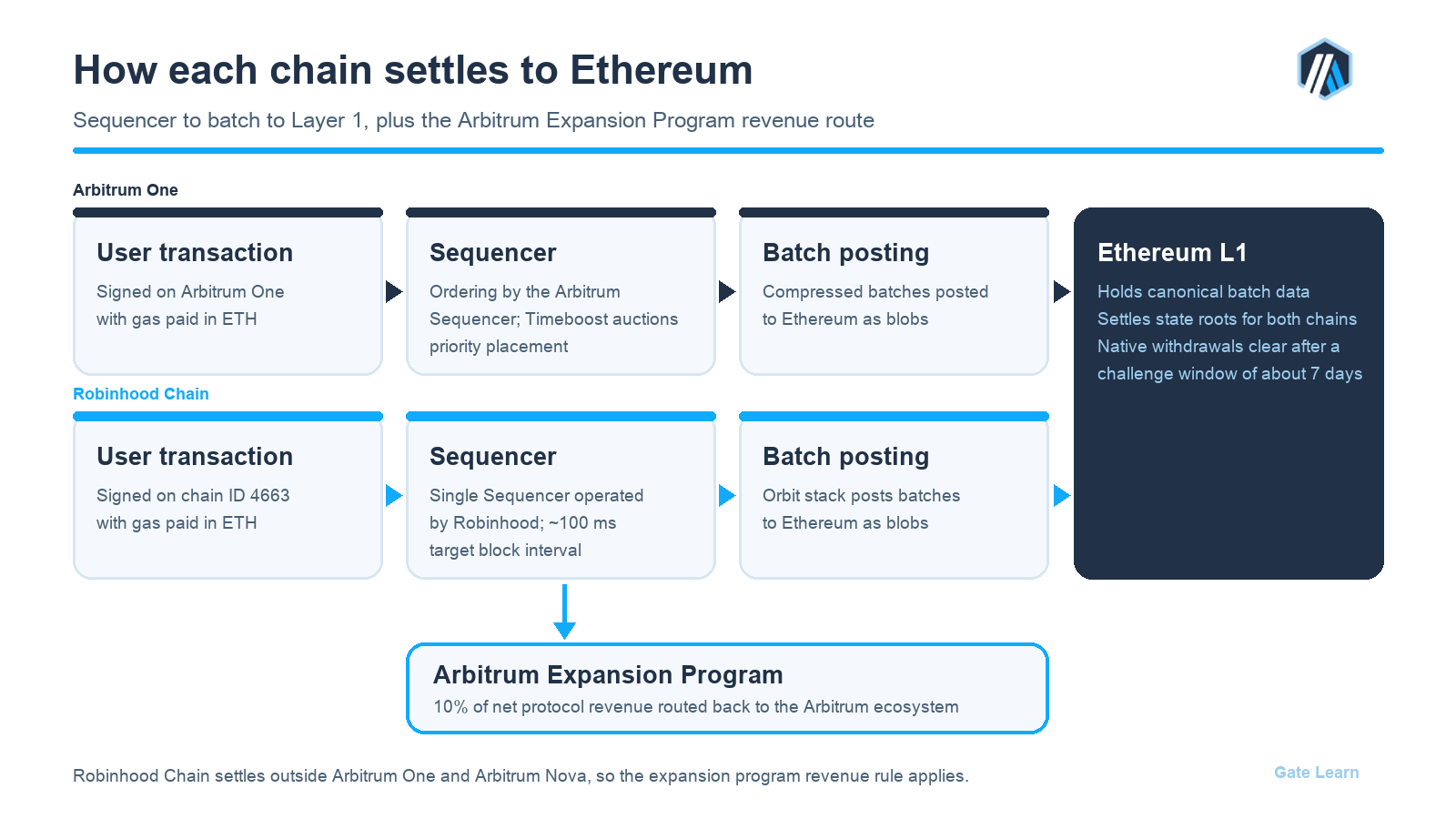
Figure 2. Sequencer ordering, batch posting, and Ethereum settlement on each chain, alongside the direction in which Robinhood Chain routes 10% of net protocol revenue under the expansion program.
Which Chain Should You Use?
Choose Arbitrum One if the requirement is a mature general-purpose DeFi cluster with deeper asset liquidity; if complete developer tooling and an established audit ecosystem inside an EVM-equivalent environment matter; if governance participation is relevant and voting on protocol upgrades and treasury spending through ARB is desirable; or if the workload needs the Stylus contract environment for Rust, C, and C++ compiled to WASM.
Choose Robinhood Chain if investors need direct access to tokenized real-world assets and 24/7 financial services as part of its longer-term future; if a target block interval of roughly 100 milliseconds is an explicit requirement; if a single operator handling sequencing and the absence of a native token are acceptable structural trade-offs; and if the applications required are already deployed on that chain. Robinhood acquired Bitstamp to enhance liquidity for tokenized stocks.
Neither chain substitutes for the other. Arbitrum One and Robinhood Chain are both Ethereum Layer 2 networks whose security ultimately anchors to the Ethereum settlement layer, so the deciding factors are target assets, whether the applications needed are already live, whether lower fees matter, and whether the respective sequencing and withdrawal constraints are acceptable without relying on assumptions that the same apps exist on both chains.
What Are the Limits, Gas Fees, and Risks of Each Chain?
The limitations of Arbitrum One concentrate in sequencing and governance. Sequencing runs through a single Sequencer, which creates concentration around transaction censorship and ordering fairness. Native withdrawals wait out a challenge window of roughly seven days, which constrains how quickly capital can rotate back to Ethereum. Concentration of ARB governance weight also shapes proposal outcomes.
The limitations of Robinhood Chain sit closer to its operating structure. Sequencing runs through a single Sequencer operated by Robinhood, and no native token has been issued, so no token-based governance path exists. The ecosystem remains early, which limits how many applications and tools are actually available and leaves open questions around third-party safety. As a purpose-built chain run by a corporate operator, shifts in that operator's product strategy would feed directly into the chain's development pace and resourcing.
Dependence on the Ethereum blob market for data availability is an external constraint shared by both chains. Importantly, on September 4, 2026, Robinhood Chain saw a batch data posting delay of roughly 14 minutes, during which the chain kept producing blocks, and Arbitrum attributed the cause to Ethereum Layer 1 blob market conditions rather than chain downtime (source: Arbitrum, L2Beat). The pace of Layer 2 data posting therefore moves with Layer 1 blockspace supply and demand, which affects the cost of data posting for both chains.
Summary
Arbitrum One and Robinhood Chain come from the same technical lineage yet serve different goals. As the general-purpose settlement network, Arbitrum One is defined by its mature application cluster, wide tooling choice, and ArbitrumDAO community governance, with Timeboost turning priority ordering rights into a biddable revenue source. Robinhood Chain runs on the Arbitrum Orbit stack under Robinhood's operation, was built to launch on that framework, organizes itself around tokenized real-world assets and 24/7 financial services, uses chain ID 4663, and has issued no native token.
Those structural differences carry different constraints. Gas on both chains is paid in ETH and settlement returns to Ethereum in both cases, yet sequencing concentration, ecosystem maturity, low costs, and revenue ownership diverge: fees and Timeboost income on Arbitrum One accrue to ArbitrumDAO, while Robinhood Chain routes 10% of net protocol revenue back under the expansion program. A withdrawal challenge window of roughly seven days and reliance on the Ethereum blob market apply to both.
FAQ
What is the difference between Arbitrum One and Robinhood Chain?
Arbitrum One is the general-purpose settlement network of the Arbitrum ecosystem, governed by ArbitrumDAO, with no restriction on asset or application type. Robinhood Chain is a purpose-built Layer 2 on the Arbitrum Orbit stack, operated by Robinhood for tokenized real-world assets and 24/7 financial services. Gas on both is ETH, and the differences are the native token (ARB governance token versus none), the sequencing model, and where protocol revenue lands.
Is Robinhood Chain built on Arbitrum?
Yes. Robinhood Chain is a layer 2 blockchain built on the Arbitrum Orbit stack, with a public testnet live on February 10, 2026 and mainnet live on July 1, 2026 (source: Robinhood Chain documentation, L2Beat). Because the chain settles outside Arbitrum One and Arbitrum Nova, the Arbitrum Expansion Program rule requiring 10% of net protocol revenue to flow back applies to it.
Does Robinhood Chain have its own token?
No. Robinhood Chain has issued no native token, and gas on the chain is paid in ETH, so no governance token or token-weighted vote exists for that network (source: Robinhood Chain documentation). ARB, by contrast, is the Arbitrum governance token with a total supply of 10 billion, used for voting on protocol upgrades and treasury spending, and it does not pay gas either.
Can you bridge assets on Robinhood Chain to Arbitrum One?
The official route passes through Ethereum rather than connecting the two Layer 2 networks directly, so connect your wallet before bridging and check any posted update or post in the bridge interface. The official bridge for Robinhood Chain is the Arbitrum bridge, so assets first move back to Ethereum, where you can explore the selected route before continuing into Arbitrum One. Before bridging, confirm the direction, the destination network, and the matching chain ID, since the bridge processes differ for withdrawals versus deposits and selecting the wrong network can leave assets uncredited.